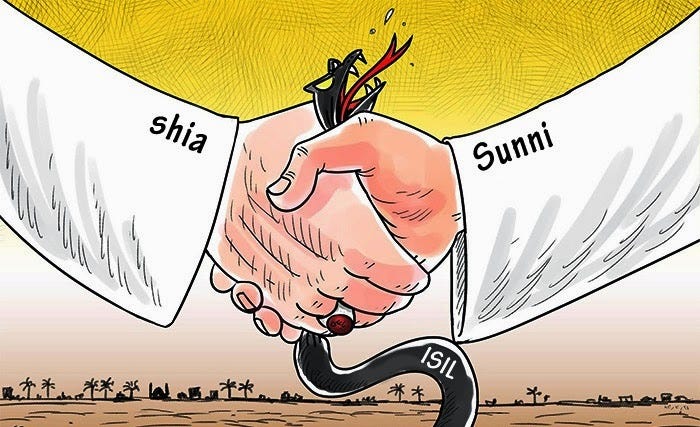
The Manufactured Fracture
How Sectarianism Became the Trap That Keeps Muslims Powerless
The “1,400-year Sunni-Shia war” has a founding document. It is not a theological text. It is the 1639 Treaty of Zuhab, signed between the Ottoman and Safavid empires at a hunting lodge in what is now western Iran. Two Muslim states divided Iraq between them, drew a border, and agreed that the populations on each side would remain aligned with the empire that administered them. The line of that treaty runs within fifty kilometers of the modern Iran-Iraq frontier. It was not ancient hatred that drew it. It was two imperial chancelleries doing what imperial chancelleries do: partitioning contested territory and assigning identities to justify the partition.
Nearly four centuries of subsequent powers have reached for the same tool: activate sectarian identity, embed it into state structures, and ensure Muslims fight each other rather than consolidate resistance. Ottoman sultans used it. British colonizers inherited it and institutionalized it. American occupiers deployed it explicitly as governance doctrine. The tool worked so consistently across such different imperial actors that its users stopped needing to design it. It runs on its own momentum now.
Understanding how it was built requires going back to the moment before the theology arrived.
The Succession Question Was Political, Not Theological
The Prophet Muhammad ﷺ died in 632 without a designated successor. The dispute that followed was immediate, urgent, and political. It concerned the machinery of power: who governs an expanding state, and by what right. The Medinan consensus assembled by Hazrat Abu Bakr (R.A.) and his supporters was a practical decision about legitimacy in a moment of crisis. Those who held that Hazrat Ali (R.A.) had been explicitly designated at Ghadir Khumm registered their objection and were sidelined.
Hazrat Ali (R.A.) became the fourth caliph in 656. His reign opened immediately into civil war. The Battle of Siffin in 657 pitted him against Muawiya, the Umayyad governor of Syria: a succession dispute conducted in the language of accountability. The arbitration that followed broke his coalition from within, producing the Kharijite splinter and deepening what scholars call a coalescing Shia identity.
But theology came later. The elaborations constructed across centuries, the claim that Imams possessed special divine knowledge and the concept of the Hidden Imam, were built to contain a political wound. Politics created the division. Theology was used to make it permanent.
Karbala: When a Massacre Became a Framework for Resistance
In 680, Husayn ibn Ali (R.A.), grandson of the Prophet ﷺ, refused to pledge allegiance to Yazid ibn Muawiya. He moved toward Kufa in southern Iraq, drawn by supporters who promised backing. Umayyad forces intercepted him at Karbala and killed him, his family, and his supporters.
For the Shia community, Karbala became the language of political exclusion. The massacre encoded resistance to illegitimate power into consciousness. But the event was not immediately constitutive of fixed doctrinal walls. It became the central node around which a distinct political theology was elaborated across centuries, particularly in moments when Shia communities faced systematic exclusion.
The Abbasids, who replaced the Umayyads in 750, explicitly mobilized Shia discontent to overthrow the regime. Shia communities fought expecting incorporation into power. What followed was the characteristic maneuver: mobilize the excluded, seize power, then suppress the very constituencies that delivered victory. The cycle repeated continuously. Ruling powers activated sectarian identity when it served them and discarded it when it threatened them.
Sectarian identity was a tool that rulers used when they needed it. It was not sacred. It was functional.
The Fatimid Interval: 262 Years the “Ancient War” Forgot
The Fatimid Caliphate governed Egypt, North Africa, Sicily, the Levant, and the Hijaz for two and a half centuries. It was an Ismaili Shia dynasty that controlled the holiest cities in Islam and administered the most sophisticated bureaucratic state in the medieval Islamic world. Its collapse in 1171 was not theological. It was strategic. Saladin needed Sunni legitimacy to unify the region against the Crusaders. He dismantled the Fatimid state, restored the Abbasid caliphate’s name to Friday prayers, and redistributed Fatimid endowments to Sunni institutions. The Ayyubid state that replaced it embedded Sunni administrative dominance as constitutional fact. This happened four centuries before European colonialism reached the region. The mechanism was already running.
What the Fatimid period also demonstrates is confessional coexistence as operational reality. Sunni populations were governed by a Shia dynasty for 262 years. Sunni scholars served in Fatimid courts. Sunni merchants traded under Fatimid protection. The theological difference did not generate perpetual conflict. It generated periodic political competition. A community that coexisted for 262 years under a government of a different confession was not engaged in a civilizational war. It was navigating political power.
The “ancient hatreds” argument cannot survive the Fatimid period intact. Anyone making it has quietly removed two and a half centuries from the timeline.
Ottoman and Safavid: When Muslim Empires Institutionalized the Division
The first time the divide functioned openly as deliberate state instrument was 1501. Shah Ismail I of the newly formed Safavid state forced Twelver Shiism onto Persian populations, executed Sunni scholars, and converted mosques wholesale. This was state policy constructing a legitimizing ideology against the Ottoman caliphate to the west.
Sultan Selim I responded with massacres of thousands of Shia Qizilbash in Anatolia and marched to Chaldiran in 1514. Both were Muslim empires. Both powerful. Both chose to embed sectarianism into their state structures because it worked.
The wars that followed turned Iraq into contested imperial terrain where sect defined loyalty, tribute, and survival. When Safavid forces took Baghdad in 1624, Shah Abbas I approved the systematic killing of the city’s Sunni population. Not theology. State power consolidating itself through sectarian administration.
The 1639 Treaty of Zuhab fixed the Ottoman-Safavid border roughly along the modern Iran-Iraq line, baking sectarian geography into the map. Geography was the objective. Theology was the mechanism of governance. And once embedded into state structures, the division became self-perpetuating because rulers depended on it to govern.
Even Muslim empires found sectarian division useful. They had the power to unify or divide. They chose division because divided populations are easier to control.
British Colonialism: Inheriting the Architecture and Making It Constitutional
When Britain carved the Iraqi state out of three Ottoman provinces after World War I, it inherited a majority Shia population and a minority Sunni administrative class trained in Ottoman institutions. London did not reverse this arrangement. It deepened it systematically.
Toby Dodge documents that Sunni officers and tribal chiefs, familiar to British administrators, were placed in dominant positions across the army and civil service. Shia clerical leadership in Najaf and Karbala, which had animated the 1920 uprising against the mandate, was marginalized as deliberate policy. Britain’s insight was not inventing sectarianism. It was recognizing that sectarianism had already been embedded into state structures by Ottoman rule and making it the administrative foundation of the colonial state.
The machinery would do the work independently. As long as Sunnis held military and bureaucratic power while Shias were excluded, tension would persist. The state would require ever-greater security forces to manage the conflict it depended on.
When Iraqi opposition groups gathered in 1992 to plan post-2003 governance, they had absorbed this colonial taxonomy so thoroughly that they allocated committee positions through explicit ethno-sectarian quotas. The British had been gone forty years. The architecture remained. An opposition committed to removing imperialism embedded the imperial administrative language back into the very institutions meant to replace it.
The same colonial administrative logic transferred outward. When Zia ul-Haq consolidated power in Pakistan in 1977, his Islamization program favored Deobandi and Sunni institutions over all others. The 1979 Zakat ordinance formalized a sectarian distinction in state fiscal policy when Shia communities successfully lobbied for exemption. By 1985, Sipah-e-Sahaba Pakistan had formed in Jhang, with ISI support, explicitly targeting Shia communities. The same ISI network was simultaneously managing CIA and Saudi funding for Afghan mujahideen through Deobandi institutions. The sectarian militia infrastructure and the Afghan jihad infrastructure were the same infrastructure. Lashkar-e-Jhangvi emerged from SSP and carried out mass killings of Shia communities across Pakistan through the 1990s and 2000s. The men who built it had been trained in the same camps, funded by the same sources, and protected by the same agencies that Washington simultaneously called partners in the war on terror.
American Occupation: Weaponizing Sectarianism as Primary Governance
The U.S. invasion of Iraq in 2003 did something unprecedented. It took sectarianism from a suppressed social fact and made it the primary organizing principle of state power.
The Coalition Provisional Authority’s de-Baathification orders expelled tens of thousands of largely Sunni professionals from public life overnight. Paul Bremer’s governing council was assembled through explicit ethno-sectarian quotas. The bureaucratic machinery of Iraqi governance was restructured to make sect the organizing category of political participation. The occupation applied and deepened colonial administrative language that Britain had perfected. The difference was speed and explicitness: Britain had a quarter-century to embed sectarian hierarchy. The occupation compressed it into months.
Nouri al-Maliki’s government then perfected the cycle. By arresting rival politicians, centralizing security forces, and systematically excluding Sunni communities from economic participation, Maliki fed the narrative that Abu Musab al-Zarqawi had deliberately constructed. Zarqawi’s strategy was to bomb Shia shrines and provoke Shia militia reprisals to destroy remaining Sunni faith in the Baghdad government. It worked. Sectarian violence escalated as a direct consequence of political exclusion.
The invasion did not activate ancient hatred. It created a political structure that could only be navigated through sectarian identity. When the choice is between powerlessness and joining a militia, people join. The sectarian violence that followed was not inevitable. It was engineered.
1979 and the Architecture of Counter-Revolution
The Islamic Revolution of February 1979 did something the regional architecture was not built to absorb. It overthrew a US-backed monarchy using Islamic mobilization. The initial popular response crossed sectarian lines. Khomeini framed the revolution as Islamic, not Shia. Anti-imperialism, Palestinian solidarity, and resistance to Western-backed autocracy resonated in Cairo and Karachi as much as in Tehran. The revolution demonstrated that Islamic identity could successfully challenge the regional order.
Saudi Arabia’s response was not theological. It was strategic. Within months, Riyadh had dramatically increased funding for Deobandi and Wahhabi institutions across South Asia and the Arab world, explicitly to counter Shia revolutionary appeal with an alternative Islamic identity that validated the existing order. The infrastructure already existed from two decades of previous investment. The Islamic Revolution funded its expansion at scale.
In November 1979, Sunni militants from the Ikhwan movement seized the Grand Mosque in Mecca. The Saudi state initially blamed Iranian agitation. The claim was false: the attackers were Wahhabi nationalists with no Iranian connection. But the framing accomplished what mattered: it positioned Iran as the threat to the holy sites, the Shia revolution as the danger to Sunni sovereignty. The false attribution hardened into regional political fact.
September 1980: Iraq invaded Iran. Saddam Hussein’s stated rationale was the Shatt al-Arab waterway and Iranian interference in Iraqi affairs. The operational reality was more direct. The United States and Gulf monarchies required that the Iranian revolution be contained. The Carter administration provided intelligence. The Reagan administration, from 1981 onward, restored diplomatic relations with Baghdad, supplied satellite data on Iranian troop positions, and continued doing so after Saddam’s forces used chemical weapons at Halabja in March 1988, killing several thousand civilians in a single operation. Donald Rumsfeld met Saddam in Baghdad in December 1983 to formalize the relationship. The State Department removed Iraq from its list of state sponsors of terrorism the following year specifically to enable the arms pipeline.
Eight years. Roughly five hundred thousand dead on both sides. No Western government intervened to stop it. Several sustained it. The war accomplished what it was designed to accomplish: it transformed an intra-imperial competition into a sectarian military line that the entire region was forced to choose sides on. Gulf monarchies backed Iraq. Syria backed Iran. Lebanon fractured along lines that had been building since the civil war. The region aligned, and the alignment was Sunni-Shia in its visible geography even when it was strategic in its actual logic.
After 1988, the alignment was permanent. The architecture that used the war to contain Iran had also, as a byproduct, constructed the most durable sectarian geography in the modern Middle East. This was not incidental. It was the design.
The Fatwa Economy: How States Converted Architecture into Conviction
After 1979, the ideological competition between Riyadh and Tehran required clerical infrastructure at scale. The mechanism was funding. Saudi Arabia’s Muslim World League, founded in 1962 but dramatically expanded after 1979 with oil revenue, channeled resources to Deobandi and Wahhabi institutions across South Asia, Southeast Asia, and Africa. Seminaries in Karachi, Lahore, and Peshawar received Saudi funding that transformed their curriculum toward Wahhabi-aligned doctrine and, in many cases, explicit anti-Shia polemic. The scholars those seminaries produced did not see themselves as instruments of Saudi foreign policy. They understood themselves as defenders of correct doctrine. The funding had done its work at the level of conviction, not instruction.
On the Iranian side, the wilayat al-faqih framework required its own clerical apparatus extending outward from Qom. Khums revenue, the religious tax paid by Shia communities globally, funded Shia seminaries and hawzas from Beirut to Karachi. The clerics trained in Qom carried both religious authority and political alignment back to their home communities. They understood themselves as scholars. The funding had already shaped what counted as correct scholarship.
The medieval texts entered this economy as weapons. Ibn Taymiyya’s 14th-century fatwas against Alawi and Shia communities, written in a specific political context seven centuries earlier, were reprinted, digitized, and distributed across the Gulf-funded institutional network through the 1980s and 1990s. ISIS recycled them wholesale in 2013 to justify the mass killing of Shia civilians in Iraq and Syria. The texts required no updating. They had been preserved precisely because their utility was considered permanent.
The clerical class that emerged from this dual funding architecture converted state design into theological conviction, and this is the most durable layer of the whole system. States can change policy. Armies can be demobilized. Satellite channels can be shut down. A generation of scholars who genuinely believe the other sect is theologically deviant, and who have institutional careers built on that belief, cannot be switched off by a change in foreign policy. They trained the next generation in the same conviction. The architecture became self-replicating at the level of faith.
The Media and Information Architecture: Industrializing the Division
The 1991 Gulf War created the infrastructure for the next stage. Al Jazeera launched in 1996 with Qatari funding. Al Arabiya launched in 2003 from Dubai with Saudi-aligned backing. Al Manar, Hezbollah’s satellite channel, had been broadcasting since 1991. By the mid-2000s, the Arab media landscape was organized around competing state and para-state broadcast ecosystems, each carrying an implicit sectarian alignment alongside its explicit news agenda.
The mechanism was not primarily propaganda in the crude sense. It was framing. A viewer consuming Al Arabiya’s Iraq coverage in 2006 received a consistent framing of Shia militia violence against Sunni civilians. A viewer of Al Manar received a consistent framing of Sunni takfiri violence against Shia communities. Both captured real events. Neither captured the political architecture that had produced both. The framing was technically accurate at the level of individual incidents and systematically false at the level of causation.
Social media accelerated the whole structure. The platforms that arrived after 2008 were optimized for engagement, and sectarian content produces engagement. A video of a shrine desecration generates shares, replies, and outrage at velocities no editorial decision can govern. The algorithm does not distinguish between organic outrage and manufactured provocation. It rewards velocity. By 2013, the Syrian conflict was being processed through Facebook and Twitter feeds that had already sorted their audiences by sectarian alignment. An event could be filmed once, uploaded simultaneously to competing networks, and circulate for weeks generating mirror-image interpretations without any state actor directing the operation.
The Gulf-funded madrassa network and the social media algorithm arrived at the same destination from opposite directions. The madrassa produced conviction. The algorithm produced amplification. Together they industrialized what states had originally constructed. The original architects are no longer required. The infrastructure maintains itself.
Regional Powers Locked in the Mechanism
By 2011, Iran and Saudi Arabia, both locked in a competition that external powers had structured across four decades, competed for regional influence through sectarian networks already embedded in state structures across the region. Neither invented the framework. Both inherited it. Both became dependent on it because the moment either attempted to build regional power independent of sectarian networks, the other would exploit the gap.
In Syria, the U.S. and its allies backed Sunni rebel factions while Iran deployed forces to protect Assad. The conflict had multiple causes: political repression, economic grievance, the particular brutality of the Assad security apparatus. The sectarian framing obscured all of it, reducing a multi-causal war to a theological contest that obscured both the material causes and the external intervention that sustained it.
In Yemen, the Houthi movement had fought for political recognition and economic justice since 2004. When the movement shifted regionally and received Iranian support, the entire conflict was reframed as a Shia-Sunni proxy war. This sectarian framing gave Saudi Arabia and its Western backers the cover needed for an air campaign that produced the worst contemporary humanitarian catastrophe in the Arab world. The theological frame made the bombing legible. It buried the actual agenda: preventing a unified Yemeni state from pursuing independent governance.
Bahrain in 2011 was the clearest demonstration of how the frame operates. When Bahraini protesters, the majority of them Shia, occupied Pearl Roundabout in February demanding constitutional monarchy and political representation, their demands were structurally identical to those driving the Egyptian and Tunisian revolts. The Obama administration had publicly supported those. On March 14, 2011, Saudi Arabia sent fifteen hundred troops under the Gulf Cooperation Council’s Peninsula Shield framework, marking the first time GCC military forces occupied a member state. The UAE deployed five hundred police. Western governments expressed concern. The Fifth Fleet operates from Manama. No action followed. The protesters’ demands were not addressed. Pearl Roundabout’s monument was demolished four days after the troops entered.
The framing that made this politically sustainable was Iranian-backed Shia uprising rather than domestic democratic demand. No operational evidence of Iranian involvement in the protests was produced. The frame did not require evidence. It required only that the sectarian label suppress the democratic content of the demand.
In Lebanon, the confessional constitution locked sect into political representation structurally. This arrangement meant that Hezbollah could only be read publicly as sectarian resistance rather than as an anti-imperial military organization, regardless of what its actual calculus was. The political system created the conditions that made opposition appear as sectarian mobilization.
Washington did not need to manage every detail. The architecture ran itself.
The “Ancient Hatreds” Frame: How the Architecture Becomes Invisible
The “ancient hatreds” narrative serves a purpose. It makes the construction invisible.
When scholars at Al Jazeera examined the origins of the contemporary Sunni-Shia conflict as a governing framework, they traced it explicitly to the late 1970s and 1980s. Before that, academic literature documents confessional ambiguity as characteristic of lived Muslim practice. Shia and Sunni populations coexisted, intermarried, shared religious space, and participated in overlapping intellectual traditions. What changed was not theology. What changed was state capacity to organize identity along sectarian lines and the strategic profit available from doing so.
The framing serves multiple interests simultaneously. For Western powers, it supplies a ready explanation for regional instability that requires no examination of occupation, sanctions, arms sales, or military presence. For Gulf monarchies aligned with the West, it justifies treating Shia minorities as inherently suspect and automatically Iran-aligned. For Iran, it justifies building protective networks against encirclement by Western-allied states. For every actor, the framing eliminates the need to address the actual causes of conflict.
If sectarian conflict is ancient and inevitable, then contemporary actors bear no responsibility for maintaining it. If it is the product of specific decisions made by specific powers at specific moments, then those decisions can be named, opposed, and dismantled. The “ancient hatreds” argument is, at its core, an argument against accountability.
The Infrastructure Under Strain
Today the Sunni-Shia divide still organizes militia payrolls, arms contracts, and satellite channel line-ups across the Middle East. Iran’s networks still channel resources through Iraq, Syria, Lebanon, and Yemen. Gulf monarchies maintain security architecture that treats Shia mobilization as Iranian infiltration by definition. The infrastructure is intact.
But the script is straining. Muqtada al-Sadr’s movement in Iraq has repeatedly demonstrated that Shia identity does not translate automatically into Iranian loyalty. The movement has pursued an explicitly nationalist posture against both U.S. occupation and Iranian regional dominance simultaneously. Houthi leadership in Yemen has pursued national and anti-imperialist framing more insistently than Shia theological claims. Young populations across the region identify state failure, unemployment, and authoritarian governance as primary grievances, not theological disputes.
The US-Israel war on Iran, now in its third week, is already being managed in Western press coverage as a Sunni-versus-Shia realignment: Gulf monarchies watching from the sidelines, calculating; Arab populations divided; Iran isolated. The framing papers over the specific decisions and specific actors that produced this war, reducing forty years of manufactured regional architecture to an ancient quarrel that required no architects.
The fracture was manufactured. Its maintenance has always required external investment.
The Last Line of Defense: Why Political Islam Must Be Kept Subdued
Islam is not a weekend religion. The Quran addresses taxation, contracts, state accountability, economic justice, the rights of the governed, and the obligations of those who govern. The Sunnah of the Prophet ﷺ establishes a framework for challenging illegitimate authority. Fourteen centuries of fiqh developed detailed positions on when obedience to rulers is obligatory and when it is not. None of this is radical interpretation. It is what the word deen means: a complete way of life, not a privatized spiritual practice cordoned off from the organization of power.
The term “political Islam” was invented to make that completeness seem dangerous. Strip a Muslim of the right to apply Islamic principles to governance, economics, and law, and what remains is a believer who prays five times a day and does not interfere with the IMF loan terms, the arms contract, or the basing agreement. That is the Muslim every current power structure can accommodate. The one who cannot be accommodated is the scholar who says Islamic economics prohibits the debt structures Pakistan is trapped in, the activist who says Islamic governance requires accountability from rulers who claim Islamic legitimacy while hosting foreign military bases, the movement that says Muslim unity across sectarian lines is an obligation, not an aspiration.
These figures are not suppressed because they are violent. The suicide bomber is too useful as justification to be genuinely unwanted. What gets suppressed is the organized, non-violent, doctrinally grounded argument that Islamic identity produces political rights and demands political accountability. In Algeria in 1992, a military coup cancelled elections when an Islamist party was about to win them. Western governments endorsed the coup. In Egypt in 2013, a military putsch removed an elected government and imprisoned tens of thousands. Western governments absorbed it. In France, headscarves in schools became a national security question. In Saudi Arabia, scholars who applied Islamic accountability frameworks to the royal family disappeared into detention. The designation changes by country. The target is the same.
What unites Washington, Riyadh, Tehran, Brussels, and Beijing on this question is not shared values. It is a shared threat assessment. A genuinely mobilized Islamic political consciousness, drawing on the Quran’s explicit commands on justice and the Sunnah’s accountability architecture, would be ungovernable by any of the current arrangements simultaneously. It would not fit neatly into the Sunni-Shia binary that organizes militia payrolls and satellite channel line-ups. It would not validate the Gulf monarchies that claim Islamic legitimacy while maintaining the most comprehensive US basing infrastructure in the world. It would treat the Palestinian question as an Islamic obligation with enforceable consequences, not a diplomatic process with managed timelines.
The consciousness already exists in the masses. Friday sermons in Karachi, Cairo, Istanbul, and Kuala Lumpur draw on the same texts. The political aspiration those texts produce is visible every time a population rises against a government that combines Islamic rhetoric with IMF compliance, foreign military presence, and domestic repression. It keeps being contained. The sectarian architecture prevents unified mobilization. The funded clerical class validates existing power in theological language. The media ecosystem frames Islamic political aspiration as extremism before it can organize. And any figure who connects Islamic identity to rights, justice, and sovereignty clearly enough to threaten the arrangement gets designated, imprisoned, or killed under a label that all sides, including governments that otherwise despise each other, find useful.


