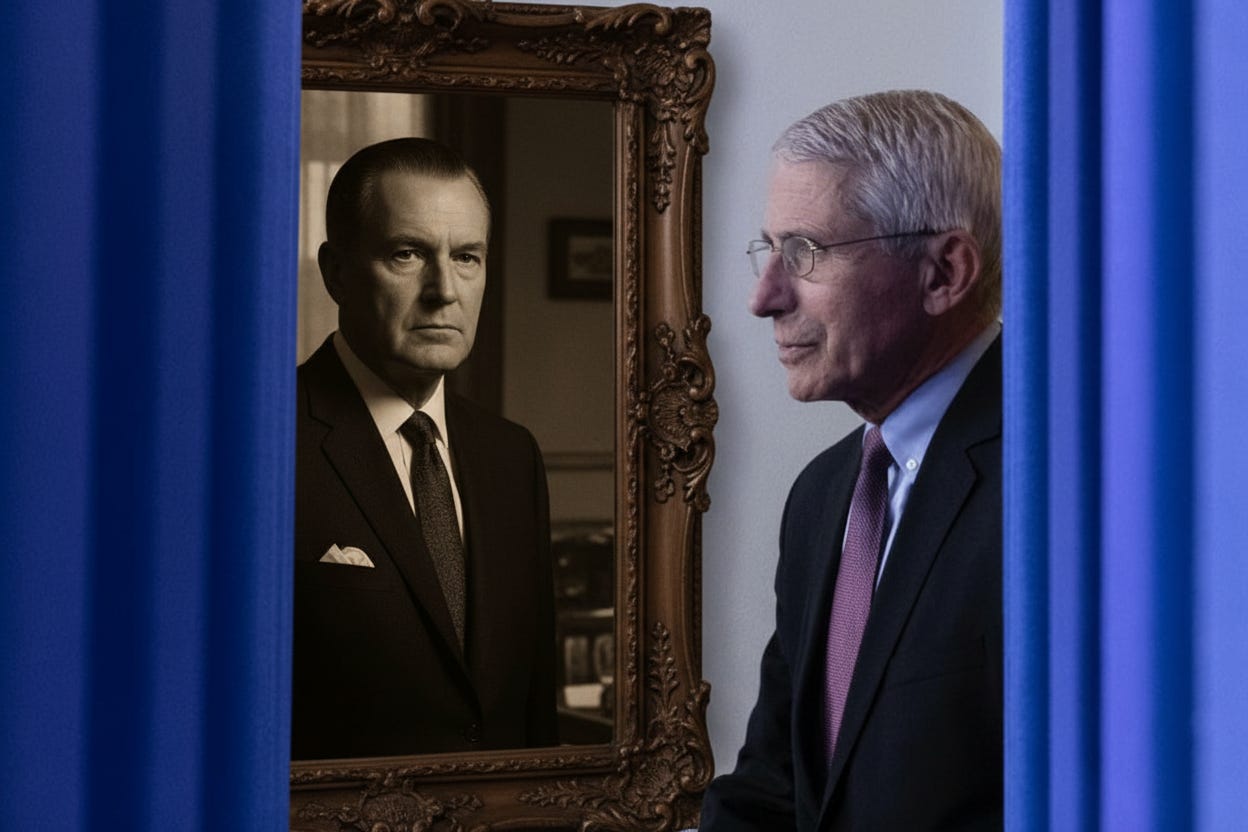
The Medical Bureaucrat Who Made Himself King
How Anthony Fauci Became America’s J. Edgar Hoover in a White Coat
Anthony Fauci is America’s J. Edgar Hoover in a white coat. There, I’ve said it. A bureaucrat who transformed a government position into a personal empire. A man who weaponized institutional power against dissent. Someone who orchestrated the destruction of those who challenged his authority and spent decades accumulating the kind of influence that should never exist in a democracy. Hoover ruled the FBI for forty-eight years. He used surveillance, blackmail, and propaganda to neutralize his enemies. Fauci commanded his domain for thirty-eight years. He controlled billions in research funding as leverage. He systematically dismantled scientific opposition through coordinated campaigns of professional destruction. Both men operated above the law. Both confused their personal judgment with institutional truth. Both left behind corrupted organizations and a public that learned, too late, that unchecked power doesn’t care whether it wears a badge or carries a medical degree. The greatest threat to democratic governance isn’t the tyrant who seizes power by force. It’s the unelected official who accumulates it quietly, year after year, until everyone forgets that he was never supposed to be indispensable in the first place.
I’ve spent enough years watching powerful men accumulate authority they were never meant to possess to recognize the pattern when I see it. And I saw it, quite clearly, in the small figure of Dr. Anthony Fauci, who for thirty-eight years sat atop the National Institute of Allergy and Infectious Diseases like a medieval lord presiding over his fiefdom. Thirty-eight years. Seven presidents came and went. Administrations changed. Wars began and ended. The Berlin Wall fell. The Twin Towers collapsed. And through it all, Fauci remained, accumulating power, influence, and an aura of untouchability that should terrify anyone who believes in democratic accountability.
There was another American who understood this game. His name was J. Edgar Hoover, and for forty-eight years he ran the Federal Bureau of Investigation not as a public servant but as a personal empire. When Hoover finally died in 1972, the relief in Washington was palpable. Presidents who had been too frightened to fire him could finally breathe. Congress, recognizing they had allowed a monster to grow in their midst, hastily imposed a ten-year term limit on future FBI directors. “Never again,” they said. Never again would America permit one unelected bureaucrat to accumulate such power for so long.
And yet we did. We watched Fauci do precisely what Hoover had done, and we called him a hero for it.
The parallels are not subtle. Hoover served under eight presidents, from Coolidge to Nixon. He outlasted them all. He accumulated files—secret files—on politicians, activists, and anyone he deemed threatening. He used these files as insurance, as leverage, as blackmail when necessary. Presidents wanted him gone, but they lacked the courage. Hoover had made himself indispensable, or so he claimed. The bureau couldn’t function without him. Only he understood the threats America faced. Sound familiar?
Fauci perfected a similar performance. He positioned himself as the irreplaceable expert, the only adult in the room, the scientist who transcended politics even as he played politics with lethal precision. Politicians deferred to him. The media canonized him. To question Fauci was to question Science itself—a neat trick that Hoover would have admired. Hoover claimed to embody American security. Fauci claimed to embody public health. Both used these mantles to crush dissent.
Let me tell you what Hoover did with his power, because the specifics matter. He created COINTELPRO, a program explicitly designed to “expose, disrupt, misdirect, discredit, or otherwise neutralize” perceived enemies. Note that word: neutralize. Not arrest. Not prosecute. Neutralize. Hoover targeted Martin Luther King Jr., perhaps the most moral figure in twentieth-century American history. The FBI surveilled King’s bedroom, recorded his extramarital encounters, and sent him the recordings along with an anonymous letter suggesting he kill himself. This actually happened. The American government, under Hoover’s direction, tried to drive a civil rights leader to suicide.
Hoover went after anti-war activists, civil rights organizations, and anyone who challenged the established order. He famously declared that “it is immaterial whether facts exist to substantiate the charge” when attacking his targets. Facts didn’t matter. Truth didn’t matter. What mattered was maintaining power and destroying threats to that power. The Constitution was an inconvenience. Due process was a nuisance. Hoover knew what was best for America, and if a few innocent people had to be destroyed along the way, well, that was the price of security.
Now consider what Fauci did during the pandemic. When credible scientists—including a Nobel laureate—proposed that COVID-19 might have originated in a laboratory, Fauci moved swiftly to destroy that hypothesis. Not to investigate it. Not to debate it. To destroy it. Private emails revealed that Fauci and then-NIH Director Francis Collins coordinated the publication of the now-infamous “Proximal Origin” paper specifically to discredit the lab-leak theory. Collins wrote that they needed to “take down” the lab-leak hypothesis. Congressional investigators later concluded this was “an elaborate scheme to create a preferred political narrative” rather than disinterested scientific inquiry.
Think about those words. “Take down.” Not “investigate” or “analyze” or “debate.” Take down. This is the language of power, not science. And it worked. The “Proximal Origin” paper became holy writ. Anyone who continued to suggest a laboratory origin was labeled a conspiracy theorist, deplatformed from social media, excluded from respectable discourse. Scientists lost funding. Reputations were destroyed. The breakdown of scientific debate during COVID-19 wasn’t an accident or a failure of the system. It was engineered, deliberately and systematically, by people who believed their control over the narrative mattered more than truth.
I’ve watched this happen before, in different contexts, in different countries. I’ve seen how authoritarian regimes silence dissent. I’ve seen how power, when concentrated and unchecked, inevitably corrupts. What shocked me about the pandemic response wasn’t that it happened—power always seeks to protect itself—but that it happened so easily in America, a country that prides itself on free speech and scientific inquiry.
The evidence of Fauci’s deceptions runs deeper. Senator Rand Paul, whatever you think of his politics, repeatedly accused Fauci of lying to Congress about gain-of-function research funding. Fauci denied, under oath, that the National Institutes of Health funded such research at the Wuhan Institute of Virology. But then Lawrence Tabak, the NIH’s own Principal Deputy Director, acknowledged to a House committee that NIH funds had indeed been used for gain-of-function research. Fauci’s own deputy contradicted his sworn testimony. This is called perjury when ordinary citizens do it. When Fauci did it, he retired with full honors and a pension most Americans can only dream about.
Paul referred Fauci to the Department of Justice for criminal prosecution. Nothing happened. Nothing will happen. Like Hoover before him, Fauci is untouchable. The apparatus protects its own.
And then there are the emails. David Morens, Fauci’s senior advisor for decades, sent emails that read like a manual for bureaucratic corruption. “I learned from our FOIA lady here how to make emails disappear after I am FOIA’d but before the search starts,” Morens wrote, “so I think we are all safe.” Safe from what? From transparency? From accountability? From the American people whose taxes funded their salaries and research?
Morens also wrote about deleting “smoking gun” emails. When confronted with this during congressional testimony, Fauci claimed Morens’ actions were an “aberration,” the work of one rogue employee. But anyone who has worked in large institutions knows that culture flows from the top. Subordinates don’t casually discuss destroying federal records unless they believe their superiors approve. Morens felt safe writing these things because he knew the culture of Fauci’s office. He knew that transparency was the enemy and concealment was policy.
Hoover’s abuses only became fully known after his death, through the Church Committee investigations of the 1970s. How many of Fauci’s communications remain hidden? How many emails disappeared before FOIA searches began? We may never know. That’s the point. That’s what institutional corruption looks like—not dramatic scandals but systematic erosion of accountability, normalized over decades by people who convinced themselves they were serving a higher purpose.
Both men shared an absolute conviction in their own righteousness. Hoover genuinely believed he was protecting America from communists, subversives, and moral degenerates. The fact that his targets were often innocent, that his methods trampled constitutional rights, that his obsessions were sometimes delusional—none of this shook his certainty. He was America’s guardian, and anyone who challenged him was, by definition, an enemy.
Fauci displayed similar certainty. “Attacks on me,” he said, “are attacks on science itself.” This is the statement of a man who cannot distinguish between his own judgment and objective truth. Science is a process, not a person. It thrives on debate, challenge, and revision. The moment someone claims to embody science, they have abandoned it. But Fauci’s claim served its purpose. It insulated him from criticism and positioned his opponents as anti-intellectual zealots rather than scientists with legitimate disagreements.
The cost of this arrogance was measured in crushed careers, suppressed research, and a public that lost faith in scientific institutions. When you systematically destroy honest debate, you don’t strengthen your position—you hollow out the foundation of trust that makes complex societies function. Hoover’s legacy was a generation of Americans who learned to distrust their government. Fauci’s legacy may be a generation that distrusts science itself.
I keep returning to the question of tenure. Why did we allow this? Congress understood after Hoover that unchecked longevity in powerful positions breeds corruption. The solution was obvious: term limits. But we failed to apply this lesson to the vast administrative state that mushroomed after Hoover’s death. We created positions of immense power—control over billions in research funding, authority over public health policy, influence over media narratives—and imposed no meaningful constraints on how long individuals could hold them.
Thirty-eight years. For perspective, the average FBI director now serves less than ten. The average NIH director serves less than seven. But Fauci, running a single institute within NIH, served thirty-eight years. He became the public face of American infectious disease response. He advised presidents. He shaped funding priorities for an entire field of science. And he answered to no one.
This is not how democracies function. This is how fiefdoms function. And when fiefdoms grow large enough and last long enough, they become indistinguishable from tyrannies, however benevolent their rulers claim to be.
The tragedy is that both Hoover and Fauci probably believed they were doing good. Hoover thought he was protecting American values. Fauci thought he was protecting American health. But good intentions married to unchecked power produce monsters. Always. The historical record admits no exceptions.
We need a reckoning. Not just with Fauci, but with the system that created him. The medical-industrial complex requires the same constraints we finally imposed on law enforcement after Hoover’s death. Ten-year term limits for all positions controlling significant federal research funding. Mandatory transparency. Criminal penalties for destroying federal records. Real consequences for lying to Congress, regardless of how many presidents you’ve served or how many magazine covers you’ve graced.
Otherwise, we’re simply waiting for the next Anthony Fauci to emerge. And the next. And the next. Because power, as Hoover and Fauci demonstrated, doesn’t surrender itself. It must be constrained by law, by structure, by citizens who refuse to worship at the altars of men who claim to be indispensable.
No one is indispensable. Certainly not bureaucrats who spend decades protecting their authority rather than serving the public. Hoover finally left when death took him. Fauci left on his own terms, lauded and celebrated, without ever facing accountability for his deceptions.
We deserved better from both of them. More importantly, we deserved better from ourselves.


