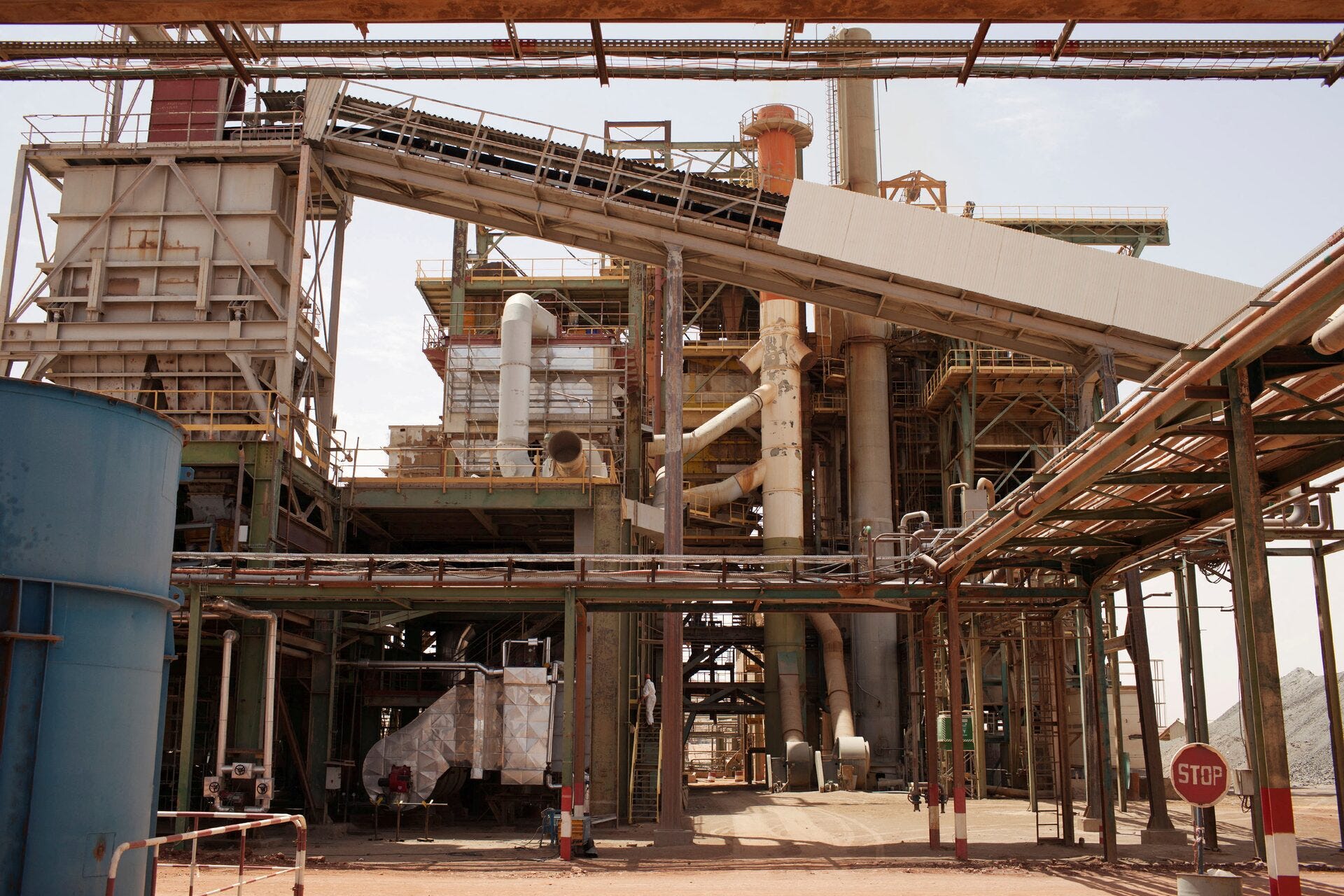
THE MINE AT ARLIT
HOW EUROPE’S NUCLEAR DEPENDENCY BECAME THE SAHEL’S COUP SEASON
The mine at Arlit sits in the Agadez region of northern Niger, 1,200 kilometers from Niamey, at the southern edge of the Sahara where the wind moves uranium dust across a landscape that the French nuclear industry has been quietly converting into an environmental debt for fifty years. The ore body was discovered in 1965 by the French Atomic Energy Commission during geological surveys conducted before Niger’s independence was four years old. Production began in 1971. Since then, Orano — the French state-controlled nuclear fuel company, formerly Areva, formerly Cogema — has extracted somewhere north of 100,000 tonnes of uranium from the Arlit deposits. The ore leaves in trucks, crosses the desert south to Niamey, flies to France, enters the enrichment plant at Tricastin in the Drôme department, and becomes the fuel that powers seventy percent of the French electrical grid. The workers at the mine, most of them Tuareg laborers from the Agadez region, earn wages denominated in the CFA franc, a currency pegged to the euro, its monetary policy conducted in Frankfurt, its foreign exchange reserves deposited, until recently, partly under French Treasury management.
In 2003, the French independent radiation monitoring laboratory CRIIRAD conducted environmental assessments near Arlit at the request of local communities. The results documented uranium concentrations in local water sources exceeding WHO safety limits, uranium-contaminated waste rock left in open piles accessible to the public, and radioactive dust measurable in homes within the town. Orano disputed the methodology. The waste rock remained. The dust moved where wind took it. Children in Arlit played near the tailings because nobody had fenced them, and the company’s own annual environmental reports noted elevated uranium concentrations in groundwater without proposing remediation timelines that anyone could hold to account.
On July 26, 2023, soldiers from Niger’s Presidential Guard placed President Mohamed Bazoum under arrest and installed General Abdourahamane Tchiani before the cameras of state television. France condemned the action. The United States condemned the action. ECOWAS set military intervention deadlines it could not enforce. Within weeks Niamey had expelled the French ambassador. By June 2024, the Tchiani government revoked Orano’s development permit for the Imouraren deposit, the largest undeveloped uranium reserve in Africa, estimated at 200,000 recoverable tonnes, which France had held under concession for fifteen years without extracting a gram. The workers at Arlit were not consulted about any of this. Their uranium dust was not on the agenda.
To understand the depth of what changed in 2023, begin not with uranium but with money, and begin not in 2023 but in 1958.
When Guinea’s president Sékou Touré voted against membership in Charles de Gaulle’s French Community in September 1958, effectively choosing full independence over the associate status France was offering its African territories, France’s response was not diplomatic protest. It was economic war. French technical advisers were ordered out of Guinea within days, taking their files and, in some documented cases, removing or destroying government records. The French Treasury withdrew from the Guinean banking system. New Guinean banknotes printed in France were never delivered; France reportedly destroyed them. In the three months after the independence vote, Guinea’s nascent administrative and financial infrastructure was deliberately dismantled by the departing power. The message to every other French African territory watching from Dakar, Niamey, and Bamako was specific: independence from the franc zone produces this.
The CFA franc, whose initials stood originally for Colonies Françaises d’Afrique, was established in 1945 and reconfigured in 1960 to accommodate formal decolonization without altering its essential mechanics. Member states received sovereignty. They kept the currency. The arrangement, codified in bilateral cooperation agreements that France’s Finance Ministry negotiated with each departing colony, required member governments to deposit a portion of their foreign exchange reserves into an “operations account” at the French Treasury in Paris. That deposit ratio stood at 65 percent until 2005, when it was reduced to 50 percent. In 2019, the West African franc was nominally reformed into the ECO, the French Treasury’s name was removed from the institutional documentation, and European Central Bank officials replaced French Treasury officials on the zone’s governing bodies. The fixed peg to the euro remained. The reserve requirement remained. The reform was in the letterhead.
The practical constraints on a Nigerien finance minister operating inside this framework are not abstract. Niger cannot devalue its currency to offset a collapse in uranium prices. It cannot set interest rates to respond to domestic inflationary or deflationary pressure. When the uranium spot price fell below $20 per pound in 2016, Niger’s government absorbed the revenue shock without a monetary adjustment tool of any kind. When it needed to borrow in local currency to finance infrastructure, the borrowing conditions were shaped by a monetary framework optimized for zone-wide stability, meaning optimized for France and the larger zone economies, not for a landlocked desert state whose fiscal position swung with the price of a single extractive commodity.
Presidents Tchiani in Niger, Assimi Goïta in Mali, and Ibrahim Traoré in Burkina Faso each made public statements targeting the CFA within months of seizing power. The Alliance of Sahel States, formalized in September 2023 as a mutual defense and political framework among the three coup governments, listed monetary sovereignty in its founding charter. In January 2024, all three countries withdrew from ECOWAS, the regional economic bloc that France had reliably used as the multilateral instrument of its bilateral political leverage since the 1990s. The withdrawal was not improvised. The legal groundwork was prepared in advance.
The uranium extraction regime and the franc zone were the same arrangement viewed through different instruments. Both transferred value systematically from the Sahelian interior to European industrial capacity, one through the pricing of a commodity and one through the architecture of the monetary system in which that commodity’s revenues circulated. The coup governments understood this and said so publicly, in terms that were domestically legible even if they struck European observers as economically simplistic. They were not simplistic. They were accurate.
France’s nuclear supply chain in Niger operated through two corporate structures at Arlit. SOMAIR, the Société des Mines de l’Aïr, was a joint venture between Orano and SOPAMIN, the Nigerien state mining company, with Orano holding 63.4 percent. COMINAK, the Compagnie Minière d’Akouta, included Japanese and Spanish interests alongside Orano in a more complex shareholding arrangement. SOMAIR operated an open-pit mine. COMINAK worked underground deposits. COMINAK exhausted its ore body and closed in March 2021, ending forty years of underground extraction. SOMAIR continued at Arlit. At peak production in the early 2000s, Niger supplied roughly 35 percent of Orano’s total uranium feed. As Orano diversified toward Kazakhstan, Canada, and Uzbekistan in subsequent years, Niger’s share fell, but the country retained a significance beyond its current production that had everything to do with what lay 80 kilometers south of Arlit.
The Imouraren deposit is geologically unusual. Its ore grade is low, around 0.08 percent uranium oxide, which at the spot prices that prevailed through much of the 2010s made it economically marginal on a standalone basis. But the deposit’s scale, roughly 200,000 recoverable tonnes across a mineralized zone several kilometers long, placed it among the ten largest uranium reserves on earth and gave it a strategic importance independent of whether it was producing. Orano signed a development agreement with Niger’s government in 2009. The mine was projected to reach production by 2012 at 5,000 tonnes per year, a rate that would have made it one of the largest uranium mines globally and would have supplied approximately five percent of world production at the time.
The 2012 date passed without a shovel in the ground. Then 2014. Then 2016. The explanation is in Paris, not Agadez, and it is corporate rather than geopolitical.
Areva, Orano’s predecessor, had committed simultaneously to two of the most expensive and technically troubled reactor construction projects in nuclear history. In Finland, the Olkiluoto 3 EPR reactor was contracted with TVO in 2003 at a price of 3 billion euros, began construction in 2005, and after a cascade of design revisions, weld quality failures, concrete specification disputes, and regulatory interventions spanning nearly two decades, reached commercial operation only in April 2023, twenty years after the contract and at a cost that multiple analyses placed between 10 and 11 billion euros, nearly four times the original figure. In France itself, the Flamanville EPR, contracted in 2007 at 3.3 billion euros, accumulated cost overruns through discovered defects in the reactor vessel, repeated weld failures in the primary circuit piping, and a succession of safety authority interventions that extended the construction timeline past every projected completion date for sixteen years. The reactor connected to the French grid only in December 2024, at a final cost exceeding 13 billion euros.
The financial consequences for Areva were severe and well-documented. The company’s debt load grew as the reactor projects bled cash. Its credit rating was repeatedly downgraded. By 2016, Areva’s accumulated losses had become a crisis requiring state intervention. The French government authorized a 5 billion euro recapitalization in 2017, restructured the company, transferred the reactor division to EDF, and rebranded the residual uranium and nuclear services entity as Orano in 2018. Through all of this, Imouraren sat. The capital required to develop a low-grade open-pit mine at the scale Orano had projected in 2009 ran to several billion euros by updated estimates. That capital simply was not available to a company managing a survival-level financial restructuring at home.
Orano never relinquished the concession during this period. Whatever the state of the company’s finances, holding the Imouraren permit cost relatively little and denied the deposit to everyone else. No other operator could acquire, license, or develop the reserve while Orano’s development agreement remained in force. The mine did not need to produce uranium in 2015 or 2020 or 2022. It needed to be unavailable to other buyers at a time when the uranium market, after a decade below $30 per pound, was beginning a price recovery that would take the spot price above $100 per pound by early 2024, the highest level since 2007, precisely as the Tchiani government was preparing to revoke the permit.
Operation Barkhane, the French counterterrorism mission that succeeded Operation Serval in 2014 and extended French military presence across five Sahelian states, cost approximately 900 million euros annually at its peak and deployed up to 5,500 soldiers across Mali, Niger, Chad, Mauritania, and Burkina Faso. It was operationally sophisticated, utilizing French intelligence assets, special forces, and air power against jihadist networks affiliated with al-Qaeda in the Islamic Maghreb and, later, the Islamic State in the Greater Sahara. By the French military’s own operational assessments, it killed significant numbers of jihadist commanders and disrupted multiple attack networks.
It did not stop the attacks.
In March 2019, Dogon militiamen attacked the Fulani village of Ogossagou in central Mali’s Mopti region and killed approximately 160 people, the deadliest single incident in the Malian conflict to that point. The attack was carried out with small arms and did not require sophisticated coordination; it required only that Malian state security forces be absent from a village that had reason to fear its neighbors. They were absent. French forces were conducting operations elsewhere in the country. In June 2021, simultaneous attacks on the Malian villages of Solhan and Daoutégueré killed more than 130 people. In Burkina Faso, attacks on villages in the Sahel, Nord, and Est regions accumulated a civilian toll through 2020, 2021, and 2022 that the UN Office for the Coordination of Humanitarian Affairs tracked in quarterly reports while the numbers climbed past any defensible characterization of a conflict being contained. Between 2015 and 2023, the number of Burkinabè displaced by conflict grew from approximately 50,000 to nearly two million.
French forces were visible in country capitals and at forward operating bases. They were not protecting the villages being attacked. In the political culture of three countries with weak civilian institutions and strong military self-perception, this gap became the operational logic for removing governments that had invited and permitted a foreign military presence that was not delivering security where security was needed. That argument was domestically irrefutable. Russia and its political operators recognized this and invested in amplifying it, through social media networks that EU and French intelligence services documented in substantial detail, including in a 2023 EU Disinfo Lab report. The amplification worked because the underlying argument was true.
The United States had its own infrastructure at stake. Air Base 201, constructed near Agadez at a cost of approximately 110 million dollars and operational since 2018, was the largest American drone installation in Africa, built to support ISR operations over northern Mali, southern Libya, and the Lake Chad basin. After the 2023 coup, Washington declined for months to formally designate the power transfer a coup, because such a designation would automatically trigger aid suspension requirements under US law, and US officials believed continued engagement might preserve the base. The calculation failed. Niger’s military government compelled a US withdrawal, and the last American forces departed Air Base 201 in September 2024. More than a hundred million dollars of infrastructure and a surveillance architecture covering hundreds of thousands of square kilometers of Saharan airspace was handed over to a government that immediately deepened its relationship with Moscow.
France’s immediate vulnerability from losing influence in Niger is cushioned by supply diversification. Its uranium procurement runs through Kazakhstan, Canada, Australia, and Uzbekistan, and no single source accounts for more than a quarter of total supply. The medium-term arithmetic is less comfortable.
Kazatomprom, the Kazakhstani state uranium producer, accounts for 43 percent of global output, a market concentration without precedent in any other strategic commodity except perhaps Saudi Arabia’s relationship to the oil market at its peak. Western utilities, including the major French, German, and British nuclear operators, rely on Kazatomprom supply as the foundational assumption of their fuel procurement. The complication that the post-2022 Ukraine war sanctions framework introduced into this assumption is structural and has not been publicly resolved.
Kazakhstan’s uranium mining uses in-situ leaching technology at most of its major deposits, a process requiring enormous quantities of sulfuric acid injected into the ore body to dissolve uranium in place. Kazakhstan produces sulfuric acid domestically and imports additional supply; Russian chemical producers have historically been among the sources. More consequentially, the primary export logistics for Kazakh uranium concentrate run north through Russian territory via the Trans-Siberian rail network to Russian ports on the Baltic, or south through the Caspian-Caucasus corridor to Azerbaijan and Georgia. The southern corridor was developed precisely as a Russia-bypass route after 2014, but its capacity constraints mean it handles a fraction of total export volume. The Western uranium industry’s diversification strategy assumed that Kazakh supply was a clean alternative to Russian uranium. The assumption rests on logistics and input supply chains that remain partially Russia-dependent, a fact that Kazatomprom’s own investor communications acknowledge in careful language.
Into this structural tightness, Imouraren was supposed to arrive. At 5,000 tonnes annually, the mine would have represented a significant and geographically independent addition to Western supply. Its ore would have been processed and enriched in France. Its product would have fed into the nuclear renaissance that European governments are now pursuing with an urgency that the energy shock of 2022 concentrated.
Poland is building its first nuclear plant, contracted with Westinghouse. The Czech Republic is expanding Dukovany. Sweden has reversed a phase-out policy it maintained for two decades. Finland’s Olkiluoto 3, after its long construction ordeal, entered commercial operation in 2023. The United Kingdom has Hinkley Point C under construction and Sizewell C advancing through development. All of this new capacity will require uranium feed that the current production base, flat to declining at the major established mines, cannot supply without significant new development. The IEA’s most recent uranium demand projections for 2040 require new mine production equivalent to a doubling of current output. Imouraren was in the planning for that expansion. It is now available to whoever the Tchiani government decides to license, in a market where the spot price has tripled in four years.
Russia’s Rosatom has signed nuclear cooperation frameworks with more than twenty African governments since 2015, including construction agreements in Egypt, Rwanda, Ghana, and Ethiopia. Whether Rosatom or a Chinese state nuclear entity acquires the Imouraren concession, the supply chain outcome for France is the same: the reserve it held in low-cost reserve for fifteen years, at a time when no one thought they needed it urgently, is now unavailable to them at the precise moment its importance has become acute.
The logic of holding Imouraren undeveloped for fifteen years made financial sense to Areva in the context of its existing financial crises. It made geopolitical sense as a control mechanism that denied the deposit to competitors. It made no development sense for Niger, whose government received no royalties, no employment, no infrastructure, and no technology transfer from a reserve sitting in its territory under a company flag.
The uranium price between 2011 and 2020 was genuinely too low to make Imouraren commercially attractive at its ore grade. That is the honest economic argument for the delay. But the concession was not structured to accommodate shared sovereignty or renegotiation in the event circumstances changed. The development agreement gave Orano the option to develop on its timeline, with its capital, on its terms, with no penalty for sustained inaction. Niger received the right to wait.
Three successive governments in Niamey, under Mahamadou Issoufou and then Bazoum, raised the question of Imouraren’s timeline in bilateral discussions with Paris and with Orano’s management. The responses, according to multiple accounts by Nigerien officials speaking to journalists after the coup, were consistent: the market conditions were not yet right, the capital was being assembled, development would begin when it could. Bazoum was removed in July 2023. Orano’s permit was revoked eleven months later. The market conditions, as of that revocation date, were the most favorable for uranium extraction in seventeen years.
The question of who licensed the deposit by the end of 2025 had not been publicly resolved as of the time of writing. The bidders are not hypothetical.


