The Misunderstood History of the Pakistan-Turkey-Malaysia Alliance During Imran Khan’s Era
How the UAE’s maneuvering on Kashmir and its sway over Saudi policy helped derail Imran Khan’s Pakistan–Turkey–Malaysia vision and reshape Pakistan’s foreign policy trajectory.


The Pakistan-Turkey-Malaysia alliance under Imran Khan remains one of the most deliberately misrepresented episodes in recent Pakistani foreign policy. The dominant narrative portrays Khan as recklessly building an anti-Saudi bloc that damaged Pakistan’s vital Gulf relationships. This narrative is not merely incomplete but fundamentally backwards. The real story involves the United Arab Emirates pushing Saudi Arabia away from Pakistan on Kashmir, Khan responding by building alternative partnerships for economic survival and diplomatic solidarity, and a sophisticated propaganda campaign inverting cause and effect to destroy an independent Pakistani foreign policy.
The Kashmir Betrayal That Changed Everything
The story begins not with Imran Khan’s ideological vision but with Kashmir in 2019. In August of that year, India revoked Article 370 of its constitution, stripping Kashmir of its special autonomous status and imposing a brutal military lockdown affecting millions of Kashmiris. This represented India’s most aggressive move on Kashmir in decades. Pakistan naturally expected its traditional Muslim allies, particularly Saudi Arabia and the UAE, to stand in solidarity on this core existential issue that had defined Pakistani foreign policy for seventy years. What transpired instead was a betrayal that would reshape Pakistan’s entire regional strategy and force Khan to seek new partnerships. Yet this betrayal has been systematically erased from the historical record by those who benefited from it.
The betrayal actually commenced months before India’s August 2019 Kashmir move. In March 2019, the United Arab Emirates invited India as the guest of honor to the Organization of Islamic Cooperation foreign ministers meeting in Abu Dhabi. The decision was stunning in its implications. The OIC had been established in 1969 partly in response to an arson attack on Al-Aqsa Mosque, with Kashmir as one of its founding agenda items. Pakistan was a founding member. For fifty years, the OIC had served as the primary multilateral platform where Muslim countries expressed solidarity with Pakistan on Kashmir. Now UAE was inviting India, the occupying power, as the guest of honor.
Pakistan’s foreign minister protested vigorously, attempting to get the invitation withdrawn or at minimum secure Kashmir condemnation in the final Abu Dhabi Declaration. UAE and Saudi Arabia refused on both counts. The declaration made zero mention of Kashmir. This marked the first unmistakable signal that Gulf priorities had fundamentally shifted.
Then in August 2019, the exact month that India imposed its Kashmir lockdown with mass arrests, communications blackouts, and curfews affecting millions, UAE awarded Prime Minister Narendra Modi its highest civilian honor, the Order of Zayed. The timing demands reflection. As Kashmir burned and Kashmiris were imprisoned in their homes, UAE was presenting Modi with a medal. When Pakistani officials reached out to Gulf allies for support, the responses proved blunt and shocking. UAE explicitly told Pakistan that Kashmir was a bilateral issue between India and Pakistan and should not be internationalized or made an issue for the Muslim world. Saudi Arabia adopted the same position, calling Kashmir India’s internal matter. Both countries advised Pakistan to resolve the dispute through dialogue with India.
After seventy years of OIC solidarity on Kashmir, the two wealthiest and most influential Muslim countries had abandoned Pakistan on its core national security issue. This was not neutral diplomacy. This was an active choice to side with India.
The Economics of Betrayal
Why did UAE and Saudi Arabia abandon Pakistan on Kashmir? The answer lies in economics and Mohammed bin Zayed’s strategic vision. India imports eighty percent of its petroleum from the Middle East, making it an essential energy customer for Gulf oil exporters. Over the previous decade, UAE and Saudi Arabia had built deep commercial relationships with New Delhi involving tens of billions of dollars in trade, investment, and infrastructure projects. Crown Prince Mohammed bin Salman had visited India with great fanfare. Modi had been received in Gulf capitals as an honored guest multiple times. Indian workers and businesses were deeply embedded in Gulf economies.
When forced to choose between supporting Pakistan’s position on Kashmir or protecting massive economic relationships with India, UAE chose India decisively. Mohammed bin Zayed then used his enormous influence over Mohammed bin Salman to ensure Saudi Arabia followed the same path. MBZ had cultivated an exceptionally close personal relationship with MBS, positioning himself as the older, experienced mentor guiding the younger Saudi crown prince. He leveraged that relationship to convince MBS that maintaining neutrality on Kashmir was necessary for Gulf economic interests.
UAE’s tilt toward India extended far beyond neutrality. After India’s reclassification of Kashmir, Abu Dhabi actively expanded its economic footprint in Indian-administered Kashmir on India’s terms. In October 2021, UAE signed a memorandum of understanding with the Indian government authority administering Jammu and Kashmir to develop infrastructure including real estate, industrial parks, information technology towers, medical facilities, and hospitals. UAE was literally investing in occupied Kashmir while Pakistan demanded international intervention for human rights violations. This represented a deliberate strategic choice to deepen partnership with India economically while maintaining just enough diplomatic courtesy toward Pakistan to avoid complete rupture. Mohammed bin Zayed had concluded that India’s economic potential and strategic value exceeded Pakistan’s historical friendship. Kashmir was the price of that calculation, and MBZ proved willing to pay it with Pakistani interests.
The Context Propaganda Erased
This context has been completely erased by propaganda narratives. By late 2019, Imran Khan faced a strategic crisis. Pakistan’s traditional allies had been compromised by Indian economic leverage and UAE’s active manipulation of Saudi Arabia. India had just annexed Kashmir, imposed military occupation, and faced virtually no meaningful consequences from the Muslim world because UAE and Saudi Arabia had neutered any collective response through the OIC. Pakistan was diplomatically isolated on its most vital national interest while Pakistani people and Kashmiris watched to see whether their government could mobilize any international support.
Khan needed alternatives. Turkey and Malaysia became critically important not because of ideological preference or anti-Saudi agenda, but because they were the only major Muslim countries willing to speak out forcefully on Kashmir when wealthy Gulf states chose silence.
Turkish President Recep Tayyip Erdogan repeatedly raised Kashmir at the United Nations and condemned India’s actions in strong, unambiguous language. He called the Kashmir lockdown unacceptable and urged international intervention. Malaysian Prime Minister Mahathir Mohamad delivered a powerful speech at the UN General Assembly in September 2019 where he explicitly criticized India’s revocation of Article 370 and called out the occupation and humanitarian crisis.
These were not cheap symbolic statements. India responded with serious economic retaliation against both countries, proving these leaders were taking real risks and paying real costs for speaking up on Kashmir. For Imran Khan and Kashmiris watching, this solidarity meant everything. When Pakistan’s traditional allies had abandoned the cause for commercial reasons, Turkey and Malaysia stood firm on principle despite economic punishment. This created the foundation for trilateral partnership, not some grand conspiracy against Saudi Arabia.
India’s Economic Warfare
India’s retaliation against Malaysia was swift and devastating. New Delhi launched an informal but highly coordinated boycott of Malaysian palm oil, the country’s single largest export commodity and critical source of foreign exchange. The Indian government pressured its vegetable oil industry to stop Malaysian imports and replace them with Indonesian supply. The impact was immediate. Malaysian palm oil exports to India collapsed from 310,000 tonnes in September 2019 to just 142,000 tonnes by November, a drop exceeding fifty percent within weeks.
This was economic warfare designed to punish a Muslim country for defending Kashmir and send a clear message to any other country considering solidarity with Pakistan. Turkey faced similar pressure including restrictions on defense cooperation, trade threats, and diplomatic isolation campaigns. Yet despite this economic pain and sustained pressure, both Erdogan and Mahathir continued speaking out on Kashmir. They did not back down. This kind of principled solidarity was exactly what Pakistan needed when wealthy Gulf states had calculated that Indian money was worth more than Muslim principles.
The Trilateral Framework’s True Purpose
The trilateral framework that Imran Khan built with Turkey and Malaysia served multiple strategic purposes that propaganda deliberately obscures. First and most importantly, it provided Pakistan with diplomatic solidarity on Kashmir when traditional allies had abandoned the issue. This was essential for Pakistani domestic politics and for showing Kashmiris they were not forgotten.
Second, it opened substantial economic opportunities through technology transfers, defense cooperation, and trade expansion. During Khan’s March 2019 visit to Malaysia, Pakistan signed agreements worth 900 million dollars covering information technology, telecommunications, power generation, agriculture, and halal food production. Serious negotiations occurred about Malaysia purchasing JF-17 Thunder fighter jets that Pakistan co-produces with China. On the Turkish side, Pakistan was coordinating on acquiring advanced defense technology including T129 ATAK attack helicopters, MILGEM class corvettes for the navy, and potential licensed production arrangements.
Third, the partnership created a platform for the three countries to coordinate on combating Islamophobia, projecting independent Muslim voices on global issues, and reducing dependence on Western technology. This was sophisticated strategic diversification designed to serve Pakistan’s concrete national interests, not ideological adventurism.
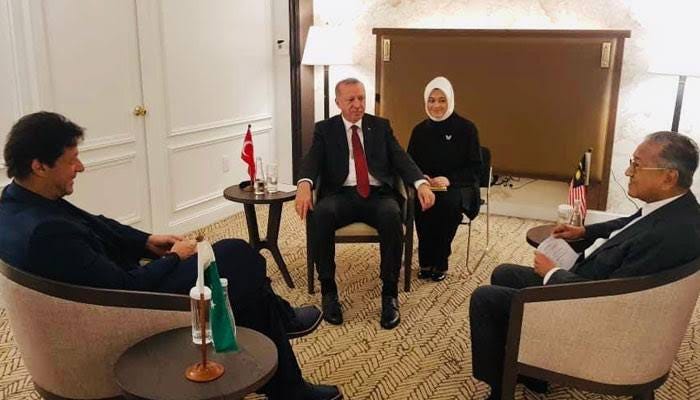
The symbolic solidarity moment came in September 2019 on the sidelines of the UN General Assembly in New York. Imran Khan, Recep Tayyip Erdogan, and Mahathir Mohamad held trilateral talks and coordinated their positions. This meeting happened right after Malaysia and Turkey had faced Indian economic retaliation for their Kashmir statements. By meeting publicly and presenting a united front, the three leaders made a powerful political statement. They demonstrated that at least some Muslim countries would not be intimidated into silence by economic threats or Western pressure.
For Pakistan specifically, this was about showing Kashmiris and the Pakistani public that their cause still had champions in the Muslim world, even if the wealthiest countries had chosen commerce over principle. Imran Khan praised both Mahathir and Erdogan publicly and repeatedly as Muslim leaders who had the moral courage to speak truth to power and defend Muslim dignity on difficult issues. He wanted Pakistan to have that same kind of independent voice and principled stance while maintaining traditional friendships. The propaganda machine portrayed this admiration as anti-Saudi sentiment through deliberate distortion.
The Kuala Lumpur Summit and Propaganda Activation
The next initiative was the Kuala Lumpur Summit scheduled for December 2019. The summit was co-initiated by Pakistan, Turkey, Malaysia, and Qatar as a platform for discussing practical challenges facing Muslim countries including Islamophobia, economic underdevelopment, technology gaps, media narratives, and governance issues. The explicit purpose was creating a space where smaller groups of motivated Muslim countries could discuss solutions and implement projects without the bureaucratic paralysis of the fifty-seven member Organization of Islamic Cooperation, where consensus requirements meant Saudi Arabia and UAE could veto any initiative that might displease India or Western powers.
The summit agenda focused on actionable cooperation on education, science, technology, trade facilitation, and media strategy. It was explicitly not designed to replace the OIC, challenge Saudi leadership of the Muslim world, or create rival institutions. The organizers were careful to frame it as complementary to existing structures. Yet the moment the summit was publicly announced, Saudi and Emirati media outlets launched coordinated campaigns portraying it as a dangerous rival bloc that would fracture Muslim unity and undermine the OIC.
This is where the propaganda machinery was activated with devastating effectiveness. Pakistani media outlets, many with established financial ties to Gulf sponsors and intelligence services, began running stories claiming that Imran Khan was building an anti-Saudi alliance that would abandon Pakistan’s seventy-year strategic relationship with the Kingdom. The talking points were remarkably uniform across different channels and personalities, suggesting central coordination.
Khan was portrayed as ideologically driven, recklessly naïve, dangerously ignorant of economic realities, and temperamentally unsuited for the careful diplomacy required to manage Pakistan’s dependence on Saudi financial support. Television anchors, newspaper columnists, and social media influencers amplified the narrative that the Turkey-Malaysia alliance was fundamentally about challenging Saudi Arabia’s position in the Muslim world, with Kashmir merely a convenient excuse.
The propaganda completely inverted cause and effect. UAE’s betrayal on Kashmir, which happened first and forced Khan to seek alternatives, was memory-holed. Khan’s response, building partnerships with countries that supported Pakistan on Kashmir, was framed as the original provocation. This inversion was deliberate and sophisticated, designed to isolate Khan both domestically and in Gulf capitals.
The Unprecedented Pressure Campaign
The pressure campaign to prevent Pakistan from attending the Kuala Lumpur Summit was unprecedented in its intensity and explicitness. Turkish President Erdogan, who has no reason to fabricate such claims, publicly revealed what happened behind closed doors. In December 2019, Erdogan stated on the record in media interviews that Saudi Arabia had threatened Pakistan with severe, immediate economic consequences if Imran Khan attended the summit.
The threats were specific and devastating. First, immediate withdrawal of six billion dollars in deposits that Saudi Arabia had placed in Pakistan’s central bank to shore up foreign exchange reserves. Pakistan’s reserves were already critically low, and losing six billion would have triggered a currency crisis and potential default. Second, mass expulsion of Pakistani workers from Saudi Arabia. Roughly 2.5 million Pakistanis work in the Kingdom, sending back billions in remittances that millions of Pakistani families depend on for survival. Threatening expulsion meant threatening economic catastrophe for ordinary Pakistani citizens. Third, immediate recall of loans that Pakistan owed and was already struggling to service.
These were not diplomatic suggestions or polite expressions of concern. These were explicit financial threats designed to force submission.
What propaganda never acknowledges is that Imran Khan tried everything possible to avoid this crisis before it escalated. Khan personally visited Saudi Arabia in October 2019, before the Kuala Lumpur Summit, specifically to brief Saudi leadership about the initiative and reassure them about Pakistan’s intentions. He explained in detail that the summit was about practical economic and social cooperation among a subset of Muslim countries, not about challenging Riyadh’s leadership or creating rival institutions to the OIC. He emphasized that Pakistan valued its relationship with Saudi Arabia enormously and had no desire to damage it.
Khan explicitly sought Saudi blessing for the Kuala Lumpur initiative and offered to modify any aspects that concerned Riyadh. Despite this personal diplomatic outreach, despite Khan’s proven track record of prioritizing the Saudi relationship throughout his tenure, the pressure campaign proceeded anyway. Saudi Arabia, guided by UAE’s strategic advice, decided to make Pakistan’s attendance at the summit a red line. The threats were delivered, and Khan was forced to choose between his diplomatic initiative and Pakistan’s economic survival.
Khan’s Impossible Choice
Imran Khan chose Pakistan’s economy. He withdrew from the Kuala Lumpur Summit at the last minute, personally humiliating himself on the international stage and severely damaging Pakistan’s credibility with Turkey and Malaysia who had organized the event based on Pakistan’s co-sponsorship. This decision was excruciating for Khan politically and personally. He had to call Erdogan and Mahathir to explain that Pakistan could not attend an event Pakistan had helped initiate.
Turkish and Malaysian officials were disappointed and frustrated, reasonably questioning whether Pakistan could be counted on as a reliable partner. Pakistani civil society and media figures who supported the Turkey-Malaysia outreach criticized Khan for caving to Saudi pressure. Yet Khan made the call that protecting Pakistan’s foreign exchange reserves and preventing economic collapse had to take priority. He subordinated his diplomatic vision to Saudi demands, even though those demands were orchestrated by UAE and served Emirati rather than Saudi interests.
This was the action of a leader managing impossible constraints, not someone pursuing an anti-Saudi agenda. But propaganda framed even this capitulation as evidence of Khan’s reckless foreign policy that had created the crisis in the first place.
Khan’s Actual Saudi Record
The anti-Saudi narrative crumbles when examining Imran Khan’s actual track record with Saudi Arabia. Saudi Arabia was the first country Imran Khan visited after becoming Prime Minister in September 2018. Not China, not Turkey, not Malaysia, not the United States. Saudi Arabia. That choice was deliberate and symbolic, signaling that Khan understood the fundamental importance of the Pakistan-Saudi relationship for economic, strategic, and religious reasons.
Over his three and a half years in power, Khan visited Saudi Arabia five separate times, more than any other country. When Saudi Arabia requested Pakistani support on regional issues, Khan accommodated those requests within Pakistan’s capacity. When Saudi Arabia asked Pakistan not to attend the Kuala Lumpur Summit, Khan complied despite the diplomatic cost. When the relationship needed repair after the summit controversy, Khan personally traveled to Riyadh in May 2021 with Army Chief General Bajwa for extensive meetings with Saudi leadership to rebuild trust.
Throughout his tenure, Khan publicly praised the historical Pakistan-Saudi brotherhood and reaffirmed Pakistan’s security commitments to the Kingdom. None of this is consistent with an anti-Saudi posture. All of it demonstrates a leader trying to balance Pakistan’s need for Saudi financial support with Pakistan’s equally vital need to diversify partnerships and maintain dignity on core interests like Kashmir.
The UAE’s Manipulation Game
The real villain in this story is the United Arab Emirates and specifically Mohammed bin Zayed’s manipulation of Saudi decision-making to serve Emirati regional interests. MBZ had spent years cultivating an exceptionally close personal relationship with Mohammed bin Salman, frequently hosting the younger Saudi crown prince in Abu Dhabi and positioning himself as the experienced elder statesman mentoring MBS on regional strategy.
MBZ systematically used this influence to shape Saudi perceptions and policies on multiple issues, often in ways that served UAE more than Saudi Arabia. On Pakistan specifically, MBZ pushed a narrative to MBS that Imran Khan’s Turkey-Malaysia outreach was the beginning of a Pakistan-Turkey-Qatar axis that would challenge Saudi leadership, undermine the anti-Iran coalition, and create a rival power center in the Muslim world. This framing was deliberately designed to trigger Saudi insecurities about regional leadership and force MBS to view Khan’s reasonable diversification as strategic betrayal.
The reality was that Khan had carefully maintained Pakistan’s neutrality between Saudi Arabia and Iran, refusing to send troops to Yemen despite enormous Saudi pressure precisely because he did not want Pakistan dragged into sectarian conflicts. But MBZ needed MBS to see Khan as unreliable and dangerous.
UAE had multiple specific reasons for wanting to sabotage the Pakistan-Turkey-Malaysia partnership and isolate Imran Khan. First, Abu Dhabi was engaged in a cold war with Turkey and Qatar, most dramatically manifested in the 2017 blockade of Qatar that UAE led alongside Saudi Arabia, Egypt, and Bahrain. Turkey had supported Qatar during the blockade with emergency food supplies, economic aid, and military deployments, which infuriated UAE. Turkey was also directly challenging UAE in Libya, Syria, the Eastern Mediterranean, and other regional theaters where both countries were competing for influence.
Any Pakistan-Turkey partnership, particularly one that included Qatar, was seen by MBZ as strengthening Ankara’s hand and undermining UAE’s regional position. Second, UAE had made massive strategic and economic bets on India as a long-term partner. This included billions in investment, intelligence cooperation, defense ties, and diplomatic alignment. A strong, economically viable, diplomatically independent Pakistan that was successfully mobilizing Muslim countries on Kashmir directly threatened UAE’s India strategy. MBZ needed Pakistan weak, dependent, and unable to effectively challenge Indian narratives or actions.
Third, UAE’s regional strategy depended on keeping Saudi Arabia aligned with Emirati priorities. An independent Pakistan working confidently with Turkey and Malaysia might give MBS alternative perspectives and reduce MBZ’s monopoly on advice. For all these reasons, MBZ had clear interest in undermining Khan and convincing MBS that the Turkey-Malaysia partnership was a threat to Saudi interests rather than a reasonable Pakistani diversification strategy.
The Coordinated Propaganda Machine
The propaganda campaign inside Pakistan that amplified the anti-Saudi narrative was funded and coordinated by multiple actors with converging interests. Gulf intelligence services and media operations provided resources and talking points. Pakistani political opposition parties saw an opportunity to portray Khan as diplomatically isolated and incompetent in foreign affairs. Elements within Pakistan’s military and intelligence establishment who preferred Pakistan to remain a client state rather than pursuing strategic autonomy used their extensive media networks and proxy commentators to undermine Khan’s foreign policy.
Business interests connected to Gulf money wanted to maintain the status quo of aid dependence that created opportunities for commissions and rent-seeking. All of these actors benefited from the narrative that Khan was anti-Saudi and recklessly endangering Pakistan’s economic lifelines. The fact that this narrative was factually false and completely inverted the actual sequence of events did not matter. It served too many powerful interests simultaneously. The propaganda was amplified across television channels, newspapers, social media, and even mosque networks until it calcified into accepted conventional wisdom that even well-meaning Pakistanis came to believe without examining the underlying facts.
The Vindication
By 2026, the entire regional dynamic has shifted in ways that completely vindicate Imran Khan’s strategic instincts and brutally expose how UAE’s influence led Mohammed bin Salman into policies that damaged Saudi interests. MBS is now systematically breaking free from MBZ’s shadow and pursuing Saudi national interests independent of Emirati preferences. The most dramatic manifestation is Yemen, where Saudi Arabia and UAE have moved from close alliance to open confrontation.
Throughout 2025 and into early 2026, Saudi Arabia has issued ultimatums to UAE-backed separatist groups in southern Yemen, conducted airstrikes on Emirati-supported forces, and publicly accused UAE of undermining Yemeni sovereignty by supporting secessionist movements that want to divide the country. These are not minor diplomatic disagreements. This is a fundamental rupture in the Saudi-UAE relationship that had been the cornerstone of Gulf politics for years.
MBS has recognized that UAE’s agenda in Yemen, which involves creating mini-states that Abu Dhabi can control, directly contradicts Saudi interests in having a stable, unified Yemen on its southern border. This is MBS realizing that MBZ’s advice served Emirati interests, not Saudi interests.
The Saudi-UAE rift extends beyond Yemen. On Pakistan specifically, Saudi Arabia dispatched its foreign minister to Islamabad in December 2025 to begin rebuilding ties and exploring renewed cooperation. The timing was fascinating and deliberate. MBZ was also visiting Pakistan at the same time, and rather than coordinating visits with UAE as would have happened during their close alliance period, Saudi Arabia scheduled its visit to signal that Riyadh was pursuing its own Pakistan policy independent of Abu Dhabi.
MBS is recognizing that UAE’s advice during 2019-2020 to isolate Pakistan and pressure Khan away from the Turkey-Malaysia framework did not benefit Saudi Arabia. It weakened a traditional Saudi ally, pushed Pakistan closer to economic collapse, created space for Chinese influence to expand, and damaged Saudi Arabia’s reputation in Pakistani public opinion for intervening so heavy-handedly on the Kuala Lumpur Summit.
The policies that MBZ pushed MBS to adopt on Pakistan served UAE’s interest in keeping Pakistan weak and dependent. They did not serve Saudi interests in having a stable, capable, economically viable Pakistan as a long-term strategic partner. MBS is now correcting course, but the damage from 2019-2020 remains.
Turkey-Malaysia Move Forward Without Pakistan
Meanwhile, Turkey and Malaysia have continued deepening their bilateral relationship without Pakistan, proving the strategic value of the framework that Imran Khan had built and the enormous cost to Pakistan of destroying participation in it. In January 2026, Turkey and Malaysia launched a High-Level Strategic Council and signed multiple cooperation agreements covering defense production including naval shipbuilding, information and communication technology, educational exchanges, scientific research, and coordinated diplomatic positions on issues like Gaza and Palestine.
The two countries announced they are targeting ten billion dollars in bilateral trade within the next several years. Turkey is now the sixteenth largest economy in the world with advanced defense manufacturing capabilities including armed drones, attack helicopters, armored vehicles, and naval vessels that dozens of countries are purchasing. Malaysia is a significant middle power with strengths in technology, manufacturing, Islamic finance, and trade.
Pakistan should have been the third pillar of this alliance, the largest of the three countries by population, benefiting from technology transfers, defense cooperation, expanded export markets, and the diplomatic weight of a united bloc. Instead, Pakistan sits on the sidelines watching Turkey and Malaysia build exactly the partnership Khan envisioned, while contributing nothing and gaining nothing because the leadership that created it was destroyed.
The Complete Story …
that needs to be understood is this: UAE pushed Saudi Arabia into abandoning Pakistan on Kashmir in early 2019 to protect Emirati economic interests with India. This happened first. Imran Khan responded to this abandonment by building partnerships with Turkey and Malaysia, the only major Muslim countries willing to support Pakistan on Kashmir despite facing economic retaliation from India.
Propaganda funded by Gulf interests and amplified by Pakistani domestic opposition then inverted this timeline, claiming Khan’s Turkey-Malaysia focus was anti-Saudi aggression rather than a response to UAE having already compromised the Pakistan-Saudi-Kashmir relationship. Saudi Arabia, influenced by MBZ’s advice, pressured Pakistan to withdraw from the Kuala Lumpur Summit through explicit economic threats. Khan complied with those threats, subordinating his diplomatic initiative to Saudi demands, yet was still portrayed as anti-Saudi.
The propaganda succeeded in creating a narrative that bore no relationship to the documented sequence of events but served powerful interests that wanted Khan removed. Pakistan is now weaker, more dependent, more isolated than during Khan’s tenure, while Turkey-Malaysia cooperation continues without Pakistan and Saudi Arabia recognizes that UAE’s advice damaged Saudi interests.
Lessons for Saudi Arabia
For Saudi Arabia specifically, there is an important lesson in this history that is directly relevant to current Saudi strategic thinking as MBS pursues greater independence from UAE. Imran Khan’s vision for the Pakistan-Saudi relationship was never about replacement, rivalry, or creating opposing blocs. It was about Pakistan being a strong, economically self-sufficient, strategically autonomous partner to Saudi Arabia rather than a weak dependent state constantly requiring bailouts and unable to contribute meaningfully to regional security or Muslim world challenges.
Khan wanted to build Pakistan’s capabilities through partnerships with Turkey and Malaysia so that Pakistan could eventually be a more valuable ally to Saudi Arabia, not a lesser one. A Pakistan with advanced technology, robust defense industry, expanding economy, and diplomatic confidence would serve Saudi interests far better than a Pakistan drowning in debt, dependent on IMF programs, and unable to project any regional influence.
The advice that MBZ gave to MBS during 2019-2020, which led to the Kuala Lumpur pressure campaign and broader cooling of Pakistan-Saudi ties, did not serve this Saudi interest in a strong Pakistan. It served UAE’s interest in a weak Pakistan that could not challenge Emirati regional agenda or India partnership. MBS is correcting many areas where MBZ’s influence led Saudi policy away from Saudi interests. The Pakistan relationship should be part of that correction.
The Consequences of Propaganda’s Victory
The misunderstood history of the Pakistan-Turkey-Malaysia alliance during Imran Khan’s era is ultimately a story about the consequences of propaganda succeeding over facts. A sophisticated, multi-sourced narrative campaign managed to convince large segments of Pakistani and Gulf opinion that Imran Khan was pursuing an anti-Saudi foreign policy, when every documented action showed him prioritizing the Saudi relationship while also seeking to diversify partnerships to serve Pakistan’s desperate economic needs and provide solidarity on Kashmir when traditional allies had abandoned the cause.
The propaganda inverted cause and effect, erased UAE’s role in pushing Saudi Arabia away from Pakistan on Kashmir, and created a crisis narrative that justified removing a Pakistani leader who was trying to build strategic autonomy. That propaganda campaign succeeded. Imran Khan was removed in April 2022.
The consequences are clear in January 2026. Pakistan is economically devastated, diplomatically isolated, strategically dependent, and excluded from the Turkey-Malaysia partnership that continues to deepen without Pakistani participation. Meanwhile, Saudi Arabia is recognizing that UAE’s advice during this period damaged Saudi interests and is working to rebuild relationships that MBZ undermined.
The truth was buried under propaganda. Pakistan paid the price. History is now revealing what actually happened. The question is whether anyone will learn the lessons before more damage is done.


