The Money Was Always There
Mamdani Balanced the $124.7 Billion City Budget
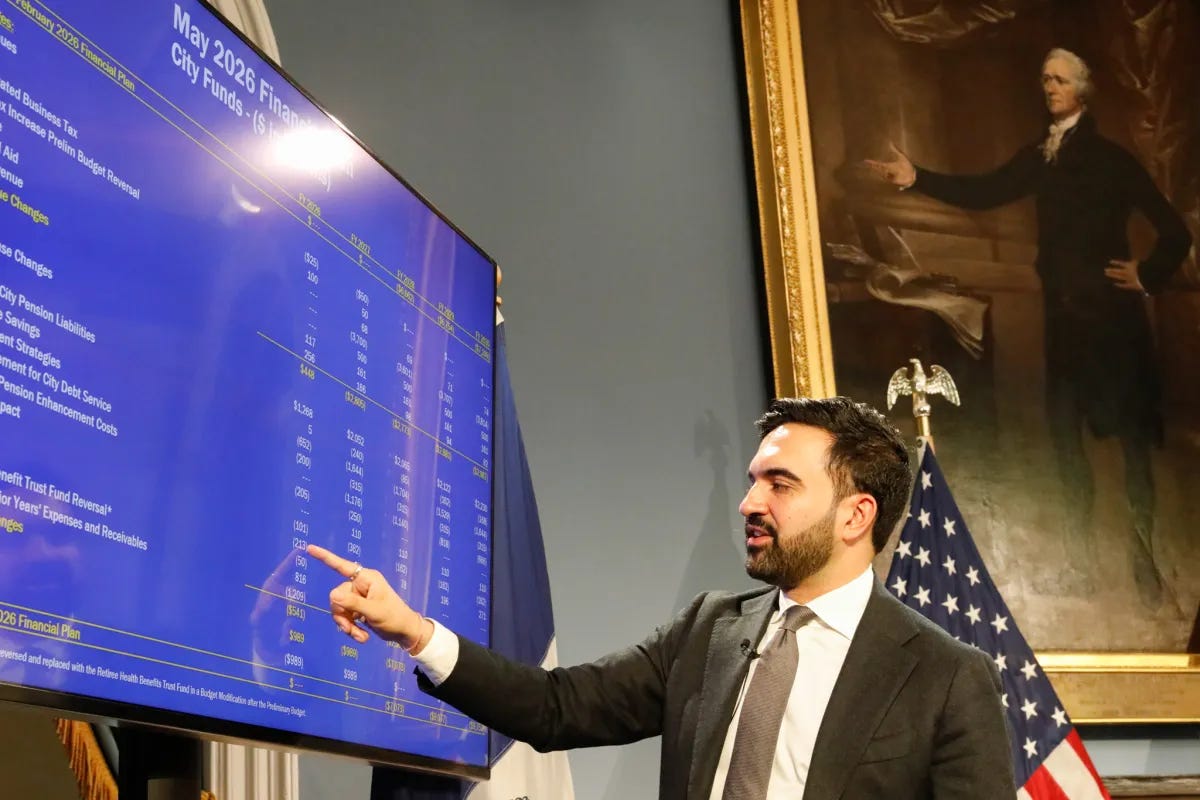
On the morning of January 28, 2026, three weeks into his mayoralty, Zohran Mamdani stood in the Blue Room at City Hall with a PowerPoint presentation and a word no administration uses in its first month: crisis. “I will be blunt,” he said. “New York City is facing a serious fiscal crisis. There is a massive fiscal deficit in our city’s budget to the tune of at least $12 billion.”
He had a name for it. He had a slide deck for it. And in his first weeks in office, he had turned up something specific he wanted New Yorkers to see.
The previous administration had commissioned an AI chatbot. Launched in October 2023 under the brand name MyCity, built on Microsoft’s Azure AI services, it was meant to help small business owners navigate city regulations. An investigation by The Markup and The City, published in April 2024, found that when asked whether a restaurant could serve cheese a rat had nibbled on, the bot replied yes, before advising the owner to “assess the extent of the damage caused by the rat” and to “inform customers about the situation.” The same bot told business owners they could legally take a cut of their employees’ tips, which they cannot under city law, and told landlords they could discriminate against tenants paying rent through city housing vouchers, also illegal. When the stories ran, Mayor Eric Adams held a press conference and said: “We’re going to have the best chatbot system on the globe.” The chatbot had cost upward of $600,000 to build and was running at roughly half a million dollars annually by the time Mamdani shut it down in week one.
Mamdani used it as an emblem of the preceding four years. Not because the chatbot was the cause of the fiscal gap, but because it illustrated the operating logic: spend on spectacle, undercount the obligations, and let someone else balance the ledger.
What Mamdani’s administration found when it opened the books had been flagged publicly by multiple watchdogs before he arrived. State Comptroller Thomas DiNapoli had noted, repeatedly, that the Adams administration was underestimating expenses for police overtime and housing vouchers. City Comptroller Brad Lander’s March 2024 budget analysis flagged that total overtime for uniformed agencies was on track to hit $1.6 billion for Fiscal Year 2025, 50 percent above the mayor’s April forecast. The Fiscal Policy Institute found that actual city spending exceeded planned spending by an average of 10 percent across the four Adams years, a rate three times the pre-Adams baseline of roughly 3 percent, itself a product of normal budget friction rather than systemic concealment.
The specifics are precise enough to carry the indictment without adjectives. The Adams administration budgeted $860 million for cash assistance in Fiscal Year 2026. The verified cost, confirmed by both comptrollers independently, was $1.625 billion, not a projection but a number the administration had access to when it set the budget line. Shelter costs were booked at $1.47 billion; the real number was at minimum $500 million higher. Special education costs, driven by legally mandated class size reductions and what are called Carter cases (private tuition reimbursements for students with disabilities severe enough that the public school system cannot meet its legal obligations) were booked at figures bearing no relationship to the legal commitments already on the city’s books.
Then there was CityFHEPS.
The city’s primary rental assistance program, launched in 2019 under Bill de Blasio, spent $155 million in Fiscal Year 2020 and $819 million in Fiscal Year 2024: a fivefold increase in four years, driven by a housing market in which vacancy rates hit record lows and a shelter census that, despite billions spent on vouchers, refused to fall. As of the end of 2024, roughly 52,000 households held active CityFHEPS vouchers. The city spent $1.25 billion on the program in FY2025. In the Adams administration’s FY2026 adopted budget, the allocation was $519 million, less than half what had been spent the year before, on a voucher population whose leases were already signed. The Citizens Budget Commission called this “a continued practice of radical underbudgeting that obfuscates the City’s fiscal plans and outlook.” That description appeared in a published CBC report in early 2025, while Adams was still in office.
What distinguished CityFHEPS from the cash assistance and shelter lines was that the Adams administration had not merely undercounted it. It had actively fought to prevent the program from operating at the scale the law required. In April and May 2023, the City Council passed a package of four bills expanding voucher eligibility: Local Laws 99, 100, 101, and 102. The package would have removed the shelter-stay precondition, raised the income ceiling from 200 percent of the federal poverty level to 50 percent of area median income, and eliminated work and income requirements. Adams vetoed the package. The Council overrode the veto. The administration then refused to implement the laws in court, arguing the state’s social services statute preempted the City Council’s authority to expand the program. In August 2024, Manhattan Supreme Court Judge Lyle Frank sided with the mayor. In July 2025, an appellate court reversed that ruling and directed implementation. The Adams administration announced it was “reviewing legal options.” By the time Mamdani took office six months later, 66,000 families were using a program that had been the subject of four years of litigation, a mayoral veto, a Council override, a court loss, an appellate reversal, and ongoing administrative resistance, with a budget line for the coming year cut by more than half.
When Mamdani described the gap as deliberate, he was not making a political allegation. He was repeating what the city’s own fiscal watchdogs had been publishing in real time.
Nothing illustrated the system as clearly as the NYPD overtime line, because its falsity had a documented history going back years.
In Fiscal Year 2023, the city set aside $453 million for uniformed NYPD overtime. It spent $817 million, a $364 million overrun, 81 percent above the adopted figure. The following year, the adopted overtime budget was set at $452 million: essentially unchanged from the year that had just blown past it by $364 million. The Citizens Budget Commission’s Andrew Rein said what was obvious to anyone reading the numbers: “It’s not as if the city adopts a budget saying, ‘Overtime’s going to be half a billion dollars lower, and here’s the plan for how we’re going to achieve that.’ They just put in a lower number.” Adams, asked about the pattern directly, called it “a very conservative approach.”
Before taking office, Adams had pledged to cut NYPD overtime in half in his first year. He had arrived at City Hall as the first cop-turned-mayor in nearly a century, having built a political identity around public safety and fiscal competence. The overtime line moved in one direction every year he was in office.
The PBA contract Adams signed in April 2023 added structural permanence to the problem. The Independent Budget Office estimated its total cost at $18 billion over four years. The Citizens Budget Commission put the police union contract’s contribution to the city’s deficit at $700 million. The NYPD’s FY2025 operating budget was $5.8 billion in direct appropriation, representing 5.3 percent of the city’s total budget. That figure excludes $2.7 billion in pension contributions and $2.9 billion in fringe benefits allocated centrally. The full public cost of maintaining the department ran well north of $11 billion annually, inside a budget that was simultaneously booking $519 million for a housing voucher program that had spent $1.25 billion the year before.
The subway policing surge ran alongside all of this. The initiative, jointly branded by Adams and Governor Hochul as Cops, Cameras and Care, sent NYPD overtime in the transit system from $4 million to $155 million in a single fiscal year. The most measurable outcome was a surge in fare evasion enforcement: between 2017 and 2023, 82 to 92 percent of New Yorkers ticketed or arrested for fare evasion were not white, a demographic consistency that held across boroughs, precincts, and years. The mental health response embedded in the program’s name was never funded at anything approaching the scale of the policing component.
The mismanagement at City Hall sat inside a structural problem that predated Adams and that his administration never seriously challenged.
In Fiscal Year 2022, New York City sent $68.8 billion in revenue to Albany and received $47.6 billion back. That single-year transfer gap of $21.2 billion is a figure Mamdani put on record in January 2026 and that no state official contested. The city generates approximately 54.5 percent of all state tax revenue and receives roughly 40 percent of state expenditures. The Fiscal Policy Institute adds a dimension that goes beyond transfers: the city’s own-source revenue, measured as a share of its own GDP, fell from 6.5 percent in FY2020 to a projected 5.4 percent by FY2027. New York City’s economy grew across that period. The problem was that the city’s tax structure could not keep pace with that growth. The state maintained revenue proportional to its economy by periodically raising personal income tax rates on high earners, a lever Albany controls and that the city cannot pull without Albany’s authorization.
This is the constraint that produced the deal Mamdani eventually struck. The $4 billion in state aid that Governor Hochul agreed to in May 2026 breaks down as $352 million in direct transfers, $3.2 billion through programs requiring state authorization to unlock city spending, and $500 million in new revenue, enough to close the gap across two fiscal years. The structural imbalance remains. The city will return to Albany.
Mamdani had originally demanded a wealth tax as the centerpiece of the resolution, framing it publicly by standing outside Ken Griffin’s $238 million penthouse at 220 Central Park South and naming Griffin by address. Hochul, whose political coalition includes the donors Griffin represents, declined. The final budget contains no new income tax on the wealthy. What it contains is the largest single infusion of state aid in the city’s recent fiscal history, redirecting toward New York City a portion of what the city had been subsidizing Albany with for years.
Every fiscal crisis in New York finds its audience in 1975. The date is when the heads of three major commercial banks sat down with Governor Hugh Carey in midtown Manhattan and told him they would no longer underwrite the city’s notes and bonds. New York had been running current-account deficits since 1961, covering them by borrowing short-term and rolling over the debt. By April 1975, that arrangement collapsed. The city ran out of money.
What followed is usually described as a rescue. The historian Kim Phillips-Fein, in Fear City: New York’s Fiscal Crisis and the Rise of Austerity Politics, establishes it as something more deliberate. The city faced a demand-side depression and a bond market failure, conditions that, in the preceding decades, would have produced a Keynesian response. The argument for stimulus was available. It was not made, not seriously, not by anyone with institutional leverage over the outcome. What was made instead was an argument that New York had simply spent beyond its means, and that the only responsible path was to cut.
The cuts were specific. Mayor Abe Beame reduced the police force, laid off teachers, shut municipal hospitals, imposed wage freezes on city workers, and introduced tuition at the City University of New York for the first time since its founding in 1847. By 1980, 800,000 fewer people lived in New York than in 1970. The people who stayed, disproportionately, were the people those programs had been built for.
Phillips-Fein’s account is careful about the federal role. Treasury Secretary William Simon and Council of Economic Advisors Chairman Alan Greenspan both saw New York’s crisis as an opportunity, not an emergency to be resolved. An internal document cited in Fear City records the First Deputy Mayor’s list of spending priorities in the event of default: payroll, welfare, Medicaid, the Health and Hospitals Corporation, day care, transit. Payment of interest on bonds was absent. The Emergency Financial Control Board, the state agency that assumed budgetary authority over the city in the fall of 1975, reversed that hierarchy. Bondholders were made whole. Services were cut. The geographer David Harvey later described the EFCB model as the template the IMF would apply across the Global South in the following decade: suspend democratic accountability over fiscal decisions, transfer authority to creditors, present the outcome as technical necessity. The city names changed from New York to Santiago, Lagos, Buenos Aires, Islamabad. The balance sheet logic was the same.
New York recovered across the early 1980s, rebuilt on federal loan guarantees, Wall Street expansion, and the inflationary erosion of the debt burden. CUNY’s free tuition, abolished in 1976, was never fully restored. The public hospital network never returned to its pre-crisis scale. The social floor that had made New York, unevenly and imperfectly but materially, a place where poor people could survive was replaced, increment by increment, by a city organized around the preferences of financial capital. Every subsequent mayor inherited a baseline defined by those cuts and a political language calibrated to defend them.
Griffin gave an interview to CNBC the same afternoon Mamdani announced the balanced budget. He warned that the city was in a “precarious position” if it made those who “create value” feel unwelcome and suggested high earners might relocate. Republican Nassau County Executive Bruce Blakeman called the Albany aid package “the largest daylight robbery in New York history.” The money he was describing had come from state revenue, largely generated by New York City’s economy, being returned to fund services in New York City that Albany had been undersupplying for decades. Trump, weighing in separately, told Mamdani to “cherish” people like Griffin: “You’ve gotta bring them to the office.”
The gap was gone. The reserves were intact. No services had been cut. No property taxes had been raised. The wealth tax Mamdani ran on was not in the final budget. Griffin remains at 220 Central Park South.
In January 2026, Mamdani signed Executive Order 12, establishing a Chief Savings Officer at every city agency with targets of 1.5 percent savings in FY2026 and 2.5 percent in FY2027. Agencies submitted proposals on March 20. The process generated $1.77 billion across the two years, primarily through unfilled vacancies and contract terminations.
The Department of Social Services terminated its McKinsey contract, on which the city had spent nearly $9 million in FY2026 alone. The Department of Correction cancelled and restructured IT and consulting contracts, saving $4.3 million. Health + Hospitals reduced reliance on temporary staffing agencies through in-sourcing and renegotiated rebates, saving $39.8 million across the two years. The Office of Labor Relations audited dependent eligibility in employee health plans, removing ineligible dependents from coverage, and projects $100 million in FY2027 savings. The naloxone contract at the Department of Health and Mental Hygiene was renegotiated against lower rates achieved in other states, saving $1.15 million. An audit of the co-op property tax abatement, tightening eligibility verification, produces $13 million in recovered revenue.
An additional $1.2 billion came from addressing inefficiencies embedded in specific programs. Improving how the city processed special education placements reduced the volume of students routed into private Carter case settings, each of which costs the city substantially more than a public school seat. Bringing classrooms into actual compliance with the state class size mandate, rather than budgeting for compliance while maintaining overcrowded rooms, cut the per-pupil overruns that had been accumulating for years. The pension amortization measure restructures payment schedules across two fiscal years, producing $1.64 billion in FY2027 savings without reducing any benefit for current or retired workers.
The state absorbed the line-of-duty death benefit payments it had previously shifted to the city, saving $202 million. With the gap closed, the budget allocates $600 million to youth programming, $31.7 million to the library systems, $15 million to Parks, $15 million to CUNY, and $10 million to cultural organizations: line items that would have been eliminated in the austerity scenario that had been the consensus forecast since February.
The wealth tax is not in this budget. Hochul’s political position has not changed, and the state income tax lever that the city’s long-term fiscal health depends on remains in Albany’s hands. The $21.2 billion annual transfer gap is intact. The Albany deal covers two fiscal years. After that, the arithmetic returns.
What Mamdani established on May 12, 2026 is more limited than his supporters will claim and more significant than his critics will allow. He closed a gap his predecessor manufactured without making the people who were owed services pay for their own dispossession. New York City has been doing the opposite, with interruptions, since 1975.
Whether this budget is a rupture or a détente depends on what happens when the Albany deal expires and whoever occupies the governor’s office has to decide whether to extend it. That answer is not in the budget document. It is in the coalition of interests that has occupied Albany for fifty years, and in the question of whether that coalition has actually changed, or simply paused.


