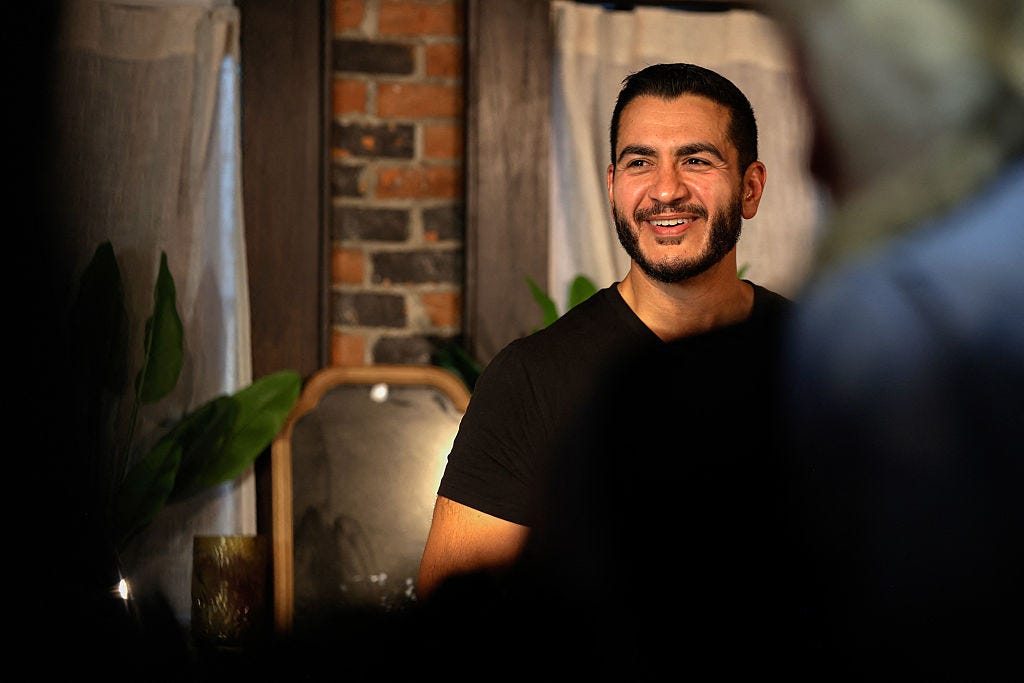
Abdul El-Sayed turned public anger at AIPAC, corporate money and the health-insurance machine into a Michigan victory, and his American birth makes him a threat the establishment cannot contain below the presidency.
You know the bill before opening the envelope. The insurer has already taken its premium, your employer has already taken its share, the hospital has already assigned a code to whatever happened to your body, and still the answer may be that the doctor is out of network, the drug is not covered or the procedure requires permission from someone paid to deny it. Then you turn on the news and watch Congress discover billions for another weapons package to Israel with none of the fiscal anguish summoned whenever Americans ask for health care. Then the political advertisements arrive, paid for by corporations and lobby groups, explaining which candidate is too dangerous to be allowed near the money.
That anger was on Michigan’s ballot on August 4. It was anger at health-insurance companies that built a business from refusing care, at corporations that purchase access ordinary voters are told to call participation, at a Democratic establishment that requests loyalty while protecting its donors, and at AIPAC’s confidence that tens of millions of dollars could define what Michigan Democrats were permitted to believe about Gaza. Abdul El-Sayed did not create the anger. He gave it somewhere to go.
The number on the screen was 48.5 percent. El-Sayed had spent Tuesday night inside the MotorCity Casino Hotel in Detroit watching a lead so narrow that no sensible campaign would call it early, while the Democratic Party establishment, the American Israel Public Affairs Committee and nearly $50 million in outside spending waited for Michigan voters to restore the expected order. By Wednesday morning, with 99 percent of the vote counted, Rep. Haley Stevens stood at 47.5 percent and the order had not been restored.
El-Sayed had won the Democratic nomination for the United States Senate. He had done it after AIPAC and its affiliated organizations spent more than $30 million supporting Stevens, their largest investment in a single race, and after outside groups poured close to $50 million into her candidacy while her own campaign spent roughly $1 million on advertising. Stevens had four terms in Congress, the backing of Senate Minority Leader Chuck Schumer, the support of Nancy Pelosi and a donor apparatus that treated Michigan television as purchasable territory. El-Sayed had never held elected office. The apparatus supplied the money, the endorsements, the warnings about electability and the familiar charge that criticism of Israel concealed hostility toward Jewish Americans, and yet Michigan Democrats chose the Muslim public-health official whom the entire operation had been assembled to stop.
The primary gave El-Sayed no national office and he has announced no presidential campaign, but it did establish the fact the entrenched establishment has reason to fear: the Muslim progressive who joined anger over Gaza to anger over medical bills and corporate power can constitutionally run for president.
El-Sayed was born in Michigan on October 31, 1984. Article II of the Constitution requires a president to be a natural-born citizen, at least thirty-five years old and a United States resident for fourteen years. He satisfies all three conditions. The point sounds elementary because it is elementary, and yet the elementary fact carries political force in a country where a Muslim name is still treated as evidence requiring an answer and where Barack Obama, born in Honolulu in 1961, spent years confronting a racist industry built around the proposition that his birth certificate was a conspiracy.
El-Sayed is an American citizen by birth. His father came from Egypt to study engineering at Wayne State University. His stepmother belongs to a family whose roots in Gratiot County reach back generations. He attended Michigan schools, captained teams at Bloomfield Hills Andover, studied at the University of Michigan, became a Rhodes Scholar, earned a medical degree from Columbia and a doctorate at Oxford, then returned to Detroit to work inside a health system serving the city where his father had first arrived. The constitutional question is settled. The political question has now been opened by voters.
The distinction matters because America has elected Muslim members of the House, Muslim mayors and Muslim state legislators, and Michigan could now elect the first Muslim senator, but the presidency sits behind a separate constitutional gate that naturalized Americans can never cross. Michigan nominated a forty-one-year-old natural-born citizen who has run a major public-health department, directed a county agency serving roughly 1.8 million people, built a national policy profile around Medicare for All and defeated the largest financial intervention AIPAC has ever mounted in one election. You do not need to invent a 2028 announcement to understand why that biography is dangerous to the people who paid to stop it.
The price of the approved result
AIPAC’s intervention should be described with numbers because adjectives let the machinery escape. The organization and its affiliates spent more than $30 million backing Stevens. A Stronger Michigan, an outside group that did not disclose its donors, spent roughly $12 million. By mid-July, Stevens was benefiting from a television advantage of more than twelve to one. The Associated Press reported that outside organizations had put close to $50 million behind her candidacy, and more than $60 million in outside spending entered the race overall. The El-Sayed campaign placed the final expenditure against him at $70 million, a campaign estimate that includes the full field of opposing outside money and should be identified as such rather than passed off as an audited total.
The scale was national because the objective was national. Stevens had described herself as a proud pro-Israel Democrat. At a Hanukkah event, she said that Israel came to her in her dreams. In July, when the House considered an amendment that would have cut $3.3 billion in annual military aid to Israel, she voted against it. El-Sayed called the Israeli assault on Gaza a genocide, opposed American military aid to Israel and accused AIPAC of distorting Democratic politics. A primary nominally conducted to choose Michigan’s next senator became the most expensive test yet of whether the lobby could punish a candidate for saying aloud what much of the Democratic electorate had already concluded.
Stevens could discuss manufacturing, Trump and her congressional record. She became much less precise when asked about the organization paying to promote her. During a July campaign stop in western Michigan, the Associated Press asked her twice about AIPAC. She spoke for more than eight hundred words without saying its name. Israel appeared once, in a statement that the United States and Israel should work together to rebuild Gaza. The group spending tens of millions on her behalf was somehow too incidental to mention, which is an impressive feat of verbal discipline when the same group had turned the race into a national referendum on its power.
The silence made sense as campaign strategy. AIPAC’s name has become a liability among Democratic voters while its money remains useful to Democratic candidates. The political solution is distance: accept the spending, deny coordination as campaign-finance law requires, discuss every issue except the benefactor and let front groups present foreign-policy enforcement as local concern. A Stronger Michigan sounds like an organization worried about roads in Saginaw. Its advertisements existed to elect a senator whose position on Israel satisfied a national lobby.
Michigan voters saw the transaction because they have lived inside transactions like it. The company buys the politician and the insurer buys the committee chair and the lobby buys the advertisement, while the voter is permitted to buy a prescription, a premium, a gallon of fuel and the explanation that nothing more ambitious can be afforded. More than 100,000 Michigan Democrats had already cast uncommitted ballots in the 2024 presidential primary to protest the Biden administration’s support for the war in Gaza. Arab and Muslim communities in Dearborn had become objects of national analysis whenever Democrats needed their votes and objects of suspicion whenever those communities attempted to set terms. American weapons continued to move while Democratic leaders described concern for Palestinian civilians as if concern were an alternative to policy, and yet when the same establishment arrived with its preferred candidate and the largest single-race AIPAC expenditure in history, the electorate refused the purchase.
The victory was only one percentage point. That makes it more instructive, not less. El-Sayed did not sweep the state and he did not dissolve the moderate wing of the party. Nearly half the primary electorate chose Stevens, and the general election will include voters who regard Medicare for All, abolishing ICE and ending military aid to Israel as disqualifying. What he proved was narrower and more consequential: the donor veto can fail even when applied at maximum force in a statewide battleground.
AIPAC understood the injury immediately. After the result, it promised to work against El-Sayed and his “radical anti-Israel agenda.” The organization had entered a Democratic primary to select Stevens and, when Democrats selected someone else, it prepared to help defeat their nominee. A health insurer does not care which party card you carry when it denies the claim, a corporation does not care which speech you applauded when it purchases the regulation, and AIPAC does not care which party controls the seat so long as the vote for Israel remains locked. Michigan’s insult was refusing the arrangement.
The government work beneath the biography
Presidential speculation flatters candidates by turning a win into destiny. El-Sayed’s case deserves a more difficult test: what has he administered, what did he deliver and which claims will survive an opposition file?
In 2015, Detroit Mayor Mike Duggan appointed him executive director and health officer of the Detroit Health Department. He was thirty years old. The department had been hollowed out during the city’s fiscal collapse, with services fragmented and public capacity diminished, and El-Sayed’s assignment was to help rebuild an institution that bankruptcy had treated as expendable. During his tenure, the department secured more than $1 million in grants, produced work on childhood lead exposure and expanded public-health programs. He later worked on Detroit’s income-based water affordability plan, a response to shutoffs that had turned the inability to pay a utility bill into a health emergency.
This is the section of his record that national profiles often compress into a polished sentence about rebuilding a department. The work was bureaucratic, incomplete and politically useful because public health forces an official to follow the cost of a decision into a home. Water policy becomes childhood illness. Housing becomes asthma. A closed clinic becomes an emergency-room bill, that bill becomes debt, and debt becomes the reason a family avoids the next appointment. El-Sayed’s politics did not descend from a seminar into Michigan. It was shaped inside agencies where the state had already transferred the cost of its withdrawal to people least able to absorb it.
In 2023, Wayne County Executive Warren Evans appointed him director of Health, Human and Veterans Services and county health officer. The department served a county of about 1.8 million residents and joined health services to veterans’ programs and human services under one administrative roof. His work included air-quality monitoring, Narcan vending machines, vision care for children and a medical-debt initiative designed with Undue Medical Debt to purchase qualifying debt in bulk. Wayne County said the program could help more than 300,000 residents, generally covering people whose household income was below four times the federal poverty level or whose debt exceeded five percent of annual income.
The medical-debt program also supplies his opponents with a legitimate line of scrutiny. El-Sayed and allies at times spoke of $700 million in relief in language that blurred the amount targeted or authorized with debt already cancelled. Reporting by the Detroit Free Press, amplified by Republican campaign organizations, challenged the claim. A presidential-quality candidate does not get to answer that dispute by pointing toward the obvious cynicism of the people raising it. Program authority, contracted capacity, notices sent and debt extinguished are different figures. If El-Sayed wants to build a national politics around government that works, his own account of government work has to be exact.
The same is true of the title “doctor.” El-Sayed earned an M.D. from Columbia and a doctorate in public health from Oxford. He has not practised clinical medicine and has not held a medical licence in Michigan or New York. Calling him a physician is conventional for an M.D., but voters are entitled to know that his career has been in epidemiology, public health, academia, policy and administration rather than bedside care. The distinction does not discredit his expertise. It tells us what kind of expertise he has.
His departure from Detroit for the 2018 governor’s race will also return under national examination. He entered as a young progressive carrying Bernie Sanders’s political energy into a state contest, won about 342,000 votes and finished second to Gretchen Whitmer with roughly 30 percent. The result demonstrated an audience but not a statewide majority. Eight years later, he converted that audience into a Senate nomination, which is evidence of political growth, and yet it also leaves an eight-year stretch in which he built influence through books, podcasts, policy work and appointed office rather than through the daily compromises of an elected legislature.
This weakness can become an asset only if he refuses the costume of spotless outsider. Government is where clean promises acquire line items, legal constraints, personnel failures and numbers that refuse to cooperate with speeches. His Wayne County record contains programs worth defending and claims worth correcting. The presidency should belong to adults capable of both.
A platform built from cost transfer
El-Sayed’s campaign arranged its economic argument into three phrases: money out of politics, money in your pocket and Medicare for All. The compression worked because millions of Americans already understand the structure without needing a policy paper. The price rises, the coverage shrinks, the executive bonus grows, the political donation clears and the senator explains that reform must wait, which is how corporations and wealthy donors make the governing choice before transferring its cost to workers, patients and taxpayers.
Medicare for All is the oldest and clearest part of his national identity. El-Sayed co-authored a citizen’s guide to single-payer health care and has argued for replacing the country’s fragmented insurance structure with universal public coverage. His public-health background gives the position more weight than a slogan because he has worked inside the consequences of fragmentation: medical debt, delayed treatment, unequal exposure to pollution, water insecurity and the administrative absurdity of asking sick people to navigate eligibility systems designed around employers and income categories.
The argument will be attacked through taxes, disruption and the loss of private coverage. You will be told to fear losing the insurance plan that makes you argue with a telephone menu while someone you love is sick. Americans already pay through premiums, deductibles, co-payments, employer compensation withheld for benefits, public subsidies and medical bills that arrive after the insurer has performed its contractual interpretation of illness. Hospitals employ departments to fight insurers, insurers employ departments to deny hospitals, employers employ departments to select plans, patients spend hours seeking permission, and yet the waste is defended as choice because the alternative would move the expense into a public budget where voters could see it.
His AI platform moves the same argument into a newer economy. In June 2026, the campaign released “AI Under Democracy,” a package of twenty-two proposals supporting public control and democratic governance of powerful artificial-intelligence systems. It endorsed a public stake in major AI companies, extending a proposal associated with Bernie Sanders for a sovereign wealth fund holding equity in the largest firms. El-Sayed’s case is that technology capable of eliminating jobs, denying health claims, producing political deception and expanding surveillance cannot remain under the exclusive control of a few executives whose legal duty runs toward investors.
The language of public ownership will be called radical by people who accept public subsidies, government research, tax concessions, energy access and municipal water for data centers without detecting ideology in any of it. The state finances the conditions for private AI fortunes and the public carries the displaced employment, the grid pressure, the water consumption and the risk of automated decisions, and yet requesting an ownership share for the people who absorbed those costs is presented as an assault on the market. There is the sardonic genius of American political economy: socialism begins precisely where the public asks for equity.
El-Sayed also supports taxing billionaire wealth, banning corporate money in politics, abolishing the Senate filibuster, expanding voting rights and replacing ICE in its current form. Each position creates a constituency against him. Billionaires can finance advertisements. Senators like the filibuster when it protects them from delivering the agenda on which they campaigned. Immigration enforcement has been converted into a test of patriotism, particularly when the candidate answering the question is Muslim and named Abdulrahman Mohamed El-Sayed.
His answer cannot rest on progressive approval. Abolishing ICE requires a clear account of which enforcement functions move where, how labor trafficking and cross-border crime are handled, what happens to detention, how asylum claims are processed and which agency becomes accountable for abuse. Ending the filibuster requires accepting that Republicans will legislate by majority when they regain control. Public AI ownership requires governance rules strong enough to prevent the public stake from becoming another fund managed for private contractors. Medicare for All requires a transition that does not sacrifice patients while dismantling an industry embedded in every hospital billing system in the country. A national candidate earns scale by describing the mechanism after the applause.
El-Sayed has one advantage that most presidential hopefuls spend millions trying to fabricate. His agenda is coherent. Health care, campaign finance, AI, immigration and foreign policy all return to the same political question: who makes the decision and who is forced to pay for it?
Gaza broke the old permission structure
The most important fact in El-Sayed’s victory is not that a Muslim candidate criticised Israel. Muslim Americans have criticised Israeli policy for decades, often at considerable professional cost. The important fact is that a statewide Democratic electorate chose him after opponents made that criticism central to the case against him.
El-Sayed has called Israel’s war in Gaza a genocide. He supports ending American military aid to Israel, including offensive and defensive assistance. He has resisted formulations asking whether Israel has a right to exist specifically as a Jewish state, returning instead to equal rights, Palestinian freedom and the question of why American taxpayers must finance another government’s military. Those answers have drawn fierce criticism from Jewish organizations, pro-Israel commentators and Democratic opponents. Some criticism addresses a real political obligation: a candidate seeking national power must speak with precision about the safety and political rights of Israeli Jews as well as the freedom and equal humanity of Palestinians. Some criticism exists to restore the old rule that Palestinian freedom may be acknowledged only after Israeli state power has been reassured.
The old rule is failing because Gaza destroyed the language that sustained it. Democratic officials could once describe Israel as a complicated ally, invoke a two-state solution, approve the weapons and trust that the issue would remain distant from an American primary. Voters then watched hospitals attacked, families displaced, aid restricted and civilian deaths accumulate while Congress continued military support. They were asked to distrust their own eyes, to treat every image as contextless and every objection as suspect, while the same politicians who could not guarantee an insulin prescription guaranteed the flow of weapons, and the distance between voters and legislators became a political space waiting for someone to occupy it.
El-Sayed occupied it by connecting foreign military expenditure to abandoned needs at home. That connection can become crude if every dollar is treated as mechanically transferable from a missile to a school, but the budget is still a record of choices. Congress can find billions for military aid with bipartisan speed while universal health coverage remains fiscally unimaginable. Lawmakers who demand a funding mechanism for medical care rarely apply the same ritual to weapons, and yet the families paying deductibles are instructed that foreign policy belongs to experts and should not contaminate their domestic vote.
Michigan refused that separation. Arab American voters did not act as a single bloc, Jewish voters did not act as a single bloc, and Gaza was not the only issue in the race. A primary result never carries one motive. The financial operation against El-Sayed nevertheless made Israel impossible to separate from campaign finance, and his win established that opposition to military aid can survive the punishment once considered fatal.
The presidency enters the argument at this point because a senator can vote against an arms package, while a president controls the executive machinery that sends the weapons, protects Israel at the United Nations, interprets the conditions attached to aid and decides whether Palestinian life has any enforceable standing in American policy. A Muslim president who understood Gaza, medical debt and corporate capture as parts of the same system of protected power would threaten the consensus that keeps each grievance isolated and therefore manageable.
November is the first gate
Mike Rogers now stands between El-Sayed and the Senate. Rogers is a former House member, a former FBI agent, Trump’s endorsed candidate and an experienced national-security politician. Michigan voted for Trump in 2016, for Joe Biden in 2020 and for Trump again in 2024. Democrats have little margin for romantic experiments, and Republicans will spend the next three months presenting El-Sayed as the proof that the Democratic Party has been captured by socialists, abolitionists and enemies of Israel.
The attack will fuse every vulnerability into identity. His support for abolishing ICE will be attached to his father’s immigration. His opposition to Israeli military aid will be attached to his faith. His lack of a clinical licence will be used to suggest fraud rather than distinguish public-health training from medical practice. His 2018 comments about defunding police will be placed beside crime footage. His public programs will be audited at the least flattering denominator, while Rogers’s own record will be presented through the soft light reserved for men whose biographies already resemble Washington.
El-Sayed cannot answer by running a national progressive campaign inside a Michigan general election. He needs union households in Macomb County, Black voters in Detroit, Arab voters in Dearborn, university communities in Ann Arbor and East Lansing, suburban voters who supported Stevens and working-class voters who backed Trump because they believed disruption might improve a life that neither party had repaired. Those constituencies do not need identical language. They need a material reason to share a ballot.
His election-night posture was disciplined. He told supporters that the contest against Stevens was small compared with the fight against Rogers and Trump. Party unity after a brutal primary is easy to request and harder to produce, particularly when major Democratic donors spent months describing the nominee as dangerous. By August 6, Stevens had conceded and endorsed him, Mallory McMorrow had backed him before the race was called, and the Democratic Senatorial Campaign Committee had released an advertisement attacking Rogers over money from pharmaceutical and insurance companies. The institutional party had begun moving behind its nominee. The larger test is whether Schumer and the same national apparatus that promoted Stevens will put the full money, staff and legitimacy of the party behind the voters’ choice once AIPAC’s next expenditure begins.
AIPAC has already answered for itself. It intends to defeat him. That commitment gives the general election a clarity Democratic consultants usually work hard to avoid: an organization that spent more than $30 million choosing one Democrat will now oppose the Democrat chosen by voters, even though Senate control may depend on Michigan. If party leaders accept that intervention while warning progressives about unity, the word will have acquired a very specific definition.
November will also determine whether El-Sayed’s primary strategy can travel beyond a Democratic electorate. Small donors and ten thousand volunteer door-knocks can break a financial blockade in August. A general election demands statewide field organization, relentless message discipline and an answer to the fear campaign before it hardens. He has proved that money does not always buy the result. He has not proved that it stops trying.
The path no one can dismiss now
If El-Sayed defeats Rogers, he would become the first Muslim elected to the United States Senate. The symbolic consequence would be historic. The structural consequence would matter more. He would enter national office without AIPAC’s permission after making its intervention part of his case, carrying a small-donor network, a health-policy identity, executive administrative experience and the loyalty of a progressive movement searching for a successor generation to Sanders.
Zohran Mamdani has already shown what can happen when a Muslim progressive makes affordability the center of politics in America’s largest city. His success broke assumptions about which voters could form a coalition and which attacks they would ignore. The Constitution fixes the boundary of that rise: Mamdani was born in Kampala, Uganda, moved to New York as a child and became a naturalized American citizen in 2018, which makes him fully American and constitutionally ineligible for the presidency under Article II. The distinction is an indictment of an exclusionary constitutional clause, but it is still the law.
El-Sayed stands on the other side of that clause. He was born in Michigan. No amendment is required, no litigation can convert his birthplace into Uganda and no birther campaign can alter the citizenship conferred at birth. Mamdani can govern New York, shape the national party and build the political imagination in which a Muslim progressive executive becomes ordinary, while El-Sayed can carry the same revolt through the constitutional door to the White House. That is the difference the establishment cannot spend away.
He would also enter a chamber designed to discipline insurgents. One senator cannot enact Medicare for All, abolish ICE, create public ownership of AI, tax billionaire wealth or end military aid to Israel. Committee assignments are controlled by leadership. Legislation requires coalitions. Donors punish deviation. The daily work of the Senate converts moral clarity into amendments, holds, appropriations language and votes scheduled by other people. El-Sayed’s presidential credibility would depend less on how often he denounced that structure than on whether he could use office to alter it.
There are precedents for thin résumés reaching the White House. Barack Obama had served seven years in the Illinois Senate and less than four years in the United States Senate when elected president. Donald Trump had held no public office. The constitutional system does not require a governorship, a military command or a prescribed number of committee hearings. It requires citizenship, age and residence, then leaves political legitimacy to voters.
El-Sayed’s route is therefore visible without being inevitable. Win in November. Build a Senate record that joins opposition to American military power with laws improving material life. Show that a politics forged in Dearborn and Detroit can speak to voters outside Michigan without translating Muslim conviction into an acceptable Western vocabulary. Survive the attempts to make every Muslim acquaintance, mosque appearance and statement on Palestine carry a burden never imposed on Christian candidates who build careers beside pastors preaching apocalypse in Jerusalem. Then decide whether the moment requires a national campaign.
The open question is whether the Democratic Party can tolerate a candidate whose biography fulfils its rhetoric while his politics threatens its donors. The party celebrates immigrant families, religious pluralism, public service, medical expertise and grassroots democracy in convention speeches. El-Sayed contains all of them, and yet the institutions surrounding the party spent a historic sum to deny him a Senate nomination because he connected those values to an enforceable position on money and war. He took the frustration people feel when an insurer refuses care, when a corporation purchases another exception and when Congress finances Israel through another assault on Gaza, then told those people that their frustrations share an architecture.
That contradiction will intensify if he reaches the Senate. The attacks will become uglier because the ordinary exclusions have failed. He cannot be barred as foreign-born. He cannot be dismissed as constitutionally ineligible. He cannot be told that opposition to AIPAC makes statewide victory impossible because Michigan has already tested that claim. His opponents can defeat him, expose failures in his record, challenge his policies and persuade voters that someone else should govern. They can no longer insist that the path does not exist.
On August 4, 2026, Michigan voters were asked to ratify an arrangement in which party leaders selected the acceptable candidate, outside groups supplied close to $50 million in support, AIPAC and its affiliates provided more than $30 million of that force, and criticism of Israel was converted into a warning about the candidate’s fitness for office. El-Sayed was outspent, institutionally isolated and placed on the defensive over the most protected question in American foreign policy, and yet the ballots gave him the nomination. Now they have to beat him.