The Numbers Don’t Lie
Trump’s Approval Rating Is the Worst of His Political Life
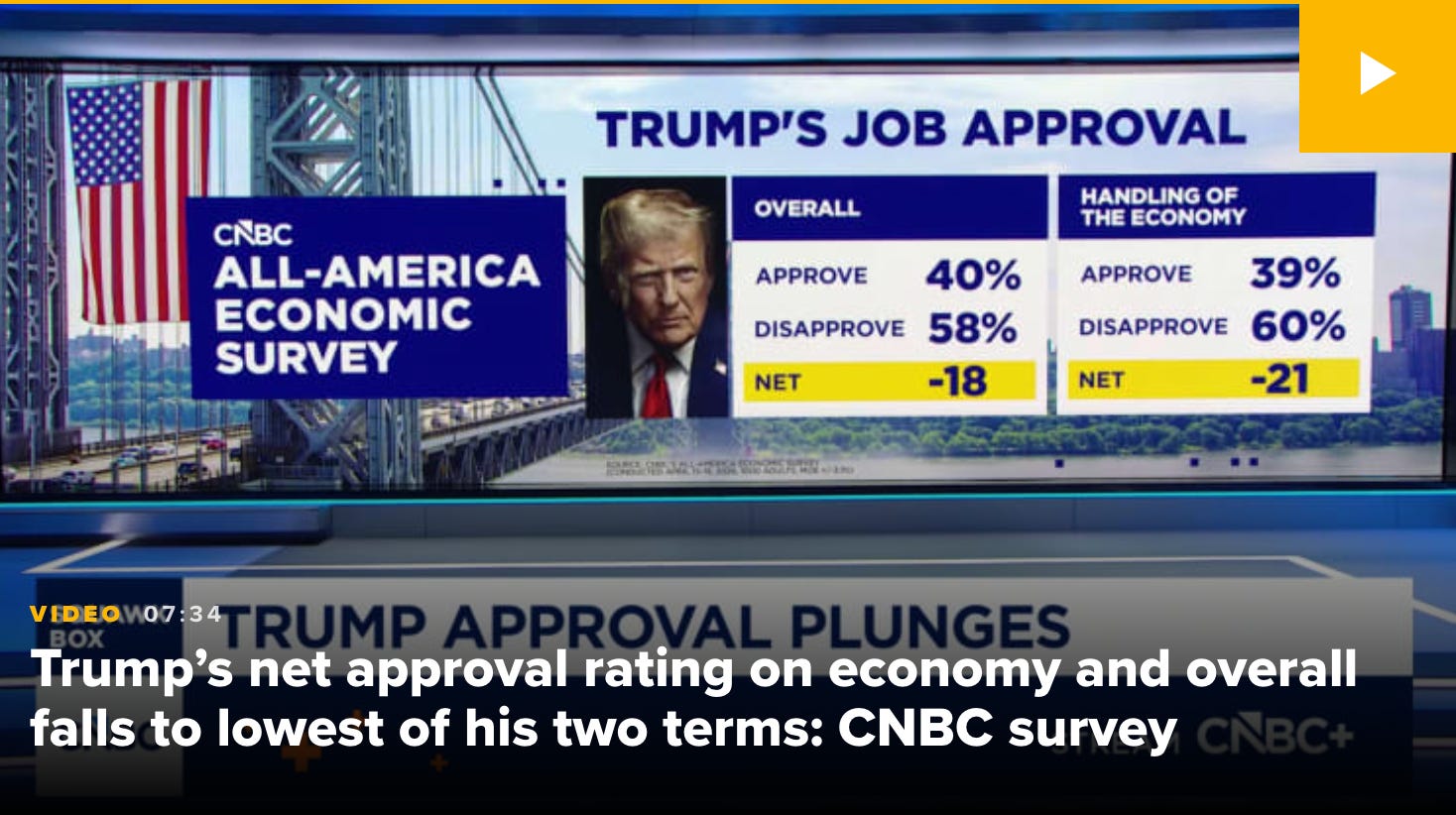
The CNBC All-America Economic Survey was released on April 23 without fanfare, as routine polling releases tend to be. The number buried inside it was not routine. Donald Trump’s overall approval sat at 40%, his disapproval at 58%, and his net approval at -18. Across both presidential terms, across every survey conducted since he descended the Trump Tower escalator in June 2015 and made himself a political fact, no poll had ever placed him this low. The floor is not yet visible.
That single number, -18, does not explain itself. It requires context, and context requires sitting with what the polling universe looked like just twelve months ago, when Trump entered his second term on the back of a decisive 2024 victory and approval numbers that hovered, depending on the pollster, somewhere in the mid-to-high forties. He arrived at the White House carrying a pocketbook mandate: voters had told the exit polls, repeatedly and without ambiguity, that the economy was their primary concern, that Joe Biden’s stewardship of it had been inadequate, and that Trump represented something approaching a correction. The economy was the weapon. He owned it.
The CNBC survey is not an isolated reading. It is one instrument in a convergence. NBC News placed overall approval at 37% and disapproval at 63% as of April 20. The Strength in Numbers/Verasight tracker, updated the same week, recorded 35% approval and 61% disapproval, a net of -26, a figure that has worsened without interruption every single month since January. The AP-NORC poll, released April 20, found only 30% of Americans approving of Trump’s handling of the economy, a collapse of eight full percentage points in a single month. CNN’s April survey placed his economic approval at 31%.
These are not methodological accidents. Each of these organizations uses different sampling frames, different weighting formulas, different modes of contacting respondents. When surveys conducted by competing organizations, some of which operate under explicit ideological scrutiny from different parts of the political spectrum, converge within a narrow band, the convergence is the data. The question is not whether Trump is unpopular. The question is what produced a decline this steep, this fast, and why the crosstabs inside the numbers are more alarming than the headline figures.
To understand the collapse in economic approval, it is necessary to spend some time with the policy instrument at the center of it.
Trump’s tariff regime, assembled through a series of executive orders beginning in February 2025 and expanded dramatically through the spring and summer of that year, represents the most aggressive use of trade barriers by any American president since the Smoot-Hawley Tariff Act of 1930. That historical comparison is not rhetorical. It is the comparison trade economists have been making in peer-reviewed journals since mid-2025, citing similar structural features: broad application across multiple trading partners, retaliatory responses from those partners, and downstream effects on consumer prices that were predicted by most mainstream economists in advance and largely materialized on schedule.
The polling on the tariffs themselves is consistent. The Pew Research Center found in February 2026 that 60% of Americans disapprove of Trump’s tariff increases, with 39% registering strong disapproval. Among independents, opposition ran 63 to 28. A February ABC News/Washington Post/Ipsos survey found 64% disapproving of Trump’s handling of tariffs and 65% disapproving of his handling of inflation. Critically, 48% of respondents in that survey said the economy had gotten worse since Trump took office.
The numbers on consumer prices are the mechanism that connects the policy to the polling. The Strength in Numbers tracker placed Trump’s net approval rating on prices and inflation at -46 in April, having deteriorated every month since January, when it stood at -31. A fifteen-point deterioration in four months on a single issue is not a blip; it is a structural rout. Consumers are not registering abstract displeasure with a trade policy. They are reporting specific, lived changes to their behavior.
Those behavioral changes are being captured in separate consumer sentiment surveys. Respondents describe cutting non-essential spending. They report traveling less because of gas prices elevated by both the tariff-induced supply chain disruptions and the fuel costs associated with the Iran war. They are carrying higher credit card balances to cover routine purchases. These are the behavioral signatures of a household sector under financial pressure, and they are appearing across income quartiles, not only at the lower end. When suburban households with two incomes and college degrees begin reporting that groceries feel different at the register, the political consequences do not stay in the economic approval numbers. They migrate.
It is worth being precise about the Biden comparison, because the comparison is not rhetorical decoration. It is the structural irony at the center of this story.
Joe Biden’s net economic approval stood at -22 at the close of 2024. Trump and his campaign used that number as the single most potent line of attack through the entire election cycle. It appeared in advertising. It appeared in debate preparation. It appeared in the rhetorical boilerplate of every surrogate who went on television for eighteen months. The argument, stated plainly, was that a president who presided over a -22 net on economic approval had forfeited his right to govern because the economy is the first obligation of the executive. The voters accepted the argument. They removed Biden’s designated successor from the race, and then they removed the party from the White House.
Trump’s CNBC net now sits at -21 on economic approval, within one point of the number he used as a sledgehammer. He has arrived at the exact place he argued was disqualifying. The electorate that installed him on the explicit promise of economic restoration is now registering the same disapproval, at the same magnitude, that it registered against the administration he replaced. The symmetry is not lost on the Republican operatives currently writing defensive strategy memos for swing-district candidates.
The top-line approval number tells you the building is on fire. The crosstabs tell you which floors are burning fastest.
Non-MAGA Republicans, the suburban, college-educated segment of the party that returned to Trump in 2024 after four years of ambivalence and third-party flirtation, saw their economic approval of him collapse from 69% to 55% in a single quarter. That is a fourteen-point drop among the voters whose defection from the party in 2018 cost Republicans the House, whose partial return in 2022 limited Democratic gains, and whose full re-engagement in 2024 provided the margin in Pennsylvania, Michigan, and Wisconsin. They are not base voters. They are swing voters with a partisan lean, and their economic assessments have historically proven predictive of their actual behavior in the booth.
Latino voters dropped nine points on economic approval. Independents dropped nine points. White Americans without a college degree, the demographic most central to the political identity Trump has constructed over a decade, dropped seven points. These are not identical constituencies; their policy priorities differ, their media consumption differs, their relationship to Trump’s cultural messaging differs significantly. The fact that all three groups moved in the same direction, by roughly the same magnitude, in the same quarter, points to a shared cause. Consumer prices are not ideological. A dollar at the register costs the same for a Latino construction worker in Phoenix, a white factory worker in Youngstown, and an independent small business owner in suburban Atlanta.
MAGA core support held at 92%, down only three points from a quarter prior. This is the one number Trump’s allies cite, and they cite it accurately. The core has not broken. It will not break on economic data, because the core’s relationship to Trump is not primarily transactional. It is tribal and expressive, and that relationship is durable across bad economic quarters. The problem is that 92% of approximately 30% of the electorate is a fortress with no surrounding territory. You cannot win a national election, or a midterm, on a base that size. The architecture of the 2024 majority required those suburban Republicans, those Latino voters, those non-college white working-class households. Without them, the map closes.
A conventional reading of presidential approval during wartime would predict a rally-around-the-flag effect from the Iran conflict. Convention has been wrong before, but it has a statistical basis: nine of the last eleven significant military engagements initiated by American presidents produced short-term approval bumps ranging from four to thirty-five points. The mechanism is straightforward. In moments of perceived external threat, partisan identification temporarily softens and the country consolidates around the executive as a focal point of national response.
The Iran war has not produced this. It has produced impeachment calls.
The reasons are traceable. The war began without a formal congressional authorization, generating immediate institutional opposition that cut across party lines in a way that foreign military action rarely does so quickly. The fuel price impact was felt within weeks of the conflict’s escalation. The combination of tariff-driven inflation already in the bloodstream of the consumer economy, layered with an energy price spike tied directly to a war the administration started, removed the psychological space in which a rally effect normally operates. You cannot ask voters to feel nationally unified around a president whose policies have increased the price of the gas they are burning to get to work. The emotional syntax does not compute.
The Strength in Numbers April survey found that a majority of Americans now say the Iran war is not worth its cost. That is a remarkable finding at the relatively early stage of an active military conflict. Presidential approval on national security, which historically tracks several points higher than overall approval, has not diverged meaningfully from the overall numbers in Trump’s case. The war that might have been an escape hatch is instead another drain.
The historical record on presidential approval and midterm outcomes is not a suggestion. It is, by the standards of political science, close to a law.
Every president since Dwight Eisenhower who carried sub-40% approval into the first half of a midterm year lost congressional seats. The average loss in those cases is 36 House seats. The losses are not uniform; they concentrate in competitive districts where the presidential drag is maximized, where the local candidate cannot effectively separate their profile from the national party, and where independent voters, who by definition are not ideologically locked, move on economic sentiment.
Trump’s current aggregate approval in Nate Silver’s Silver Bulletin model stands at approximately -18.8, updated April 25, a figure comparable to where he stood in the immediate aftermath of January 6, 2021. That was the lowest point of his first term. He has now returned to it through a different mechanism: not a violent rupture with democratic norms that shocked even some supporters, but a slow, compounding economic disappointment that has accumulated over fifteen months with no apparent floor.
The generic congressional ballot, which measures which party voters prefer in a hypothetical House race without naming candidates, shows Democrats leading by five to six points in the latest Economist/YouGov and Quantus Insights surveys. A five-point generic ballot advantage, applied across the current district map, would translate to a House majority for Democrats and significant Senate exposure for Republican incumbents in states Trump carried by fewer than five points in 2024. Republican senators in states like Wisconsin, Pennsylvania, and Nevada are not running in the 2026 cycle, but House members in those states’ competitive districts are. They are reading the same internal polling that the Republican strategy documents, now circulating among congressional leadership, have framed around the phrase “deliverables over drama.” The phrase is an admission, laundered into management language, that the current news environment is damaging Republican candidates before they have concluded their primaries.
Democrats have adjusted their posture accordingly. Chuck Schumer is no longer invoking the approval numbers as opposition theater. He is citing them as a mandate argument: that Trump’s economic agenda has lost popular legitimacy not because Democrats oppose it, but because the public that elected Trump on economic grounds has assessed it and rejected it. That shift, from performative resistance to a substantive claim of governing authority, is the posture that historically precedes wave elections. It is what Nancy Pelosi’s caucus looked like in the spring of 2006.
There is a question underneath the approval numbers that the polling itself cannot answer, but that the structural evidence points toward.
Trump’s 2024 victory was built on a specific promise: that inflation was a Democratic failure, that economic mismanagement was a Democratic signature, and that the Republican party under his leadership had the tools, the will, and the competence to restore purchasing power to an electorate that had watched its real wages stagnate across four years of Biden-era price increases. The coalition he assembled was not primarily ideological. It was a customer coalition: voters who had been hurt, who believed the cause was the incumbent party’s policies, and who hired the alternative. Customer coalitions are conditional. They come with return policies.
The tariff regime was a choice. Not an inherited constraint, not a fiscal hand dealt by a predecessor, not a crisis that arrived without warning at the Oval Office door. It was a signature policy, designed and defended by Trump personally, publicly previewed during the campaign, and implemented immediately upon taking office. The inflation that followed was similarly a choice and its predictable consequence, documented in advance by the Congressional Budget Office, the Federal Reserve’s research division, and every major trade economics faculty in the country. The voters who constituted the customer coalition are not being asked to absorb an economic shock from outside. They are absorbing a shock that originated in the Oval Office, was signed into law by executive order, and was defended as a feature rather than a bug.
The -18 approval number is not a weather event. It is a receipt.
How long customer coalitions hold before they migrate is an empirical question, and the data available in April 2026 does not yet answer it cleanly. Midterms are still months away. Prices could theoretically stabilize. A negotiated trade settlement with China, or a favorable development in the Iran war, could shift the psychological environment before November. These possibilities exist. They are not equivalent to probabilities.
Nate Silver’s model is not stabilizing. The AP-NORC trend line is not stabilizing. The consumer sentiment data is not stabilizing. A sitting president who ran on economic restoration is carrying approval numbers on the economy that are, to within a rounding error, identical to the numbers he used to argue that his predecessor had no right to govern.
The electorate made a decision in 2024. It is making another one now, incrementally, in polling booths and credit card statements and grocery aisles across the country. It is arriving at that decision without drama, without a single precipitating event, without a scandal that can be contained or a crisis that can be managed. It is doing it the old-fashioned way.
Quietly. Conclusively.


