The Oldest Administration
How Russia Managed Islam And What It Has Built
The street in Novye Aldi, a suburb of Grozny, was quiet when the riot police from St. Petersburg arrived on the morning of February 5, 2000. They went house to house. By the time they finished, sixty civilians were dead. Among them: an eighty-two-year-old woman who had not left her home, a one-year-old boy and his twenty-nine-year-old mother, eight months pregnant. Human Rights Watch documented forty of the killings individually, including six rapes. Witnesses reported the soldiers demanded gold before executing people who had none. The bodies were left in the street. Six weeks earlier, Vladimir Putin had gone to Chechnya to present hunting knives to soldiers on camera for New Year’s Eve.
Secretary of State Madeleine Albright flew to Moscow while the bombing continued and chose to speak about Putin’s qualities as a new leader. The United Nations would later call Grozny the most destroyed city on earth. Russian officials called the campaign counterterrorism.
This is the gap inside which Russia has operated for three centuries: between what it announces and what the documents record. For Muslim peoples specifically, that gap is the widest, and the archive is the oldest. Russia’s relationship with Islam is not a modern security problem. It is the founding structural problem of Russian statecraft, older than the Russian state in its current form, and it has never been resolved because the only resolution available is the one no imperial power accepts: genuine sovereignty for the peoples being administered.
Ivan’s Arithmetic
When Ivan IV destroyed the Kazan Khanate in 1552, he extinguished the last successor state of the Golden Horde and began absorbing a Muslim civilization that had flourished in the Volga River valley since the tenth century. The Tatars had adopted Islam in 922 AD. They were Muslims for six centuries before Ivan arrived with his armies. What he absorbed was not a primitive territory waiting for Russian administration. It was a literate, commercially organized civilization with its own legal traditions, theological scholarship, architectural forms, and networks of learning that connected it to the broader Islamic world from Bukhara to Cairo.
The Muscovite state destroyed it and replaced it with tribute, garrison, and church.
The conquest of the Caucasus came next, grinding across the seventeenth and eighteenth centuries, producing resistance so sustained that it inspired two generations of Russian writers from Pushkin to Tolstoy, without once disturbing their fundamental faith in the imperial project. Imam Shamil held the mountain tribes of Dagestan and Chechnya against Russian forces for twenty-five years, from 1834 to 1859, in one of the longest anticolonial military campaigns of the nineteenth century. He was eventually captured, taken to St. Petersburg, displayed at court, and held in polite captivity until he was allowed to perform Hajj in 1869, an old man by then, and died in Medina in 1871. The Russian empire could accommodate a defeated enemy as a trophy. A Muslim people governing themselves on Russia’s border was another matter entirely.
By the first national census of 1897, Russians comprised only 44 percent of the empire’s population. The Muslim population, growing faster than any other, was the demographic problem the Kremlin spent the next century attempting to solve. The arithmetic had not changed since Ivan’s time. Russia was always, by its own count, a minority governing a majority that included, at its southern and eastern edges, a Muslim civilization that had been on that land before the Russian state existed.
Catherine’s Solution
The Tsarist solution was not primarily military. It was institutional domestication, and its architect was Catherine the Great, who understood something Ivan had not: that conquering Muslim peoples is easier than administering them, and that administration requires the cooperation of religious authority.
In 1788, Catherine established the Religious Council of Muslims in Ufa, a state-supervised body that would function as the official intermediary between the Kremlin and Muslim communities across the empire. Muslim clerics who operated through this structure received recognition, limited protection, and a degree of institutional legitimacy. Those who organized outside it were suppressed as threats to public order. What Catherine built was not religious tolerance. It was the conversion of Islamic religious authority into a branch of the imperial administrative apparatus: the mosque as a sub-ministry of the interior, the mufti as a civil servant who owed his appointment to the state and whose continued function depended on his continued compliance.
This mechanism was the most consequential single policy decision in the history of Russian-Muslim relations, because it established the template every subsequent Russian government has replicated. The Soviet Spiritual Directorates of the 1940s were Catherine’s council with a new name and more explicit surveillance functions. The state-licensed muftis of Putin’s Russia operate within the same structural logic. The architecture changes with each regime’s ideology. The function has not changed since 1788: Islam is permissible when the state controls its institutional expression, and dangerous when it does not.
The controlled clergy did not go uncontested. Muslim communities across the empire found ways to maintain authentic religious practice outside state-licensed structures, through Sufi orders, clandestine networks of scholars, and family transmission of knowledge that the state could not easily locate and dismantle. The Naqshbandi and Qadiri orders were particularly resilient in the Caucasus. The Russian state knew about them, tracked them through the tsarist security apparatus, and treated independent Sufi authority as a permanent low-grade security problem that occasionally erupted into open resistance.
The conquest of Central Asia between 1865 and 1884, absorbing what is now Uzbekistan, Tajikistan, Kyrgyzstan, Kazakhstan and Turkmenistan, extended Catherine’s architecture across populations whose Islamic traditions were ancient and whose scholarly infrastructure was, in cities like Samarkand and Bukhara, more sophisticated than anything the conquering power possessed. The 26,000 mosques and 45,000 mullahs that existed across the Russian empire in 1917 were the surviving visible infrastructure of civilizations the Tsar chose to administer rather than immediately destroy. The Soviets would be less patient.
The Soviet Erasure
In November 1917, weeks after the revolution, the new government issued a proclamation to “all the Muslim workers of Russia and the East,” pledging that their beliefs and customs were “forever free and inviolate.” The massacre at Kokand followed fourteen weeks later. Red Army forces attacked the autonomous Muslim government that had been established in the Fergana Valley and killed up to 25,000 people. The promise and the massacre ran on the same calendar. This was not a contradiction the Bolsheviks found embarrassing. It was the operational logic: declare liberation, destroy the institutions of independent governance, replace them with managed substitutes loyal to the new state.
Through the 1920s the campaign proceeded sector by sector. Mosques were closed or converted into warehouses, factories, and state offices. Books in Arabic script were burned. Islamic courts were outlawed. The waqf endowments, the religious property holdings that had funded madrasas, hospitals, and scholarship across Central Asia for centuries, were confiscated. The Hujum campaign of 1927, the Soviet offensive against the veil and female seclusion, was not a feminist initiative. It was a deliberate assault on Islamic household practice designed to fracture the social structures through which Islamic identity reproduced itself. The campaign largely failed on its own terms: veiling became more widespread among women who had not previously worn it, as an act of communal resistance. Soviet officials noted this in their internal reports and increased the pressure.
Stalin’s collectivization campaigns of the early 1930s destroyed what remained. Of the 26,000 mosques functioning in the Russian empire in 1917, fewer than 1,000 were open by 1941. The Great Purge arrested and executed thousands of Muslim clerics. The reformist Jadidist intellectuals, the Muslim scholars who had attempted to build an accommodation with Bolshevism on the premise of socialist-Islamic coexistence, were among the first to be shot. Their collaboration with the state had been real, their ideological investment genuine, and it protected none of them when the state decided they were no longer useful.
In 1943, at the height of the war against Germany, Stalin deported the entire Chechen and Ingush populations to Central Asia. Hundreds of thousands of people were loaded into cattle cars in winter. The NKVD reports document that thousands died in transit. Many thousands more died in the forced settlements of Kazakhstan and Siberia from disease, exposure, and deliberate starvation in the years that followed. The justification was collective punishment for alleged collaboration with the Wehrmacht, applied to every man, woman, and child in a people who had been fighting Russian domination for over a century and who had also sent thousands of their sons to die in the Red Army against the Nazis. Khrushchev allowed them to return in 1956, to homelands that had been resettled, their property redistributed, their cemeteries plowed under, their very place names erased from Soviet maps and replaced with Russian ones.
In place of the destroyed religious infrastructure, the Soviet state constructed the four Spiritual Directorates in 1943, the same year as the deportations: managed institutions that nominally represented Muslim communities across the USSR while functionally serving as extensions of state control and security service penetration. The clergy produced by these bodies were, in documented cases, KGB informants. Their theological training was designed to produce compliance, not scholarship. Soviet Muslims emerged from seventy years of this system substantially cut off from the intellectual and legal tradition that had sustained Islamic civilization in their regions for a millennium. The scholarly networks were gone. The Sufi orders were underground or destroyed. The independent legal culture had been replaced by Soviet civil and criminal codes. What remained was a set of folk practices, family memories, and a residual Muslim identity that the state had not managed to fully eradicate, but had succeeded in largely emptying of institutional content.
This was the vacuum. When the Soviet Union collapsed in 1991 and Gulf-funded missionaries arrived in Uzbekistan, Tajikistan, and the Caucasus, they were not introducing foreign ideology to populations with strong indigenous Islamic traditions. They were filling a void the Soviet state had spent sixty years deliberately creating. Saudi and Egyptian scholars, arriving with uninterrupted theological traditions and the financial resources of Gulf state religious export programs, faced Muslim communities who had been deliberately cut off from their own scholars for three generations. The radicalism that followed in some areas, and that Russia has since used to justify resumed suppression, was the direct product of the suppression that preceded it.
Afghanistan: The Logic of the Southern Frontier
In December 1979 the Soviet Union sent 100,000 troops into Afghanistan. The official rationale was support for a Communist government facing internal destabilization. The structural logic was simpler and older: an independent Islamic political movement governing the country directly adjacent to Soviet Muslim populations that Moscow was still trying to contain was intolerable. Afghanistan free was a problem for the Spiritual Directorates. Afghanistan governed by a secular Communist administration aligned with Moscow was manageable.
The war lasted nine years. Over one million Afghan civilians died. Five million were displaced. Soviet forces destroyed irrigation systems that had sustained agriculture for centuries, mined agricultural land across entire provinces to drive the rural population out of areas where the mujahideen operated, and used chemical weapons in documented incidents that Soviet spokesmen denied until the evidence became unavoidable. The scorched earth was military doctrine, not the accidental excess of individual commanders.
What Moscow did not adequately calculate was the acceleration the invasion produced inside its own borders. The Afghan resistance, organized through Pakistani intelligence and financed by Saudi Arabia and the United States, established direct links with Soviet Muslim communities in Uzbekistan, Tajikistan, and the Caucasus. Central Asian Muslims who had been severed from their religious traditions by sixty years of Soviet suppression were now in contact with a living armed theology of resistance being practiced on their doorstep. The Soviet invasion of Afghanistan did not introduce Islamic radicalism to Central Asia as a foreign import. It delivered it to populations that Soviet policy had already spiritually emptied and politically humiliated, in the precise moment when they were most receptive to whatever could name what had been taken from them.
The lesson Moscow drew from Afghanistan was not that military occupation of Muslim countries destabilizes your own Muslim population. The lesson Moscow drew was the opposite: that the southern Muslim frontier required more reliable management, that partners who could provide the ground component of that management were valuable, and that future engagements with Muslim political resistance would require either more overwhelming force or more effective outsourcing. Both lessons were applied: overwhelming force in Chechnya, effective outsourcing in Syria.
Chechnya: The Doctrine Demonstrated
The first war, from 1994 to 1996, was a military catastrophe for Russia by any measurable standard. Fourteen thousand Russian soldiers died. The rate of bombardment over Grozny in the winter siege of 1994-95 reached 4,000 detonations per hour — at the height of the siege of Sarajevo, by comparison, the rate was 3,500 per day. The National Security Archive’s declassified State Department documents record American officials noting internally that Russia was pursuing “a scorched-earth policy” while publicly choosing diplomatic language that described it as an internal matter. The Chechen defenders fought the Russian military to a ceasefire that left Chechnya with de facto independence. Moscow could not accept this. A Muslim people on Russia’s own territory governing themselves was the scenario that the entire architecture from Catherine’s Ufa council through the Soviet Spiritual Directorates had been built to prevent.
The second war, from 1999, incorporated what the first had taught about the gap between declared objectives and operational doctrine. The entire civilian population was rhetorically designated as a combatant population. Russian state media translated this into coverage that described Chechens as cockroaches, bandits, and bedbugs. On October 21, 1999, ballistic missiles struck a market, a maternity hospital, and a mosque in central Grozny in a single morning, killing at least 137 civilians. Thermobaric weapons, which ignite the air in enclosed spaces, were used against civilians sheltering in basements. The United Nations called Grozny the most destroyed city on earth in 2003. Russian courts later acquitted the officers responsible for the Novye Aldi massacre on the grounds of following orders. The acquittals were not judicial failures. They were institutional declarations about which lives required no accounting.
Putin built his first electoral majority on Chechnya. His approval ratings rose with the bombardment. The framing was civilizational: Orthodox Russia defending itself against the Muslim extremist threat from the mountains. The framing worked as political messaging precisely because it asked no one to examine who had been in those mountains, under what political conditions, and for how many centuries before the most recent war. The officers who developed the Chechen doctrine in the 1990s later commanded Russian forces in Syria. The tactics that were tested on Grozny’s apartment blocks were subsequently applied to Aleppo’s. The Syrian civilians who watched Russian forces level Ukrainian cities in 2022 recognized the methodology from direct experience.
The Contemporary Administration
The Putin-era management of Islam represents the third iteration of the architecture Catherine built, updated for the conditions of a state that needs to present itself to the Muslim world as an alternative to Western hegemony while simultaneously administering Muslim populations through the same mechanisms of licensed authority and suppressed independence that have operated since 1788.
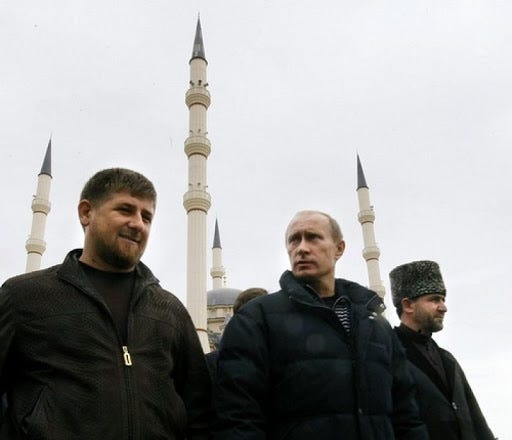
Within Russia’s borders, the gap between the performance and the practice is now a matter of public record. Moscow is home to an estimated four million Muslims. The city has four official mosques, a number the Mayor of Moscow has publicly defended as sufficient. In Chechnya, by contrast, the Kremlin has funded the construction of over a thousand mosques under Ramzan Kadyrov, the strongman who serves Moscow’s interest in the region. The distinction between these two facts illuminates the architecture precisely. Chechnya’s mosques are not expressions of religious freedom. They are instruments of political control, physical demonstrations of a managed Islamic piety that legitimizes Kadyrov’s authority and redirects the religious energy of a conquered people into a form the Kremlin can monitor and use. The difference between four mosques for four million Muslims in Moscow and a thousand mosques for 1.5 million people in Chechnya is not a difference in religious provision. It is a difference in political function.
Across the five Central Asian republics that remain within Moscow’s economic and security orbit, the same architecture continues, now in collaboration with their own governments. Islam is instrumentalized outward and suppressed inward: Uzbekistan deploys its Islamic heritage sites in Samarkand and Bukhara to attract Gulf investment while simultaneously arresting independent imams and framing unsanctioned religious practice as Wahhabi extremism. The term “Wahhabi” functions in Russian-aligned Central Asian legal codes as a designation for any Sunni religious activity that operates outside state-licensed structures, meaning any practicing Muslim who attends a mosque not registered with the government, studies theology outside approved institutions, or communicates with Islamic scholars in the wider Muslim world can be prosecuted as a terrorist. The Soviet practice of treating independent Islamic scholarship as a security threat has been rebranded as counterterrorism, with full Western endorsement after 2001.
Russia’s domestic policy toward its Muslim minorities since 2014 has maintained this framework with an additional layer: the mobilization of managed Islamic authority in support of Russian foreign policy objectives, including the war in Ukraine. The Grand Mufti of Russia and other state-affiliated religious leaders have issued statements supporting the invasion of Ukraine. Kadyrov’s forces, presented to the Muslim world as an expression of Chechen Islamic participation in Russian state life, have fought in Ukraine on behalf of the government that destroyed Grozny twice. The management is working, at the political level. What it is managing is the residual legitimacy of a religious tradition that Russian state policy spent seventy Soviet years attempting to eliminate.
The Propaganda Layer
What makes the Russian management of Islam in the twenty-first century different from its previous iterations is the propaganda infrastructure that has been built to prevent the Muslim world from examining it.
The argument Moscow presents to Muslim audiences is built on a genuine observation: the United States has bombed Muslim-majority countries for decades, backed Israel through the documented massacre of Palestinian civilians, and ran its global counterterrorism architecture in ways that treated Muslim populations across the world as suspect communities requiring permanent surveillance. The grievances are real. Washington’s record in the Muslim world is a legitimate indictment that does not require fabrication.
What the argument requires is that this indictment function as a complete account, leaving no room for a parallel inquiry into Russian conduct. The Kokand massacre of 1918 is not on this ledger. The deportation of the Chechens in 1944 is not on it. The closure of 25,000 mosques between 1917 and 1941 is not on it. The cluster bombs over Aleppo’s Sunni civilian markets in October 2016, when Russia flew over 19,000 combat missions and killed more than 7,700 Syrian civilians, approximately a quarter of them children, while over 80 percent of Russian strikes targeted opposition militias rather than ISIS, are not on it. The two Chechen wars that killed more than 160,000 people, by conservative estimates, are presented as a settled domestic security matter rather than the latest installment in a three-century campaign against Muslim self-governance on Russia’s frontiers.
The operation does not require its audience to believe Russia is virtuous. It requires only that Russian conduct be held to a categorically different standard than American conduct, that anti-imperialism be defined in a way that excludes Russian military operations from the definition, and that the Muslim world’s political energy be directed outward toward Washington and Tel Aviv rather than inward toward Moscow and the regimes Moscow supports.
The 2025 Kazan Summit, at which Moscow convened Islamic world leaders to discuss economic cooperation and positioned Russia as a natural partner for the Muslim Global South, was the cleaner version of this operation: not the suppression of Islamic authority in Chechnya but its display, not the bombardment of Grozny but the financing of its reconstruction, not the four mosques for four million Muslims in Moscow but the thousand mosques of a managed theocracy presented as evidence of Islamic partnership.
The Muslim world is not short of genuine adversaries. The clarity required is not more grievances but a more consistent standard of scrutiny applied to all of them, including the one that has been managing, deporting, bombing, and institutionally hollowing out Muslim civilization for five centuries while presenting itself, in each successive era, as the authority most suited to administer it.
What the Partnership Adds
The Russia-Iran strategic relationship, formalized through the twenty-year Comprehensive Strategic Partnership Treaty signed in January 2025 and covering military, intelligence, energy, and financial cooperation across forty-seven provisions, is where this history intersects with the present war on Iran and the active reconfiguration of the Middle East. That relationship, and the specific mechanisms through which Iran has functioned as an instrument of Russian regional strategy, the Shia proxy network, the sectarian fragmentation of Sunni political capacity in Iraq, Syria, Lebanon, and Yemen, is the subject of a separate examination. What the historical record established here makes clear is the context within which that partnership operates: not as an alliance between two anti-imperial powers offering the Muslim world a genuine alternative, but as the latest configuration of the oldest administrative problem in Russian statecraft, extended into the Arab Muslim world through a partner whose own relationship to authentic Islamic governance is more complicated than the multipolar narrative allows.
The Imam Shamil who held the mountains of Dagestan for twenty-five years, the Chechen fighters who defeated the Russian army in 1996, the clerics who maintained clandestine networks through sixty years of Soviet suppression and continued to transmit Islamic knowledge in secret in the Fergana Valley, the Baloch scholars who objected in 1979 to what was being built in Tehran’s constitutional assembly: they all understood something about the nature of these administrations that the propagandists of multipolarity need their audience not to understand.
What Moscow has never resolved, across every regime that has attempted it, is that Islamic civilization on its frontiers is not a security problem with a military or institutional solution. It is a civilization. It has its own legal traditions, intellectual heritage, political theology, and claim to self-governance that predates the Russian state and has survived every instrument that state has deployed against it. The archive of that survival is longer and more detailed than the archive of any state that has tried to administer it into submission. It runs from the libraries of Bukhara to the clandestine networks of Soviet Uzbekistan to the mosque in Zahedan where a cleric stood in 2022 and named what had been done to his congregation in the language of plain fact, without apology and without asking anyone’s permission to speak.


