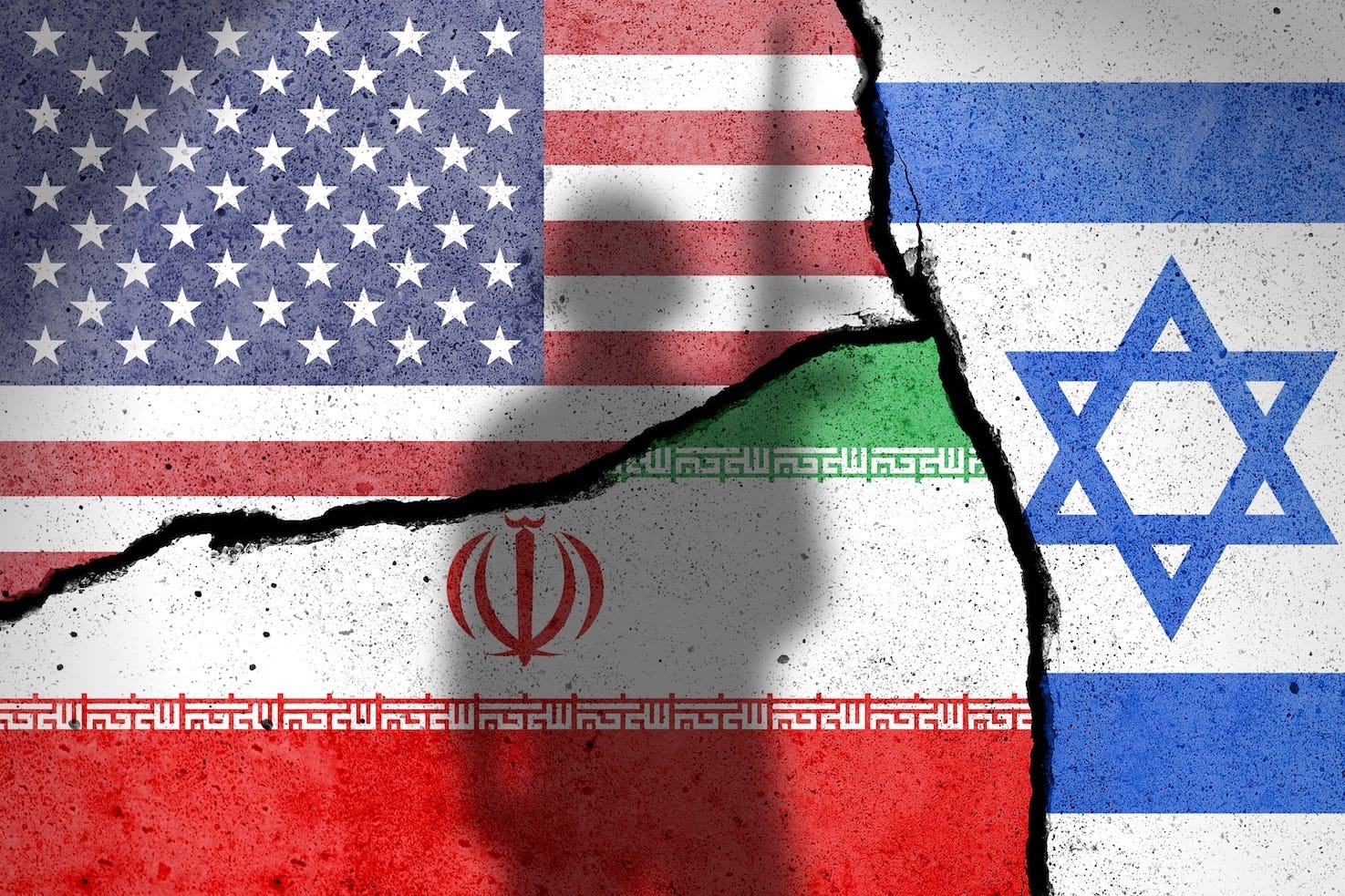
The war planners in Washington and Tel Aviv have run this scenario ten thousand times. The targeting packages exist. The flight paths have been calculated. The sequence of strikes against hardened underground facilities at Fordow, the enrichment complex at Natanz, the naval installations at Bandar Abbas, and the command nodes scattered across Tehran has been war-gamed against every known Iranian countermeasure. The hardware is ready. The political authorization is the only missing element, and the reason it remains missing has nothing to do with diplomatic restraint or international law. It has everything to do with one calculation that keeps coming back the same way every time it is run.
If Iran fights back, the United States and Israel lose.
Not in the conventional sense of military defeat. America’s air power and Israel’s strike capability can destroy infrastructure that took decades to build. They can set programs back. They can kill scientists, blow up centrifuges, crater runways, and sink naval vessels in the Gulf. What they cannot do is absorb what comes next. Because what comes next, if Iran chooses to deploy its full retaliatory architecture, is not a limited exchange that gets managed through diplomatic backchannels. It is a regional war with no ceiling.
Begin with what Iran actually has, because Western coverage consistently treats Iranian military capability as a political claim rather than a documented reality.
Iran’s hypersonic ballistic missile program is not ambition. It is operational. The Fattah missile, announced publicly in June 2023 and developed through the Islamic Revolutionary Guard Corps aerospace division, travels at speeds that existing American and Israeli air defense systems were not designed to intercept at scale. A single volley is manageable. A coordinated salvo across multiple vectors, launched simultaneously with drone swarms from Iranian territory and proxy forces across four countries, overwhelms the intercept architecture that Israel and American regional bases depend on.
In April 2024, Iran demonstrated a fraction of this capability. Over 300 drones and ballistic missiles were launched in a single night toward Israeli territory. The vast majority were intercepted through a coordinated American, Israeli, British, Jordanian, and Saudi effort. Western capitals declared it a failure for Tehran. What they did not say clearly is that the intercept required the combined air defense infrastructure of five nations, burned through interceptor stockpiles that cost orders of magnitude more than the weapons they destroyed, and represented, by Iranian military doctrine, a calibrated demonstration rather than a full engagement. Tehran was showing the map, not burning it.
Behind that demonstration sits the full architecture. Hezbollah in Lebanon controls a missile inventory estimated at over 150,000 projectiles, accumulated over two decades of IRGC logistics running through Syrian territory. Houthi forces in Yemen have demonstrated the ability to strike Saudi oil infrastructure and disrupt commercial shipping lanes through the Red Sea. Shia militia networks in Iraq sit within range of every significant American military installation in the region. Iranian naval doctrine in the Strait of Hormuz is built specifically around the ability to close the passage that carries roughly 20 percent of global oil supply through a narrow chokepoint. These are not theoretical deterrents. They are operational capabilities with documented employment histories.
Any American president who orders a strike on Iran without certainty about the retaliation calculus is ordering a strike that could simultaneously light up American bases from Baghdad to Bahrain, trigger an oil shock that collapses fragile Western economies still recovering from post-pandemic inflation, and hand Tehran the political narrative of Muslim resistance it has spent forty years constructing.
No president takes that risk without one specific precondition being met.
The precondition is not a diplomatic breakthrough. It is not a nuclear deal that Tehran honors and Washington respects. It is not sanctions relief producing a moderate Iranian leadership that dismantles its own deterrence in exchange for economic integration.
The precondition is Iranian capitulation before the first bomb falls.
This is not a fringe scenario. It is, historically, the only scenario in which American military campaigns against heavily armed adversaries have succeeded at acceptable cost. The template is not difficult to locate.
When the United States invaded Iraq in March 2003, the Iraqi military on paper represented a significant force, battle-hardened from the Iran-Iraq war, possessing armor, air defense, and a command structure that had survived twelve years of sanctions and two no-fly zones. Baghdad fell in three weeks. The Republican Guard divisions that were supposed to defend the capital largely did not fight. Senior commanders had been reached. Deals had been made. The institutional capacity to resist had been penetrated so thoroughly that resistance became an individual act rather than a coordinated military response. The invasion did not defeat the Iraqi army. The Iraqi army had already been purchased.
Iran has studied that history with the obsessive attention of a state that knows it is next on the list. The IRGC’s organizational structure is specifically designed to prevent the kind of top-level decapitation and elite compromise that hollowed out Iraqi resistance. Command is distributed. Operational authority is decentralized below the level where foreign penetration can neutralize the whole by removing the head. Financial networks sustaining the resistance axis run through channels that Western sanctions have consistently failed to fully close, partly by design and partly because the architecture is deliberately opaque.
And yet.
The question Western analysts rarely ask in print, because the answer implicates too many actors who present themselves as Iranian patriots or pragmatic reformers, is this: what does it look like when a state surrenders its sovereignty from the inside?
It does not look like a coup announced on state television. It does not look like a general crossing into Turkey with a thumb drive. It looks like a pattern of decisions that, taken individually, can be explained as pragmatism, fatigue, or miscalculation, but that, traced across time and institution, point toward a coordinated posture of non-resistance at the moment of maximum pressure.
It looks like sanctions that should have produced economic crisis producing instead a leadership class that has quietly positioned its assets, its families, and its financial interests in jurisdictions that an American administration would find convenient to protect in a post-conflict settlement. It looks like nuclear negotiations that drag through years of technical agreement and political collapse, each cycle consuming another tranche of Iranian leverage while delivering diminishing returns to the population that bears the cost. It looks like a Revolutionary Guard that arrests domestic reformers with enthusiasm but whose operational responses to direct Israeli strikes on Iranian officers in Syria across 2023 and 2024 were, by any historical standard, remarkably restrained.
None of this constitutes proof of deliberate internal betrayal. What it constitutes is a pattern that any intelligence service serious about its work would be examining carefully.
The Israeli assassination campaign against Iranian nuclear scientists, which has run for over a decade with a success rate that implies extraordinary intelligence penetration, does not happen in a vacuum. Operational security at that level, sustained across multiple years and multiple targets inside Iranian territory, requires local knowledge that is not collected remotely. Someone inside is talking. The question is whether those conversations extend beyond targeting individual scientists to conversations about what happens on the day American and Israeli aircraft appear over Iranian airspace.
The scenario Washington fears most is not an Iranian nuclear weapon. That threat is manageable through deterrence architectures that have functioned reliably since 1945. The scenario that produces genuine paralysis in American strategic planning is an Iranian leadership that, under attack, decides the cost of full retaliation is worth paying and closes the Strait of Hormuz while activating every proxy simultaneously.
Oil at 200 dollars a barrel is not a foreign policy problem. It is a domestic political catastrophe for whichever American president ordered the strike. European allies who tolerated the sanctions regime because it cost them less than compliance costs suddenly face energy crises that their populations blame directly on Washington. Gulf states that quietly facilitated Israeli overflight and American logistics find themselves holding an impossible position between Iranian missile range and their populations’ political sympathies. The entire architecture of American regional dominance, constructed over fifty years through bases, bilateral agreements, and petrodollar recycling, faces simultaneous stress tests it was not designed to pass all at once.
This is not Iranian propaganda. This is the assessment that circulates in the think tanks that advise American administrations, written in language careful enough to preserve the authors’ access to future administrations but clear enough that anyone who reads it understands the conclusion. The strike is viable. The aftermath is not, unless Iran does not fight.
A serious piece on this subject requires confronting the strongest version of the opposing analysis, not to validate it, but because the evidence base for both positions exists in documented form and the gap between them is where the actual story lives.
The counterargument runs as follows. Iran’s retaliatory restraint after Israeli strikes in Syria does not indicate compromise. It indicates strategic calculation by a leadership that understands the difference between a provocation designed to trigger a disproportionate response and a genuine existential attack. Tehran has consistently absorbed Israeli strikes on its officers and proxies without triggering full escalation because doing so would hand Washington the political justification it needs to bring NATO architecture into a conflict where Iran would face a coalition rather than a bilateral fight. Restraint, by this reading, is not betrayal. It is operational discipline.
The Fattah missile program and the April 2024 strike, by the same counterargument, were not demonstrations of a limited willingness to engage. They were signals to Washington that the next round would not be calibrated. The message was not “we will not retaliate.” The message was “you have seen what we held back. You have not seen what we have not used.”
On the Iraq comparison, the counterargument is stronger still. The IRGC is not the Iraqi Republican Guard. It is not a conscript army whose senior officers were reached through Jordanian and Saudi intermediaries in the months before the invasion. It is a parallel state with its own intelligence services, its own financial networks, its own ideological formation system, and its own institutional memory of exactly how Saddam’s commanders were neutralized. The organizational lessons of 2003 are baked into IRGC doctrine at the structural level.
Both positions are documented. Both have evidentiary support. The question of which analysis is correct cannot be resolved from open sources alone, which is precisely why the gap between them matters. If the first analysis is right, Iran has already been partially compromised and a strike becomes viable under specific conditions. If the counterargument is right, any strike triggers a full regional war that no American administration has the domestic political capacity to sustain past the first oil price shock.
Washington’s actual behavior, the years of sanctions pressure combined with consistent failure to pull the trigger despite repeated Israeli lobbying, suggests that American planners are not certain which analysis is correct. And in strategic terms, uncertainty about enemy retaliation capability is functionally equivalent to deterrence.
What made the American imperial project in the greater Middle East sustainable was never military superiority alone. It was the consistent ability to find, develop, and ultimately rely upon local actors whose class interests, foreign financial exposure, or simple survival calculations aligned with American objectives at the decisive moment. Sometimes those actors were bought. Sometimes they were blackmailed. Sometimes they simply calculated, correctly, that resistance was personally fatal and compliance was personally profitable.
The question of whether that process has advanced far enough inside the Iranian system to make a strike militarily viable is the only strategic question in this theater that actually matters. Everything else, the nuclear timeline, the sanctions architecture, the diplomatic choreography, is peripheral to this central variable.
If Iran retaliates fully when struck, the United States and Israel are in a war they have not prepared their publics or their economies to sustain. If Iran does not retaliate fully, the question is not whether America won. The question is what Iran’s leadership sold, and to whom, and at what price, and whether the Iranian people who have borne forty years of sanctions and isolation in the name of sovereign resistance will ever be told the true cost of the deal their rulers made on their behalf.
The bombs, if they come, will be the visible event. The real story will have happened years earlier, in the rooms where sovereign decisions were quietly transferred to people who were not elected to make them.
That is how empire works when it is working correctly. Not through the force that everyone can see, but through the arrangements that nobody announces.


