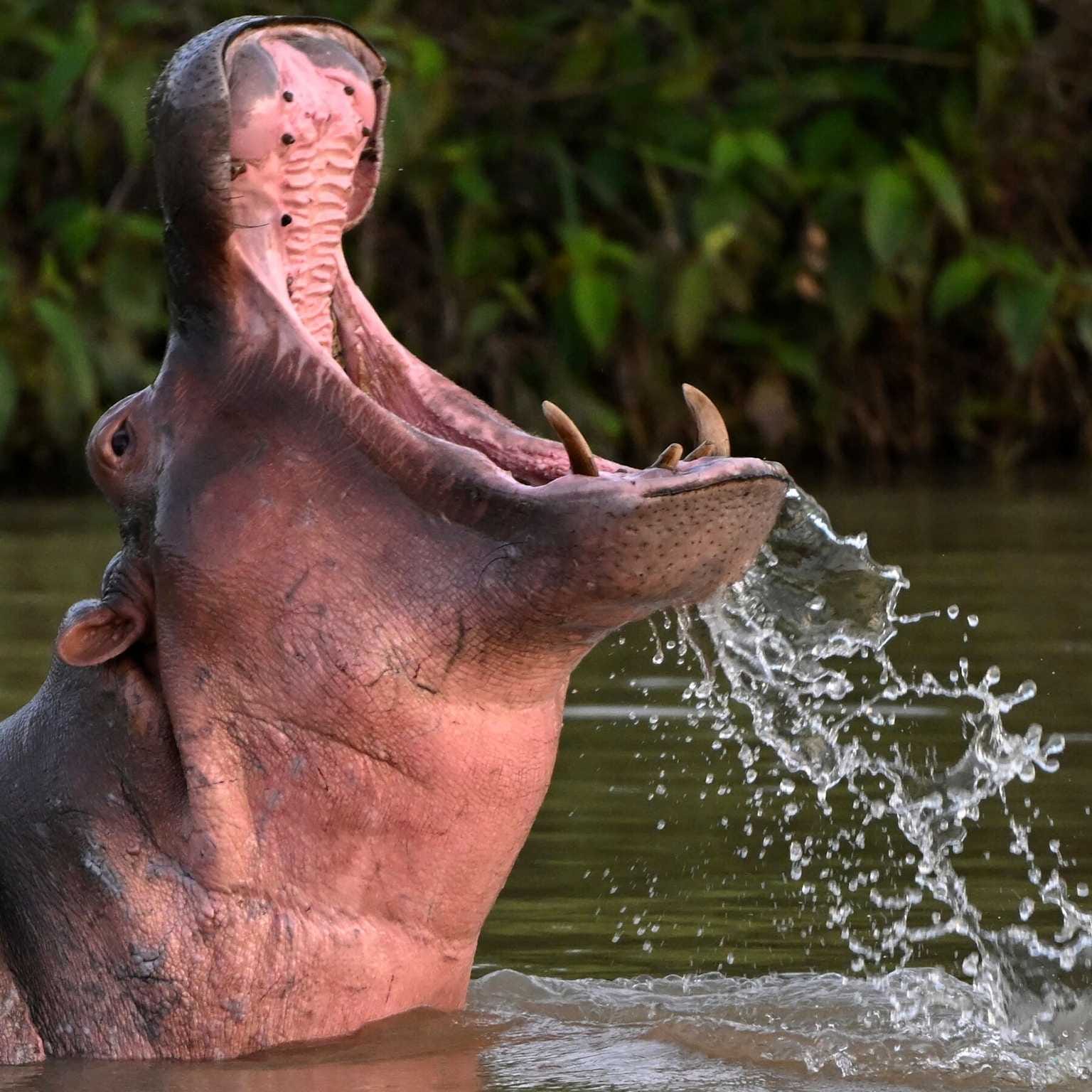
The Pablo Escobar Hippos
The Cartel He Left Behind Has Four Legs and Weighs Two Tons
Pablo Escobar is dead. His hippos are not. Colombia, facing a ballooning invasive species, a fractured Magdalena River ecosystem, and a public that has named the animals and made them into movie stars, is running out of patience and options.
Thirty years after a police bullet ended the Medellín Cartel’s reign, Colombia is fighting a new kind of overflow from Escobar’s empire: animals that wallow in the Magdalena River, eat 110 pounds of vegetation a night, and are turning one of South America’s great waterways into something it has never been before.
In April 2026, the Colombian government approved a plan to cull up to 80 of the roughly 200 hippopotamuses now roaming freely through the country’s central lowlands. The internet erupted: petitions circulated, documentaries were referenced, and one woman on X posted a photo of a hippo she had named “Gustavo” and acquired 40,000 likes in four hours. Colombia’s Environment Ministry, meanwhile, was staring at a population projection that could top 1,000 animals by 2035 and a river ecosystem that no longer looks like the one that existed before any of this started.
At the height of his cocaine empire in the early 1980s, Escobar imported one male and three female hippos to his sprawling Hacienda Nápoles estate, an act of extravagance so operatically outsized it fits the man perfectly. The hippos arrived alongside giraffes, kangaroos, and rhinoceroses, all sourced illegally for a private zoo that stretched across several thousand acres of Antioquian grassland.
When Colombian forces shot him dead on a Medellín rooftop on December 2, 1993, authorities dispersed most of the zoo animals. The hippos stayed. They were too big, too expensive, and too dangerous to move, and government officials apparently calculated, wrongly, that the tropical lowlands would not suit them indefinitely. Four animals became 35 by 2012. By 2022, Colombia officially labeled Hippopotamus amphibius an “invasive alien species,” a designation that unlocks a different regulatory toolkit. By 2026, the count had passed 200, with some individuals documented more than 60 miles from the original estate.
“There are two ways to reduce the hippopotamus population: translocation and euthanasia.”
— Irene Vélez Torres, Colombia’s Acting Environment Minister, April 2026
The Magdalena River runs 950 miles through the Colombian Andes before emptying into the Caribbean. It is one of the most biodiverse river systems in South America, hosting more than 200 fish species, river manatees (Trichechus manatus), American crocodiles, pink river dolphins, and giant otters. It evolved over millions of years without megafauna of the hippopotamus scale. Every organism in that system — fish, invertebrates, riparian vegetation — calibrated itself to a specific water chemistry, a particular oxygen regime, a predictable nutrient budget. The hippos are rewriting all of it.
The mechanism is deceptively simple and relentlessly destructive. Hippos are what ecologists call ecosystem engineers: they do not passively occupy a habitat, they physically transform it. Each adult spends its nights feeding on land and its days submerged in the river. The result is a one-way nutrient conveyor. Organic carbon and nitrogen stripped from land-based plants ends up in the water column as fecal matter. Each adult hippo deposits approximately 13 pounds of waste directly into the Magdalena every single day. Two hundred animals means 2,600 pounds of organic waste entering the river daily: a pulse of nutrients the ecosystem has no evolutionary history of processing.
Metric Figure Hippos now in the Magdalena basin ~200 Waste per hippo per day entering waterways 13 lbs Vegetation consumed nightly, per animal 110 lbs Projected population by 2035 without intervention ~1,000
Downstream, the consequences stack. The sudden spike in nitrogen and phosphorus drives algal blooms: dense mats of cyanobacteria and green algae that blanket the water’s surface and block out sunlight. When the blooms decompose, bacteria consume dissolved oxygen at a rate the river cannot replenish. The result is hypoxia — oxygen concentrations so low that fish, invertebrates, and aquatic mammals begin to suffocate. In the Magdalena Medio, where hippo density is highest, researchers have documented measurable drops in water oxygen levels during dry season, precisely when the river is at its most vulnerable and the hippos are most concentrated around shrinking water bodies.
Dr. Amanda Subalusky at the University of Florida has spent years tracking how the herd’s expansion compounds the damage. Her research, published in Scientific Reports, demonstrated that management costs climb non-linearly as the population grows, not because each additional hippo is more expensive to deal with, but because the ecological disruption they cause enters a regime of self-reinforcing feedback. Altered water chemistry changes what species can survive in a stretch of river, which makes the ecosystem less resilient to the next disturbance and narrows what remains possible. Some management approaches, her modeling showed, simply stopped being viable after a decade of delay.
What makes the Magdalena case particularly sobering is that hippos in their native African range are also ecosystem engineers, but there the system co-evolved with them. The Nile, the Zambezi, the Mara River all developed biological communities adapted to hippo-scale nutrient loading. The Magdalena did not. The river’s fish, its manatees, its reptiles are encountering for the first time a disturbance that African waterways built tolerances to over millions of years. The hippos are not invasive because they are aggressive or because they eat the wrong things. They are invasive because the Magdalena’s ecological architecture has no place for them.
The government did not leap to culling. The Colombian state spent years pursuing sterilization campaigns in 2022 and 2023, and held sustained talks with India, Mexico, the Philippines, South Africa, Ecuador, and Peru about relocation. Every option collapsed under its own logistics. Mexico hit an import barrier for invasive species. A Philippine zoo backed out when costs materialized. Shipping a single hippo runs an estimated $3.5 million, not because hippos are rare but because moving a 3,000-pound animal that can sustain speeds of 19 mph on land requires sedation, crating, air-freight, quarantine, and veterinary oversight at every step.
Sterilization looked gentler until the biology ran the numbers. Treating males reduces mating pressure but does not remove females already producing calves every 18 months. Female survival, not birth rate, is the primary driver of population growth in long-lived, slow-reproducing species like hippos. The animals descend from just four individuals, making them genetically homogeneous, which limits their value to any zoo or conservation breeding program and closes off many would-be host countries on scientific grounds alone. Anticonception drugs would require recapturing and re-dosing each female repeatedly, across decades, with no margin for error: one missed female continues the curve.
The government has now budgeted 7.2 billion pesos (roughly $2 million) for a culling program set to begin in the second half of 2026. Each operation requires documentation within 10 days: sex, estimated age, GPS coordinates, method, photographs. Regional authorities in Puerto Triunfo and along the Magdalena Medio will coordinate the first phase, targeting the highest-density hotspots where hippo-human conflict has been most acute.
Senator Andrea Padilla called the plan “cruel” and accused the government of taking the “easy way out.” A judge in Antioquia accepted an urgent legal claim arguing that animals capable of feeling pain deserve constitutional protections and that irreversible actions should come only after all nonlethal options are exhausted. The court has not blocked the cull, but the case remains open, leaving authorities and animal rights organizations in a standoff that mirrors, with uncanny precision, the debates playing out over wolf reintroductions in Europe and feral horse management in the American West.
What makes Colombia’s version harder is that the animals have names. One, Vanessa, is the mascot of the water park now operating on Escobar’s old estate. Another, Pepe, was shot by hunters in 2009 and became such a sympathetic public figure that a documentary followed his story and a 2024 film was built around him. Local children along the Magdalena grew up with hippos in the river the way rural Americans grew up with deer at the treeline, a feature of the landscape rather than an intrusion. The fishermen who have been charged at by two-ton animals tend to see it differently.
Escobar spent his career building problems too large and too interconnected to dismantle cleanly. The cocaine trade he industrialized did not end with his death; it adapted, diversified, and found new routes. His hippos are following the same logic, occupying territory, altering conditions, making themselves difficult to remove without cost. The difference is that the hippos did not choose any of it. They were imported by a man who wanted a private Africa and left behind when the state came for him. The Magdalena River is now paying the interest on a debt it never incurred.
Whatever the Antioquia court ultimately decides, delay will make every remaining option more expensive, less humane, and harder to defend scientifically. Dr. Subalusky’s modeling was not ambiguous on that point. Colombia is not choosing between a good answer and a bad one. It is choosing, under growing pressure, between the least damaging options still available. Escobar has been dead for thirty years.


