The Patron State
How Abu Dhabi Kept Assad Alive, Protected His Exit, and Then Tried to Bury His Replacement
On December 27, 2018, the United Arab Emirates reopened its embassy in Damascus. The Arab League boycott of Assad’s government was still in force. The Caesar Act, which would later threaten sanctions on anyone materially supporting Damascus, was two years from passage. The Syrian regime had, by that point, killed upward of 350,000 of its own citizens and disappeared more than 100,000 into detention facilities whose conditions prosecutors at The Hague compared to the documented record of Nazi Germany. None of that was in dispute. The UAE reopened its embassy anyway, and its Charge d’Affaires in Damascus, Abdul Hakim Ibrahim al-Nuaimi, held a reception at which he praised “the wise leadership of President Bashar al-Assad,” described relations between the two countries as “strong, solid, and distinct,” and called the Assad administration “a smart administration.” Syrian Deputy Foreign Minister Faisal Mekdad, expressing gratitude, stated publicly that Syria could not forget that the UAE “stood by Syria in its war against terrorism.”
The Ideology: Anti-Islamism as Organizing Principle
That principle is the suppression of political Islam in its broadest definition: not jihadism, which any state would oppose, but electoral, organized, representative Islam, the Muslim Brotherhood as a governing category, any government or formation that draws legitimacy from an Islamic framework rather than from the dynastic or secular nationalist structures Abu Dhabi considers stable. The UAE imprisoned citizens at home on these grounds, funded the 2013 counter-revolution in Egypt to install Abdel Fattah el-Sisi after the Brotherhood won a free election, and backed Khalifa Haftar in Libya against a UN-recognized government it labeled Islamist. Syria was the most explicit application of this policy. Bashar al-Assad, by 2015, was a secular authoritarian state defending itself against insurgent formations some of which were Islamist. From Abu Dhabi’s vantage point, Assad was, for all his documented atrocities, on the right side of a binary Abu Dhabi had constructed and committed to.
UAE Foreign Minister Anwar Gargash articulated the position openly in April 2018: the Syrian civil war, he said, was a conflict between Assad and “radical Islamic” groups. More than 500,000 dead, twelve million displaced, chemical weapons deployed against civilian neighborhoods, a crematorium at Saydnaya prison processing the bodies of the tortured so that mass graves would not be found. The UAE reduced this to a counterterrorism operation it chose to support.
The Doha Institute for Graduate Studies, in a 2021 analysis of UAE motives, concluded that Abu Dhabi’s engagement was “almost entirely linked to an ‘ideological’ position hostile in principle towards any democratic change,” structured around “the stability of authoritarian regimes in the Arab republics in exchange for a rapidly developing alliance with Israel.” Geography, economics, sectarianism: these were secondary justifications for a decision made at the level of doctrine.
The Training: What the Embassy Actually Did
By June 2020, Orient XXI, the French-language Arab affairs publication, had assembled from multiple sources a detailed account of what Abu Dhabi had operationalized since the embassy reopened. UAE instructors were training approximately forty Syrian military intelligence officers: thirty-one non-commissioned officers and eight civilian information and communication systems engineers, in logistics, technical, and scientific fields. Five Syrian pilots were attending the UAE Air Force’s Khalifa bin Zayed Air College in Al Ain, all costs covered by Abu Dhabi. The supervisory mission at the college was headed by Lieutenant Colonel Jihad Barakat, Assad’s own cousin and a former commander of Syrian paramilitary units. The United States had previously attempted to kill Barakat in targeted operations.
The intelligence services Abu Dhabi was upgrading were the same services the UN had documented as responsible for the systematic torture and murder of more than 100,000 detainees. Training them, at UAE facilities, while simultaneously financing the reconstruction of public buildings, thermal power stations, and hydraulic infrastructure in regime-controlled Damascus, constituted material support for an enterprise the Caesar Act had been designed to end. US Special Representative for Syria Engagement James Jeffrey warned the UAE publicly in June 2020 that it faced potential Caesar Act consequences. Washington, which receives roughly sixty percent of its arms trade from the UAE market, never applied them.
Two weeks after Mohammed bin Zayed made his first publicly confirmed phone call to Assad in March 2020, his first since ties were severed in 2012, reports from regional intelligence sources indicated MBZ had committed $3 million to the regime for renewed operations in Idlib, where a Turkish-brokered ceasefire had just been signed and which Abu Dhabi, according to those sources, moved immediately to undermine.
The UAE company Yona Star, registered in a Dubai Free Zone with offices in Damascus, was documented by the US Treasury as providing transportation services to Assad’s Air Force, the Scientific Studies and Research Center, the Syrian Air Force Intelligence, and the Army Supply Bureau. A Dubai-registered company servicing Syrian intelligence aviation. The arrangement was not hidden from view; it required investigators to look.
The Lists: Citizens Delivered
According to documents published by Zaman Al Wasl, the Arabic investigative outlet, the UAE’s share of Interpol warrants originating from Assad’s regime stood at 187, the smallest of any Gulf state relative to its population. Kuwait, with one-third the UAE’s population, had 680 such warrants against its citizens. Bahrain, with one-tenth the population, had 122. The disproportion does not indicate less coordination. It indicates more direct coordination: Emirati citizens were being identified, arrested, and prosecuted in cooperation with Syrian intelligence services at a scale that bypassed formal Interpol channels entirely.
In the summer of 2013, UAE authorities sentenced sixty-nine citizens to prison in a single proceeding: fifteen years for eight defendants, ten years for fifty-six detainees with three additional years of post-release monitoring, seven years for five others. The charge in every case was membership in a “secret organization.” The Zaman Al Wasl documents show all sixty-nine were listed by name on Assad’s own intelligence files. The Syrian intelligence apparatus had, in effect, compiled the prosecution list. The UAE courts converted it into sentences.
One case in the same documents involved the family of an Emirati colonel who had gone to Syria to fight alongside the opposition. After the colonel’s death, UAE authorities arrested his daughters. A senior Emirati official described the arrests as crossing “the red lines of society that refuses to involve women in such cases.” The eldest son was detained shortly afterward, joining his brother and sisters already in custody. The UAE security apparatus, according to the documentation, formally confirmed that arresting relatives of those who assisted the Syrian opposition was “a legitimate behavior for the UAE security services.”
The coordination between Abu Dhabi and Damascus in 2013 was judicial on one side, archival on the other. The outcome was the same.
The Visits: Normalization as Performance
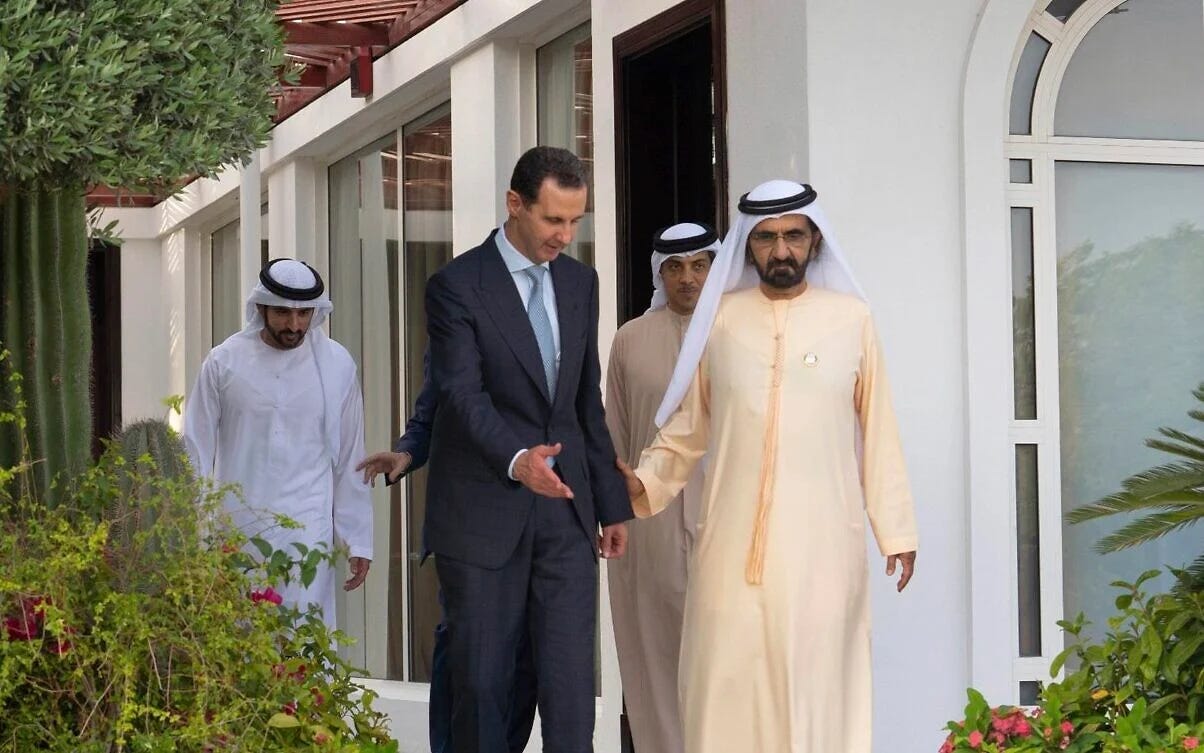
November 2021: UAE Foreign Minister Abdullah bin Zayed flew to Damascus, the first such visit in ten years, met Assad, and invited him to the Syrian pavilion at Expo 2020 Dubai. March 2022: Assad landed in the UAE, his first official visit to an Arab country since the war began, on the eleventh anniversary of the Syrian uprising. Mohammed bin Zayed received him. Emirati media described the encounter as “brotherly.” One senior European diplomat told the Middle East Institute that the images made his “skin crawl.” A regional official called it “heartless.” March 2023: Assad returned to Abu Dhabi after the earthquake in southern Turkey and northwestern Syria, and Mohammed bin Zayed told him that “Syria has been absent from its brothers for too long, and the time has come for it to return.”
Later that year, Syria was readmitted to the Arab League. The Doha Institute, Carnegie Endowment researchers, and the Arab Center Washington DC all identified the UAE as the primary architect of that readmission, with Egypt and Saudi Arabia following the Emirati lead. Qatar, which had refused to normalize with Assad at any point, did not participate. The UAE had managed, across five years of sustained diplomatic pressure, to end the regional isolation of a head of state whose government had been formally compared to the Third Reich by international prosecutors.
Ali Mamlouk, Assad’s intelligence chief, visited Abu Dhabi periodically throughout this period. According to a European official cited by the Middle East Institute, he came, among other purposes, to offer UAE mediation between Abu Dhabi and the Houthis in Yemen. The head of Syrian intelligence, operating from Abu Dhabi, available as an intermediary in a separate conflict: the relationship was close enough to make that kind of service possible.
The Last Flights: December 2024
On December 6, 2024, as Hayat Tahrir al-Sham fighters advanced toward Homs and rebel formations from Idlib moved on the capital, a thirteen-seat Embraer Legacy 600 jet approached Damascus International Airport. More than a dozen men in the camouflage uniforms of Syrian Air Force Intelligence sealed off the VIP terminal. Dark-windowed vehicles belonging to the Republican Guard, the elite units assigned to protect Assad personally, moved toward the aircraft. The jet’s registration was C5-SKY. It had been registered in Gambia to a company called Flying Airline, owned seventy percent by Iraqi national Safa Ahmed Saleh and thirty percent by Lebanese national Oussama Wehbe. The Dubai Free Zone company operating it, Flying Airline FZCO, was owned by Mohamad Wehbe, who had posted photographs of the aircraft on LinkedIn eight months earlier with the caption “welcome.”
The plane had been arranged by Yasar Ibrahim, Assad’s top economic adviser and the man who had spent years building the corporate architecture the regime used to control Syria’s banking, telecoms, real estate, and energy sectors. That network had a codename: The Group. Over the next forty-eight hours, Ibrahim arranged four flights between Syria and Abu Dhabi’s Al Bateen Executive Airport, a facility reserved for senior officials and known for protocols that keep its passenger manifests private.
Sources at Damascus International Airport, interviewed by Reuters in April 2025, described cars rushing to the aircraft each time it landed, staying briefly, and departing just before takeoff. Brigadier General Ghadeer Ali, head of airport security, instructed his staff to let Air Force Intelligence handle the plane without interference. The first two flights, on December 6, carried Assad’s family members including teenagers, presidential palace personnel, cash, paintings, and small sculptures. The third flight, on December 7, carried unmarked black bags holding at least $500,000 in cash alongside laptops and hard drives containing the full financial cartography of The Group: offshore account records, ownership documents, real estate holdings, and records of money transfers across multiple continents.
The cash had been withdrawn from an account at Syria International Islamic Bank held by Al-Burj Investment Company, fifty percent of which Ibrahim owned. The withdrawals were made two days before the flights began.
The fourth and final flight departed Al Bateen shortly after midnight on December 8. It passed over Homs and then disappeared from commercial flight tracking systems for approximately six hours, reappearing over Homs heading back to Abu Dhabi. A satellite image captured by Planet Labs at 9:11 that morning shows the C5-SKY on the tarmac at Russia’s Hmeimim Air Base in Latakia province. Ahmed Khalil, a figure in Assad’s financial network under Western sanctions, was aboard, having traveled to the Russian base in an armored vehicle belonging to the UAE embassy in Damascus. Before an earlier flight had departed the Damascus VIP terminal, according to the former Air Force Intelligence officer who was present, UAE embassy vehicles had pulled up to the area.
The UAE foreign ministry did not respond to Reuters’ questions about any of the flights.
The Intercept: Stopping Damascus After Assad
As HTS fighters closed on the capital in the last days before December 8, the Emirati and Jordanian ambassadors in Syria made what security sources described to Middle East Eye as “desperate attempts” to stop HTS from assuming control of Damascus. The plan, as reconstructed by security sources and reported by Middle East Eye, was to position Free Syrian Army groups from southern Syria, backed by Jordan and the United States, to reach the capital before HTS did. The Emirati and Jordanian ambassadors arranged for FSA fighters to pick up Syrian Prime Minister Mohammed Jalali from his home and transport him to the Four Seasons Hotel, where state institutions would formally pass to the southern factions rather than to the forces arriving from Idlib. Ahmad al-Sharaa reached Jalali by phone and told him not to do it. Jalali complied.
When the military option collapsed, Abu Dhabi moved diplomatically. On December 15, 2024, the Wall Street Journal reported that the UAE had communicated to Washington that it was uncomfortable with the new Syrian government due to its Islamic identity and that it “completely refuses for America to tolerate their ascension to power and government formation.” The language it used, governance and stability and security, covered a position the UAE had held consistently since 2011: that governments with Islamic legitimacy must not be allowed to consolidate, regardless of what their populations chose.
The information operation ran alongside the diplomatic one. Amjad Taha, a British-Bahraini commentator who carries the title “Emirati Expert in Strategic and Political Affairs” and who has appeared regularly on GB News, CNN, and Sky News, began posting warnings of genocide against the Druze of Suwayda and Islamist atrocities in Latakia. The posts invoked ISIS and Al-Qaeda as active threats from the new Syrian government. Loay Alshareef, another figure in the same network, posted that Syria “should face the fate of Hamas” if it pursued an Islamic political identity. Marc Owen Jones, a disinformation researcher at Hamad Bin Khalifa University whose analysis of these networks runs to several thousand documented connections, describes Taha as a node in a cluster of accounts circulating narratives aligned with the UAE government, the Israeli government, and the European far right simultaneously. In 2025, GB News paid substantial damages and issued an on-air apology after broadcasting Taha’s false claim that the UK charity Islamic Relief had funded terrorist organizations. The New Yorker had reported two years earlier that the UAE had financed a coordinated smear campaign against Islamic Relief specifically.
Taha’s book, “The Deception of the Arab Spring,” was published by AuthorHouse. So were the books of at least eight other figures in the same network, all published within a two-month window in 2025, all carrying signs of AI generation, per Jones’s analysis.
The Release: What the Prisoners Confirm
After Ahmad al-Sharaa visited the UAE in 2025 and ties were formally established between Damascus and Abu Dhabi, the UAE released Mohanad al-Masri, a Syrian businessman from northern Syria who had operated between Syria, Turkey, and the UAE and had been held without trial for six years on charges of “supporting terrorism.” He returned to Damascus on the Syrian president’s private plane. Tariq Ahmad Alaa al-Din, a Syrian activist imprisoned for ten years for collecting donations for Ahrar al-Sham, was also released.
Both men had been arrested under the same framework that produced the sixty-nine detainees in 2013: Syrian opposition figures identified by Damascus and held by Abu Dhabi on terrorism charges whose evidentiary basis was never tested in court. Al-Masri had no trial in six years. Al-Din had spent a decade in prison for fundraising. The UAE held them, maintained them, and released them when the new Syrian government made diplomatic engagement their condition for release. The “terrorism” designation was a retention instrument, not a legal finding. The men were intelligence assets in an active relationship with Damascus, warehoused until their political utility expired.
The Ahmed Al-Awda group, the former Eighth Brigade that the UAE had attempted to deploy during the offensive to seize Damascus before HTS could consolidate, dissolved formally and handed its military equipment to Syria’s Ministry of Defense shortly after al-Sharaa’s visit. Its personnel were absorbed into the national army. The proxy Abu Dhabi had positioned as a counterweight to the new government was folded into the institution it had been assembled against.
The Accounting
The UAE’s engagement with Assad ran across two simultaneous tracks for more than six years: a public track of humanitarian solidarity and economic cooperation, and an operational track of intelligence capacity-building, judicial coordination, financial facilitation, asset-transfer complicity, and diplomatic sabotage. These were not sequential phases but overlapping operations. In the same months that Abu Dhabi was hosting Assad as a “brother” at the Dubai Expo, its security services held Syrians imprisoned on Assad’s intelligence lists. On the same night that UAE embassy vehicles approached the Damascus VIP terminal to facilitate the cash flights, Abu Dhabi’s foreign ministry was preparing to lobby Washington against recognizing the government that replaced him.
Abu Dhabi concluded, with accuracy, that its relationship with Washington was durable enough to absorb the friction of materially supporting Assad. The Caesar Act threatened sanctions that never came. The Arab League boycott prohibited a normalization that Abu Dhabi pursued anyway. The US business delegation warned that attending Damascus trade fairs risked Caesar Act consequences; forty UAE businessmen attended the August 2019 fair and nothing followed. Each unenforced warning confirmed the calculation. The UN designation of Assad’s detention facilities as crimes against humanity registered as background noise.
Ahmad Khalil, riding in a UAE embassy armored vehicle across the tarmac of a Russian military base on the last operating night of the Assad regime, carrying cash drawn from a Damascus bank two days earlier, is the most precise image of what the partnership produced: a state that described itself as a beacon of modernity and stability, exfiltrating the last resources of a government whose war crimes it had spent six years underwriting.


