The Positions They Built Before the Storm
How China and the UAE Turned Pakistan’s Ports into a Hedge
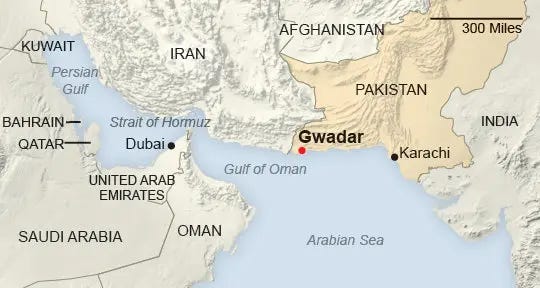
When the Strait of Hormuz closed to commercial shipping in early March 2026, the first question most analysts asked was who had lost. The answer was obvious: Gulf states, global supply chains, crude importers, container lines with assets stranded in contested waters. Port revenue losses across Gulf states reached an estimated $14.4 billion in March alone. Jebel Ali, the ninth-busiest container port on earth and the architectural spine of Dubai’s trade economy, temporarily suspended operations after Iranian strikes; when it reopened, the ships had already left. The question that received less attention was more instructive: who had prepared for exactly this?
The answer is Abu Dhabi and Beijing. Not as a matter of luck, and not as an incidental benefit of unrelated investments. Both had spent years constructing port positions in Pakistan that would, in the event of a Hormuz disruption, allow them to absorb diverted traffic at facilities they controlled, on terms they had negotiated, at a time when their counterpart had no leverage to revise them. The result is that the March 2026 shipping crisis is not purely a story of losses and rerouting. It is, for two of the actors involved, a story of contingency planning that worked.
Abu Dhabi’s Geometry
AD Ports Group did not stumble into Karachi. It arrived there with deliberation. In June 2023, AD Ports, in partnership with Kaheel Terminals, secured a 50-year concession to manage, operate, and develop Karachi Gateway Terminal Limited (KGTL), covering berths 6 through 10 at Karachi Port’s East Wharf. The concession was signed when Pakistan was, as it characteristically is, in need of foreign capital and in no position to extract competitive terms. The royalty Pakistan would receive: $36 per container, a flat fee, fixed regardless of market rates.
By September 2025, AD Ports had signed a dredging agreement with Van Oord, the Dutch marine contractor, to deepen the berths and navigational channels at KGTL to accommodate post-Panamax vessels exceeding 13,000 TEUs. The work was designed to complete in early 2026, expanding capacity from 750,000 TEUs annually to one million. That timeline was not clairvoyance about the Iran war. But the infrastructure was ready when the crisis arrived. In December 2025, AD Ports announced a separate agricultural terminal partnership at Karachi through its Noatum Ports arm. The group was not building a single facility. It was building a node in a network.
That network context is essential to understanding what AD Ports was doing in Pakistan and why it mattered in March 2026. The company’s strategic framework, which it calls “intelligent internationalisation,” is explicitly organized around the Middle Corridor: a land and sea trade route connecting China to Europe via Central Asia, the Caspian, and the Caucasus. In 2025, AD Ports launched a logistics joint venture in Kazakhstan, opened a hub in Tbilisi, partnered at Kuryk Port on the Caspian, and signed concessions in Egypt, Jordan, and Cameroon. Karachi sits at the Arabian Sea terminus of this corridor. It is the point at which the Middle Corridor connects to open ocean. AD Ports did not invest in KGTL to handle Pakistani domestic trade. It invested in KGTL because KGTL is, in the logic of its broader architecture, the western anchor of an alternative to Jebel Ali.
When the Hormuz crisis arrived, the group activated what it called its “full suite of logistics capabilities”. Feeder services operated by SAFEEN Feeders and Global Feeder Shipping were rerouted via Fujairah and Khor Fakkan. New container feeder routes were established connecting India, Pakistan, and Oman with destinations across the Red Sea and Upper Arabian Gulf. An air bridge using chartered aircraft moved essential goods. Eight hundred trucks and four new daily rail services on Etihad Rail linked Fujairah and Khor Fakkan to Khalifa Port and Jebel Ali through bonded customs corridors. Karachi was not an emergency fallback. It was a scheduled node in a system that had been engineered to route around exactly the kind of disruption that occurred.
AD Ports Group reported record revenue of AED 20.77 billion in 2025, up 20 percent year-on-year, and record net profit of AED 2.07 billion, up 16 percent. Revenue and profits had grown more than fivefold since 2020. Free cash flow turned positive for the first time since the company’s 2022 listing. These results were reported in February 2026, days before the Hormuz closure. They represent the baseline from which the group entered the crisis. The financial machinery was already running at peak performance when the window opened.
The Hedge That Was Never Called a Hedge
DP World’s position in Pakistan is older and, in some respects, more revealing. The Dubai-based port operator, a subsidiary of Dubai’s sovereign wealth infrastructure, has run the Queen’s International Container Terminal (QICT) at Port Qasim for years. Pakistan’s royalty is $15 per container. DP World collects the handling fees, storage revenue, and operational margin. Its parent reported revenues exceeding $19 billion in 2025.
Jebel Ali is DP World’s flagship asset. It is also the facility that suffered the most acute reputational and operational damage in the early weeks of the Iran war. DP World temporarily suspended Jebel Ali operations in late February and early March as a safety measure after Iranian strikes. When it reopened, the major shipping lines, including Hapag-Lloyd and MSC, had already suspended Gulf routes. Inbound vessel traffic dropped sharply. The port was functional, but its position in the global routing network had been severed by the decisions of carriers operating under force majeure conditions.
What DP World held, in addition to Jebel Ali, was QICT at Port Qasim, located entirely outside the Hormuz risk zone, in a country whose ports had become the primary destination for traffic fleeing the Gulf. The Federal Board of Revenue granted DP World a special 16.9-acre designated storage facility at Port Qasim in March 2026 via emergency regulatory order, SRO 518(I)/2026, explicitly to handle the trans-shipment surge. The company that had temporarily lost its primary Gulf facility was simultaneously expanding its Pakistani one. The ships that could no longer call at Jebel Ali were calling, in part, at a DP World facility in Karachi. The company’s revenue was not simply diverted by the crisis. It was, through QICT, partially recaptured by the same crisis at a different location.
This is the structural logic of geographic diversification in port investment. A company that operates facilities across seventy countries is not simply a port operator. It is a network. When one node is disrupted, the network redistributes. The disrupted node belongs to DP World. The receiving node belongs to DP World. Pakistan provides the land, the labor, the berths, and the sovereign territory. Pakistan receives $15 per container.
China’s Longer Calculation
China’s interest in Gwadar precedes the current crisis by a decade and is grounded in a logic different from the UAE’s commercial network strategy. COPHC’s 40-year BOT concession, with its 91/9 revenue split, was not designed primarily as a trans-shipment play. It was designed as an energy security hedge.
China’s vulnerability at the Strait of Hormuz is structural. More than 13 percent of its seaborne crude intake in 2025 came from Iran alone. The broader Gulf supplies a significant share of China’s energy imports, all of which must transit the Strait or the Red Sea. Gwadar’s value to Beijing has always been less about port revenue and more about what it represents in extremis: a terminus for an overland corridor that bypasses the Strait entirely. The CPEC route from Kashgar to Gwadar, approximately 2,395 kilometers, reduces the oil transport journey from the Gulf to China from 12,000 kilometers to less than a quarter of that distance. Chinese planners have estimated this could save China $2 billion annually in transport costs if fully operationalized.
The Iran war did not solve China’s Hormuz problem; it made it acute. With the Strait closed, Brent Crude surged past $120 per barrel. China, which had relied on discounted Iranian crude and now faced both its disruption and the cost pressure of sourcing alternatives, found its industrial profit boom of early 2026 running directly into a raw material cost spike. The geopolitical rationale for Gwadar as an overland corridor was, in the space of weeks, demonstrated in real time.
That demonstration happened at a moment when Gwadar was processing its first meaningful trans-shipment volumes, entering the regional network as an operational hub for the first time. COPHC collects 91 percent of what those volumes generate. The port whose strategic value China has been accumulating through a decade of investment and a 40-year operating concession is now, for the first time, actually moving the kind of traffic it was designed to attract. China does not need the trans-shipment royalties. It needs the proof of concept, the operational precedent, and the permanent routing relationships with shipping lines that, once established, persist beyond the crisis that created them.
What “Internationalisation” Looks Like from the Outside
There is a rhetorical framework shared by AD Ports, DP World, and COPHC when they describe their Pakistani investments. The language is uniformly developmental: partnership, connectivity, trade facilitation, mutual benefit. AD Ports speaks of “strengthening Karachi’s position as a logistics hub”. CPEC literature describes the corridor as a mechanism for Pakistani economic development. The Gwadar Free Zone is modeled, by its architects’ own description, on Jebel Ali.
The comparison to Jebel Ali is, unintentionally, precise. Jebel Ali was built to make Dubai the logistics hub of the Gulf. It succeeded. The wealth it generated stayed in Dubai, as it was designed to do. Gwadar’s Free Zone is not designed to make Makran the logistics hub of anything. It is designed to provide a free economic zone for Chinese and international companies, on a 23-year tax holiday granted by the Pakistani government, at a port where COPHC retains 91 percent of gross revenue. The model is not Jebel Ali as a Pakistani development project. It is Jebel Ali as a template for how to build a profitable port on someone else’s sovereign territory.
What both the UAE and China have demonstrated in March 2026 is that the investment structures they negotiated during Pakistan’s years of fiscal fragility were not incidentally favorable. They were designed to be resilient. AD Ports had completed its KGTL dredging in early 2026, precisely when capacity was needed. COPHC held a concession through 2057. DP World had its emergency storage facility approved by SRO within weeks of the crisis beginning. None of these outcomes required the Iran war to be foreseen. They required only that the concession terms be good enough to generate returns across a wide range of scenarios, including the one that arrived.
The Network Effect and Its Beneficiaries
The shipping intelligence from March 2026 makes one structural point with clarity: when a port loses its position in a carrier’s network, the rerouting decisions create inertia. Routing, once established, persists. The carriers that called at KGTL in March 2026 renegotiated their port call sequences. Those sequences do not simply revert when the Gulf stabilizes. Singapore took permanent market share from Hong Kong through exactly this mechanism. Colombo displaced Indian trans-shipment volumes for over a decade through the same process.
The beneficiaries of that inertia, when it materializes in Karachi and Gwadar, will be AD Ports at KGTL, DP World at QICT, and COPHC at Gwadar. They hold the operating concessions. They set the handling terms. They collect the majority of the revenue those routing relationships generate. Pakistan will retain the infrastructure debt, the security costs, the labor, and the territory. It will retain a royalty that was set when it was, as it so often is, too weak to negotiate otherwise.
The positions were built before the storm. The storm arrived on schedule. The positions held.


