The Price You Pay Twice
Why a Hormuz Disruption Doesn’t Just Raise Oil Prices It Multiplies Them
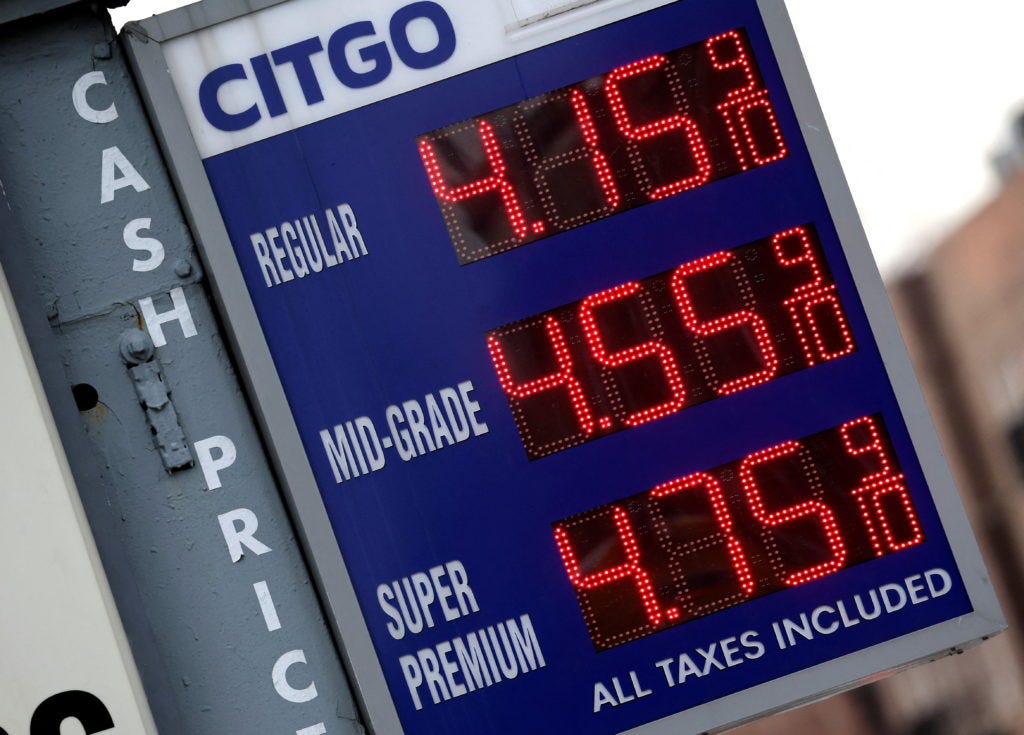
The average American was paying $4.13 per gallon at the pump this week, up $1.14 since the war on Iran began on February 28. That figure has been cited in news reports as evidence of the economic cost of the conflict. It is not the cost. It is the floor.
On Sunday, Donald Trump announced a US naval blockade of the Strait of Hormuz after twenty hours of ceasefire talks in Islamabad collapsed over Iran’s nuclear program. CENTCOM specified that the blockade, effective 10am Monday, April 13, would target all vessels entering and leaving Iranian ports, not all Hormuz transit. Brent crude surged more than 8 percent on the announcement, clearing $100 per barrel again for the first time since the ceasefire was declared. Iran’s Parliament Speaker Mohammad Baqer Ghalibaf, who led the Iranian negotiating team in Islamabad, posted a photo of Washington-area gas prices on his return and wrote: “Enjoy the current price of gasoline. With what is being called a ‘blockade,’ you will soon miss $4 to $5 gasoline.”
He was describing a mechanism, not making a political threat. And the mechanism is worth understanding precisely, because the policy conversation in Washington has been conducted almost entirely around first-order effects, the immediate price spike, while the second-order effects, the amplification of that spike by every market and logistics system it passes through, are already in motion.
What Is Actually at Stake in That Channel
The Strait of Hormuz is 21 miles wide at its narrowest point. In 2025, according to the IEA and EIA drawing on Kpler tanker tracking data, 20 million barrels of crude oil and petroleum products transited it every day, accounting for 25 percent of all global seaborne oil trade and roughly 20 percent of total global petroleum consumption. Qatar’s liquefied natural gas, nearly 20 percent of all global LNG trade, moves through the same passage with no alternative route. Iraq, Kuwait, Qatar, Bahrain, and Iran have zero pipeline bypass infrastructure to reroute exports if the Strait is closed. Saudi Arabia and the UAE operate bypass pipelines, but combined available capacity on those routes tops out at roughly 3.5 to 5.5 million barrels per day, covering at most a quarter of normal Hormuz flow. The remainder is structurally locked to a single 21-mile marine corridor.
That structural lock-in is not a temporary condition or a planning gap. It is the architecture of five decades of Gulf energy infrastructure, built on the assumption that the Strait would remain open. It has remained open through every previous crisis precisely because every party understood that closing it would destroy the leverage and the revenues of the party that closed it. That calculus broke down on February 28. What replaced it is a contest over who absorbs the cost of closure faster.
Six weeks into the conflict, Karen Young, a senior scholar at Columbia University’s Center on Global Energy Policy, told CNN on Sunday that the global market is currently short approximately 7 million barrels of crude and 4 million barrels of petroleum products per day. Saudi Arabia this week reported that attacks on its oil facilities have reduced production capacity by around 600,000 barrels per day, while throughput on its East-West bypass pipeline was cut by approximately 700,000 barrels per day before partial restoration was announced on April 12. Twelve vessels crossed the Strait on Saturday, the highest single-day count since the ceasefire and still less than a tenth of the 130 daily transits that were normal before the war.
The First Price and the Price of the Price
Brent crude closed at approximately $65 per barrel in the weeks before the war. By March 9, it had cleared $94, a 44 percent increase in under two weeks. It peaked at $119 in mid-March. The ceasefire announcement drove it below $92 as markets priced in a diplomatic resolution. Trump’s blockade announcement on Sunday sent it back above $103 within hours. By Monday morning, April 13, Brent was trading between $101 and $104, up 6 to 8 percent on the day.
Most of the commentary on these numbers focuses on the futures price, which is the figure that appears in news reports. A more revealing number is the physical spot price, known as Dated Brent, which represents what buyers are paying for oil that can be delivered immediately. According to Al Jazeera’s reporting this week, Dated Brent peaked at over $144 per barrel, roughly $35 above the futures benchmark. Under ordinary market conditions, the spot and futures prices are roughly equivalent, because oil available today carries no particular premium over oil contracted for future delivery. A $35 spread signals that the physical supply deficit is considerably more severe than the headline futures price conveys. Buyers in the real economy are paying $144 for barrels that exist and can move now, not $102.
This distinction is the first-order effect in its most honest form. What follows is the second-order layer, and it is already accumulating.
How the Price Gets Multiplied
Insurance. Before the current conflict, war-risk insurance premiums for tankers transiting the Persian Gulf ran at between 0.125 and 0.4 percent of ship value per passage. By March 9, those rates had risen four to six times in a single week, according to Lloyd’s List intelligence cited across multiple reports. The US government began providing insurer support under the Terrorism Risk Insurance Act within days of the conflict’s onset. When premiums become prohibitive, or when coverage is withdrawn entirely, tanker operators cannot legally sail, regardless of whether the physical channel is technically passable. Monday’s blockade announcement has reset every underwriter’s risk model for the region. The insurance constraint operates independently of the military situation, and it is its own form of closure: ships that could theoretically move through the Strait will not, because the financial and legal infrastructure that makes commercial voyages possible has seized up.
Bypass ceilings. Saudi Arabia’s East-West Petroline and the UAE’s Abu Dhabi Crude Oil Pipeline are the only mechanisms for routing significant volumes of Gulf crude without transiting Hormuz. Saudi Arabia has now restored full pumping through the Petroline to Yanbu following the attack-related disruptions. But the combined bypass ceiling of 3.5 to 5.5 million barrels per day covers, at maximum stretch, roughly a quarter of the 20 million barrels that normally transit Hormuz. The other 14 to 16 million barrels have nowhere else to go. This arithmetic does not improve with time or escalation. It is a physical constraint.
Rerouting costs. Any cargo leaving the Gulf via bypass routes or rerouting around the southern tip of Africa instead of through the Suez Canal faces dramatically longer transit times and fuel costs. The Cape of Good Hope route from the Gulf to European ports adds weeks to delivery timelines and thousands of miles of additional vessel fuel consumption per voyage. Those costs transfer directly into the cargo price at every destination. They are not a one-time adjustment. They apply to every shipment, every delivery, for as long as the routing constraint holds. The premium compounds across the entire supply chain.
Futures momentum. When traders buy forward contracts to lock in today’s price before it rises further, the buying pressure drives futures prices higher, which feeds back into spot prices, because current prices are partly indexed to futures expectations. The mechanism is self-reinforcing. Prices climb because traders expect them to climb, and traders expect them to climb because prices are already rising. This has been operating since February 28, interrupted briefly by ceasefire optimism, and reset by Sunday’s events. The traders who sold off positions during the ceasefire are now repricing on the failure of that ceasefire’s diplomatic follow-through.
Refinery specificity. Gulf crude is a particular grade. The refineries in Asia that receive 84 percent of normal Hormuz crude flows are calibrated for it. Sourcing replacement crude from West Africa, the North Sea, or the Americas requires time, separate logistics chains, and in some cases physical equipment modifications to the refining units themselves. During that adjustment period, finished fuel products, including gasoline, diesel, jet fuel, and heating oil, face their own shortage dynamics, entirely separate from the crude supply disruption. Young’s figure of 4 million barrels per day of petroleum products currently offline illustrates the consequence: the product shortage has its own price trajectory, and it runs on top of, not instead of, the crude trajectory.
Currency compression in the Global South. Oil is priced in US dollars. When prices spike, countries with weaker currencies must spend proportionally more of their own currency to import the same volume. Pakistan imports roughly 30 percent of its energy needs and is managing this cost shock against an already-pressured rupee. Bangladesh, with 170 million people and a garment export economy built on energy, has no reserve buffer to absorb a doubling of fuel costs. The Philippines draws 96 percent of its oil from the Persian Gulf. Vietnam draws 87 percent. These countries had no vote on the decision to launch Operation Epic Fury on February 28. They have no strategic petroleum reserves of consequence. They absorb the second-order effects in the form of shortages, inflation, and constrained public services, while the policy conversation about Hormuz takes place in Washington.
What 1973 Actually Tells You, and What It Cannot
The 1973 Arab oil embargo is the standard historical reference point for this kind of disruption, and it is instructive up to a point. Arab OPEC members removed 4.5 million barrels per day from global supply, approximately 7 percent of production at the time, targeting the United States and several European nations. Oil prices quadrupled from roughly $3 to nearly $12 per barrel within months. US inflation hit 12.3 percent in 1974, up from 3.4 percent two years earlier. The economic consequences took the better part of a decade to resolve. The International Energy Agency was founded in 1974 specifically as a structural response to what a 7 percent supply shock could do.
The current disruption has removed approximately 15 million barrels per day from effective global supply, according to IEA estimates, more than three times the 1973 shock. The 1973 embargo was a coordinated multinational political action targeting specific Western importers, lasted five months, and ended through a diplomatic negotiation that gave the exporting states their stated objective. The current closure is a single actor controlling a single transit point, affecting the entire global economy regardless of any particular nation’s position on the conflict, with no negotiated exit framework visible as of April 13.
The Asian Development Bank this week formally revised its Asia Pacific growth projections downward, forecasting regional growth of 5.1 percent in 2026, with inflation rising to 3.6 percent from 3 percent in 2025. These are the second-order effects registering in macroeconomic forecasts after six weeks. Young told CNN on Sunday: “I think for now and into the end of 2026 we are looking at elevated oil prices for certain.” She added that prices will not decline meaningfully until the Strait is reopened and damaged oil facilities are repaired, calling both “huge variables which are really, really unsolved.”
The 1973 precedent tells you what the mechanism produces when a 7 percent supply shock hits the global economy. It cannot tell you the ceiling for a shock that is three times larger, hits economies with far higher oil import dependency, and arrives without a diplomatic exit in sight.
The Blockade’s Own Compounding Logic
There is a dimension of Monday’s escalation that the coverage has not fully examined. The US naval blockade does not simply add pressure to Iran’s existing closure. It introduces its own independent layer of market disruption.
Trump’s initial announcement on Truth Social said the US would block “any and all ships” entering or leaving the Strait of Hormuz. CENTCOM’s subsequent clarification narrowed the stated scope to vessels transiting to and from Iranian ports specifically. The distinction matters significantly in principle. In practice, the enforcement questions remain unresolved: Iranian mines reportedly remain in the channel. The IRGC warned on Sunday that military vessels approaching the Strait would be considered a ceasefire violation. US warships entered on Saturday for a mine-clearing operation that Iran publicly called a breach of the ceasefire. The ceasefire formally expires on April 22. No diplomatic framework is in place to replace it.
Shipping operators making routing decisions today are not navigating the narrowly stated CENTCOM scope. They are navigating a strait where two overlapping military closure operations are in effect, where mine locations are uncertain, where IRGC retaliation threats are current, and where the insurance market has just reset for the third time in six weeks. The practical effect on commercial traffic will exceed the legal scope of either closure individually.
There is also a political economy dimension that Washington appears to have underweighted. Trump’s stated logic for the blockade is to deny Iran the Hormuz leverage it has been using as a bargaining chip, by imposing a countervailing US-controlled closure. The assumption behind this is that denying Iran toll revenue from the Strait will accelerate Iranian capitulation on the nuclear issue. What the assumption requires is that the United States and its allies absorb the economic cost of a dual-blockade scenario faster than Iran absorbs the cost of continued military pressure on a country whose conventional military infrastructure is already largely destroyed. Six weeks of price data at the pump and at the production level suggest this is not the sequence that is running.
The Equation Restated Without the Variables
The standard way to think about an oil supply shock is linear: supply falls, price rises, eventually supply is restored or alternatives are found and price stabilises. This framework is adequate for temporary, bounded disruptions. It is not adequate for the current situation.
What the data shows is a disruption whose compounding characteristics are already visible. The $35 gap between Dated Brent and futures Brent measures physical scarcity in real time. The 4-to-6-times increase in war-risk insurance premiums measures the institutional seizure that runs alongside the physical shortage. The ADB’s revised growth forecasts measure the macroeconomic effects already materialising in the second month. Young’s assessment that prices will remain elevated “into the end of 2026” reflects her judgment that the repair and reopening timeline is uncertain enough to preclude a near-term reversal.
Each of these is a second-order effect. Each one is adding price pressure on top of the original supply disruption. And each one is now operating in an environment where a new escalation, the US naval blockade beginning this morning, has reset the baseline from which the next round of second-order effects will compound.
Brent at $65 before the war. Peaked at $119 in mid-March. Fell to $92 on ceasefire optimism. Back at $102 this morning, with the blockade taking effect at 10am and the ceasefire expiring in nine days.
The $4.13 at the pump is the floor. What is being called a resolution is still the first chapter.


