The Quiet Collapse of Sovereignty
How Pakistan’s Foreign Policy and Domestic Crisis Are Converging
When external alignment begins to shape internal political outcomes, sovereignty stops being a principle and becomes a slogan.
The Moment Pakistan Was Not Supposed to Reach
In 1947, when Muhammad Ali Jinnah led the creation of Pakistan, the idea was not simply independence from colonial rule. It was independence from external control in all forms. Political. Economic. Strategic.
Pakistan was meant to make its own decisions.
Today, many critics argue that the country stands at the edge of a different reality. A reality where foreign alignment is no longer strategic cooperation but structural dependence. A reality where participation in global platforms branded as peace initiatives is seen not as diplomacy but as normalization of power politics. And most dangerously, a reality where domestic democratic outcomes appear increasingly entangled with external expectations.
This shift has not happened overnight. It has unfolded quietly through economic vulnerability, security partnerships, and institutional pressure.
Now it is visible.
The Language of Peace and the Politics of Power
Pakistan’s participation in international peace frameworks is naked betrayal of Pakistan’s ideological stance. These structures operate selectively, enforcing stability where convenient while failing to prevent mass civilian suffering elsewhere.
The humanitarian catastrophe in the Gaza Strip involving Israel and Palestine has sharpened this criticism.
For decades Pakistan positioned itself as a consistent advocate for Palestinian rights. That moral clarity carried diplomatic weight.
Now critics argue that participation in international platforms framed as peace initiatives while destruction continues risks signaling acceptance rather than resistance.
Peace without justice does not stabilize the world. It stabilizes power.
The ideological concern is becoming more direct. If global institutions fail to stop what many observers describe as ethnic cleansing and collective punishment, continued diplomatic participation risks appearing as moral endorsement.
The Kashmir Question That Cannot Be Ignored
Pakistan’s global case on Kashmir has always depended on moral consistency and international legal arguments, especially through forums such as the United Nations.
This is where the contradiction becomes strategically dangerous.
If Pakistan appears selective in defending human rights across conflicts, critics argue that its diplomatic credibility weakens.
Moral authority is not declared. It is demonstrated.
Once that authority erodes, the ability to persuade international audiences on Kashmir becomes significantly harder.
Diplomacy does not operate on arguments alone. It operates on consistency and Pakistan has NONE!
The Domestic Shock That Changed the Debate
The foreign policy argument intensified dramatically after the removal and subsequent imprisonment of former Prime Minister Imran Khan and the crackdown on members of Pakistan Tehreek-e-Insaf.
Supporters claim that Khan attempted to reposition Pakistan toward a more independent foreign policy direction. They argue that his removal and the legal actions that followed represent a broader political realignment.
They point to mass arrests, restrictions on political organization, and allegations of mistreatment in detention. Authorities deny wrongdoing and describe the actions as legal enforcement.
But perception has already reshaped the narrative.
For many observers inside Pakistan, foreign alignment and domestic political pressure no longer appear as separate developments.
They appear connected.
When external approval becomes economically necessary, internal political independence becomes structurally difficult.
This perception is driving one of the most intense ideological debates in Pakistan’s modern history.
Economic Dependency and Strategic Constraint
Pakistan’s recurring financial crises and repeated engagement with the International Monetary Fund, combined with long term security coordination with the United States, have reinforced arguments about structural dependency.
Critics argue that economic fragility reduces policy flexibility. Over time, strategic decisions begin to narrow. Domestic political direction becomes sensitive to external expectations.
This is where the sovereignty debate becomes existential.
Pakistan was not created to operate within strategic boundaries defined by larger powers. It was created to define those boundaries itself.
The Emerging Legitimacy Crisis
Two forms of legitimacy are now being debated simultaneously.
External legitimacy tied to moral consistency in global conflicts.
Internal legitimacy tied to democratic mandate and political freedom.
If Pakistan participates in international peace platforms that critics believe are normalizing mass civilian suffering while simultaneously facing accusations of suppressing its own elected political movement, the state risks weakening both.
Sovereignty abroad and democracy at home rise and fall together.
This is the convergence shaping Pakistan’s political future.
A Crossroads That Cannot Be Avoided
Pakistan is entering a defining phase. Not because of one leader. Not because of one alliance. Not because of one crisis.
But because multiple pressures are converging at the same moment.
Foreign policy credibility
Economic dependency
Domestic political legitimacy
Moral positioning on global conflicts
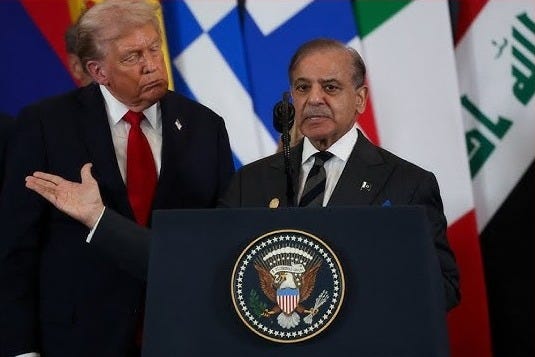
Countries do not lose sovereignty in a single event. They lose it gradually through decisions that appear temporary but become structural. With Pakistan’s participation in “Board of Peace”, Pakistan’s sovereignty is in question.
The debate now unfolding is not simply political. It is foundational.
What does sovereignty actually mean in the twenty first century?
And more importantly, who gets to decide it?


