The Resignation of Joe Kent
How a Trump loyalist's single letter exposed the intel fraud, the MAGA fracture, and the controlled demolition of Tulsi Gabbard
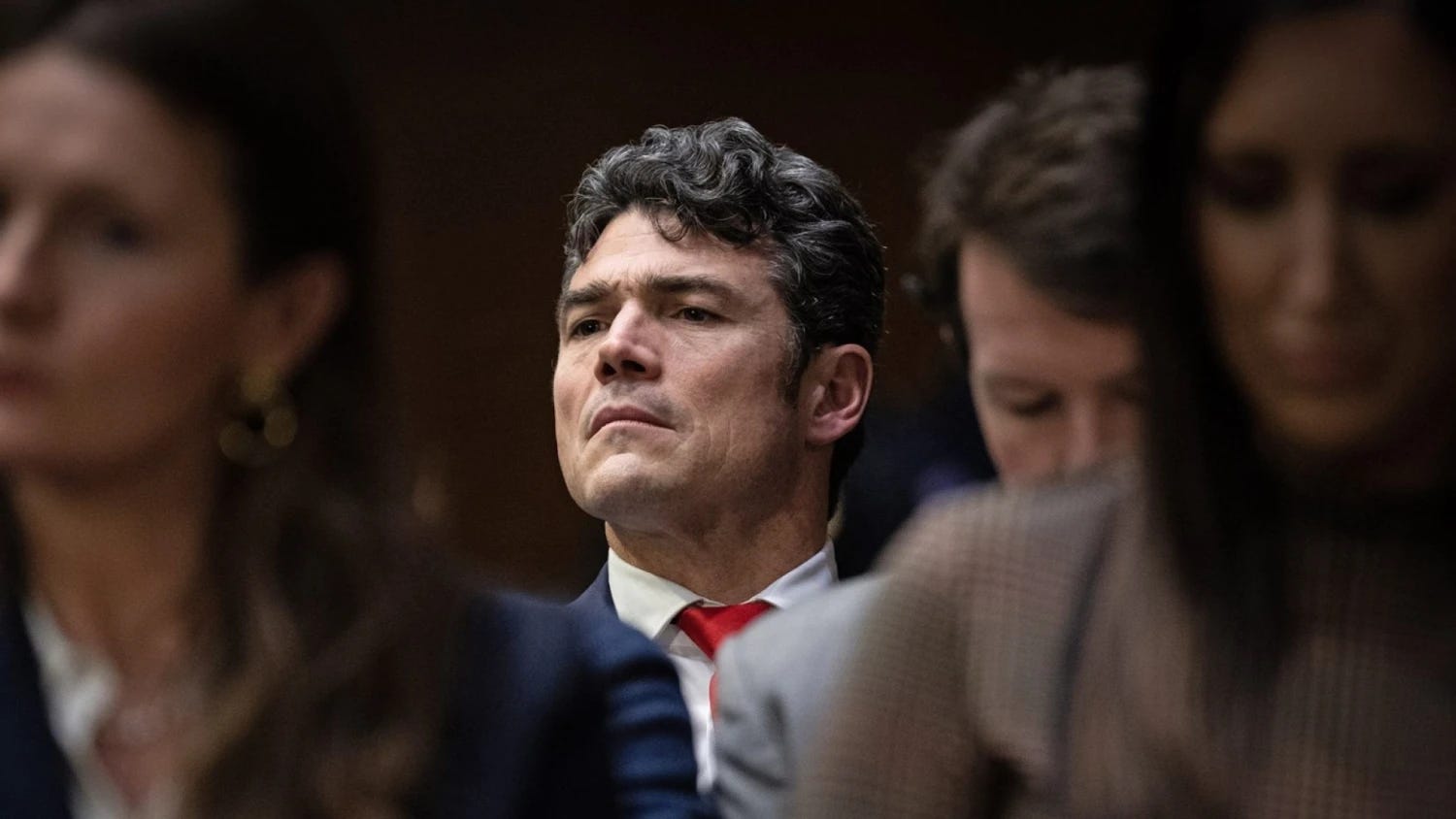
Joe Kent posted his resignation letter on X at 11:43 a.m. on Tuesday, March 17, addressed directly to Donald Trump, and walked out of the building where America’s counterterrorism architecture lives. He was not fired. He was not reassigned. He chose to be gone, and in choosing it, he handed a 56% anti-war American public the one thing it had been missing: a credentialed voice from inside the machine confirming what it already knew.
The letter ran a single page. It contained one sentence that made the rest irrelevant: “Iran posed no imminent threat to our nation, and it is clear that we started this war due to pressure from Israel and its powerful American lobby”.
That sentence came from the Director of the National Counterterrorism Center, a man with 11 combat deployments and a Gold Star around his neck, a man confirmed 52-44 by a Senate Trump largely controls, a man who voted for Trump when it was easy and when it cost him. Trump called him “very weak on security” within hours. The White House said his claims were “false” and “insulting”. Neither response engaged the substance of a single word he wrote.
The full text of Kent’s letter lays out a sequential argument that cannot be dismissed as partisan rage. He wrote that Trump, in his first term, “understood better than any modern President how to decisively apply military power without getting us drawn into never-ending wars”. He praised the killing of Qasem Soleimani, praised the defeat of ISIS, and then turned the same logic on the current war: this is not that. This is the trap, not the escape from it.
His central allegation was not that the war was wrong on principle. It was that an “echo chamber” was constructed by “high-ranking Israeli officials and influential members of the American media” to “deceive” Trump into believing Iran posed an imminent threat, using “the same tactic the Israelis used to draw us into the disastrous Iraq war”. He ended the letter with a direct plea: “You can reverse course and chart a new path for our nation, or you can allow us to slip further toward decline and chaos. You hold the cards”.
That is not the language of someone who hates Trump. It is the language of someone who believes Trump was played.
The distinction matters because it is exactly what 55% of American voters already told Quinnipiac pollsters before Kent said it publicly. The public reached the same conclusion as the director of the National Counterterrorism Center, independently, before he confirmed it in writing. That is not coincidence. That is the information environment doing what information environments do when a government’s case for war is weak.
Before Kent, before the letter, before the cables and the congressional hearings, the American public had already rendered its verdict. A Marist poll on March 5 put opposition to military action in Iran at 56%. Quinnipiac found 74% against sending ground troops, including 52% of Republicans. NPR’s polling found only 36% of registered voters approved of Trump’s handling of the war. 55% said they did not believe Iran posed an imminent threat before the strikes began.
These numbers existed before Kent resigned. They were not caused by Kent’s letter. They were confirmed by it. The American public’s post-Iraq skepticism about threat justifications has become structural. It does not require a leak or a whistleblower to activate. The default assumption, for a majority, is that the intelligence was shaped to fit the conclusion. Kent’s resignation did not create that sentiment. He walked through a door the public had already built and left standing open.
The anti-war sentiment has no political home. No party is holding it. No institutional champion with real power has claimed it. The 56%, the 74%, the 36%: those voters exist between affiliations, unable to find a vehicle, watching the one official who sounded like them get called antisemitic by Mitch McConnell and dismissed as “weak” by the President he served.
89% of self-identified MAGA supporters back the war. The White House leans on this number like a load-bearing wall. It is not a wall. It is a curtain.
The “America First” brand was built on one promise above all others: no more forever wars. Not as a foreign policy nuance, not as a diplomatic preference, as a foundational campaign commitment delivered in arenas to roaring crowds in 2016, 2020, and 2024. The base heard it. It was why they stayed when other Republicans left. It was the core product they bought.
Now Megyn Kelly, who campaigned for Trump, says publicly she has “serious doubts” about the war. Marjorie Taylor Greene, who resigned her House seat in the middle of this administration, backed her. Tucker Carlson has been audibly quiet. A senior Senate aide told Time the Kent resignation was “an imperfect canary in the coal mine” and that more defections were expected. Joe Kent met with Vice President Vance and Tulsi Gabbard the day before going public, presented his resignation, and was told to consult Chief of Staff Susie Wiles. He did. Then he resigned anyway.
The 89% approval within MAGA and the 56% national opposition are not contradictory numbers. They describe two parallel realities. The base supports the war because Trump supports it, and tribal loyalty is the primary variable. The broader electorate, including independents and a significant slice of Republicans on the ground troops question specifically, opposes it because the justification was never made credibly. Those two realities will not coexist indefinitely. Tribal loyalty has a half-life. It corrodes when body bags arrive.
In 2019, Tulsi Gabbard was selling t-shirts. On them: opposition to war with Iran, in print. She said from a debate stage that military conflict with Iran would make Iraq and Afghanistan “look like a picnic”. She built an entire political identity around the argument that the foreign policy establishment lies about threats, manufactures pretexts, and sends working-class Americans to die for interests that are not theirs.
That identity is what got her hired. And that identity is precisely what she abandoned the moment the bombs fell.
In March 2025, Gabbard sat before the Senate Select Committee on Intelligence and delivered formal, sworn testimony: “The IC continues to assess that Iran is not building a nuclear weapon and Supreme Leader Khamenei has not authorized the nuclear weapons program that he suspended in 2003”. This was not an offhand comment. It was the official, documented position of the United States intelligence community, stated under oath by the person legally responsible for conveying it.
Trump publicly said she was wrong. Weeks later, Gabbard reversed. Iran, she posted on X, could produce a nuclear weapon “within weeks to months”. She claimed she had been taken out of context. She had not been misquoted. She had been promoted, and promotion changes what people say.
Then for two weeks after the Iran strikes began, she disappeared. The Office of the Director of National Intelligence posted travel advisories. That was the output. The country’s top intelligence official, the person constitutionally positioned to tell the American public whether the intelligence justified the war, chose silence over the fight Kent was willing to have in public.
When she finally spoke after Kent’s resignation, she did not address the intelligence. She addressed the chain of command. “As our Commander in Chief, he is responsible for determining what is and is not an imminent threat,” she wrote. That is not an intelligence assessment. That is a loyalty pledge dressed in bureaucratic language. The DNI reduced her entire function to deference in one sentence.
A White House official told CNN that Gabbard had been instructed to fire Kent before he could resign. She did not fire him. She also did not join him. She waited. Then she backed the President. The sequencing reveals the calculation: she will not lead dissent, but she will comply with authority at every turn, and she will absorb whatever ideological reversal compliance requires.
The argument worth making, the one that the facts actually support, is this: Tulsi Gabbard was never the anti-war voice her audience believed her to be. She was a recruitment vehicle, deployed to manage the one coalition that posed a genuine obstacle to a new Middle East war: Trump’s own base.
The Democratic Party never blocked these wars. It has its own hawks, its own AIPAC relationships, its own institutional ties to the defense establishment. The real structural obstacle was the MAGA voter who joined the coalition specifically because Trump promised to end the forever war cycle. That voter needed management.
Kent’s resignation letter confirmed what Gabbard testified under oath in 2025 and then spent the rest of the year walking back. He cited the same intelligence she had placed into the congressional record. She did not back him. She did not say his intelligence assessment was wrong. She said the President decides.
The Situation Room photograph exists. The woman who condemned the Soleimani killing from the House floor in 2020 was watching the sequel in real time, from the best seat in the building. The t-shirts from 2019 are a museum piece now. The position they represented was not a conviction. It was a product.
Joe Kent is not a hero of the anti-war movement. He has connections to far-right figures the record clearly documents. His letter contained a sentence about Israel that drew immediate accusations of antisemitism from Mitch McConnell and Don Bacon and handed the White House a deflection. The administration used it. They always do.
But the deflection does not erase the argument. The Senate Intelligence Committee was set to hear testimony from Gabbard and the broader intelligence community the day after Kent went public. That timing was not accidental. His letter was an opening statement filed outside the room, delivered to a public that had already been waiting for someone to say it.
56% opposed. 74% against ground troops. 36% approval on war handling. 55% saying the threat was overstated before the bombs fell. Those numbers existed before Kent resigned and they will be there long after the cable news cycle moves on.
America did not want this war. The public registered that in polling before the first strike. The director of the National Counterterrorism Center registered it in a resignation letter on March 17. The Director of National Intelligence, who swore under oath that the intelligence did not support this war, registered it by choosing not to say so again.


