The Rise and Fall of Bitcoin: Blockchain's "Digital Gold" Faces a Crisis of Faith Amid a 67% Plunge
Speculation Trumps the Blockchain Technology
Introduction: From Digital Gold to Speculative Mirage
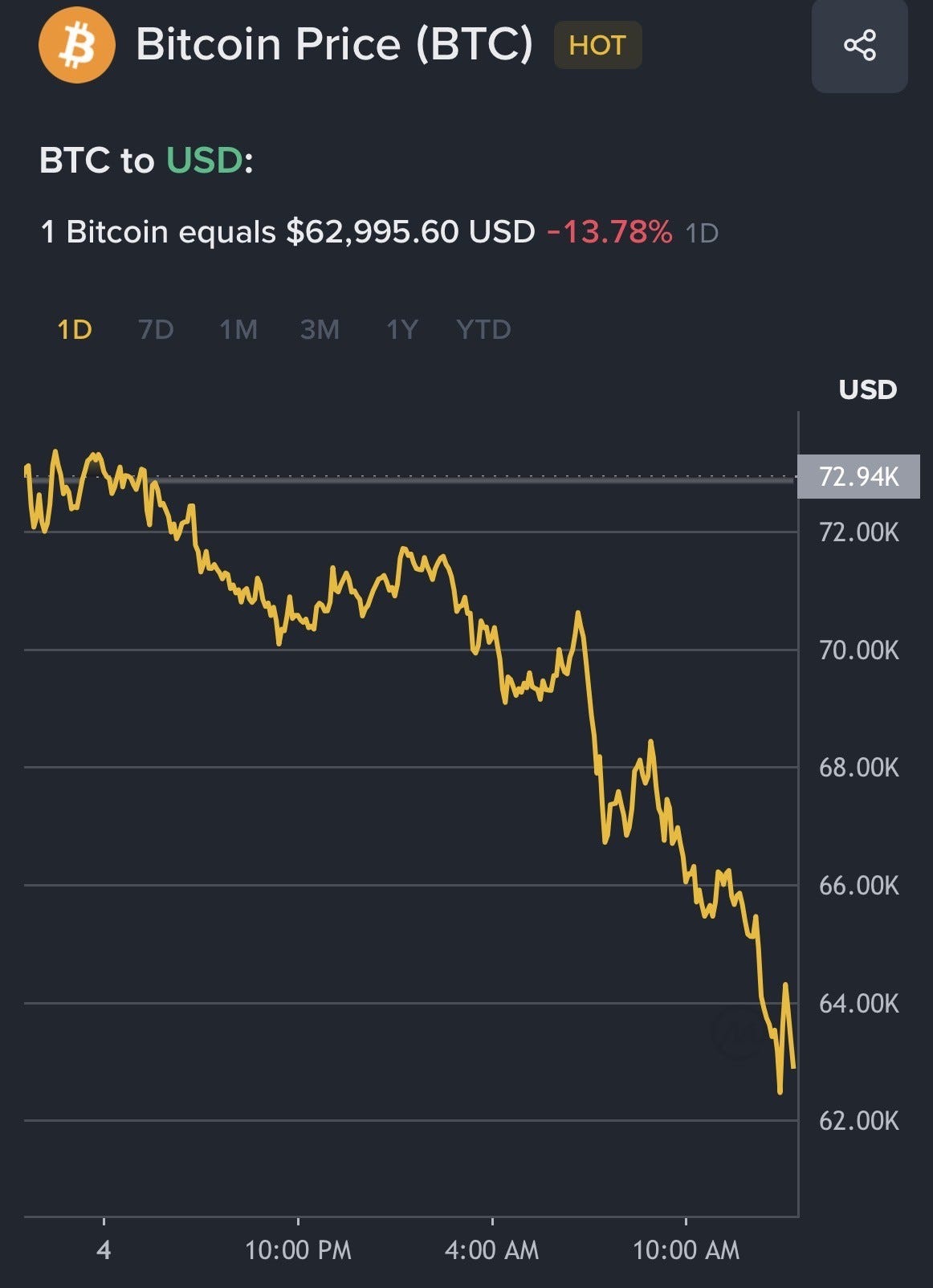
In the annals of financial innovation, few assets have captured the imagination like Bitcoin (BTC), often dubbed "digital gold" for its purported scarcity, decentralization, and potential as a store of value. Born from the 2008 financial crisis via Satoshi Nakamoto's blockchain technology, Bitcoin promised a hedge against inflation, government overreach, and traditional banking failures. For years, it surged in popularity, drawing comparisons to gold as a safe haven in turbulent times. Yet, as of February 2026, Bitcoin finds itself in a profound crisis of faith. Having peaked at around $126,000 in early October 2025, BTC has plummeted to approximately $63,000—a staggering drop of over 67% in just four months - This decline underscores a broader reckoning in the cryptocurrency space - Crypto, including stablecoins and meme coins, is increasingly viewed not as revolutionary money but as highly speculative assets with minimal regulatory oversight, buoyed temporarily by pro-crypto political figures. Meanwhile, leverage trading in crypto diverts capital from more stable investments like stocks and bonds, and Bitcoin's real-world utility remains questionable, often linked to illicit activities. In contrast, physical gold has reaffirmed its timeless appeal, surging 65% in 2025 while Bitcoin ended the year down 6%. This article explores Bitcoin's rise, its dramatic fall, and the underlying factors eroding trust in what was once hailed as blockchain's crown jewel.
The Rise: Crypto as the New Gold
Bitcoin's ascent began modestly but accelerated dramatically. Launched in 2009, it traded for pennies initially, but by 2017, it hit $20,000 amid a speculative frenzy. Proponents argued that its fixed supply of 21 million coins mirrored gold's scarcity, making it a superior "digital gold" in an era of fiat currency debasement. Blockchain technology, the decentralized ledger underpinning Bitcoin, promised transparency, security, and immunity to central bank manipulation. During the COVID-19 pandemic, institutional adoption surged: companies like Tesla and MicroStrategy added BTC to their balance sheets, and Wall Street launched Bitcoin ETFs. By 2021, BTC reached $69,000, and in 2025, it shattered records again, climbing to $126,000 in October amid optimism from a pro-crypto U.S. administration under President Trump, who had campaigned on supportive policies.
Crypto enthusiasts extended the gold analogy to the broader ecosystem. Stablecoins like USDT and USDC were seen as digital dollars, providing stability for trading, while meme coins like Dogecoin and Shiba Inu captured viral attention, drawing retail investors with promises of quick riches. The narrative was compelling: in a world of rising inflation and geopolitical uncertainty, crypto offered a borderless, inflation-resistant alternative to traditional assets. Gold, by comparison, seemed archaic—physical, cumbersome, and yielding no interest. Bitcoin's 10-year return of over 22,890% dwarfed gold's 335% over the same period.
Yet this rise masked inherent vulnerabilities. Crypto's value derives largely from speculation rather than intrinsic utility. Unlike gold, which has industrial uses in electronics and jewelry, Bitcoin's blockchain primarily facilitates peer-to-peer transactions—often inefficiently due to high fees and slow speeds. The "new gold" label began to crack as market dynamics shifted.
The Fall: A 67% Plunge and Eroding Confidence
The turning point came in late 2025. After peaking at $126,000, Bitcoin entered a steep decline, dropping below $70,000 by early February 2026 and hitting lows around $63,000—a 67% fall from its high. This rout wiped out nearly $1 trillion in crypto market cap since mid-January, with BTC down 23% year-to-date and 30% since January 14. Analysts attribute the slide to forced deleveraging, where over-leveraged positions were liquidated amid broader market turbulence, echoing the 2022 "crypto winter."
This fall represents a crisis of faith. Crypto was meant to decouple from traditional markets, but correlations with indices like the S&P 500 have increased during downturns. Pessimism grew as Bitcoin failed to act as a hedge; instead, it amplified losses. Stablecoins, touted for their peg to fiat, faced scrutiny over reserves and potential runs, while meme coins collapsed amid hype cycles. Minimal SEC controls exacerbated the volatility—unlike stocks, crypto trades 24/7 with lax oversight, allowing manipulation and fraud. The "crypto president" narrative, tied to Trump's election, provided a temporary boost but couldn't sustain the market amid economic realities like persistent inflation and policy shifts. As one analyst noted, the "Bitcoin Boomer Adoption" trade is dead, signaling waning institutional enthusiasm.
Speculative Assets and Regulatory Vacuum
At its core, Bitcoin and crypto are speculative bets. With minimal SEC regulation, exchanges operate with high leverage—up to 100x in some cases—amplifying gains and losses. This contrasts with gold, which trades on regulated futures markets. Crypto's backing by a "crypto president" like Trump offered rhetorical support but little structural stability; policies favoring deregulation fueled bubbles rather than sustainable growth.
Leverage trading in crypto has broader implications, siphoning credit from traditional markets. When investors borrow to bet on crypto, it diverts capital that could fund stocks or bonds. During downturns, margin calls force sales across assets, increasing interconnectedness. Retail traders, drawn to crypto's volatility, often exhibit momentum-chasing behavior, unlike contrarian strategies in stocks or gold. This creates feedback loops: rising prices attract more leverage, but falls trigger cascading liquidations, as seen in the recent $1.5 billion in wiped-out positions. Such dynamics strain liquidity in short-term funding markets and could spill over if crypto's ties to traditional finance deepen.
Bitcoin's Uses: Legitimate and Illicit
What is Bitcoin actually used for? Legitimately, it serves as a payment method in some economies with unstable currencies, like El Salvador, and as a store of value for long-term holders. However, its volatility limits everyday use. More concerningly, BTC is implicated in crimes. In 2025, illicit crypto flows hit a record $154-158 billion, up 145-162% from 2024, though as a share of total volume, it fell to 1.2%. Money laundering alone reached $82 billion, driven by Chinese-language networks and sanctions evasion. Violent "wrench attacks" surged 75%, with 72 incidents involving physical coercion to steal crypto. Scams stole $17 billion, often targeting the elderly via Bitcoin ATMs. While not all crypto is criminal—stablecoins facilitate 84% of illicit volume for efficiency—Bitcoin's pseudonymity aids dark web transactions, ransomware, and fraud. This association further erodes faith, contrasting with gold's untainted reputation.
Conclusion: Gold Is the New Gold
Bitcoin's >48% plunge signals the end of an era. Once the "new gold," crypto now exemplifies speculation run amok: minimally regulated, leverage-fueled, and tainted by crime. As capital flees to safer havens, gold has surged to over $4,900, outperforming BTC amid uncertainty. The crisis of faith is real crypto diverts resources from productive investments, while its utility remains niche. For enduring value, gold proves timeless. Blockchain may yet innovate, but Bitcoin's fall reminds us: not all that glitters digitally is gold.


