The central fact about the war in Ukraine in July 2026 is no longer difficult to see. It is only difficult for Western governments and the media ecosystems tied to them to admit. Russia has seized the initiative, it is escalating from a position of strength, and Ukraine is now fighting a war of attrition that increasingly favors Moscow at every serious level: manpower, missile output, escalation control, operational depth, and political stamina. The old language of stalemate has become a fiction maintained for public consumption. The battlefield has moved on.
One has to begin there because the Western presentation of this war now lags far behind the reality of the war itself. For a long time the public was told that Russian gains were marginal, that Ukrainian resilience would translate into strategic recovery, and that sustained Western support would eventually reverse the balance. Instead, what has happened is that Russia has adapted the war to its strengths while Ukraine has been driven into a defensive struggle defined by shortages, exhaustion, and dependence. Russia is now conducting repeated and increasingly punishing missile and drone attacks on Kyiv and other major urban centers, while maintaining pressure across the front and forcing Ukraine to consume scarce air-defense assets at a rate that it plainly cannot sustain indefinitely. That is not a side issue. It is the war.
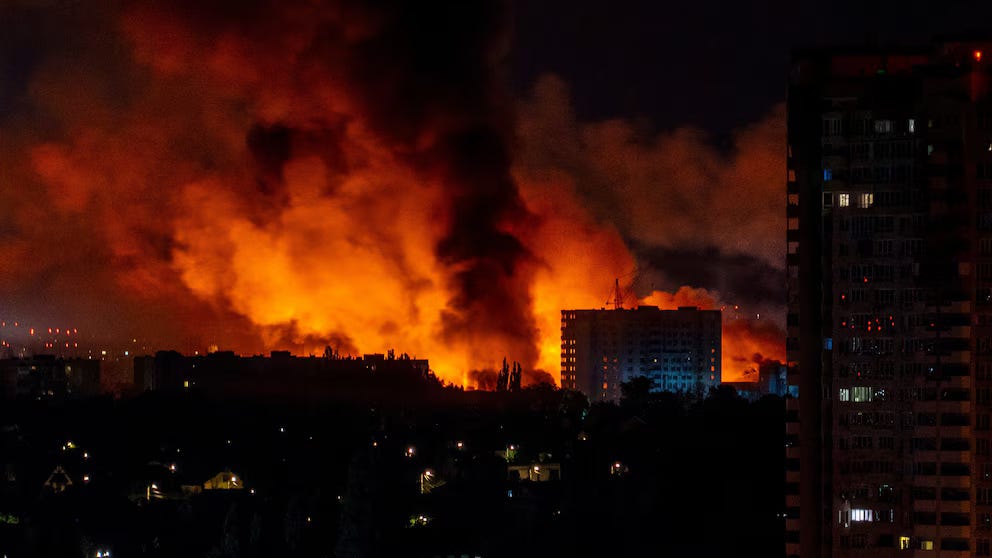
The attacks on Kyiv in early July made this crystal clear. Russia launched another heavy series of strikes, the civilian toll mounted again, and Ukrainian officials openly pointed to shortages in air-defense munitions. That admission matters more than all the rhetoric that surrounds it. Once a country is reduced to publicly signaling that its missile-defense shield is thinning while the enemy is increasing the pace of attack, one is no longer talking about a balanced strategic contest. One is talking about a deteriorating defensive position. The Russians understand this perfectly well, which is why they said pressure would increase and then proceeded to increase it.
This is the point that The Duran and a number of other non-Western or non-aligned commentators have been making for months, often to the irritation of the Western policy world. The claim that the war had settled into a stable stalemate was always misleading. The front may not be collapsing in one dramatic movement, but the cumulative pressure on Ukraine has been building steadily: more drones, more missiles, more pressure on infrastructure, more demands on shrinking air-defense inventories, more strain on a manpower system that is already overstretched, and more evidence that Russian strategy is now geared toward systematic degradation rather than theatrical breakthrough. Moscow no longer needs a spectacular advance to improve its position. It only needs to keep doing what it is doing.
That is exactly what it is doing. Russia is forcing Ukraine to defend the front, defend the cities, defend the power system, defend the logistics chain, and defend public morale all at the same time. This is the essential shape of the campaign now. The front line is only one part of the war. The rear is another. The political atmosphere in Kyiv and in Europe is another. Every large strike package is military action, psychological pressure, and political signaling at once. It tells Ukraine that nowhere is secure. It tells the West that sanctions have not neutralized Russian production or Russian strike capacity. It tells everyone watching that Moscow still has escalation room while Kyiv is still petitioning its sponsors for the means to survive the present level of violence.
This is why the usual Western fallback point, that Russia has not achieved a dramatic operational breakthrough, misses the larger reality. Attritional wars are not decided only by breakthrough. They are decided by whether one side can keep deepening the other side’s disadvantage. Russia is doing that. The daily map updates, the village-by-village arguments, the endless effort to reduce everything to whether one settlement has formally changed hands, all of that can obscure the more important movement underneath. Ukraine is being pulled into a worse strategic position week by week. Its capital is more exposed. Its air-defense burden is more severe. Its dependence on external supply decisions is more obvious. Its room for recovery is narrower. These are not disconnected developments. They are the same development.
The information war around this has become almost as important as the battlefield because the Western and Ukrainian side understands that morale, financial support, and political legitimacy all now depend on keeping the old story alive. That story says Russia is paying too much, gaining too little, and exhausting itself in a war it cannot truly win. There is truth in part of that. Russian losses are real. Russian gains are costly. Russian logistics are not immaculate. Ukrainian strikes inside Russia have imposed friction and embarrassment. But this line of argument has become deeply misleading because it takes selected facts and arranges them to conceal the broad direction of the war. A Russia that pays heavily can still be the side moving the war its way. A Ukraine that fights bravely can still be losing the strategic balance. Courage is not the same thing as advantage.
That is the sentence much of the Western class cannot bring itself to say. Advantage now lies with Russia. Not because Moscow has solved every problem, and not because Ukraine is on the verge of instant collapse, but because Russia has found a way to impose compounding costs that Ukraine cannot match and the West has not been able to offset. Ukrainian long-range strikes on Russian targets matter, but they do not yet alter the structure of the war. Russia’s long-range strikes do. They shape alliance politics, civilian life, military calculations, and the entire economic and social tempo of the country. Ukraine can make Russia uncomfortable. Russia can make Ukraine unstable. The difference is immense.
There is also a wider political point that many non-Western observers have understood more quickly than the transatlantic establishment. Outside the NATO information sphere, wars are often judged not by declarations of values but by industrial depth, military staying power, escalation dominance, and the capacity to endure material strain. Viewed from that angle, the Russian position looks stronger than it does in Brussels or London editorials. Russia has accepted the logic of the long war. Europe has not. Russia has built a campaign around repetition, pressure, and endurance. Ukraine remains dependent on external donors whose support is politically contested and operationally uneven. Russia is fighting from stock, production, and accepted sacrifice. Ukraine is fighting from courage, improvisation, and requests.
That asymmetry is widening. It is why every new Russian barrage does more than destroy buildings. It reinforces the central political argument Moscow is making: that the war can continue at a level of pain Ukraine cannot indefinitely absorb, and that Western promises of support do not change the deeper arithmetic. President Zelensky’s repeated appeals for Patriots and other air-defense systems have become part of the same story. They are intended to rally support. They also advertise vulnerability. Every time Kyiv says it needs more interceptors immediately, it is conceding the basic strategic fact that the Russians are now setting the pace and that Ukraine’s defensive system is reacting to Russian choices rather than dictating its own terms.
The Duran’s value in this debate has been that it has refused to flatter the Western audience. It has argued, sometimes too confidently but in the main correctly, that the real issue is not whether Ukraine can still resist. Of course it can. The real issue is whether Ukraine can alter the strategic direction of the war. On present evidence, it cannot. It can complicate Russia’s advance. It can impose costs. It can delay outcomes. It can fight with extraordinary persistence. But delay is not reversal, and persistence is not strategy. Russia remains the actor with the larger room to escalate, the stronger position in a long industrial war, and the clearer belief that time is now an ally rather than an enemy.
This is why the phrase “Russia is winning” needs to be used carefully but directly. It does not mean a triumphant march to Kyiv tomorrow morning. It means Russia is winning the kind of war that now exists, not the kind of war many Western analysts continue to imagine. It is winning the contest over tempo. It is winning the contest over depletion. It is winning the contest over strategic patience. It is increasingly winning the contest over what the future looks like if current trends continue. That last point matters because wars often turn politically before they turn conclusively on the map. Once enough capitals begin to understand that Ukraine is not on a road back but on a road of managed loss, the diplomatic and financial atmosphere changes with them.
There are still caveats. There are always caveats. Ukraine may receive enough additional support to slow the deterioration. Russia may still fail to convert pressure into political settlement on its preferred terms. Internal strains inside Europe or Russia may yet alter the equation. But those are contingencies. The structure as it stands now is Russian. The initiative is Russian. The escalation ladder is Russian. The war’s momentum is Russian. That is why the propaganda war has grown so feverish. Western governments need their publics to believe that endurance is still a bridge to something better. Increasingly, endurance is simply endurance. The bridge has gone.
A serious editorial has to stop performing balance where the strategic balance itself has shifted. Russia has shaped the war into an attritional struggle in which Ukraine’s weaknesses are now exposed daily, publicly, and repeatedly. The attacks on Kyiv, the shortage of interceptors, the strain on manpower, the growing dependence on outside resupply, the inability to impose equivalent structural pressure on Russia, and the widening gap between official optimism and battlefield reality all point in one direction. Moscow has not won the war outright. It has bent the war decisively toward itself.
That is where matters stand. Initiative.


