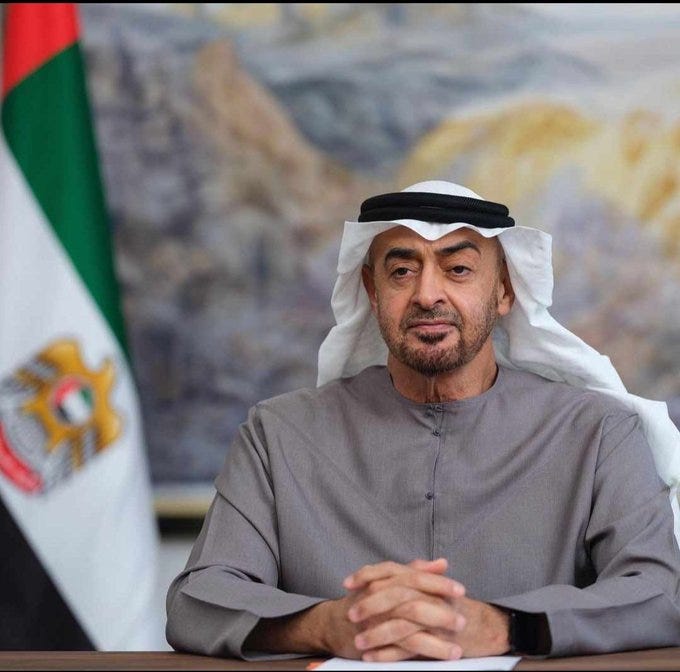
The Shadow Vizier
MBZ doesn’t topple governments. He makes them unaffordable to save.
There is a recurring figure in the political mythology of the Arab world: the vizier who sits below the throne and controls everything above it. He does not claim the crown. He arranges who receives it, who loses it, and at what price. In the fairy tale, he is eventually exposed. In the real world, he writes the ending himself.
Mohamed bin Zayed Al Nahyan, president of the United Arab Emirates, is the most consequential Arab ruler of his generation and the least examined. While Saudi Arabia absorbs the spotlight and Iran absorbs the bombs, MBZ has spent two decades constructing a foreign policy empire built on three instruments: financial dependency that functions as political control, military infrastructure that operates without attribution, and a strategic alignment with Israel and Washington so deep and so durable that it has survived a genocide, two regional wars, and growing Arab rage. He is not a passive partner in the Israel-USA project for the Middle East. He is its Arab architect. Every major rupture in the region since 2020, the Abraham Accords, the destruction of Gaza, the neutralisation of independent Muslim-world voices, the war on Iran, the carving up of the African coastal corridor, traces a line back to Abu Dhabi.
The vizier is not a character in a story. He is a documented foreign policy operator. The documentation follows.
The Abraham Accords: What Was Actually Purchased
In September 2020, MBZ signed the Abraham Accords, becoming the first Arab leader in a generation to formally normalise relations with Israel. The press framing was all about peace: a new Middle East, Arab-Israeli cooperation, the Palestinian issue quietly set aside. What was actually purchased, in both directions, was more precise.
Israel received Arab cover. The Abraham Accords gave Netanyahu’s government the ability to claim regional legitimacy at the exact moment it was consolidating the most right-wing administration in Israeli history and preparing the conditions for what would become a full military assault on Gaza. MBZ called the Palestinian Authority leadership “Ali Baba and the forty thieves” in a meeting with Arab foreign ministers. He did not say this in private. He said it in a room full of officials and it was reported. The UAE spent the years after the Accords flying Emirati airlines to Tel Aviv throughout the Gaza campaign, the only Arab carrier that did not suspend flights. Bilateral trade reached 3.2 billion dollars in 2024, up eleven percent from the year before, through every month of the killing.
What MBZ received was the Washington relationship. The Accords gave Abu Dhabi a level of access to the American political establishment, to the Pentagon, and to the Trump administration specifically, that no amount of investment could have purchased on its own. The US Department of Defense transferred Israel from European Command to CENTCOM in January 2021, integrating Israeli and Gulf Arab air defence into a single operational architecture. Arab states, led by the UAE, accounted for 24 percent of Israel’s 12.5 billion dollars in defence exports in 2022. Israel supplied the UAE with SPYDER air-defence systems. The UAE supplied Israel with the regional legitimacy the Accords conferred. This was not normalisation. It was a defence treaty wrapped in the language of peace, and MBZ authored it.
The strategic logic underneath was anti-Iran and anti-Islamist simultaneously. MBZ has treated political Islam, in any form, as an existential threat to his model of authoritarian modernisation since the Arab Spring forced the question in 2011. The Muslim Brotherhood, Hamas, Erdogan’s AKP, Qatar’s foreign policy, every manifestation of political Islam as a mobilising force, is the enemy in Abu Dhabi’s strategic doctrine. Iran is the military-theological version of that threat. The Accords solved both problems in one move: they integrated the UAE into an Israeli-American security architecture directed at Iran while providing Washington the political capital to sideline every Muslim-world voice that might complicate the project.
Pakistan: Clearing the Board
Imran Khan’s removal from power in April 2022 is remembered primarily through two frames: the constitutional frame, a parliamentary no-confidence vote, and the Washington frame, a US diplomatic cable expressing displeasure at his February Moscow visit. Both frames are accurate as far as they go. Neither accounts for the Gulf layer, which was the mechanism that made the operation executable.
Pakistan in early 2022 was financially exhausted. Foreign exchange reserves were falling toward critical levels. Inflation was running above thirteen percent. The IMF programme had stalled. The current account deficit had no path to closure under normal financing conditions. The country owed the UAE two billion dollars, extended in 2018 and rolled over annually because Pakistan could not repay it. Shehbaz Sharif was in Abu Dhabi within days of taking office. MBZ pledged three billion dollars: the existing two-billion-dollar deposit rolled over and a fresh billion on top. The financial lifeline that kept the new government viable was disbursed within weeks of the government’s formation.
The timing is the argument. Abu Dhabi did not create the dependency after Khan fell. It existed before the vote, and everyone in the relevant rooms knew its dimensions precisely. The question of whether the no-confidence motion would hold was not solely a question of parliamentary arithmetic. It was a question of whether a successor government could be financed. The UAE answered that question before the National Assembly convened.
Why did Khan have to go? The answer has two parts and they belong together.
The first is Palestine. A Pakistan under Khan, with his vocal record on Palestinian rights and his non-aligned foreign policy posture, was an active liability for the Israel-USA-UAE project at the precise moment it needed the Muslim world either compliant or silent. Pakistan is the world’s second most populous Muslim state, nuclear-armed, and capable of anchoring an alternative bloc if its leadership chooses to do so. Khan did not choose silence. That made him a problem. The GCC states, with the UAE at the helm, needed an Islamabad that would not generate moral or diplomatic noise while Gaza burned and while the Iran war was being planned.
The second is the Iran war itself, which was not spontaneous. The regional clearing operation that preceded it required compliant governments across the Muslim world: governments that would not threaten to rupture the Abraham Accords framework, governments that would not mobilise their populations against a US-Israeli military campaign, governments that owed their survival to Gulf financial support and knew it. Pakistan under Sharif was that government. Pakistan under Khan was not.
By early 2026, the UAE was rolling over the same two-billion-dollar tranche on monthly extensions, charging 6.5 percent interest against Pakistan’s request for 3 percent and a two-year term. Pakistan’s finance minister was telling the press there was “no problem” while simultaneously acknowledging the decision had not yet been formally communicated. Abu Dhabi had adopted what Pakistani financial press described as “a tougher stance.” What that phrase means in practice: a nuclear-armed state of 240 million people waits, each month, to learn whether Abu Dhabi will allow it to keep its reserves intact. That is not a bilateral financial relationship. It is a leash.
Iran: The Willing Forward Partner
From late 2023 through early 2025, the UAE performed a diplomatic rapprochement with Tehran: bilateral meetings, Iranian naval port calls at Sharjah, foreign minister consultations. Analysts concluded that Abu Dhabi had demonstrated “scant appetite” for renewed Iranian isolation. Six months later, American and Israeli strikes on Iranian nuclear facilities began. The UAE absorbed more Iranian retaliatory missiles and drones than Israel. A UAE minister of state went to Euronews and declared that anyone opposing Abu Dhabi’s model was “in the camp of Iran and rogue state actors trying to export nihilism to the whole international system.”
The rapprochement was preparation, not policy. MBZ was maintaining channels that kept him useful to Tehran while sustaining the alignment that made him indispensable to Washington and Tel Aviv for the war. He managed both sides of the relationship until the operation began, then declared.
The anti-Iran position is not simply strategic preference. It is the load-bearing wall of the entire Emirati foreign policy structure. The Abraham Accords were sold to the region as an anti-Iran alliance. The CENTCOM integration of Israeli and Gulf air defence is directed at Iran. The network of bases in the Horn of Africa monitors Iranian naval movement through the Gulf of Aden. Every component of what MBZ has built has Iran as its designated adversary, which means that whatever emerges from the war, MBZ needs to be positioned to shape the post-Islamic Republic order before Riyadh does.
The contrast with MBS is structural. Saudi Arabia cannot be openly aligned with an American-Israeli military operation against a Muslim-majority state. The kingdom’s legitimacy is inseparable from Mecca and Medina. Every calculation Riyadh makes about Iran runs through that constraint. MBZ operates under no equivalent burden. Ninety percent of the UAE’s population holds foreign nationality. There is no domestic religious constituency to manage, no Arab street to absorb. The structural freedom to be Washington’s visible forward partner in the Gulf, the freedom MBS cannot exercise without cost, is the core of the UAE’s offer to the Americans and the core of MBZ’s leverage over MBS. He can do what the Saudi crown prince needs done but cannot be seen doing.
Africa: The Arc That Explains Everything
While every camera points at the Gulf and Iran, MBZ has been building the most significant Arab military and commercial expansion on the African continent since the colonial era. It is operational, it is documented, and it connects directly to the same axis.
The network runs from Yemen’s Socotra archipelago to Puntland and Somaliland on the Somali coast, designed to control three things: the Gulf of Aden shipping corridor through which twelve percent of global trade passes, the logistics chain supplying the UAE-backed Rapid Support Forces in Sudan, and the political futures of territories whose contested sovereignty made them available for precisely the kind of arrangement no functioning state would ever grant.
In Bosaso, Puntland’s main port, the UAE transformed a civilian airport into a covert military hub. Throughout 2024, satellite imagery documented the construction of fortified hangars, radar towers, drone pads, and ammunition depots. IL-76 heavy transport aircraft operated by UAE-linked carriers fly directly from Emirati military bases into Bosaso with transponders switched off, continuing toward Nyala in Darfur, Chad, or Libya. Gewan Airways, registered in Kyrgyzstan but owned since October 2024 by an Emirati holding company connected to Hamdan bin Zayed, the UAE president’s own brother, is one of the two central carriers in this supply chain. In April 2025, an Israeli-manufactured ELM-2084 radar system was confirmed at the Bosaso facility, its 256-nautical-mile range covering the entire Gulf of Aden. The Institute for the Study of War mapped the installation and published its range.
In Berbera, Somaliland’s port city, a $442 million DP World investment announced in 2017 as commercial port development has become a premier military facility: deep-water naval dock, airstrip capable of receiving C-130 Hercules transports, hardened hangars, drone infrastructure. The commercial concession runs for thirty years alongside the military base. They are not separate operations.
At a US Congressional hearing in May 2025 on the Sudan crisis, former diplomat Cameron Hudson testified that the RSF’s coordinated drone strikes on Port Sudan, six consecutive days of civilian infrastructure targeting, would have been “impossible without sustained logistical, financial, and technical support from foreign states, chief among them the UAE.” Sudan’s government filed a case before the International Court of Justice alleging Emirati complicity in RSF atrocities. The ICJ dismissed it for lack of jurisdiction. Abu Dhabi denied everything. The flights continued.
Now the Russia connection. The Wagner Group, subsequently rebranded as Africa Corps under direct Russian Ministry of Defence control, initially supported the RSF in the early stages of Sudan’s civil war, using the same cross-border routes from Libya and the Central African Republic. Wagner’s African logistics network has long relied on UAE financial infrastructure: gold extracted from RSF-controlled territory in Darfur was transported through South Sudan to Juba, transferred to private jets, and flown to the UAE. Several hundred kilograms of gold from RSF mines moved through this pipeline in a single documented shipment in March 2024, according to the Global Initiative Against Transnational Organized Crime. The UAE is the terminal point for the gold that funds the war that the UAE is also directly supplying with weapons and logistics. Moscow and Abu Dhabi are not coordinating in any formal sense. They are operating compatible infrastructure, each for their own purposes, in a geography where their interests converge: Sudan fragmented, the Sahel destabilised, African coastal access controlled outside of any accountable framework.
Russia eventually shifted support to the Sudanese Armed Forces to secure a naval base near Port Sudan. The RSF supply chain remained Emirati. The two external powers backed opposing sides in the same civil war while sharing the logistics geography that sustained both. This is not a contradiction of their interests. It is a description of how managed instability functions when multiple actors have reasons to keep a conflict alive.
The political engineering ran in parallel with the military. The UAE cultivated Somaliland’s independence movement not from solidarity with self-determination but because a recognised Somaliland provides Abu Dhabi with a permanent, treaty-bound military presence on the Gulf of Aden under terms no federal Somali government would grant. The Ethiopia-Somaliland memorandum of January 2024, granting Addis Ababa coastal access in exchange for potential recognition, was widely assessed as Emirati-facilitated: Ethiopia had signed a bilateral maritime agreement with Abu Dhabi in August 2023. In December 2025, Israel became the first UN member state to recognise Somaliland. The UAE, a signatory to the Abraham Accords, said nothing publicly. Analyst Cameron Hudson told the BBC that the Emirates appeared “very much aligned with Israeli interests” on Somaliland and predicted greater convergence of Emirati and Israeli objectives across the entire Red Sea corridor. Saudi Arabia condemned the recognition. The UAE’s silence was the answer.
The Mentor’s Account
Between 2015 and 2019, MBZ and MBS were read as a unified Gulf axis: the senior strategist and the reforming crown prince, jointly responsible for the Yemen coalition, the Qatar blockade, the anti-Iran and anti-Brotherhood alignment. MBZ opened Washington for MBS, introduced him to the foreign policy establishment, supported his consolidation of power over rival contenders within the House of Saud. One Carnegie researcher captured the asymmetry without euphemism: MBS’s inexperience allowed MBZ to shape Saudi policy in ways compatible with Emirati interests.
The Saudi-Iran normalisation brokered by China in March 2023 was the moment MBS broke from the script. Riyadh chose de-escalation, stability, and the economic headroom that regional peace would provide for Vision 2030. MBZ had spent years positioning the entire regional order around an anti-Iran consensus. The Chinese-brokered deal threatened to dissolve that consensus from within. The proxy confrontations that followed, Yemen, Sudan, the Israeli recognition of Somaliland that Saudi Arabia condemned and the UAE did not, are not simply economic rivalry or personal friction. They are MBZ working against a Saudi foreign policy direction that, if consolidated, would undermine the logic of everything he has built.
Vision 2030 broke the personal alliance. Saudi Arabia’s diversification programme required displacing the commercial hub model Dubai had built over thirty years. Riyadh stopped awarding government contracts to companies not headquartered in the kingdom. It launched competing economic zones. It pursued multinationals based in the UAE. MBS asked Trump directly, during a November 2025 Washington visit, to pressure Abu Dhabi over Sudan. MBZ said nothing publicly.
The Iran war placed MBS in the position MBZ had engineered over a decade. MBS approved the strikes because a nuclear Iran was a more immediate threat than the post-war geometry. But the post-war geometry is now the central problem of Saudi foreign policy. A Tehran reoriented toward Washington and Tel Aviv, integrated into an Emirati-anchored commercial and security order, completes an encirclement that leaves Riyadh as the largest economy in the region outside the new architecture. Saudi strategists have begun calling the UAE “an Israeli project wearing an Arab cloak.” That phrase, reported in Israeli press in January 2026, is not rhetoric. It is the diagnosis.
The Architecture and Its Cost
Every component of what MBZ has built reinforces the others, and together they constitute a project whose beneficiaries are not the Arab people, not the Muslim world, and ultimately not even the UAE’s long-term interests. They are Israel and the United States, in that order of operational priority.
The Abraham Accords gave Washington the Arab cover it needed to prosecute the Iran war without triggering a unified Muslim-world response. They gave Israel the regional legitimacy it needed to conduct the Gaza campaign while maintaining commercial and security ties with the Gulf. They gave MBZ the Washington access that converted Abu Dhabi’s small size into disproportionate global weight. The deal worked for all three parties. It cost the Palestinians everything and will cost the region for a generation.
The financial architecture over Pakistan converted a sovereign nuclear state into a client that waits monthly for Abu Dhabi’s decision on loan rollovers. The military architecture in the Horn of Africa gave Washington and Israel a forward-operating presence on the Gulf of Aden without requiring visible American or Israeli ground commitments. The proxy war infrastructure in Sudan and across the Sahel, operated in parallel with Russian logistics chains and funded partly by Darfuri gold flowing through UAE financial systems, keeps the African coastal geography fractured and available. Fractured states are not a failure condition for this model. They are the operating environment.
What MBZ has built is also, in the long run, the source of the region’s deepest instability. Iraq was destroyed by direct intervention. Libya was destroyed by NATO-enabled intervention. Syria was destroyed by proxy war intervention. Gaza is being destroyed in real time. Iran is burning. Every intervention in the region that has carried the Israel-USA-UAE signature has produced rubble, displacement, and the conditions for the next intervention. The pattern holds not because the architects are incompetent. It holds because instability is not the unintended consequence of the strategy. It is the intended output. A stable, self-determining Muslim world would have no need for Abu Dhabi’s financial guarantees, no need for Washington’s security umbrella, and no need for Israeli military technology. The dependency is the product. The chaos is what keeps the dependency intact.
The region’s only viable path runs in the opposite direction: Saudi-Iran normalisation consolidated, not reversed; Pakistan’s financial sovereignty recovered; Turkey, Iran, and the Arab states working through their own disputes without the Israel-USA-UAE triangle deciding outcomes. Every time that triangle intervenes, it decides outcomes in its own favour and the region pays the price.
In the old story, the vizier is eventually exposed by the hero, usually a young man with nothing to lose who stumbles on the truth. The contemporary version of that story has no such character scheduled to appear. The vizier has made sure of it. The governments that might have produced that character are in debt to him, and the ones that tried are in prison.


