The State Behind the State
The IRGC, the Multipolar Transition, and the War for the Next Financial Order
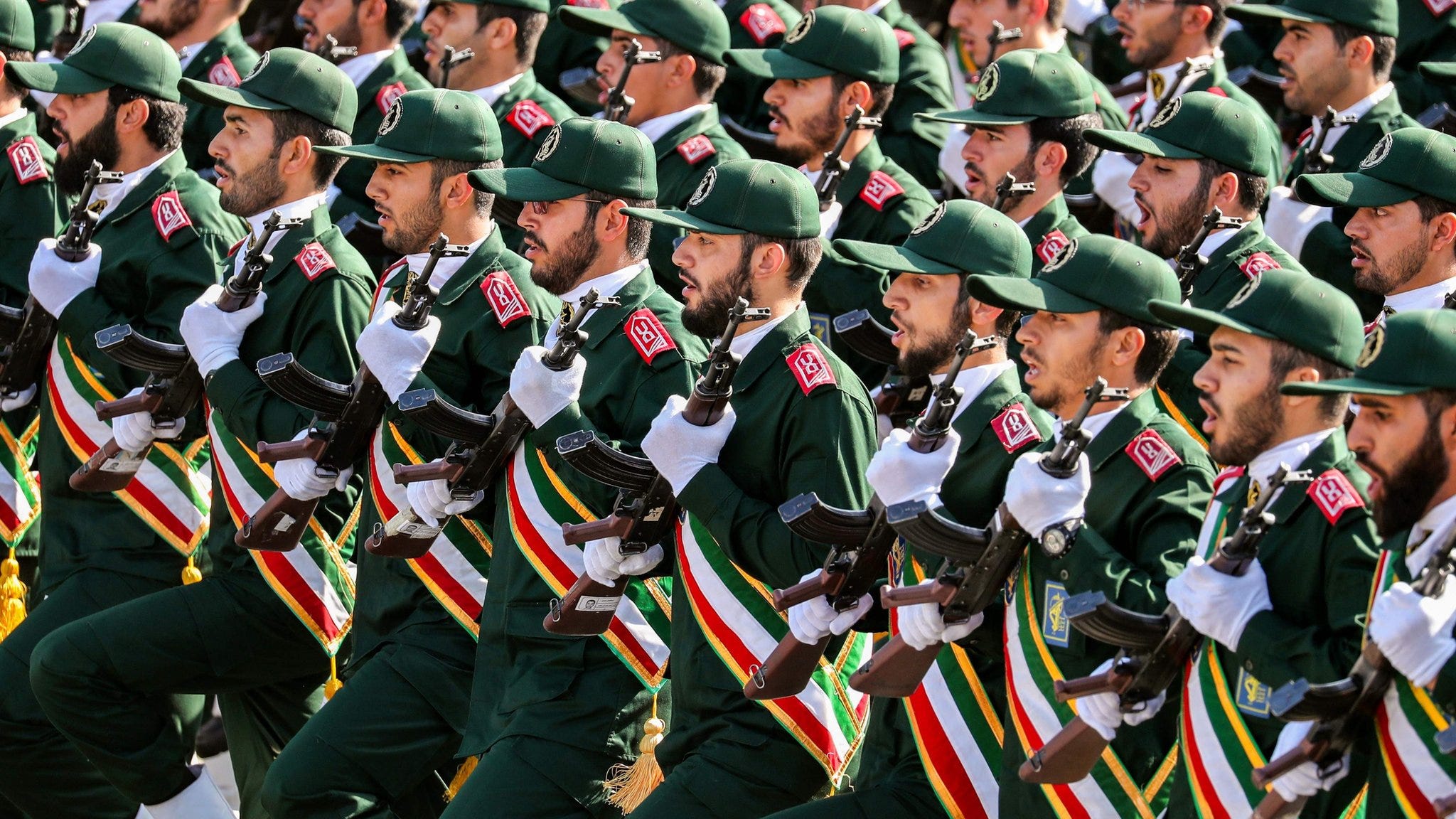
On February 28, 2026, US and Israeli aircraft killed Ali Khamenei in his compound in Tehran. By March 8, the Assembly of Experts had appointed his son, Mojtaba: a former IRGC member, trained in the Corps’ intelligence and defense apparatus, the IRGC’s preferred candidate according to every analyst watching the succession. Washington announced regime change. The IRGC announced its man. The two announcements are not in contradiction. They describe the same event from different angles, and the difference in the angles is what this piece is about.
What the Bombs Cannot Reach
To understand what Operation Epic Fury is actually targeting, you have to understand what it cannot target. The Supreme Leader’s compound is a building. The military-bonyad complex is not.
The Clingendael Institute’s analysis of Iran’s political economy places the combined weight of the Islamic Revolutionary Guard Corps and Iran’s revolutionary-religious foundations, the bonyads, at more than 50 percent of the country’s GDP as of 2013. That figure has not contracted in the decade since. The IRGC’s Khatam al-Anbiya Construction Headquarters holds contracts the US Treasury estimated at $22 billion in June 2019 for oil and petrochemical projects alone, four times the IRGC’s official defense budget at the time. Khatam builds the roads, dams, gas pipelines, and rail infrastructure of the Iranian state. Its subsidiary controls Tehran’s Imam Khomeini International Airport. When Operation Epic Fury launched on February 28, the first operational decision at the airport was made by the organization that owns it.
The bonyads, Bonyad Mostazafan (Foundation of the Oppressed), Bonyad Shahid, and more than 500 affiliated subsidiaries, operate across agriculture, tourism, manufacturing, insurance, and real estate. Their combined budgets represent over 30 percent of central government spending. They are not subject to parliamentary oversight or national audit. They report to the Office of the Supreme Leader. Setad, the Supreme Leader’s direct economic holding assembled from post-revolution asset transfers, was valued by Reuters at $95 billion. In 2025, Iran’s budget bill directed 51 percent of total oil and gas export revenues, estimated at 12 billion euros, to the IRGC and Law Enforcement Command, outside the formal defense appropriation.
Between 2005 and 2013, during the Ahmadinejad presidency, Iran sold more than $120 billion in public assets. Independent auditors and parliamentary reports indicated that over 80 percent of those sales went to IRGC-affiliated entities, bonyads, and state-controlled pension funds, through single-bid closed auctions. The 2009 privatization of the Telecommunication Company of Iran, valued at $8 billion, transferred a controlling stake to Mobin Trust Consortium, directly linked to the IRGC’s Etemad-e-Mobin group, in a one-day auction. The IRGC gained operational control of the country’s core telecoms infrastructure at the moment Western governments were tightening sanctions precisely to isolate it.
The Janes defense intelligence firm assessed in 2024 that the IRGC’s sources of funding were unlikely to be significantly weakened by either internal or external contingencies in the medium to long term. The assessment was clinical. It pointed at the same structural fact that every sanctions architect in Washington has encountered and not resolved: every round of sanctions since 2005 increased the IRGC’s share of the Iranian economy. When formal market access was blocked, the Corps expanded its shadow fleet and cryptocurrency infrastructure. When the private sector was squeezed by regulatory isolation, state contracts migrated further into Corps-affiliated entities. The Clingendael analysis put it directly: the IRGC used Western economic pressure as justification and cover for a process of economic consolidation that was already underway.
This is the architecture that Operation Epic Fury is attempting to collapse through air power. No previous sanctions regime, no maximum pressure campaign, no twelve-day war in June 2025 has dented it. The IRGC did not build this structure accidentally. It built it to survive precisely the kind of pressure it is now under.
The Border as a Ledger
There is a road out of Zahedan, in Iran’s Sistan and Baluchestan province, that tells the whole structural story in miniature. It runs east toward the border crossing at Mirjaveh, into Pakistan’s Balochistan. On this road, convoys of pickup trucks carrying subsidized Iranian diesel move toward the crossing points in volumes that Iranian officials have estimated at between 7 and 11 million liters per day.
Iranian gasoline sells domestically for less than $0.03 per liter, placing it alongside Libya and Venezuela among the three cheapest fuel markets on earth. The arbitrage against Pakistani market prices is structural and self-perpetuating. The Pakistan Petroleum Dealers Association has estimated that up to 35 percent of all diesel sold in Pakistan is sourced from Iran across this corridor, a share so large that, as the association’s chairman noted, the trade has spread well beyond Balochistan into the national supply chain.
The IRGC formalized its management of this trade in 2018 through the Razzagh Plan, which established a controlled distribution system: IRGC-run fuel stations at border distribution points, a registration system for authorized carriers, and a logistics structure that placed the final sale and margin under Corps control while using independent transporters for the physical movement. The 2025 successor schemes, “Fuel Tanker” and “Cooperation,” were designed, according to Iranian media and local residents’ accounts, to further centralize logistics management under the Corps.
Iranian economic journalist Reza Gheibi put the operative fact plainly: the volume of fuel crossing the border would be impossible without the knowledge or direct participation of the IRGC. The organization controls the transportation networks, the ports, and the border infrastructure. The Iranian judiciary chief acknowledged in March 2025 that the scale of smuggling, including underground pipelines extended from airports to the sea, “can’t be the work of an ordinary person.” He named no institution.
What this corridor represents, at the structural level, is the IRGC’s gray economy operating as a parallel trade architecture: sovereign in its logistics, self-financing, operating outside the formal budget, and entirely invisible to the Western sanctions regime designed to isolate Iran’s formal economy. The fuel that reaches Pakistani Balochistan bypasses SWIFT. It bypasses OFAC. It bypasses every mechanism of financial coercion Washington has constructed since 2005.
This is not smuggling as deviation from a functioning system. It is a parallel system functioning exactly as designed.
The Pakistani Mirror
The IRGC is not a unique formation. It is the Iranian instance of a structural condition that has reproduced itself across postcolonial states in the Global South wherever a security apparatus has had sufficient institutional longevity to build economic autonomy.
Pakistan’s equivalent is called Milbus, military business. The Fauji Foundation, established in 1954 from British colonial resettlement funds as a charitable trust for ex-servicemen, is now the largest business group in Pakistan. The Economic Policy and Business Development think tank’s Wealth Perception Index 2025 places its net worth at $5.9 billion, topping a list of 20 major public-listed conglomerates. It controls over 50 commercial entities: Fauji Fertilizer Company commands roughly 80 percent of Pakistan’s fertilizer market; Mari Petroleum supplies over 22 percent of the country’s gas output; Askari Bank and Askari Insurance operate inside the formal financial system; Foundation Power produces electricity at national scale.
The full architecture of Pakistan’s military-commercial complex runs through four parallel empires: the Fauji Foundation, the Army Welfare Trust, the Shaheen Foundation (Air Force), and the Bahria Foundation (Navy). Foreign estimates as of 2025 place the military’s total business footprint at over $50 billion. The Defence Housing Authority has made the Army the country’s largest land developer, with projects across every major city. Pakistani scholar Ayesha Siddiqa, whose book Military Inc. documented this system in detail, estimated military private wealth at $20 billion in 2008. That figure is the floor of what exists now.
The structural parallel with the IRGC’s bonyad network is precise. Both systems were established under a welfare framework. Both expanded during periods of external pressure and internal economic stress. Both operate outside parliamentary oversight and national audit. Both have become, over time, the primary institutional force shaping the political economy of their respective states, more consequential than any elected government, more durable than any individual leader.
The parallel is what makes the ISI-IRGC analogy analytically useful, not as moral equivalence but as structural recognition. Two security apparatuses, formed in the revolutionary and postcolonial period, that independently arrived at the same institutional solution: build an economic base that is not dependent on the formal state’s fiscal position, that operates outside the oversight mechanisms available to civilian governments, and that controls the physical infrastructure, the border corridors, the banking, and the logistics on which the formal economy depends.
Both institutions are, in the precise sense Liang Qichao used when writing about sovereignty, already sovereign. The elected government is the tenant. The institutional complex is the landlord.
The Corridor as Structural Evidence
The connection between these two parallel state structures across the Iran-Pakistan border is not primarily ideological. It is structural.
The IRGC controls the Iranian side of the border corridor: the fuel distribution infrastructure, the tanker networks, the final sale margins, and the official border apparatus in Sistan-Baluchestan. The Pakistani military controls the Balochistan side: the road network, the border security apparatus, and the political administration of a province where no civilian government in Islamabad has successfully established independent governance since partition. The corridor between them carries an estimated $1 billion annually in fuel alone, with narcotics, manufactured goods, and weapons documented across the same routes.
The analytical point is not that a formal agreement exists between these two institutions. No such document is in the public record. The analytical point is that two military-economic entities, each operating outside civilian oversight, each with the institutional capacity to shut down the corridor, have both chosen not to. The corridor is financially beneficial to both. It operates in the gray zone that neither formal state acknowledges and neither formal government can shut down, because the institutions that could shut it down are the institutions running it.
What this establishes, as a structural matter, is that the IRGC and Pakistan’s military apparatus are not merely analogous formations. They are, across this corridor, economically integrated ones. The integration predates the current war. It has survived every diplomatic crisis between Islamabad and Tehran. It has survived sanctions. It has survived the June 2025 twelve-day war. It continues in the context of Operation Epic Fury because the border infrastructure on both sides is controlled by institutions whose interests in its continuation are structural, not contingent.
This is the kind of integration that Washington’s sanctions architecture was never designed to address, because it operates entirely outside the dollar-denominated formal financial system that sanctions are built to coerce.
What the War Is Actually About
The stated rationale for Operation Epic Fury was nuclear nonproliferation and regime change. Both are real concerns. Neither is sufficient to explain the timing.
In February 2026, Iran and the United States were in nuclear negotiations that mediators described as making substantial progress. Trump told The Atlantic the day after the strikes that Iran “should have given what was very practical and easy to do sooner.” He was describing talks that were proceeding toward an agreement when the bombs fell. The decision to strike was not a response to negotiations failing. It was a decision to substitute military action for negotiations that were succeeding toward an outcome Washington apparently did not want.
To understand what that outcome would have been, the financial context is necessary.
In 2023, China brokered diplomatic normalization between Saudi Arabia and Iran, two states whose hostility had been the central organizing principle of Gulf geopolitics for decades. In the same year, China began receiving Saudi oil in yuan. India and Iran operationalized a rupee-rial payment mechanism for bilateral trade. Saudi Arabia engaged with BRICS membership. The UAE’s non-oil GDP exceeded 70 percent of its economy. Russia had shifted the majority of its energy trade out of dollar settlement following 2022 sanctions. By early 2026, the BRICS bloc, now including Egypt, Ethiopia, Indonesia, Iran, Saudi Arabia, and the UAE as full members, represented nearly half of world population and over 40 percent of global trade. The New Development Bank had announced its first rupee-denominated bond issue for March 2026. The BRICS Pay pilot, a blockchain-based settlement system routing central bank digital currencies without SWIFT intermediation, was the largest structural financial story of Q1 2026.
The petrodollar system is the arrangement by which global oil trade is denominated and settled in US dollars, compelling all oil-importing nations to maintain dollar reserves and dollar-denominated bonds. It is not a policy or a treaty. It is the structural condition that has financed US fiscal deficits for fifty years and underwritten American military primacy in every theater it operates in. Iran, since 1979, has been the one major oil producer operating entirely outside this arrangement, its oil sanctioned off-market, its trade increasingly conducted in yuan, rupees, and barter, through the exact gray economy infrastructure the IRGC built and owns.
A nuclear agreement between Washington and Tehran that left the IRGC’s institutional architecture intact would not have restored Iran to the dollar system. It would have formalized Iran as a sovereign actor inside the emerging multipolar settlement architecture: selling oil in yuan to China, settling trade in rupees with India, participating in BRICS payment infrastructure, all while its nuclear program was frozen. That outcome, for Washington, was structurally worse than a frozen conflict, because a frozen conflict keeps Iran isolated. A normalized Iran inside BRICS is an anchor of the post-dollar energy settlement system.
The bombs were not surgical. They were structural. The target was not the nuclear program. It was Iran’s potential role in the financial architecture of the next fifty years.
The IRGC’s Strategic Bet
The IRGC understood this logic before the bombs fell.
The institutional decisions the Corps made over the past four decades, the shadow fleet expansion, the cryptocurrency infrastructure, the border corridor logistics, the shadow banking network through bonyad-affiliated financial institutions, the off-market oil sales to China and India, collectively constitute a strategy for operating a sovereign economy entirely outside the Western financial coercive architecture. That strategy was not reactive. It was anticipatory.
The Clingendael analysis documents that each cycle of sanctions, rather than weakening the IRGC’s position, produced a further consolidation of its economic control, because the Corps was already positioned to expand into the spaces that sanctions closed to the formal private sector. When the formal banking system was isolated from SWIFT, the IRGC’s off-SWIFT financial infrastructure became more valuable. When oil exports through formal channels were blocked, the IRGC’s shadow fleet and its relationships with Chinese import intermediaries became the operational backbone of the Iranian economy. When Western companies left Iran under maximum pressure, the Corps-affiliated construction and engineering empire moved into the contracts they vacated.
This is what the Atlantic Council, analyzing the succession question on March 11, described as the likely end state: IRGCistan, a configuration in which the new Supreme Leader is a partner of the IRGC rather than its principal, with the Corps exercising institutional authority more transparently than at any point in the history of the Islamic Republic. Mojtaba Khamenei was installed within ten days of his father’s death. He is the IRGC’s man. The institutional transition was faster and cleaner than any civilian succession process in any democracy in 2026.
The IRGC played its cards correctly. It survived the decapitation of its nominal principal with its economic architecture intact and its preferred successor in place. Whatever the outcome of Operation Epic Fury at the level of military attrition and territorial control, the institutional question is already resolved. The state behind the state is still the state.
The GCC’s Calculated Position
The Gulf Cooperation Council states are not passive observers of this transition. They are among its most sophisticated actors.
Saudi Arabia has not formally joined BRICS, though it was invited at the Johannesburg summit in 2023 and is listed as a participant in the concept note of Brazil’s 2025 BRICS presidency. The kingdom has maintained deliberate ambiguity across every major multilateral platform. This is not indecision. It is the strategic posture of a state that understands its leverage derives from remaining bidirectional: necessary to the West’s financial architecture because of dollar-peg maintenance and US Treasury bond holdings, and simultaneously integrated into the East’s energy settlement systems through yuan oil pricing with China and engagement with the New Development Bank.
The UAE has moved further and faster. Non-oil GDP in the UAE now exceeds 70 percent of the economy. Jebel Ali Port functions as the connective tissue between Western capital and Asian manufacturing. UAE entities settled oil trades in yuan with Chinese partners while maintaining the dollar peg. The UAE hosted IRGC-linked infrastructure projects as recently as 2004, when a Bonyad Mostazafan subsidiary built a road in the Hajar mountains, while simultaneously hosting US military assets at Al Dhafra. The UAE is not navigating a binary choice between Washington and Beijing. It is positioned as the clearinghouse between the two systems, charging a transit premium to both.
Saudi Arabia’s refusal to increase oil output despite sustained US pressure during the Russia-Ukraine war was the clearest signal of the new relationship. Riyadh acts now as a sovereign economic actor managing its own production calculus, not as a managed US ally responding to Washington’s energy policy needs. MBS hosting Ukraine peace talks in Jeddah, purchasing Turkish Kaan fifth-generation fighters, settling oil in yuan with China, and maintaining F-35 procurement from the US simultaneously: these are not contradictions. They describe the post-unipolar condition expressed as foreign policy. The GCC states are decolonizing their strategic dependency without announcing it, using economic multi-alignment as the mechanism.
The Iran war places this strategy under direct pressure. Saudi Aramco’s Ras Tanura facility was struck by Iranian missiles in early March. Gulf airspace closures disrupted the logistics networks that underpin the UAE’s connector model. Every week of active conflict is a week in which the premise of multi-alignment, that security relationships with Washington and economic relationships with Beijing and Tehran can be maintained simultaneously, is tested in real time. That premise has not broken. But the cost of the US security guarantee is now visible in a way it was not before February 28.
The Leverage Play: How the IRGC Is Playing Its Cards
On February 27, 2026, the day before the bombs fell, Oman’s Foreign Minister Badr Al-Busaidi announced that a breakthrough had been reached in Muscat. Iran had agreed to never stockpile enriched uranium and to full IAEA verification. He said peace was “within reach.” The next round of talks was scheduled for March 2. The bombs fell on February 28.
On March 1, Trump told The Atlantic that Iran wanted to resume negotiations and that he had agreed to talk. He told the Daily Mail that US operations were to be completed within a four-week timetable. The war was seventeen days old on the morning of March 15. The timetable and the diplomacy were always running simultaneously.
What the IRGC understands, and what the framing of this as a conventional war obscures, is that the Strait of Hormuz is not a military objective. It is a negotiating instrument.
On March 2, a senior IRGC official confirmed the Strait was closed, threatening any vessel attempting transit. Tanker traffic dropped to near zero within 48 hours. Protection and indemnity insurance was cancelled effective March 5. Maersk, CMA CGM, MSC, and Hapag-Lloyd suspended transits. The IEA announced a release of 400 million barrels from global strategic reserves, the largest coordinated drawdown in the agency’s history, to manage the price shock. Brent crude climbed from $70 before the war to above $93 per barrel by March 13. The IRGC’s Khatam al-Anbiya spokesperson stated: “You will not be able to artificially lower the price of oil. Expect oil at $200 per barrel.”
But the Strait was not closed uniformly. On March 5, the IRGC revised its position: the waterway would remain closed specifically to ships from the US, Israel, and their Western allies. On March 13, Iran approved passage of a Turkish ship. Two Indian-flagged gas carriers and a Saudi oil tanker carrying 1 million barrels destined for India were also permitted through. Iranian oil continued flowing to China through the Strait throughout the closure, documented by multiple maritime intelligence trackers. The IRGC Navy chief, Alireza Tangsiri, stated publicly: “The Strait of Hormuz has not yet been militarily closed and is merely under control.”
Read that sentence carefully. Not destroyed. Not permanently sealed. Controlled, with precision, as a tool of graduated pressure applied selectively along geopolitical lines.
Turkey passes. India passes. Saudi oil for India passes. Iranian oil for China passes. Western shipping does not pass. The architecture of the new order is being drawn in ship movements and passage permissions, in real time, through the world’s most critical energy chokepoint.
The mine-laying operation, confirmed by US intelligence and described by CNN’s sources as a few dozen mines laid while Iran retained 80 to 90 percent of its minelayer fleet intact, is the escalation ladder being held in reserve. The IRGC is not deploying its full naval capability. It is demonstrating credible escalation capacity while managing the dial. CENTCOM destroyed 16 minelayers. The IRGC still holds the majority of its minelaying fleet. The message is precise: this can be turned up further if the terms are not right.
The back-channel evidence confirms the frame. Iran’s Deputy Foreign Minister Kazem Gharibabadi confirmed publicly that Russia and China had both contacted Tehran over a ceasefire. Iran stated its condition: a halt to aggression before negotiations resume. China’s Foreign Minister Wang Yi conducted shuttle calls with his counterparts in Kuwait, Bahrain, Pakistan, Qatar, and Israel, with Beijing’s special envoy on the Middle East issue simultaneously conducting in-person visits across the region. Russia provided intelligence to Iran on US military positions while publicly condemning the strikes and calling for a return to dialogue. Neither Moscow nor Beijing committed military materiel. Both are running the mediation track.
This is the superpower deal being assembled in the margins of the war. Its contours are already visible in the diplomatic traffic. Washington wants the nuclear program frozen, the proxy network degraded, and the IRGC’s regional military posture reduced. Tehran wants recognition of the IRGC’s institutional permanence, sanctions relief, and a settlement framework that does not require subordination to Western financial architecture. Mojtaba Khamenei, posting on X from an undisclosed location on March 13 with text only and no video or voice, is alive, mobile, and in command of the negotiating position.
The transitional logic of this war is now legible. Washington struck at a moment of Iranian domestic weakness, when nuclear talks were producing a deal that would have normalized Iran without restructuring its institutional architecture. The war was meant to produce regime collapse or institutional capitulation. Neither has happened. What has happened is that the IRGC has closed the Strait, the global energy price has spiked past $90, China and Russia are running the mediation track, and Trump has publicly accepted the premise of returning to talks within a four-week operational window.
The war is not being fought to destroy Iran. It is being fought to set the terms on which Iran re-enters the global order. And the IRGC’s leverage play, the mine threat, the selective passage permissions, the $200/barrel signal, the retention of escalation capacity, is calibrated to ensure those terms reflect the new structural reality rather than the old unipolar one.
Washington is trying to write the terms of a deal that preserves the dollar-denominated energy order. The IRGC is trying to write the terms of a deal that legitimizes the multipolar one. The bombs are the negotiating position. So is the Strait closure. What is being settled in this war is not whether Iran survives. That question is resolved. What is being settled is the architecture of the regional order for the next generation: the permanent removal of US forward-basing as the organizing principle of Gulf security, the legitimization of non-dollar energy settlement as the norm, and the recognition of the IRGC’s parallel state as an institutional fact rather than a problem to be solved.
The question is who writes the final clause.
China’s Method
Liang Qichao, in exile in Japan after the failed Hundred Days’ Reform of 1898, argued that sovereignty is not lost all at once. It is surrendered through a sequence of institutional arrangements, each framed as necessary, rational, and modern at the time it is accepted. He was writing about the Qing dynasty’s accommodation of imperial power. He was describing a mechanism with no historical expiration date.
China’s project in the current transition is architectural, not military. The Belt and Road Initiative is the construction of supply chains, ports, roads, and financial corridors that function outside US-dominated logistics networks. The SCO, originally a security framework, now provides what multiple analysts describe as the security guarantee for those corridors. BRICS provides the institutional financial framework. The New Development Bank issues bonds in rupees. BRICS Pay connects central bank digital currencies across member states without SWIFT. Each of these is a component of an infrastructure for a parallel global financial system, assembled over twenty years below the threshold of any single decisive rupture.
The 2023 Saudi-Iran normalization, brokered by China without a single US-affiliated institution at the table, was the most consequential single diplomatic act of the decade. China’s trade with Russia exceeded 40 percent of Russia’s total trade turnover as of January 2026. China purchases the majority of Iranian oil exports under sanctions, through shadow fleet arrangements that the IRGC has operated for years. China has condemned the US-Israeli strikes while providing no military materiel, maintaining the posture of a power whose strategic horizon extends beyond the current conflict.
China does not need to stop the bombing of Iran. It needs the bombing of Iran to demonstrate, to every oil producer and oil importer in the Global South, what the current global order costs its participants. Every missile that hits an Aramco facility makes the GCC’s multi-alignment strategy more urgent. Every week of conflict accelerates the argument for dollar-independent energy settlement. Every disruption to Strait of Hormuz shipping makes the case for the overland trade corridors China has been building through the BRI since 2013.
The Iran war is Beijing’s best argument. Beijing did not make the argument. Washington made it for them.
The Structural Roots of the Decolonization
Iqbal’s diagnosis of the postcolonial condition was not about Western military presence. It was about the internalization of Western institutional frameworks as the only legitimate form of governance. The state that accepted the Washington Consensus as the only valid economic model, the state that routed its oil revenues through dollar-denominated instruments and its capital through New York correspondent banks, the state that required Western institutional certification to be recognized as legitimate: that state was already subordinate, regardless of its flag.
The IRGC’s institutional architecture is, at the structural level, the most advanced postcolonial construction in the Global South: a parallel state that has immunized itself against every mechanism of Western institutional coercion available since 1979. No SWIFT dependency. No foreign direct investment dependency. No IMF program. No dollar-denominated sovereign debt exposure. No formal defense procurement from Western suppliers. Its oil moves through a shadow fleet the Corps operates and controls. Its financial flows move through cryptocurrency networks and bonyad-affiliated institutions that do not appear in the architecture of Western sanctions compliance. Its construction capacity comes from Khatam al-Anbiya, which has built the equivalent of a mid-sized country’s infrastructure from domestic resources under maximum pressure.
The Western academic framing of this as kleptocracy or institutional failure misses the functional logic. The IRGC’s economic empire exists not despite Western pressure but because of it. Sanctions created the conditions under which an institution that had already begun building economic autonomy could complete the construction. The result is a state that is, in every operationally meaningful sense, delinked from the Western financial architecture that is the primary coercive instrument of US hegemony.
That is the precedent the Global South is watching in 2026. Not the bombs. The survival of the architecture under the bombs.
Pakistan, sitting at the margin of this conflict with its own parallel state intact, its own gray economy corridors running, its own military-commercial empire operating outside parliamentary accountability, is watching the same question that every postcolonial state with a significant security apparatus is watching: how much of the institutional decolonization that the IRGC completed can be replicated, before the window closes?
The Unresolved Equation
The IRGC installed Mojtaba Khamenei in ten days. Its economic empire survived the strikes. Its border infrastructure is operational. Its shadow financial network continues to function. The structural conditions that produced the IRGC’s dominance: the institutional design of the Islamic Republic, the privatization transfers of the Ahmadinejad era, the four-decade construction of economic architecture outside Western financial systems, none of these have been altered by the bombing campaign.
What the war has done is accelerate the multipolar transition it was designed to prevent. The petrodollar debate is no longer theoretical in Riyadh. The BRICS settlement architecture has acquired an urgency it did not have on February 27. China’s position as the alternative diplomatic broker in the region is demonstrably stronger than it was before the war. The GCC’s multi-alignment strategy is under pressure but has not broken, and the pressure itself is producing a recalculation of the cost of the US security guarantee. The IRGC, having survived the decapitation of its nominal principal, now exercises institutional authority more visibly than at any point in its history.
In Pakistan, the Milbus complex watches from a position of structural entanglement. The gray economy corridors through Balochistan are disrupted by the conflict’s regional spillover. LNG supply chains that run through the Strait of Hormuz face pressure the Army’s commercial empire, Fauji Fertilizer, Mari Petroleum, Askari Bank, cannot hedge against. Islamabad observes Tehran not as ideological ally or adversary but as institutional mirror: a parallel state whose architecture is now being stress-tested by the most concentrated application of US military force in the region since Iraq.
The question Washington’s planners have not answered is the structural one. If the IRGC emerges from Operation Epic Fury with its economic architecture intact and its preferred successor governing the formal state, what is the theory of change? Decapitation works against hierarchical systems where power concentrates in a single named individual and dissipates on their removal. It does not work against a military-bonyad complex that has, over four decades, distributed its economic sovereignty across 500 subsidiaries, shadow fleets, cryptocurrency networks, cross-border trade corridors, and tax-exempt foundations specifically designed to survive the removal of any individual.
The IRGC understood the game. It built the architecture for the world that is arriving, not the world that existed when the architecture was designed. Washington is fighting to preserve the financial order of the past fifty years. The IRGC built the institutional infrastructure for the next fifty. The bombs have not changed that calculus. They have clarified it.


