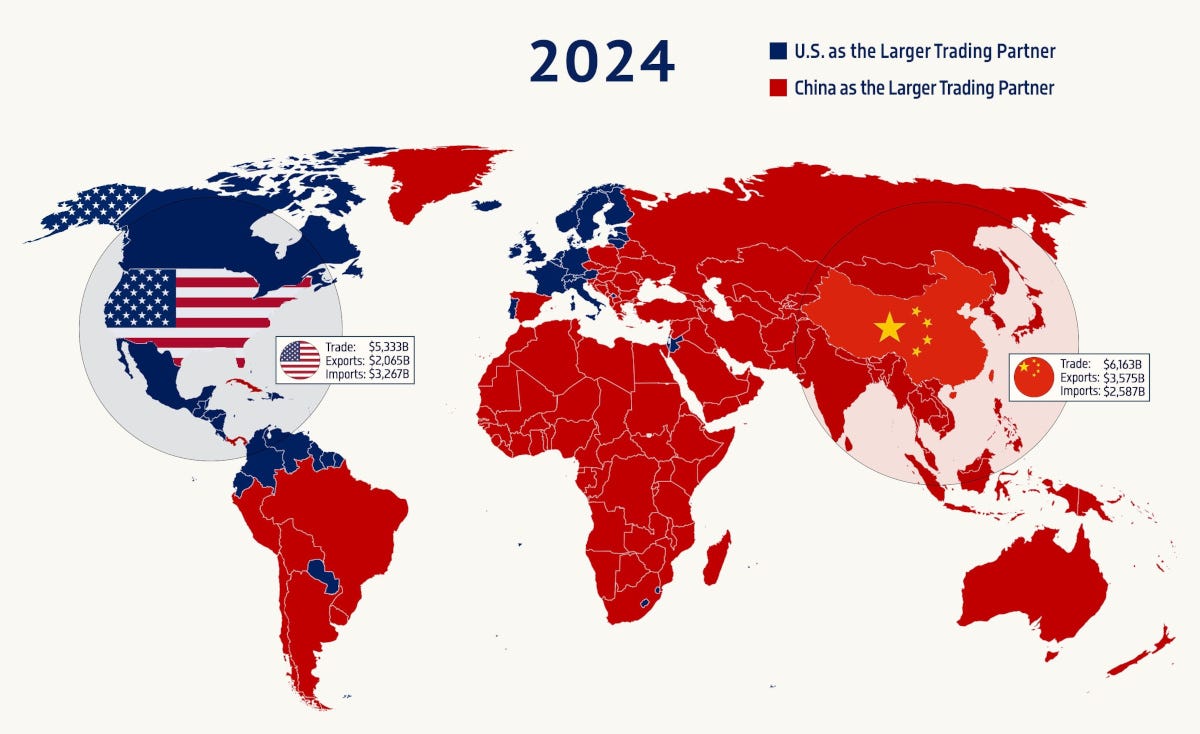
The Structural Logic of a China-First World
The official Washington position on China trade has not moved in any material way since the first Trump administration articulated it in 2018: that dependence on Chinese manufacturing is a strategic vulnerability, that supply chains must be repatriated or redirected, and that allies who do not follow the American lead will eventually face consequences. Eight years later, China’s share of global goods exports has climbed from roughly 13 percent to over 15 percent, according to WTO data. The countries the US designated as preferred alternative manufacturing hubs, Vietnam, India, Mexico, absorbed some production but not the structural role. The arithmetic of cost did not yield to the arithmetic of geopolitics, because it never does when the cost differential is this large.
China manufactures approximately 28 to 30 percent of global industrial output. That concentration took four decades to build. A solar panel assembled in a Shenzhen factory costs, on global spot markets, roughly 40 to 50 percent less than an equivalent panel produced in the United States. A container of consumer electronics shipped from Guangzhou to Rotterdam costs a fraction of what the same goods would cost if produced in a country that meets US labor and intellectual property compliance standards. For governments managing populations whose real wages have been flat or declining for a decade, this calculus does not yield to strategic preference. It is a procurement constraint, and procurement constraints are not resolved by diplomatic communiqués.
The Bundled Offer
Washington has always priced its trade relationships above their stated value. Market access to the United States has historically come attached to conditions that are rarely described as conditions: compliance with US intellectual property law, written to protect US corporations rather than enable technology transfer; dollar-denominated trade finance, which routes interest flows back to US financial institutions; adherence to IMF structural adjustment programs that mandate the removal of subsidies, the liberalization of capital accounts, and the reduction of state-owned enterprise, all of which serve Western portfolio investors before they serve domestic populations.
The operating history of this arrangement is documented and long. When the IMF extended emergency credit to Argentina in 2018, the largest loan in IMF history at the time at $57 billion, the conditionality required deficit reduction through austerity while the peso collapsed and food prices doubled. When South Korea, Thailand, and Indonesia sought stabilization support during the 1997-98 Asian financial crisis, the programs attached to those loans required financial sector liberalization that opened the region’s banking systems to foreign acquisition at distressed prices. The World Bank’s own internal evaluations, released under Freedom of Information requests and documented in academic literature through the 2000s, recorded the systematic gap between stated development objectives and actual structural outcomes across sub-Saharan Africa in the 1980s and 1990s.
The governments of the Global South have read this record with care. It does not make them anti-American in any cultural sense. It makes them attentive to the gap between the stated terms of the American offer and its operational history.
The Sanctions Architecture
Where the trade offer fails to coerce, the sanctions architecture is supposed to finish the work. Since 2001, the United States has dramatically expanded its use of secondary sanctions: measures that do not restrict only US persons from trading with a designated country, but threaten any third-country entity that does. The effect is to extend US jurisdiction over transactions with no US nexus. A Malaysian bank financing a Vietnamese company’s purchase of Iranian petrochemicals can, under OFAC’s current secondary sanctions framework, face US enforcement action and exclusion from dollar correspondent banking.
As of 2025, the US Treasury’s Office of Foreign Assets Control maintains comprehensive sanctions programs against Iran, Russia, Cuba, North Korea, Venezuela, Syria, and Belarus, along with targeted sanctions touching individuals and entities in over 30 additional jurisdictions. The combined population living under comprehensive US sanctions exceeds 500 million people. Their combined GDP, measured at purchasing power parity, exceeds $6 trillion. Excluding that share of the world from dollar-denominated commerce is not a marginal enforcement exercise, and it has consequences for countries that are not themselves sanctioned.
The weapons-grade use of SWIFT exclusions and dollar correspondent banking denial has given every central bank on earth a reason to quietly reduce its dollar exposure. The IMF’s Currency Composition of Official Foreign Exchange Reserves database shows the dollar’s share of global central bank reserves declining from 71 percent in 1999 to approximately 57 to 58 percent by late 2024. That decline did not accelerate after the 2008 financial crisis. It accelerated after 2022, when the US and its G7 partners froze approximately $300 billion of Russian sovereign assets held in Western custodial accounts. The signal to every finance ministry in the developing world was unambiguous: dollar reserves are not unconditional reserves. They are deposits in a system that the United States can revoke on a political decision.
Central banks do not respond to signals like that with press statements. They respond with quiet reallocation.
The Preference Paradox
Populations in Latin America, sub-Saharan Africa, Southeast Asia, and South Asia, when surveyed on the country whose values and model they most admire, continue to identify the United States at rates that significantly exceed China. Pew Research Center surveys conducted in 2023 and 2024 across 24 countries in the Global South found favorable views of the US higher than favorable views of China in Nigeria, Kenya, Brazil, Mexico, Indonesia, and the Philippines, among others. This finding is consistent across methodologies and has not shifted materially in a decade.
It does not translate into trade alignment. Populations express cultural preference; governments sign contracts. A finance minister in Nairobi who admires American universities, constitutional traditions, and popular culture still has to close a deal on a port expansion or a power grid upgrade. The American offer, when it arrives, typically comes through multilateral institutions with conditionality and timelines calibrated to Washington’s domestic political cycle. The Chinese offer comes directly, with state-backed financing, construction managed by Chinese firms at Chinese labor costs, and no governance conditionality attached.
The contract goes to the offer that can be signed this year, not the offer that will be negotiated over the next three.
The generation that came of age on American soft power, educated partly on American curricula, engaged with American platforms, wearing American brands, has watched Washington sanction their governments, pressure their central banks, and threaten their development partners. The America encountered through culture and the America encountered through policy are not the same country, and the gap between them has been the primary political education of the Global South in the 21st century. Cultural admiration and procurement decisions operate on different timelines and respond to different pressures. Washington has consistently conflated the two.
China’s Structural Offer
The Belt and Road Initiative is described in most Western policy analysis as a debt trap: a mechanism through which Beijing extends concessional loans at terms that cannot be serviced, then acquires strategic assets when the borrower defaults. The Hambantota Port case in Sri Lanka is the canonical reference. In 2017, Sri Lanka transferred a 99-year lease on the port to China Merchants Port Holdings after failing to service its debt to Chinese state lenders.
The case is real. It is not representative. A 2021 study by AidData, the research laboratory at William and Mary that tracks Chinese development finance, examined 165 Chinese loan contracts across 21 countries and found that while the contracts do contain collateral provisions favoring Chinese state creditors, only 18 of the more than 1,000 Chinese development finance projects it examined between 2000 and 2017 ended in asset transfers or collateral enforcement. The debt trap frame, built on one high-profile case and extended analytically across a financing architecture covering roads in Ethiopia, railways in Kenya, ports in Pakistan, power plants in Bangladesh, and fiber optic networks across Central Asia, does not survive contact with the project-level data.
What makes the Chinese offer structurally competitive is simpler than the debt trap debate suggests. China exports capital at competitive rates to countries that Western capital markets either will not enter or will only engage with governance conditions requiring years to negotiate. It builds infrastructure at a speed and cost that no Western development institution matches. And it does not ask for anything that resembles a political system change. For a government that needs a hospital in a rural province, a rail corridor to a landlocked neighbor, or a coastal road that will cut transport costs by 40 percent, the Chinese offer is frequently the only offer with a construction timeline attached. The Western alternative is a consultant’s report and a workshop on procurement transparency.
The Erraticism Variable
The most significant structural shift in the global trade order over the last decade is not China’s rise. China’s rise has been continuous and documented since the 1990s. The variable that changed is American predictability, and its deterioration has been rapid.
The Trump administration imposed 25 percent tariffs on imported steel in 2018 under Section 232 of the Trade Expansion Act, citing national security grounds that required classifying Canada, the European Union, Japan, and South Korea as security threats to the United States. The tariffs were applied, challenged at the WTO, found inconsistent with US obligations, and not withdrawn for years. The same administration withdrew from the Trans-Pacific Partnership on its third day in office, eliminating the primary US-designed counterweight to Chinese economic influence in the Indo-Pacific, on the reasoning that bilateral deals would serve American interests better. No equivalent bilateral deals were concluded with the countries the TPP was designed to anchor.
The Biden administration maintained the Trump tariffs and added its own. In 2024, it imposed 100 percent tariffs on Chinese electric vehicles, 50 percent on Chinese solar cells, and 25 percent on Chinese steel and aluminum, while passing the Inflation Reduction Act and the CHIPS and Science Act, both of which explicitly conditioned subsidies on domestic production in ways that triggered WTO complaints from the EU and formal protests from South Korea. The message to Washington’s trading partners was that the United States would apply the tools of economic coercion as readily against its allies as against its rivals.
By 2025 and into 2026, the cycle had accelerated beyond any prior tempo. Tariff announcements, reversals, 90-day pauses, sectoral exemptions, and reimpositions followed no discernible rule-based schedule. The Chamber of Commerce, the Business Roundtable, and the National Association of Manufacturers, institutions not historically inclined toward public criticism of Washington trade policy, published statements documenting the planning impossibility. For a German automaker, a South Korean chipmaker, or a Brazilian soybean exporter managing a three-to-five year capital investment horizon, American policy had become the primary source of commercial uncertainty in the global trading system. Chinese policy, whatever its limitations, can at least be modeled.
The De-Dollarization Mechanics
Discussion of de-dollarization in Western media is almost always framed as a BRICS political project to dethrone US primacy, which misses the actual mechanism. De-dollarization is happening at the central bank level, in decisions made by officials managing balance sheet risk rather than pursuing ideology.
The People’s Bank of China has signed local currency swap agreements with over 40 central banks, giving those institutions access to yuan liquidity without using dollars as an intermediary. China settles approximately 52 percent of its cross-border transactions in yuan, up from under 2 percent in 2010. The mBridge project, developed under the Bank for International Settlements Innovation Hub with the central banks of China, the UAE, Thailand, and Hong Kong, has completed real-value cross-border settlements in central bank digital currencies without dollar routing. Saudi Arabia has signed yuan-denominated oil contracts with Chinese state refiners. India and Russia conducted a substantial share of their bilateral trade in rupees and rubles following the 2022 sanctions.
None of this has displaced the dollar as the primary global reserve and invoicing currency. The dollar’s institutional depth, the size of US Treasury markets, and the absence of a ready alternative at scale ensures dollar dominance for years to come. But dominance and monopoly are different conditions. The dollar’s monopoly, which allowed Washington to use SWIFT exclusion as a near-total economic weapon, is eroding. The next time the US attempts to deploy that weapon at scale, the infrastructure to route around it will be more developed than it was in 2022, and the political will to use it will be more consolidated.
The European Calculation
In April 2023, French President Emmanuel Macron, returning from a state visit to Beijing, argued in interviews with Politico and Les Echos that Europe should not be a “vassal” of the United States and should avoid being drawn into a US-China confrontation over Taiwan that was not Europe’s conflict to manage. European governments that agreed with his substance did not say so publicly. They expressed their position through capital allocation.
Germany’s federal government published its first China strategy in July 2023, framed explicitly around “de-risking” rather than decoupling. The choice of language was not semantic: it was a direct acknowledgment that Chinese economic relationships were too structurally embedded to abandon. Volkswagen, BASF, and Siemens continued expanding their Chinese operations through 2024 despite US pressure to reduce exposure. BASF alone invested approximately $10 billion in a new chemical complex in Guangdong province, noting that China was a market it could not serve from outside.
When the US passed the Inflation Reduction Act in 2022, the EU’s initial response was to call it illegal under WTO rules and begin drafting its own industrial policy legislation. The EU filed the yuan-electric vehicle tariff case at the WTO in 2024 while simultaneously opening a separate negotiating channel with Beijing. European industry’s direct investment in China exceeds $200 billion. China is the EU’s largest trading partner in goods. Decoupling from that relationship at US request, without a US-supplied substitute market of equivalent scale, is not a policy option that any European government can survive electorally. Washington has consistently overestimated the willingness of commercial interests to absorb economic costs in the service of geopolitical solidarity, and Europe’s behavior over the last three years is the clearest evidence of that miscalculation.
The Survival Arithmetic
At the household level across the Global South, the China trade debate resolves into an arithmetic that has nothing to do with the grand strategic competition being adjudicated in Washington and Brussels. A family in Lagos buying a Tecno smartphone, a Chinese brand commanding over 30 percent of the Nigerian market, is buying a device for $80 to $150 that provides functionality indistinguishable from devices costing three to four times as much from Western brands. A Cambodian smallholder buying Chinese agricultural equipment on a credit line extended through state-backed lending facilities, an Egyptian contractor buying Chinese construction machinery at prices the American alternatives cannot approach: these are not ideological choices. They are decisions made by people who cannot afford the premium the American supply chain requires, and no amount of geopolitical repositioning changes that arithmetic.
The IMF’s April 2024 World Economic Outlook projected that emerging market and developing economies would account for approximately 57 percent of global GDP at purchasing power parity by 2028. For governments representing that share of the global economy, the China trade relationship is not a political alignment. It is a supply chain.
American trade policy has understood this arithmetic clearly when applied domestically. The political economy of deindustrialization in the Midwest drove US trade policy into a nationalist turn that began before Trump and will outlast him. The same logic, applied to governments managing populations with far less purchasing power and far fewer alternatives, should produce the same conclusion. It has not, and the gap between the domestic political logic Washington applies to itself and the strategic logic it demands of its partners is one of the more durable contradictions in American foreign economic policy.
The Open Question
Whether Beijing can sustain the structural offer as its own internal pressures mount is not a question the available evidence resolves. China’s property sector recorded asset writedowns exceeding $1 trillion between 2021 and 2024. Youth unemployment reached 21.3 percent in June 2023 before Beijing discontinued the monthly publication. The demographic contraction, a consequence of the one-child policy and now irreversible without immigration at a scale China does not permit, will reduce the working-age population by an estimated 100 million people between 2020 and 2050. A state-directed external financing machine that requires domestic surplus capital and surplus labor to function will eventually feel those constraints.
How Beijing manages that tension, whether BRI deal flow, currency swap extensions, and concessional infrastructure lending hold as fiscal and demographic pressure intensifies, will determine whether the current trade reorientation is permanent or transitional.


