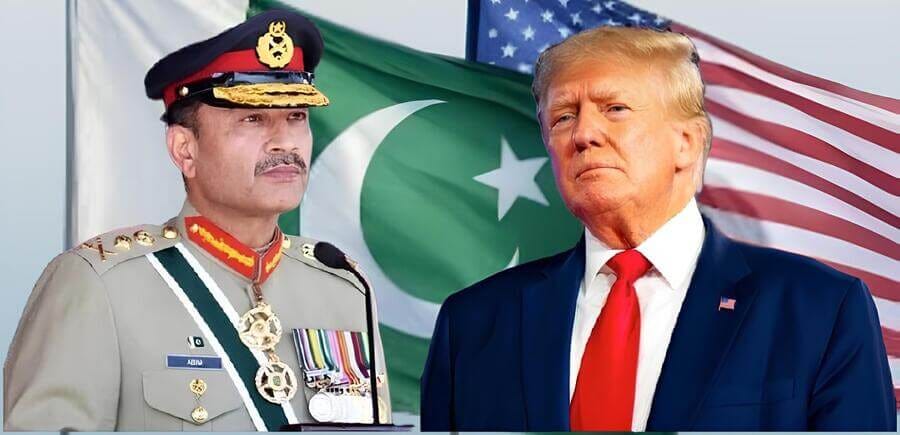
We need to keep revisiting the geopolitical evolvement for Pakistan since the military leadership is taking sequential steps to change the entire system within the country to serve foreign interests and become a close partner with the Washington think tank establishment in the China containment policy.
On August 20, 2026, Pakistan’s National Assembly passed the Defence Forces of Pakistan Act 2026, consolidating operational command of the Army, Navy and Air Force under the current army chief, who holds the office of Chief of Defence Forces concurrently with Chief of Army Staff. The Act grants the CDF authority to retire, discharge, retain or alter the prescribed retirement limits of personnel across all three services, while the federal government and the CDF may issue instructions and amend rules “from time to time” to enforce its provisions. One clause adds that the CDF may exercise “such other powers and perform such other functions as the Federal Government may prescribe.” The bills passed during an opposition walkout and took retroactive effect from November 13, 2025, giving statutory authority to actions taken months before Parliament voted. Thirteen days before the National Assembly vote, Saudi Arabia, Türkiye and Pakistan signed the Mecca Joint Defence Agreement. Nine days after the vote, Donald Blome, the former United States ambassador to Pakistan, was sworn in as Assistant Secretary of State for Near Eastern Affairs, the senior State Department official responsible for the Middle East. The announcements arrived through separate news cycles and bureaucracies, and yet they serve the same project.
Pakistan’s military command is assembling the constitutional, financial and diplomatic infrastructure for a turn towards the American strategic camp. Saudi liquidity, Turkish defence-industrial cooperation, American political acceptance, access to Western finance, critical-minerals supply chains and maritime cooperation form the return. A presidential system, secured through a formal 28th Constitutional Amendment or enough executive instruments to produce the same result, would provide the domestic command structure. Baloch civilians, urban consumers, provincial governments, courts, journalists and a population never asked for its consent would carry the cost. Any serious national strategy must answer a basic test: does it strengthen the freedom and institutions of the country, or does it make the country easier for somebody else to use?
The reported American “green light” for a presidential transition requires precise language. Private assurances between military and intelligence establishments rarely produce a public memorandum. Washington can shape the political environment through White House access, meetings with senior military officials, investment commitments, diplomatic protection, silence on constitutional centralisation and the treatment of Pakistan’s army chief as the decisive representative of the state. The reported understanding amounts to political permission, and the sequence across Islamabad, Rawalpindi, Riyadh, Ankara and Washington supports that assessment. Evidence of a written American instruction has not entered the public record.
The Man Who Knows Both Portfolios
Donald Blome’s career deserves more precise attention than the shorthand descriptions circulating in South Asian media. He is not, as some Pakistani outlets have described him, a Middle East ambassador. As of August 19, 2026, he is the Assistant Secretary of State for Near Eastern Affairs, confirmed by the Senate on a narrow 51-47 vote after the Trump administration’s first nominee for the post, Joel Rayburn, was withdrawn in October 2025 following allegations that he had helped obscure US troop-level numbers in Syria from the president. The Near Eastern Affairs bureau had been without a Senate-confirmed leader since January 2025, a vacancy that coincided with an active Iran war, stalled Gulf diplomacy, and continued Israeli military operations in Gaza and Lebanon. Blome enters the post, as the Jewish News Syndicate reported on August 11, “amid a still-simmering Iran war, ties with Gulf allies strained or in limbo and uncertainty ahead in Gaza and Lebanon,” with no Senate-confirmed US ambassadors in Iraq, Kuwait, Qatar, Saudi Arabia, or the United Arab Emirates.
Blome’s prior postings make his appointment consequential for Pakistan. He served as US ambassador to Pakistan from 2022 to 2025, a period that included the military’s intervention against the Pakistan Tehreek-e-Insaf government, the consolidation of the Shehbaz Sharif coalition, the passage of the 26th Constitutional Amendment and the initial stages of SIFC-led economic restructuring. Before Pakistan, he served as US Consul General in Jerusalem from 2015 to 2018, placing him at the centre of Washington’s diplomatic machinery before the Trump administration recognised Jerusalem as Israel’s capital and folded the independent US Consulate General into the embassy structure. Earlier posts included political counsellor in Kuwait and Kabul, minister-counsellor at the US embassy in Cairo, director of the State Department’s Office of Arabian Peninsula Affairs, and service as its Israel and Iran desk officer. He is fluent in Arabic.
Pakistan formally belongs to the State Department’s South and Central Asian Affairs portfolio, while the political geography now being built runs through Saudi Arabia, the Gulf, Iran, Türkiye, the Arabian Sea and a US-led regional order whose security logic includes Israel even when agreements leave Israel unnamed. The official who represented Washington in Islamabad now manages the bureau responsible for Saudi Arabia, Israel, the Gulf monarchies, Jordan, Egypt, Iraq and the broader Near East. He knows the Pakistani military establishment, the civilian hierarchy, the country’s elite networks and the methods through which foreign relationships become domestic power. Career chronology cannot prove that Blome arranged a constitutional transition. It does place a former US ambassador to Pakistan with senior Jerusalem experience inside the office responsible for the Gulf security system at the moment Rawalpindi is reorganising Pakistan to serve that system. Pakistan policy and Middle East policy are moving closer together, with Blome positioned to treat Pakistan’s military role in Saudi Arabia, its relationship with Türkiye, its mediation with Iran and its value to Washington as one regional file.
The Constitutional Machine
The Twenty-Seventh Constitutional Amendment, passed in November 2025, centralised authority over all three armed services in the office of Chief of Defence Forces, held concurrently by the serving army chief. It granted lifetime immunity from prosecution to a five-star officer, changed constitutional adjudication and extended the tenure of the current occupant of the chair to at least November 2030, with another extension still legally available. Parliament abolished the Chairman Joint Chiefs of Staff Committee, the coordinating post that had balanced the service chiefs, when its final occupant retired on November 27, 2025. The Defence Forces of Pakistan Act 2026 then converted that constitutional position into statutory powers over personnel, operational command and “multi-domain integration,” with retroactive effect. Amendments to the National Command Authority Act passed on the same day placed the CDF at the centre of Pakistan’s nuclear command structure.
One office now commands the Army, exercises operational command over the Navy and Air Force, oversees joint and strategic operations, controls personnel decisions across all three services and sits at the apex of the nuclear command system. The prime minister retains constitutional responsibility for defence and the CDF formally reports to the federal government, and yet the state’s coercive capacity has been concentrated in one military office to a degree without precedent in Pakistan’s constitutional history. Ayub Khan used martial law, Zia ul-Haq used the Eighth Amendment and Musharraf used the Legal Framework Order. The current arrangement acquires comparable power through a parliamentary form equipped with statutory tools to defeat parliamentary restraint.
A formal presidential system would give the existing concentration a civilian executive face capable of negotiating foreign deals, managing resource concessions, making regional security commitments and directing internal policy with less parliamentary resistance. As of late August 2026, the 28th Constitutional Amendment remains political discussion rather than a tabled bill. Reporting by News18 and the Organiser, repeated across South Asian outlets, has linked it to new provinces, changes to the National Finance Commission Award, altered local-government powers and a possible presidential system with a formal military role. Investigative journalist Zahid Gishkori has said the package could touch as many as 117 constitutional articles. Law Minister Azam Nazeer Tarar stated in May that the government had no concrete draft and would require coalition consensus, while the PPP said it had not been consulted. Leaked components, public denial and later parliamentary action formed the sequence before the 26th Amendment in 2024. The public has earned the right to judge the text before another constitutional settlement is negotiated above its head.
The Mecca Subcontract
The Mecca Joint Defence Agreement, signed on August 7, 2026, by Turkish President Recep Tayyip Erdoğan, Saudi Crown Prince Mohammed bin Salman and Pakistani Prime Minister Shehbaz Sharif, establishes a collective-defence clause under which an armed attack on one signatory is treated as an attack on all three. Turkish Foreign Minister Hakan Fidan compared the mechanism to Article 5 of the NATO treaty. The three countries field approximately 1.4 million active military personnel, 3,400 aircraft, 6,000 tanks and more than 340 naval assets, according to the 2026 Global Firepower Index. Their combined annual defence budgets total approximately $124.4 billion: $63.9 billion from Saudi Arabia, $51.4 billion from Türkiye and $9.1 billion from Pakistan.
Foreign Policy observed on August 25 that the agreement creates no central command, route to interoperability or clear obligations for defence spending and procurement. Its immediate substance lies in a political and financial division of labour. Saudi Arabia provides money and demand for security. Türkiye contributes a NATO-linked military, an expanding defence industry and independent arms production. Pakistan contributes trained forces, nuclear status, Chinese-origin weapons and a state structure through which the army can commit national resources with limited legislative interference. The United States supplies the outer permission structure because all three signatories still protect their working relationships with Washington.
The Atlantic Council wrote on August 7 that the Trump administration would probably welcome a burden-sharing pact intended to strengthen regional deterrence against Iran. The agreement gives Washington a tolerable security structure that can reduce the visible American burden in the Gulf while drawing Pakistan deeper into its regional strategy. Pakistan can deploy forces and operate air-defence systems financed by Saudi Arabia, Türkiye can connect Pakistan to Western-linked supply chains, and Riyadh can provide liquidity during recurring balance-of-payments crises. Washington gains so long as the arrangement strengthens Gulf deterrence, restricts Iranian freedom of action and stops China from turning CPEC into an exclusive strategic corridor.
Foreign Policy and a PBS report quoting Islamabad-based defence analyst Abdullah Khan both questioned the pact’s operational substance. Its political signal already has value: Pakistan has declared the availability of its military to the Gulf security system while the command structure, procurement arrangements and deployment rules can be built later. The declaration comes first because availability is the product being sold.
The Weapons Pivot
The Mecca pact rests on a defence-industrial transition already under way. Türkiye became Pakistan’s second-largest arms supplier after China, according to SIPRI’s March 2025 report, which found that Pakistan received ten per cent of Turkish arms exports between 2020 and 2024. The clearest expression is the $1.5 billion MILGEM contract signed in 2018 for four Ada-class corvettes, two built at Istanbul Naval Shipyard and two at Karachi Shipyard and Engineering Works. PNS Babur was delivered in May 2024, PNS Khaibar was commissioned in December 2025, PNS Badr was scheduled for June 2026 and PNS Tariq is expected in the first quarter of 2027. Pakistan has also acquired Bayraktar TB2 and Akinci armed drones, while Baykar reportedly plans a Pakistani assembly facility. Turkish firm STM completed the mid-life upgrade of Pakistan’s Agosta 90B submarines, the two countries are collaborating on air-to-air missiles, and Ankara has reportedly encouraged Islamabad to join its KAAN fifth-generation fighter programme.
Pakistan will remain dependent on Chinese-origin systems across its air, land, naval, missile, air-defence and industrial domains. The JF-17 programme, the Hangor-class submarine acquisition, decades of artillery, armour and small-arms supply, and the maintenance infrastructure behind them cannot be discarded in one political season. Rawalpindi is widening the supply base so that defence readiness no longer depends on one relationship while the political terms of that relationship are being renegotiated.
The Mecca pact supplies the institutional framework. Türkiye becomes the bridge into a defence-industrial ecosystem linked to NATO while retaining room for independent action, Saudi financing can underwrite weapons Pakistan cannot afford from its $9.1 billion defence budget, and the United States can permit selected transfers of targeting pods, avionics and munitions through Turkish intermediation. That route creates dependencies useful to Washington while avoiding some of the congressional scrutiny, end-use monitoring, sanctions risk and political conditions attached to direct US arms sales.
Ports, Minerals, and the Geopolitics of Availability
The Financial Times reported in October 2025 that advisers to the current army chief had approached US officials with a proposal for American investors to build and operate a civilian deep-water terminal at Pasni, a fishing town in Gwadar District, Balochistan, approximately 112 kilometres from the China-backed Gwadar port and 160 kilometres from the Iranian border. The proposed $1.2 billion facility would export copper, antimony, neodymium and other minerals used in batteries and defence technology, financed through Pakistani federal investment and US-backed development funds. The proposal excludes a US military base and includes a railway connecting the port to mineral-rich western provinces, including the Reko Diq copper-gold belt.
In September 2025, Missouri-based US Strategic Metals signed a memorandum of understanding with the Frontier Works Organisation, the Pakistan Army’s engineering arm, to explore cooperation in mineral refining and exports. Pakistan subsequently shipped a small first consignment of copper, antimony and neodymium to USSM. The Lowy Institute described the Pasni proposal as a commercial and logistical partnership that could give the United States a foothold beside expanding Chinese influence without establishing a military base. Dawn’s editorial page noted in October 2025 that neither the government nor the Foreign Office had denied the reported discussions; the only clarification came from unnamed security sources speaking to selected journalists, who said the proposal did not represent official policy.
Pasni would create an American commercial node beside Chinese infrastructure without formally displacing Gwadar’s concession framework. Pakistan could invite US participation near CPEC while retaining enough ambiguity to reassure Beijing. No binding agreement has been finalised, but the proposal tests a clear model: offer minerals and logistics in commercial language, draw value from rival patrons and grant neither exclusive access. International-relations literature calls this hedging. For Pakistanis, the judgement must rest on a harder standard of sovereignty: who controls the assets, who receives the proceeds and who absorbs the cost?
The Class Interest Behind the Pivot
Pakistan’s military elite has spent decades settling families, educating children, investing wealth and planning retirement in the United States, the United Kingdom, Canada, the Gulf and Western Europe. The Pandora Papers, published by the International Consortium of Investigative Journalists in 2021, identified offshore holdings connected to several former military officers and their families, including a British Virgin Islands company controlling a London property. Fact Focus’s September 2024 investigation documented a former corps commander with properties in Manhattan, London and Dubai acquired during and shortly after his service, while reporting gaps remained over values and sources of income.
These holdings create a class interest that constrains foreign policy. An officer corps whose children attend American and British universities, whose retirement properties sit in London and Dubai, whose medical treatment takes place in Western hospitals and whose reserves are held in dollar-denominated instruments has a material interest in avoiding sanctions, travel bans and asset freezes. China supplies arms, infrastructure, diplomatic cover and project finance, while the West supplies the social and financial system in which Pakistan’s military elite has chosen to build its life after service. A managed turn towards Washington protects that choice.
Strategic diversification also has a valid security logic because concentrated Chinese influence leaves Pakistan vulnerable. The Mecca pact creates additional channels for finance and military cooperation, Pasni could open a commercial route beside CPEC, and the Turkish defence relationship reduces reliance on Chinese platforms. Those choices are being made by an institution whose senior members also hold personal stakes in Western access. Strategic calculation and class interest therefore run in the same direction, helping explain the speed of the turn and the weakness of resistance inside the system.
China’s Veto Without Soldiers
Rawalpindi’s confidence in a Western turn rests on a judgement about China’s limits. Beijing can punish Pakistan financially but has avoided the sustained ground deployments that defined American wars in Afghanistan and Iraq. It maintains a military base in Djibouti, deploys naval forces, conducts evacuations, expands arms transfers and relies on private contractors, police cooperation, surveillance systems and host-state forces. Attacks on Chinese nationals and CPEC projects produced a new joint security unit in January 2026, with Pakistani police training and faster response mechanisms. Pakistan supplies the personnel and carries the risk while Beijing sets the security demand.
China can make a Pakistani strategic switch expensive without stationing troops in Gwadar. Pakistan’s external public debt reached $91.8 billion in June 2025, while gross external financing requirements for 2025-26 were projected at $19.4 billion. Chinese loans total approximately $29 billion, or roughly 22 per cent of Pakistan’s external debt, according to the World Bank’s International Debt Report. Chinese and Saudi deposits exceeding $10 billion remain inside the State Bank reserve structure; reserves stood at $17.1 billion on August 21, 2026, equal to about 2.6 months of imports. Beijing can slow debt rollovers, harden refinancing terms, postpone CPEC commitments, reduce investment, demand new security concessions and alter supplies, maintenance, spare parts and munitions for systems Pakistan has integrated over decades. It can also withhold diplomatic support when Islamabad needs China on India, Afghanistan, debt negotiations or multilateral disputes. Administrative decisions provide the veto.
Asia Times wrote in April 2026 that Pakistan’s defence readiness depends on Chinese supply chains, maintenance, technical training and industrial cooperation that “cannot be discarded in a single political season.” A rapid move into US systems would substitute congressional scrutiny, end-use monitoring, sanctions exposure, technology restrictions and political conditions for Chinese influence. Rawalpindi is therefore pursuing diversification through Türkiye, which offers access to Western-linked defence technology without immediately reopening the full history of suspensions and interference attached to direct US-Pakistan arms relations.
The Domestic Machine
A presidential system would supply the domestic mechanism for the external turn. Rawalpindi wants Pakistan to operate as a US-aligned Gulf security partner, minerals supplier, maritime logistics state, Turkish defence-industrial collaborator and managed counterweight to Chinese expansion. Parliamentary bargaining, provincial objections, judicial review, investigative reporting and organised political opposition place friction between that programme and the public resources it requires. The proposed system would remove much of that friction by placing policy, coercive power and foreign negotiation behind one executive chain.
Balochistan carries a documented history of armed conflict, forced displacement, political exclusion, enforced disappearances, resource extraction and state violence. HRCP and Paank documented 1,355 enforced disappearances in 2025 alone. Port arrangements, mineral concessions, deployments, intelligence access and defence-industrial agreements face resistance when elected legislatures, provincial governments, courts, local communities, labour organisations and journalists can inspect their terms. A presidency gives foreign patrons one negotiating office, gives the state one chain for approving contracts and deployments, and gives the security apparatus one vocabulary for classifying opposition as separatism, sabotage or disloyalty. That efficiency serves the deal by denying Balochistan the right to decide what happens to its land.
The existing constitutional framework has already reduced those obstacles. The concurrent CDF role centralises command, lifetime immunity removes a future route to accountability, judicial restructuring weakens a court system that has sometimes complicated military plans, and the extension to 2030 gives the current command time to pursue a regional and economic redesign beyond one electoral cycle. A formal presidency would complete the political side by converting military-centred authority into state doctrine, giving it an executive face and insulating it from parliamentary partners Rawalpindi regards as unreliable.
Washington can benefit without designing the doctrine, Riyadh can benefit without endorsing constitutional centralisation, and Ankara can benefit without commenting on Pakistan’s internal system. Each gains from an executive able to make commitments without public disruption. They will call it stability, and yet the cost reaches Balochistan through coercive control of ports and minerals, reaches urban Pakistan through utility bills and IMF conditions, reaches the provinces through centralised resource decisions, and reaches the courts and political parties through the loss of their power to restrain the executive.
Pakistan’s rulers have made such wagers before. The Cold War alignment with the United States brought bases, alliances and strategic attention before the Afghan war’s consequences reached Pakistan. The post-September 11 partnership brought $33 billion in coalition support funds and military reimbursements alongside drone strikes, Raymond Davis and the unilateral Abbottabad operation. CPEC brought $65 billion in pledged investment alongside debt, stalled projects, energy obligations and a security bill the state struggles to pay. The state received each promise at the top while ordinary Pakistanis carried the debt, inflation, insecurity and institutional damage after the patrons moved on.
The current wager may produce Saudi deposits, Gulf contracts, Turkish production capacity, American diplomatic favour and mineral revenue. Pakistan should judge those benefits by what reaches its people, what remains under public ownership and what survives a change of patron. An arrangement built through external patronage and internal concentration makes the state more available to foreign powers while making its rulers less answerable at home. Pakistan has paid for that bargain before.


