The Surgeon Who Stayed
Israel took him from an operating table, put him in a prison yard, and has never explained why he is dead.
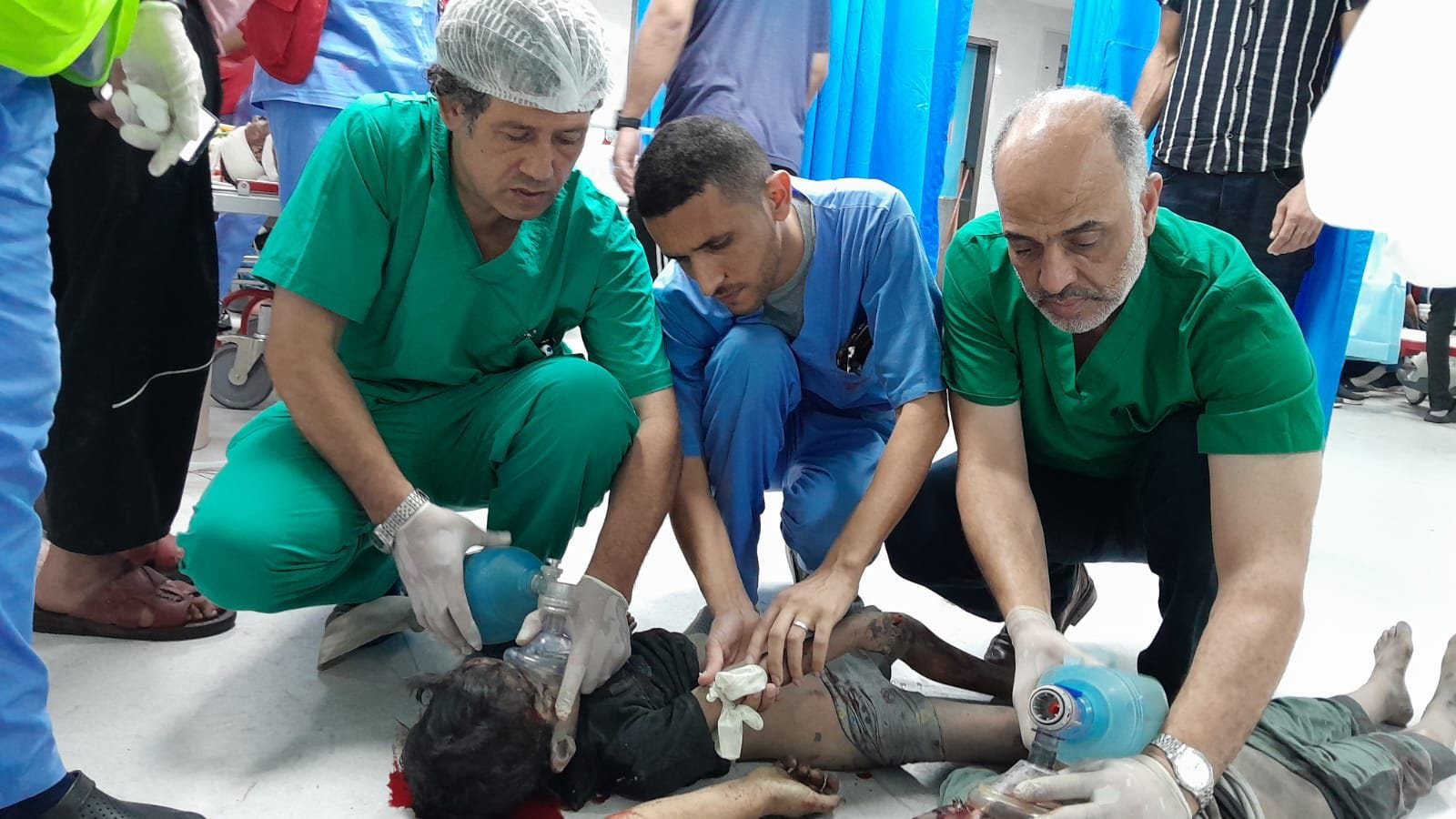
Over two and a half years ago, Israeli soldiers entered Al-Awda Hospital in North Gaza and walked past the patients to find the doctors. Among the men they took that morning was Dr. Adnan Al-Bursh, fifty years old, head of orthopedics at Al-Shifa Hospital, the Gaza Strip’s principal referral facility and the institution through which the worst trauma cases in the territory had flowed for decades. He was treating patients when they arrived. He had been treating patients through bombardments, power cuts, supply collapses, and every prior episode of Israeli military operations since the Second Intifada, and when the October 2023 war began and Israeli forces ordered all medical staff in the north to evacuate south, Al-Bursh did not go. His colleagues from that period, those who survived to speak publicly, give a consistent explanation: the patients could not leave, so he did not leave. It was not a political statement. It was a man standing by the oath he had taken thirty years earlier and had not once broken.
Four months and one day after soldiers removed him from the hospital ward, on April 19, 2024, Adnan Al-Bursh died in Ofer Prison in the occupied West Bank. He had never been charged with a crime. No indictment was filed. No security file was made public. No evidence was ever produced linking him to any act of violence, any weapons cache, any operational role in the conflict that had consumed the territory where he had spent his career. His body was not returned to his family. The location of his grave has not been disclosed by Israeli authorities, and no Israeli military official, prison administrator, or government minister has faced any criminal accountability for his death. His family cannot bury him because they cannot find him, and Israel has not explained why.
What the documentation assembled by the United Nations, by Physicians for Human Rights Israel, by Human Rights Watch, by Addameer, by B’Tselem, by the Euro-Mediterranean Human Rights Monitor, and by journalists working from released-prisoner testimony reveals about how Al-Bursh died is inseparable from what Israel has been operating inside its detention facilities since October 7, 2023. It is a story of deliberate, systematic cruelty on a scale that the institutions assembled after the Second World War were specifically designed to prevent and punish, and those institutions have now spent two years documenting it in formal reports, in legal submissions, in testimony coded against the Nelson Mandela Rules and the Geneva Conventions, in press releases from Geneva that name names and describe methods. They have documented it. They have not stopped it.
What Happened at Sde Teiman
Before Ofer Prison, there was Sde Teiman. The military detention base sits in the Negev desert, near the Gaza border, and since October 2023 it has served as the primary initial processing facility for Palestinians swept up by Israeli forces during operations inside the Strip. Detainees are transported there blindfolded and shackled, usually at night, without any explanation of the legal basis for their detention, and the International Committee of the Red Cross, the body specifically mandated under the Geneva Conventions to monitor the treatment of prisoners of war and conflict detainees, has been denied access to the facility for more than two years. Israel has offered no public legal explanation for that denial.
The UN Human Rights Office published its report on arbitrary detention in July 2024, and UN Human Rights Chief Volker Türk issued a formal press release whose language was among the most direct the Office has produced in its history of reporting on Israeli conduct. “The testimonies gathered by my Office and other entities indicate a range of appalling acts, such as waterboarding and the release of dogs on detainees, amongst other acts, in flagrant violation of international human rights law and international humanitarian law,” Türk said. The testimonies described detainees held in cage-like enclosures, stripped naked for prolonged periods and made to wear only diapers, subjected to prolonged blindfolding, and deprived of food, sleep, and water for days at a time. They described electric shocks, burns from cigarettes pressed into skin, suspension from the ceiling by chains attached to handcuffs, and dogs being released onto restrained detainees who could not move to defend themselves.
Dr. Khalid Hamouda, a Palestinian physician held at Sde Teiman at the same time as Al-Bursh, later gave testimony to human rights investigators. When he encountered Al-Bursh at the facility, the surgeon could barely walk or use the toilet without assistance. Al-Bursh told him he believed his ribs had been broken. The injuries were plainly visible. When Al-Bursh was subsequently transferred to Ofer Prison, fellow prisoners described his condition to investigators at HaMoked, the Israeli human rights organisation that has been documenting detention abuse for decades: severe injuries across his body, visible evidence of sustained physical assault, the state of a man who had been beaten with deliberate, prolonged force. Prisoners carried him to a cell, and he died there, in a room inside a prison he had been sent to without charge, without a lawyer, without any process that any court in any democratic state would recognise as law.
In August 2024, an Israeli television station broadcast leaked CCTV footage from Sde Teiman showing guards abusing a Palestinian detainee. Five soldiers were subsequently charged with “employing severe violence against the detainee, including stabbing him in the buttocks with a sharp object that penetrated near his rectum.” The detainee had sustained cracked ribs, a punctured lung, and a rectal tear requiring hospitalisation. The footage existed, the injuries were documented, and the charges were filed. In March 2026, Israel’s military advocate general dismissed all charges against all five soldiers. Prime Minister Benjamin Netanyahu publicly commended the decision. Yael B, executive director of the Against Torture organisation, told reporters that the dismissal amounted to Israel’s military granting its soldiers “license to rape” provided the victim is Palestinian, and B’Tselem described the exoneration as consistent with a documented pattern in which Israeli soldiers who abuse Palestinian detainees face no legal consequence regardless of the evidence against them.
The Systematic Record
The cases of Al-Bursh and the Sde Teiman CCTV incident are not exceptional data points on a record that is otherwise clean. They are the visible surface of a system whose full scope has been documented across 917 testimonies gathered between October 2023 and June 2025 by Addameer, the Palestinian prisoner support and human rights association, which published its analysis in October 2025 in the Torture Journal. The researchers coded those testimonies thematically against the Nelson Mandela Rules, the Geneva Conventions, the Convention Against Torture, and the International Covenant on Civil and Political Rights, and they found consistent, escalating abuse across six facilities: Sde Teiman, Ofer, Damon, Naqab, Megiddo, and others. In the late-2023 period, 73 of 91 testimonies described torture or serious ill-treatment. Through 2024, that figure rose to 500 of 628. In the first half of 2025, it reached 184 of 198, meaning that of every Palestinian detainee whose testimony was gathered in that period, all but fourteen described being subjected to torture or treatment that violated every international legal instrument to which Israel is a formal signatory.
Starvation was documented as deliberate, not incidental. Detainees at multiple facilities described receiving one small piece of bread and a few olives per day for weeks on end, insufficient to sustain basic physiological function in people being held in stress positions for hours at a time and denied sleep for extended periods. Palestinian journalists held at Israeli detention facilities told the Committee to Protect Journalists in February 2026 that they had been denied food until they were unable to stand, that guards used the provision of food as a coercion tool, and that requests for medical assistance were routinely ignored. B’Tselem’s January 2026 report compiled testimony from survivors describing beatings with batons, prolonged forced kneeling on sharp stones, mock executions in which soldiers pressed weapons to detainees’ heads, and conditions of deliberate filth in which detainees were denied hygiene for weeks while being forced to sit in their own waste in temperatures that medical professionals described as physiologically dangerous.
The sexual violence documented across these facilities does not appear in a single testimony or a single report. It runs through the entire evidentiary record across multiple independent organisations working from separate sources. One survivor’s account published in the B’Tselem report reads directly: “During the torture, one of the soldiers raped me. He shoved a wooden stick up my anus, left it there for about a minute, and pulled it out.” The Palestinian Prisoners’ Club, operating from Ramallah, had by October 2025 confirmed ten cases of rape using objects in Israeli detention, and its director stated publicly that the documented number was significantly lower than the actual number because most survivors would not speak for the record, afraid of retaliation against family members still inside Gaza and afraid of the particular social shame these acts were designed to produce in communities where sexual assault carries stigma for the survivor rather than the perpetrator.
The April 2026 Euro-Mediterranean Human Rights Monitor report, drawing on testimonies from former detainees compiled by researchers tracking the system since October 2023, concluded that sexual violence in Israeli detention constitutes “an organised state policy” endorsed at the “highest political, military, and judicial authorities.” The report documented the testimony of a 42-year-old woman from North Gaza held at Sde Teiman, bound naked to a metal table, and raped repeatedly by two masked soldiers over two days, left shackled and bleeding overnight before the soldiers returned. She told investigators she had wished for death during those hours. The same report documented the use of trained military dogs as instruments of sexual assault against male detainees, a practice also referenced in testimony compiled by Al-Araby TV journalists from the Palestinian Prisoners’ Club archive in Ramallah and confirmed in reporting by Nicholas Kristof in The New York Times. The UN Committee Against Torture, in November 2025, formally described evidence of “a de facto state policy of organized and widespread torture and ill-treatment” of Palestinian detainees and noted that documented abuse had “seriously intensified” after October 7, 2023. The Israeli government rejected the characterisation without engaging the specifics of the evidence.
The Legal Architecture of Impunity
None of what happened to Adnan Al-Bursh, or to the hundreds whose testimonies now fill the archives at Addameer and the case files at B’Tselem, occurred in a legal vacuum or in spite of Israeli law. It occurred because Israeli law, amended and expanded after October 7, 2023, was constructed to permit it. The Unlawful Combatants Law, revised in the immediate aftermath of the Hamas attacks, extended Israeli authorities’ power to detain Palestinians from Gaza without charge, without judicial oversight, and without access to legal representation for periods that would be unconstitutional in any liberal democratic state whose government claims to honour the rule of law. The amendments lengthened the permissible period of incommunicado detention and delayed judicial review in ways specifically designed to remove the period of most intensive abuse from any possibility of legal scrutiny. The practical effect was to convert facilities like Sde Teiman into jurisdictional voids, sites that +972 Magazine and the Euro-Med Monitor described as “black holes,” where the normal prohibitions of Israeli civil law were suspended and international monitors were barred from entry.
Administrative detention, a mechanism Israel inherited from the British Mandate’s Defence (Emergency) Regulations of 1945 and has maintained and expanded through military orders in the occupied territories across more than five decades, permits the indefinite imprisonment of individuals on the basis of secret security files that neither the detainee nor their lawyer is permitted to see, challenge, or rebut. It is detention without accusation, imprisonment without trial, and its use expanded dramatically after October 7, 2023, to numbers not seen since the First Intifada. Of the 431 Palestinian healthcare workers detained since the start of the conflict, many were held under this mechanism with no access to legal process of any kind. As of October 2025, 95 remained in Israeli detention, having spent an average of 511 days in custody. As of May 2026, Physicians for Human Rights Israel was petitioning the Israeli Supreme Court for the release of fourteen Palestinian doctors held without charge, arguing in formal legal submissions that continued detention without legal basis under documented conditions of abuse constituted a violation of both Israeli law and the international instruments to which Israel is bound.
The question of what those instruments require is not complicated or contested. The UN Convention Against Torture, which Israel ratified, prohibits torture and cruel, inhuman, or degrading treatment without exception and without derogation, including in conditions of armed conflict. The Fourth Geneva Convention explicitly protects medical personnel performing humanitarian functions from detention, violence, and coercion. Article 3 common to all four Geneva Conventions prohibits violence to the life, health, or physical well-being of persons not taking active part in hostilities. Adnan Al-Bursh was detained from a hospital ward, never charged, tortured, and killed, and every element of that sequence is a clear violation of instruments that have existed in international law for more than seventy years, that Israel has formally adopted, and that the governments supplying Israel with weapons and diplomatic protection have also formally adopted and regularly invoke in other contexts as the foundation of the international order.
The Healthcare System as Target
The detention and killing of medical workers did not happen alongside the destruction of Gaza’s healthcare infrastructure. It was part of it, one dimension of a coordinated campaign whose effect, whatever its stated intent, has been the comprehensive destruction of the medical capacity of a civilian population of 2.3 million people. By mid-2024, more than 34 of Gaza’s 36 hospitals had been damaged or rendered non-functional through direct strikes, military raids, or the destruction of the power and water systems they depended on to operate. Al-Shifa Hospital, where Al-Bursh had spent his career building the orthopedic department into the primary referral service for complex trauma across the entire Strip, was raided twice by Israeli forces. During those raids, physicians were detained and others were killed, and the hospital that had served as the central node of Gaza’s trauma response was left in ruins from which it has not recovered. The WHO confirmed the detention of at least 214 healthcare workers while on duty by May 2024, and by early 2026 the Healthcare Workers Watch tally of Palestinian healthcare workers killed by Israeli forces since October 7, 2023, stood at more than 1,200.
Dr. Hussam Abu Safiya, the director of Kamal Adwan Hospital in northern Gaza, was detained by Israeli forces in December 2024 while the hospital was still attempting to function under bombardment, still treating the wounded arriving from strikes on residential buildings in the area. Testimony gathered by his legal representatives and published by Front Line Defenders in February 2025 described a systematic process that had become entirely predictable to anyone who had been reading the testimony archives: forced stripping and photographing at the point of detention, handcuffing and blindfolding during transport, kneeling on sharp stones on arrival, electric shocks, sustained baton beatings, twenty-five days in solitary confinement, and deliberate starvation that had by the time he was permitted minimal lawyer contact removed fourteen kilograms from his body weight. The BMJ reported in 2026 that Abu Safiya remained in Israeli detention, his administrative detention period extended without charge, without trial, and without any of the procedural protections that international law requires to be afforded to everyone. The BMJ Global Health journal, in research published in February 2025, described Israel’s detention and killing of medical personnel as “an integral aspect of the intentional disintegration of the Palestinian healthcare system,” a framing that placed the individual deaths not as operational accidents but as elements of a strategy, documented, deliberate, and ongoing.
The Man Himself
Before soldiers took him from Al-Awda Hospital on that December morning, Adnan Al-Bursh had spent his professional life building something inside a system specifically designed to prevent anything from being built. Gaza’s medical sector had operated under Israeli blockade since 2007, which meant constant shortages of medications, imaging equipment, anaesthetic supplies, surgical instruments, and the spare parts needed to keep operating theatres functioning in a territory that had been systematically de-developed for nearly two decades before the October 2023 war began. Al-Bursh worked through all of it, through the blockade years and the 2008-09 war and the 2012 operation and the 2014 war and the 2021 bombardment and the recurring cycles of destruction that had characterised life in Gaza throughout his career. He trained surgeons at Al-Shifa, creating practitioners capable of handling the specific trauma profile of a population living under periodic aerial bombardment: blast injuries, crush fractures from collapsing residential buildings, the particular pattern of orthopedic damage produced by the kinds of munitions that Israel deployed at scale. He performed complex procedures under conditions that would have caused any Western hospital to suspend operations, conditions that required improvisation not as an emergency response but as the permanent baseline of professional life.
The claim that circulated after his death, that he had performed more than twenty surgical operations in a single day during the acute phase of the October 2023 conflict, is consistent with everything that every Gaza surgeon who has spoken publicly describes of those weeks: shifts measured by physical exhaustion rather than by hours, patients arriving faster than any system could process them, decisions about who could be saved being made not by triage protocols but by the limits of men who had been standing at operating tables through the night and into the following day and beyond. He refused to evacuate when Israeli forces issued their orders to move south, and his colleagues do not describe this as a difficult decision or a moment of heroism requiring explanation. There were patients in the north who could not be moved. There were wounds that needed a surgeon. He stayed because staying was the only thing consistent with the oath he had taken and the profession he had practised, and the soldiers found him there, doing exactly what he had spent his career doing, and they took him anyway.
His family could not bury him in Gaza. Two years after his death, they do not know where his body is, and the state that killed him has not offered an explanation, has not disclosed the grave, has not offered any accounting of what happened to the man they detained without charge from a hospital ward and returned to no one. That is not administrative neglect or bureaucratic oversight in a state managing the pressures of war. It is a deliberate final act against a family that has already lost everything, the last exercise of power over a man who could no longer resist it.
The Gap That Has Not Closed
The UN Special Rapporteur on the Right to Health demanded an independent investigation in May 2024. Human Rights Watch published its investigation of the torture of healthcare workers in August 2024. Physicians for Human Rights Israel published its report in February 2025. Addameer’s analysis of 917 testimonies was published in October 2025. The UN Commission of Inquiry formally described the situation in Gaza as genocide in September 2025. B’Tselem published its report on the Israeli prison system as a network of torture camps in January 2026. The Euro-Med Monitor published its report on sexual torture as organised state policy in April 2026. In June 2025, more than two dozen civil society organisations including Amnesty International, Human Rights Watch, and Médecins du Monde issued a joint statement demanding the immediate release of all unlawfully detained medical personnel, citing the documented pattern of torture deaths and the specific cases that had accumulated since October 2023.
No Israeli official has been prosecuted for the death of Adnan Al-Bursh. The five soldiers charged with sexually assaulting a detainee at Sde Teiman had their charges dismissed in March 2026 and received congratulations from the prime minister. The ICC arrest warrants issued for Netanyahu and former Defense Minister Yoav Gallant in November 2024 for crimes against humanity and war crimes remained unexecuted as of June 2026, with neither man having been detained by any jurisdiction. The United States, which supplies Israel with the weapons, the diplomatic cover at the UN Security Council, and the annual military assistance package that funds the operations inside which these detention facilities function, has not conditioned any of that support on accountability for a single documented torture death. The European Union, whose member states have signed and ratified the Convention Against Torture and whose foreign ministers issue periodic statements about the importance of international humanitarian law, has imposed no sanctions on any individual connected to the facilities where Palestinian detainees have been raped, starved, beaten, and killed.
What this means, stated without embellishment, is that the governments that built the post-war international legal order and continue to invoke it as the foundation of the international system have decided, through the accumulation of specific choices made over more than two years, that it does not apply to Palestinian detainees in Israeli prisons. The documentation assembled by the UN, by Israeli human rights organisations, by international NGOs, and by journalists working from testimony gathered at considerable risk does not lack credibility or evidentiary specificity. It lacks consequence because the governments with the power to impose consequence have chosen not to, and that choice is actively renewed every day that Abu Safiya remains in an Israeli cell without charge, every day that the grave of Adnan Al-Bursh remains undisclosed to his family, and every day that the facilities at Sde Teiman and Ofer and Naqab continue to operate without independent oversight, without ICRC access, and without any accountability for what is done inside them to the people who have been placed there by force.


