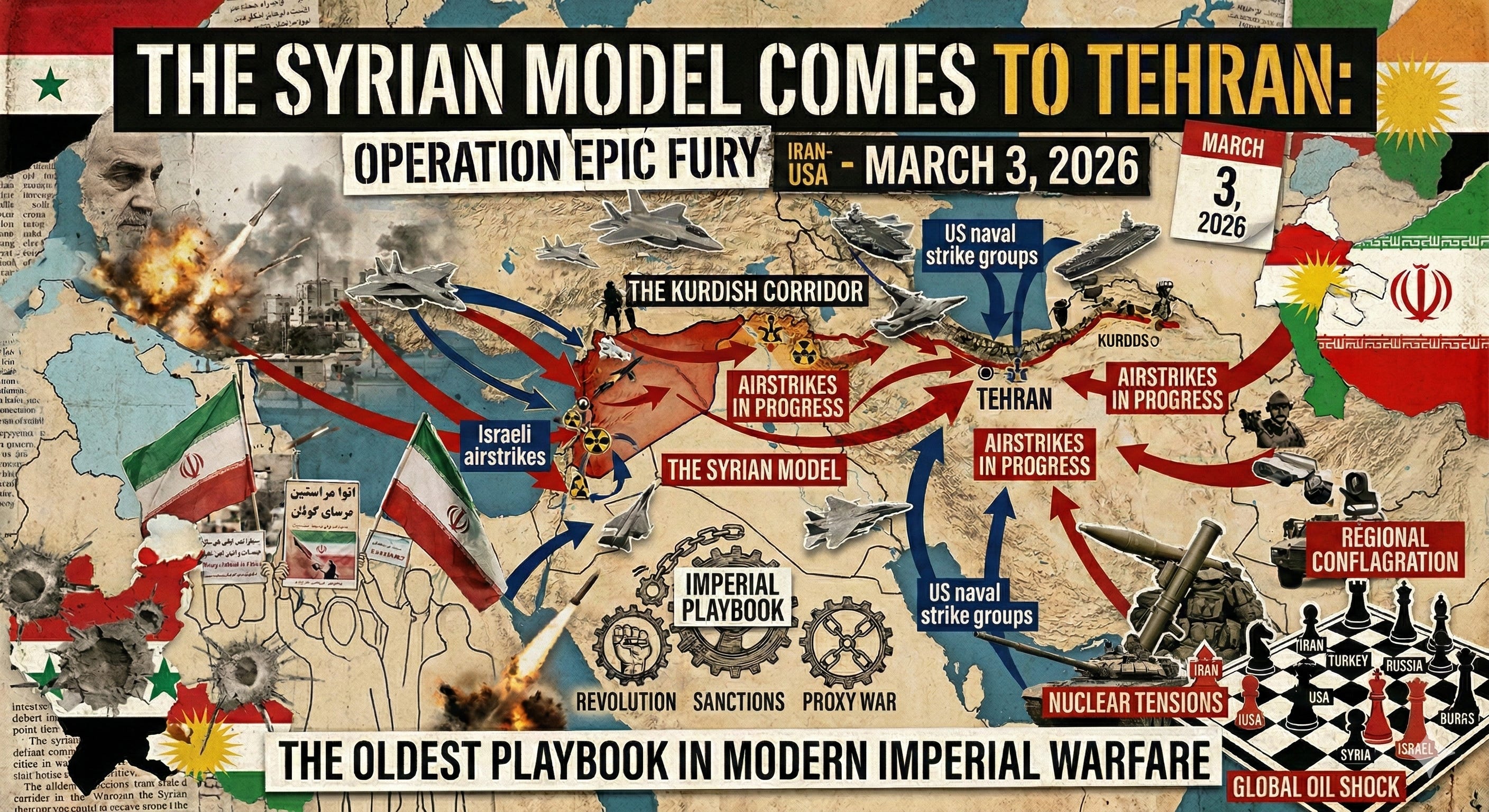
The Syrian Model Comes to Tehran
Operation Epic Fury, the Kurdish Corridor, and the Oldest Playbook in Modern Imperial Warfare
There is a body in the rubble of a border post in West Azerbaijan Province. Twenty-two more at the Mehran Border Regiment in Ilam. Both posts sit along Iran’s northwestern frontier, the one that faces Iraqi Kurdistan, the one through which armed men have been trying to cross since January. The strikes that killed those border guards were not accidents of targeting. They were the architecture of a second front, delivered from the air to clear the path for what comes next on the ground.
This is not how the story is being told in Washington. There, the language is familiar: imminent threat, nuclear ambition, regime terror, freedom for the Iranian people. The same sentence structure was used for Iraq in 2003. The same grammar for Libya in 2011. The same paragraph, nearly word for word, for Syria from 2011 through 2024. The words change enough to require a new press conference. The structure does not change at all.
On February 28, 2026, the United States and Israel launched Operation Roaring Lion and Operation Epic Fury simultaneously against Iran. They struck Tehran, Isfahan, Qom, Karaj, and Kermanshah. They aimed to induce regime change and to address concerns regarding the nuclear programme. The strikes are reported to have caused both military and civilian casualties. By March 1, the Iranian state broadcaster confirmed what the bombs had done to Ali Khamenei. The supreme leader was dead. His compound was destroyed. His daughter, son-in-law, and grandson were killed alongside him.
Pentagon briefers acknowledged to congressional staff that Iran was not planning to strike US forces unless Israel attacked Iran first, undercutting the administration’s claim of an imminent threat as a reason to launch strikes. The justification dissolved the moment someone told the truth about it. What remained was the operation itself, already running, already killing, already executing a template that everyone in the region recognizes because they have watched it destroy their neighbors for the past two decades.
Begin where the damage began: not at the airbase, not at the targeting cell, but at the currency desk.
US Treasury Secretary Scott Bessent claimed that Washington engineered a dollar shortage in Iran to send the Iranian rial into freefall and cause protests in Iran. He said this openly. He did not describe it as a consequence of sanctions policy or an unintended byproduct of financial pressure. He described it as a deliberate mechanism for generating domestic unrest. The dollar shortage was a weapon, wielded against 90 million people, calibrated to produce the kind of desperation that fills streets.
It worked, or at least it worked in part. By late December 2025, the protests had begun. Merchants at Tehran’s Grand Bazaar struck first. In the corridors of the gold market, the currency exchange, the fabric bazaar, shutters came down. The Bazaar became a war zone. Within weeks the protests spread across all 31 provinces, reaching the Kurdish west and the Baloch south, the industrial cities and the university campuses. US-based Human Rights Activists News Agency estimated the death toll at 7,000. The Iranian government said 3,117. Donald Trump said 32,000. None of these numbers could be independently verified because Iran imposed a near-total internet blackout, with connectivity dropping to as low as 1 to 4 percent of normal levels.
The Starlink terminals that activists had smuggled in kept some of it visible. Starlink satellite internet service was unaffected, allowing users to bypass government-controlled internet blackouts. What the world saw through those terminals was security forces firing into crowds, families forced to pay for the bullets that killed their children before they could retrieve the bodies, and in Kurdish areas, eyewitnesses who reported that the forces conducting the killings did not speak Persian. In Karaj, an eyewitness said the forces spoke Arabic and took selfies with the bodies. Iran had imported its repression. A source told CNN that nearly 5,000 fighters from Iraqi militias had crossed into Iran over the preceding weeks. The regime was suppressing its own population with foreign soldiers, paying each one $600 per engagement.
This is where the Syrian model begins. Not at the military phase, but at the moment a government becomes so frightened of its own people that it imports foreign killers to stand between them. Assad did it. Gaddafi did it. The pattern is structural.
Study the sequencing and you find preparation where the official narrative insists there was only reaction.
The Mossad’s official Farsi X account posted on December 29, 2025, three days after the protests began: “We are with you. Not only from a distance and verbally. We are with you in the field.” This was not diplomatic solidarity. Intelligence agencies do not publish operational disclosures on social media by accident. This was a message to networks already in place, a signal that the window the protests had opened would not close without being used.
Mossad Director David Barnea had stated after the June 2025 strikes that Israel “will continue to be there, as we have been there.” Former CIA Director and Secretary of State Mike Pompeo went further, wishing “Happy New Year to every Iranian in the streets. Also to every Mossad agent walking beside them.” Not adjacent to them. Beside them.
Israeli Heritage Minister Amichai Eliyahu told Army Radio in January: “When we attacked in Iran during Rising Lion, we were on its soil and knew how to lay the groundwork for a strike.” The June 2025 campaign had not only degraded Iranian air defenses. It had pre-positioned. Assets inside the country were established not for the June operation but for the one that would follow it.
Ahron Bregman of King’s College London, who has written extensively on Israeli intelligence operations, assessed in January 2026: “I assume there are Israeli agents on the ground, reporting back on the situation from the streets, particularly now that the internet in Iran is down. Operationally, it is easier to do things on the ground as it is so chaotic now.” The internet blackout the regime imposed to suppress the protests had paradoxically created the conditions for deeper covert penetration. In a country running at 4 percent connectivity, no one was watching.
When Operation Roaring Lion began on February 28, the cyber layer activated in precise coordination with the bombs. Israel conducted coordinated cyberattacks on Iranian infrastructure, media, and phone applications. The BadeSaba Calendar prayer app, with over 5 million downloads, was compromised and broadcast push notifications in Persian urging military personnel and citizens to defect, lay down weapons, and join opposition forces. The messages read “Help has arrived” and “It’s time for reckoning.” The state broadcaster was hit. Phone networks were disrupted. The psychological operation and the kinetic operation ran simultaneously from the same command structure.
Unspecified sources told anti-regime media that parts of Iran’s chain of command have been disrupted, leading to issues in relaying directives and operational coordination. Some military commanders and lower-ranking personnel have stopped reporting to their bases and military centers due to fears of strikes.
By March 2, four days into the campaign, Al Arabiya reported that Israeli special forces and Mossad operatives had carried out a ground operation inside Iran. No further details were provided. Israel carried out a ground operation in Iran on Tuesday night involving Mossad and special forces. Israeli authorities issued no response to the report. Their silence was the confirmation.
Watch the targeting pattern from March 1 and the sequencing becomes visible.
The combined US-Israeli force targeted the West Azerbaijan Provincial Border Guard. West Azerbaijan Province is located along Iran’s border with Turkey and Iraqi Kurdistan. The combined force separately struck the Mehran Border Regiment in Ilam Province, killing 22 security personnel. Mehran is also located along the Iran-Iraq border.
These were not high-value strategic targets in the conventional sense. They were border posts. The people who died there were guards, not generals. The reason for striking them is stated explicitly in Russian and Eastern European military analysis being circulated in real time: these strikes are considered preparation for the penetration of Kurdish groups, as well as possibly more trained American and Israeli groups from Iraq into Iran in order to seize a foothold on its territory.
The evidence assembled over the preceding six weeks supports exactly this reading.
On February 22, 2026, five major Iranian Kurdish parties formed the Coalition of Political Forces of Iranian Kurdistan. This coalition, assembled six days before the bombing campaign began, brought together the KDPI, PAK, Komala, and allied organizations, precisely the armed parties maintaining bases in Iraqi Kurdistan from which operations inside Iran are staged. The timing of the coalition’s formation relative to the launch date of Operation Roaring Lion is not a coincidence.
Kurdish Iranian opposition groups said on March 1 that they have been targeted by drone and missile attacks in the Kurdistan Region of northern Iraq. The Kurdistan Freedom Party distributed footage of what it claimed was a drone attack. Several other Kurdish opposition groups also said they were targeted. Five of the groups recently agreed to form a coalition against the Iranian regime.
The Kurdistan Region became a major target of Iranian missile strikes, as US presence in the rest of federal Iraq had been significantly reduced since 2020 but increasingly redeployed to the autonomous region, which also hosts armed Iranian Kurdish opposition parties. US President Donald Trump spoke with leaders of the Kurdistan Region’s two main factions, Masoud Barzani and Bafel Talabani, a day after the bombing campaign began, discussing what were described as “sensitive” topics.
That conversation happened within 24 hours of the opening strikes. That is not diplomacy. That is coordination.
These organizations have been fighting a low-level insurgency inside western Iran since 2016. Armed Kurdish separatist groups had already attempted to cross from Iraq into Iran in January 2026. Iranian officials claimed the fighters were repelled by the Revolutionary Guards after a tip from Turkish intelligence. Turkey warned Iran in January. Turkey’s NATO membership and its own complicated relationship with Kurdish politics meant that even Ankara, which had enabled the proxy war in Syria through its MIT intelligence service, was not yet ready for a full escalation on the Iranian Kurdish front.
By March 1, with the border guards dead and the US strikes opening corridors in West Azerbaijan and Ilam, the calculus had changed. What was probing in January had become operational.
The southern front runs in parallel. The Mobarizoun Popular Front, a coalition of Baloch anti-regime groups, killed an Iranian Law Enforcement Command officer in Iranshahr, Sistan and Baluchistan Province, on January 7, in response to the regime’s violent crackdown on protesters. The group had previously warned that it would respond to “every bullet” fired by Iranian security forces at protesters. The Sistan-Baluchistan province sits at the intersection of Iran, Afghanistan, and Pakistan. It is the farthest point from Tehran’s center of gravity. It is the hardest province to reinforce. It has been burning for years.
The logic of the two-front ethnic strategy is not hidden. A state whose military is simultaneously absorbing 2,000 aerial strikes, managing urban unrest across 31 provinces, deploying forces to suppress protests in the Kurdish west, and trying to hold its Baloch south against insurgent pressure cannot concentrate its force at any single point. This is force dispersion as strategy. The IRGC is being pulled in every direction at once by design.
In the opening strike, the combined force killed Supreme Leader Ali Khamenei; Ali Shamkhani, advisor to the supreme leader and secretary of the Defense Council; Mohammad Shirazi, head of the supreme leader’s military office; Defense Minister Aziz Nasirzadeh; IRGC Commander Mohammad Pakpour; Salah Asadi, head of the intelligence department in the military emergency command; Hossein Jabal Amelian, head of SPND; Chief of Staff Abdolrahim Mousavi; and Gholamreza Rezaian, head of the IRGC’s police intelligence organization.
This was not a strike against military targets in the conventional sense of degrading operational capacity. This was the removal of an entire command layer. The supreme leader, the defense minister, the IRGC commander, the chief of staff: all killed in a single coordinated operation.
A three-person council consisting of Iran’s President Pezeshkian, Supreme Court Chief Justice Gholam-Hossein Mohseni-Ejei, and one of the jurists of the Guardian Council will temporarily assume all leadership duties in the country, Iran’s state TV reported. The Islamic Republic, built across 47 years on the principle of velayat-e faqih, the guardianship of the Islamic jurist, has no replacement for Khamenei in place. The constitutional mechanism for succession requires an Assembly of Experts convening to appoint a new supreme leader. In a country absorbing 62 waves of missile attacks in 24 hours, with internet connectivity at 4 percent and the senior IRGC command dead or in hiding, that constitutional process does not exist in any functional sense.
Iran’s army chief, Amir Hatami, pledged to continue defending the country, as the army claimed its fighter jets had bombed US bases across the Gulf region on Sunday. The IAF destroyed one Iranian F-4 and two F-5 fighter jets preparing to take off from the Artesh Air Force 2nd Tactical Airbase in Tabriz. The Israeli Air Force said it conducted large-scale strikes to establish air superiority and “pave the path to Tehran.”
That phrase carries its own meaning. A path to Tehran is not a phrase you use for a punitive campaign. It is a phrase you use for a campaign aimed at entry.
Walk through what has happened to the Gulf states and you find a case study in how imperial architecture converts nominal neutrals into passive combatants.
The Gulf Cooperation Council states issued statements of neutrality before the bombing campaign began. Saudi Arabia, Qatar, the UAE, Kuwait, Oman, Bahrain: each said publicly that it would not allow its territory or airspace to be used against Iran. Each one hosts US military infrastructure that was used to stage, supply, or coordinate the campaign regardless.
For the first time in history, all the GCC states were targeted by the same actor within 24 hours. Their long-standing nightmare scenario has happened.
Iranian ballistic missiles and drones struck military and civilian infrastructure in Bahrain, Oman, the UAE, Qatar, and Kuwait. Iran struck the Zayed Port in Abu Dhabi, which serves as a major commercial hub and is located near the al Dhafra Airbase supporting US operations in the region. Iran also struck the Jabal Ali Port in Dubai, which houses French naval forces and serves as the US Navy’s largest port of call in the Middle East.
Two Iranian drones struck Duqm Port in Oman. The US Embassy in Riyadh was hit by drones. Iran’s defense minister and the commander-in-chief of the IRGC were among those killed in the opening strikes. In response, Iran’s IRGC announced it had launched attacks on 27 bases in the Middle East where US troops are deployed.
Saudi Arabia’s Foreign Ministry confirmed that Iran targeted Riyadh and the kingdom’s eastern region, adding that the attacks were repelled. “These attacks cannot be justified under any pretext or in any way, and they came despite the Iranian authorities knowing that the Kingdom had confirmed that it would not allow its airspace and territory to be used to target Iran,” the statement said.
This is the passive platform problem made catastrophic. Saudi Arabia’s objection is technically accurate and practically irrelevant. The US military infrastructure that Iran is targeting does not care about Saudi Arabia’s press releases. Iran is targeting what is there, not what Riyadh says it endorses.
Washington Post reported that Trump’s decision to attack Iran came after Saudi Crown Prince Mohammed bin Salman and the Israeli government lobbied him repeatedly to make the move. The same government now issuing statements of protest about Iranian attacks on its territory spent the preceding months lobbying for the campaign that produced those attacks. This is not hypocrisy in the ordinary political sense. This is the structural position of a client state: it lobbies for outcomes it cannot publicly own and then objects to the consequences it cannot publicly acknowledge having invited.
The UAE’s position is the most acutely compromised. The confrontation is forcing the UAE much closer to the US and Israeli position than it wants to be. The UAE remains a security partner of the United States while having heavily invested in building a more stable relationship with Tehran, with trade growing and diplomatic ties renewed. Tehran’s missiles do not distinguish between a state that wanted the war and a state that merely hosted the infrastructure for it. From an Iranian targeting perspective, the distinction is without operational meaning.
The assault on Iran did not begin on February 28, 2026. It began in October 2023.
The targeting sequence that made this campaign possible was assembled over more than two years of degrading every element of Iran’s regional deterrence network. After Israel launched a ground invasion and large-scale aerial campaign against Hezbollah in Lebanon in September 2024, the group significantly scaled back its contingency presence in Syria. The Russian invasion of Ukraine forced Russia to shift forces away from its bases in Syria. By November 2024, the retrenchment of Assad’s foreign allies provided a military opening for Syrian rebel groups to renew their campaign against the Assad regime.
Assad fell in December 2024. The Syrian corridor through which Iran moved weapons and personnel to Hezbollah in Lebanon ceased to function in that capacity. The logistics infrastructure of the Axis of Resistance, assembled over 15 years, was dismantled in weeks.
Hezbollah, whose leadership was systematically eliminated in the September 2024 Israeli campaign, re-entered the conflict after Khamenei’s death was confirmed. Lebanon’s Hezbollah group claimed responsibility for firing rockets at northern Israel for the first time since the November 2024 ceasefire. Israel has vowed more strikes on Lebanon as the country and Hezbollah trade blows. The organization survived the 2024 campaign with diminished but functional military capacity. Its re-entry into the war opens a second front for Israel precisely when Israel is conducting simultaneous operations against Iran, Lebanon, and in ground operations in southern Lebanon.
Hamas, after 18 months of bombardment in Gaza, has been militarily degraded. The Houthis in Yemen have sustained sustained US and Israeli air strikes. Many of Iran’s regional allies have been significantly weakened, primarily by Israeli military action from 2023. Israeli military strikes in 2024 and joint strikes with the US over 12 days in 2025 have undermined Iran’s defenses and nuclear programme.
By February 28, 2026, the Axis of Resistance was in its most degraded state since the concept was assembled. This degradation was not background context for the main campaign. It was the main campaign’s prerequisite.
Here is where the template meets the country and the template faces its own limits.
Syria fell for reasons that were partly internal and partly structural. The Assad military defected in the hundreds of thousands. Rebel supply lines through Turkey were viable from the first months of the conflict. Russia and Iran, Assad’s external supporters, faced military constraints that limited what they could sustain over thirteen years of attrition. The country’s geography made it accessible to proxy forces from multiple borders. And Syria, hollowed out by decades of mismanagement, had a state apparatus whose legitimacy had been spent long before the bombs fell.
Iran is not Syria.
The Iranian regime managed to survive the economic devastation wrought by US sanctions, the 2009 Green Movement protests, further protests in 2019 and 2020, the 2022 Woman Life Freedom uprising, and major anti-regime protests in 2025 and early 2026, mainly through state violence that killed thousands of Iranian citizens. Iran’s government is a hard target.
Iranian security forces remained loyal to the regime during the 2025 and 2026 protests, with no reports of defections.
Iran’s military strategy is derived from its political structure. Their political aim is to safeguard their own territorial integrity and stop foreign intervention targeted at overthrowing their rule. Defence analysts say that such a complex military structure is a deliberate strategy to safeguard the country from both external and internal threats, such as coups. The parallel army structure, the Artesh alongside the IRGC, was designed specifically to prevent the scenario where a single decapitation strike destroys the entire command structure. The IRGC’s distributed command architecture, its regional bases, its embedded relationship with the population, and its history of operating without central command during the Iran-Iraq war: these are features built precisely for the moment when the supreme leader is gone and the chain of command is disrupted.
Killing Khamenei accomplishes little except creating a power vacuum that various armed factions will try to fill. The most likely outcome in the current scenario is military rule, probably under IRGC generals. Military rule under remaining IRGC commanders is not regime change. It is the removal of the clerical layer while leaving the coercive apparatus intact, the worst possible outcome for Washington’s stated objective, because it produces a state still capable of fighting but stripped of any civilian legitimacy that might have enabled negotiation.
The critical difference from Syria: Russia committed military assets to Assad’s defense. China has condemned the strikes. China’s Foreign Minister Wang Yi called the US-Israeli attack on Iran “unacceptable” and condemned the “blatant killing of a sovereign leader and the incitement of regime change.” But condemnation from Beijing is not a carrier battle group in the Persian Gulf. Chatham House argues that a weaker Iran will allow greater Chinese influence. China is positioning for the aftermath of a state it will not defend.
The IRGC announced the closure of the Strait of Hormuz.
This is not a peripheral consequence of the conflict. It is its central strategic weapon, and Iran activated it.
The hostilities effectively forced the closure of the strategic Strait of Hormuz, through which no less than 20 percent of the world’s oil supply passes. Iran claimed it struck three US and UK-linked oil tankers with missiles in the Persian Gulf and the Strait of Hormuz. The IRGC also claimed it conducted several other attacks targeting US-linked vessels in the Strait of Hormuz and the Persian Gulf.
For China and Asian economies, the crude supplies from Saudi Arabia and Kuwait that fuel their industries transit the Strait. European gas prices exceeded $700 per 1,000 cubic meters for the first time since January 2023. Six American service members have been killed. Trump told the New York Times that casualties “could be quite a bit higher” than current projections.
The United States Department of State urged Americans in the Middle East to leave due to safety risks, as the conflict could last from 4 to 5 weeks or even more. Secretary of State Rubio said the next phase of the US operation against Iran will be “even more devastating.”
More devastating than killing the supreme leader, the IRGC commander, the defense minister, the chief of staff, and the entire top tier of the intelligence apparatus in a single night. More devastating than 2,000 strikes in four days. More devastating than closing the Strait of Hormuz and bombing civilian ports across the Gulf.
The scale of what has already happened has produced a global energy crisis, a regional air travel shutdown, and civilian casualties in six Gulf states that publicly asked not to be involved. The scale of what Rubio is promising is not containable within any framework that still calls itself a limited operation.
The US campaign will likely take weeks. Enemy air defense must be suppressed. That opens air corridors for larger bomber strikes. That will be followed by precision strikes to assist the hoped-for uprising if we are to avoid a US invasion. That could easily grow into a months-long campaign.
If the air campaign does not produce the internal collapse Washington is waiting for, three paths present themselves.
The first is a negotiated settlement. Iran’s remaining leadership structure, the three-person council of Pezeshkian, the Supreme Court chief, and the Guardian Council jurist, agrees to nuclear and missile concessions in exchange for a ceasefire. This scenario requires a coherent Iranian interlocutor with the authority to deliver compliance. The decapitation of the SNSC, the IRGC command, and the intelligence apparatus in the opening strikes may have removed the very decision-making architecture necessary for such a deal to hold. The Middle East Forum’s analysis notes that the diplomatic track collapsed entirely when Rubio’s scheduled meeting with Netanyahu on February 28 was replaced by the operation itself. The negotiations had been overtaken before they concluded.
The second scenario is prolonged proxy attrition. Kurdish groups operating from Iraqi Kurdistan, with US air cover eliminating the border guards who would stop them, push across the West Azerbaijan and Ilam frontiers. Baloch insurgents intensify operations in the south. The IRGC is stretched across a country the size of France, Germany, Italy, and Spain combined, fighting on three axes simultaneously while absorbing sustained aerial bombardment. This produces Iranian state fragmentation over years, not regime change in weeks. It is the Syria scenario at three times the geographic scale and four times the population, with none of Syria’s accessible supply lines and none of Russia’s willingness to intervene on the other side.
The third scenario is a ground invasion. A definitive victory requires a ground force. If dissidents, who just got crushed last month, cannot do it, then Trump must send in the troops. A ground invasion will result in large casualties. That will polarize the politics of the war, both in the US and among its allies, who are already keeping their distance from this. In February 2026, polling showed that only 21 percent of Americans supported strikes on Iran, while 49 percent saw them as unnecessary and expensive. A ground invasion of a country that has not collapsed, conducted against a military that has not defected, in a geography that makes Iraq look accessible, with a domestic political foundation that does not exist: this is the scenario that ends the political careers of everyone who authorized it and generates the conditions for a regional war that no one’s air defenses can stop.
Trump has not ruled it out. When asked, he said ground troops would be deployed if necessary. The question of what constitutes necessity, in a conflict where the stated objective is regime change and the regime has not changed, is the most dangerous question currently without an answer.
The Syrian model was deployed against Iran. The sequence is exact.
Economic warfare against civilian populations was the opening move. Mossad and CIA assets were embedded in protest networks and Kurdish armed organizations during the protest phase. A media narrative was constructed framing a foreign-managed destabilization campaign as organic democratic uprising. An aerial campaign targeted the leadership, command infrastructure, and internal security apparatus. Border guard posts in the Kurdish northwest were struck to clear corridors for ground movement. Mossad operatives conducted documented ground operations inside the country. Kurdish proxy forces operating from Iraqi Kurdistan are active and absorbing Iranian retaliation. The Strait of Hormuz is contested.
The template is identical across Iraq, Libya, Syria, and now Iran. The architecture does not change. The target changes.
The difference that may break the template is the target’s size, institutional depth, and the absence of anyone willing to do what Russia did for Assad. Syria was a state already hollowed out by decades of external proxy warfare and internal decay. Iran is 47 years of revolutionary state formation, a military designed from its founding to survive exactly this kind of attack, and a population of 90 million people who have already demonstrated, across five major protest cycles since 2009, that grievances against the regime do not automatically translate into willingness to be liberated by the United States and Israel.
The window between regime fall and ethnic fragmentation opens for 72 hours at best. Planners must identify, prepare, and ready Kurdish, Baluch, Arab, and Azeri interlocutors for immediate deployment. The NRC must keep the bureaucracy running. Iran employs 2.5 million government workers. Guaranteeing continued employment and salary payment for all civil servants not directly involved in repression is necessary to prevent 2.5 million suddenly unemployed people from joining an insurgency.
That analysis was published by the Middle East Forum, a pro-intervention think tank. It describes, with technical precision, the 72-hour window before a post-regime Iran becomes ungovernable. The planning it recommends was not done. There is no National Reconstruction Council. There is no pre-negotiated autonomy framework for the Kurdish regions. There is no coherent successor force capable of holding a country of Iran’s size and ethnic complexity together through a transition.
What exists is an air campaign. An Mossad ground operation with no disclosed objectives. A Kurdish coalition that formed six days before the bombing started. A Baloch insurgency that has been killing IRGC soldiers for years. And a Trump administration whose stated objective is regime change in a country larger than all three of its previous regime change campaigns combined.
The bombs have fallen. The border guards are dead. The supreme leader is dead. The IRGC commander is dead. The chain of command is disrupted, with some commanders no longer reporting to their bases.
And the question that destroyed Iraq, shattered Libya, and consumed Syria for thirteen years hangs over Tehran the same way it hung over Baghdad in April 2003, over Tripoli in August 2011, over Damascus in December 2024.
What comes after the vacuum?
In Iraq, what came after was ISIS.
In Libya, what came after was a decade of civil war.
In Syria, what came after is still being decided at gunpoint.
Iran is larger than all three combined. It has an active nuclear program whose sites the IAEA says have not yet been hit. It has a military that has not surrendered. It has ethnic movements that want independence, not a new government. And it has a Strait through which 20 percent of the world’s oil supply must move, if anyone is going to let it move at all.
The template is running. The answer at the end of it has not been written. What history suggests about that combination is not something the architects of Operation Epic Fury have chosen to say in public.


