The Third Enemy
Washington, Tel Aviv, and the Political Liquidation of Iran’s Left
The bombs that fell on Tehran this morning were not simply aimed at the Islamic Republic. They were aimed at the question of what replaces it. That question has been answered before. The answer was SAVAK. The answer was twenty-six years of Pahlavi monarchy, sustained by American money, Israeli intelligence training, and the systematic destruction of every political formation in Iran that organized workers, named imperialism, or belonged to the tradition of Mohammad Mossadegh. The answer is being prepared again, in Maryland, in the corridors of the Munich Security Conference, in the Mossad’s Persian-language Telegram channel, which opened this morning while the strikes were still underway and asked Iranians to photograph and report what they saw in the streets of their burning capital.
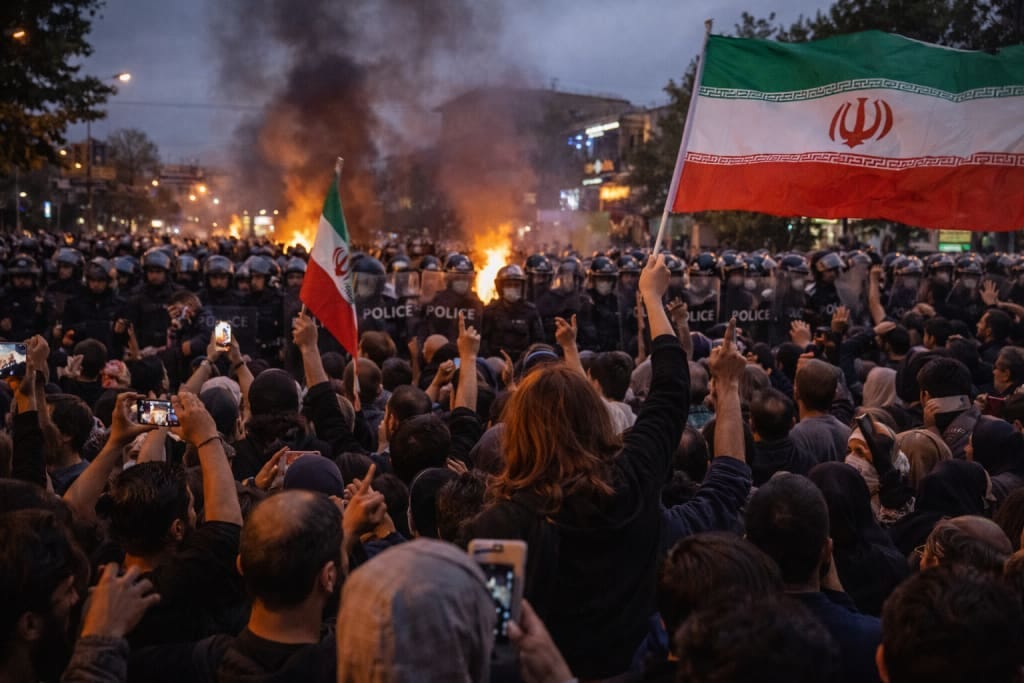
The names of the political forces being cleared out of Iran’s future are not a secret. They are chanted at monarchist rallies in London, Munich, Los Angeles, and, increasingly, Tehran itself. “Marg bar seh chapaleh: Akhund, Chapi, Mojahed.” Death to three corrupt: the cleric, the leftist, the MEK. The Islamic Republic is the first enemy. The Mojahedin-e-Khalq is the second. The left, the Mossadegh nationalists, the Tudeh cadres, the secular republicans, the labor organizers, the feminist movements that emerged from the Woman Life Freedom uprising of 2022 explicitly rejecting both theocracy and monarchy is the third. This is the story that the coverage of Operation Epic Fury is not telling.
The Structural Argument
Tariq Ali’s central observation about Iran, made across decades of writing, is the one that best fits this morning: the political settlements imposed after imperial military intervention do not simply change governments. They reorganize the political field, eliminating the forces that would challenge the class structure the intervention is designed to protect. In Iran’s case, that class structure is the one that keeps Iranian oil and Iranian strategic territory inside the American-Israeli regional architecture. The Islamic Republic disrupted that architecture in 1979. The current operation is designed to restore it. The political instrument of restoration is Reza Pahlavi, a man who has lived in the United States for forty-eight of his sixty-six years and whose transition roadmap was presented not in Tehran but at the Munich Security Conference.
The documentation of this project is extensive. Haaretz reported that Israel operated a coordinated covert influence campaign using fake accounts and AI-generated content to promote Pahlavi and build the case for monarchy restoration. Al Jazeera’s network analysis identified a web of Israeli-linked accounts driving the hashtag #FreeThePersianPeople and presenting Pahlavi as “the face of the alternative Iran.” Steve Witkoff, Trump’s Middle East envoy, met with Pahlavi directly. At Munich, Pahlavi presented a phased transition: stabilization, maximum defections from the IRGC, a constitutional process, a referendum. He specified three categories excluded from his coalition: separatists, the MEK, and reformists. His base handles the fourth exclusion in their chants.
What Pahlavi said at Munich about Iran’s energy resources is worth holding. “A free Iran that would be able to supply Europe with its energy needs,” he told the assembled European foreign policy establishment, “would certainly be an alternative to the only source that you have right now,” meaning Russia. The political economy of the post-regime settlement was stated plainly, in a sentence: Iran’s oil and gas, redirected into the Western energy architecture, away from Russian influence. The transition roadmap is a pipeline prospectus with constitutional language attached.
The Formation of the Third Enemy
The Iranian left is not a recent invention. Its roots run through the Constitutional Revolution of 1905, through the Tudeh Party’s founding in 1941 and its rapid organization of industrial workers, teachers, oil workers, and intellectuals across the country. By 1946, the Tudeh-linked United Council represented 400,000 Iranian workers. It was the most organized mass political force the country had produced. It supported Mossadegh’s nationalization of the Anglo-Iranian Oil Company in 1951, the act that produced the CIA-MI6 coup two years later.
After the coup, SAVAK, the Shah’s secret police, was built with direct American and Israeli intelligence support. Its primary domestic mission, documented in the party’s own records and in subsequent academic scholarship, was the destruction of the Iranian left. Thousands of Tudeh members were arrested immediately after August 1953. Communist newspapers were shut. The party was driven entirely underground. Over the following decades, the Shah’s state executed hundreds of leftist activists, dismantled workers’ organizations, infiltrated trade unions, and treated any expression of class-based political organization as a national security threat. Anti-communism was not incidental to the Pahlavi state. It was demanded by Washington, which needed Iran as a bulwark against Soviet influence and a stable environment for oil extraction, and implemented with Israeli technical assistance.
The 1979 revolution removed the Shah. The Islamists who consolidated power after it then conducted their own systematic liquidation of the left. In 1988, in what human rights organizations have documented as crimes against humanity, thousands of political prisoners, overwhelmingly Marxists, communists, and leftists already serving prison sentences, were executed in summary proceedings. Iran’s left has been crushed twice in seventy years. Once by Washington’s man. Once by his replacement.
The Tudeh Party stated the structural argument in its January 2026 analysis with the precision of people who lived it: “The historical experience of the past eighty years demonstrates that the policy of regime change has always been pursued to serve the strategic interests of global imperialism and can never lead to freedom, the realization of national and democratic rights, or the people’s sovereignty over their own destiny.” They issued this warning while simultaneously supporting the popular uprising against the Islamic Republic’s massacres. They drew the line between the legitimate rage of Iranians and the imperial machinery waiting to capture its outcome.
What the Transition Roadmap Erases
The political opposition to the Islamic Republic inside Iran is not a single formation. It never was. The five-party “Solidarity for a Secular Democratic Republic in Iran,” formed in 2023 and including the Left Party of Iran, represents a tradition that has demanded neither theocracy nor monarchy. The chant that carried the 2022 Woman Life Freedom uprising, “neither king nor supreme leader,” remains the most honest expression of what the Iranian street has actually demanded across protest cycles. Analysts across the political spectrum, from the International Crisis Group to 972 Magazine, noted that the dominant demand in the 2025-2026 uprising was sovereignty, accountability, and economic justice not a return to the ancien regime.
The monarchist diaspora’s counter-narrative, amplified by Israeli influence infrastructure, has worked systematically to erase this distinction. When Iranians chanted against the Islamic Republic, Pahlavi’s network “translated” their demands as demands for his return. The Intercept documented this feedback loop: Pahlavi and his networks joined forces to create what the publication called “a monarchist feedback loop that tars and suppresses genuine democracy movements,” while pro-democracy activists inside Iran, including those hounded by security forces, took time to refute Pahlavi’s claims in statements smuggled out of prisons and in labor union communiques.
Pahlavi at Munich did not speak of these forces. His exclusion list was implicit, carried by the movement’s chants and by the IranWire interviews with monarchist political prisoners who stated their position without diplomatic softening: they see this window Trump and Netanyahu in power simultaneously as the closing opportunity to install the restoration before “power falls back to the Left.” That sentence is the political program. It is not a fringe sentiment inside the Pahlavi movement. It is its urgency.
The Instrument and Its Patrons
The structural pattern that Tariq Ali identified across post-colonial states holds with precision in the Iranian case. The ruling class being assembled around Operation Epic Fury is not an Iranian formation. It is a diasporic formation, shaped outside Iran, loyal to patrons outside Iran, presenting itself as the authentic voice of Iranians whose actual political demands are considerably more complex and considerably more threatening to Western strategic interests.
Pahlavi has lived in the United States since 1978. He met with Witkoff. He addressed the Munich Security Conference. He was promoted by Israeli covert influence operations. His base waves Israeli flags alongside the imperial Iranian flag at rallies in European capitals. His mother was photographed holding the Israeli flag in Paris. When Israeli and American bombs struck Iranian cities this morning, he called it a humanitarian intervention and asked Trump, as a courtesy, to minimize civilian casualties.
This is the political class that will govern Iran’s “transition period.” This is the class that will conduct the stabilization phase before any democratic process is permitted. This is the class that has already named the left as its enemy in its most repeated public slogan.
The machinery of empire functions through exactly this arrangement. The intervention is presented as liberation. The installed government is presented as the authentic expression of the liberated people’s will. The political forces that would challenge the class content of the settlement are eliminated in the stabilization phase, before the referendum, before the election, before anyone outside the arrangement understands what has happened. In 1953, it took twenty-six years for the full consequences to arrive. The Islamic Republic is those consequences. What comes next will have its own.
The Mossad’s Telegram Channel and What It Is Doing
This morning, while strikes were still underway across Iranian cities, the Mossad posted on its official Persian-language Telegram channel: “Dear people of Iran, did you see the attacks on regime buildings? The attacks on the headquarters and bases of the security forces? Residents fleeing, destruction, protests? The presence of security forces? Continue taking photos and sending them to us.”
Read this carefully. An intelligence agency, conducting active military operations against a country, is asking the civilian population of that country to photograph and report what they see. Every person photographed and reported is being categorized. The political content of that categorization is determined by who is running the operation and what the post-regime political settlement requires.
The Pahlavi movement has already declared the left its enemy. The Mossad is Israeli state intelligence, which has run covert operations to promote Pahlavi restoration. The transition roadmap requires a stabilization phase. The stabilization phase will be conducted by those with guns, foreign backing, and a pre-existing list of who belongs in the new Iran and who does not.
The social media reports of leftists being targeted today are, as of this writing, unconfirmed by independent journalism. The structural conditions for exactly this are not unconfirmed. They are documented, historical, and currently active.
The Conclusion the Evidence Supports
The strikes on Iran today are a military intervention in support of a specific political settlement. That settlement has a designated leader, a documented patron relationship, a transition roadmap presented at one of the world’s most prominent foreign policy forums, an exclusion list chanted in the streets of three continents, and a seventy-year historical precedent that produced SAVAK, the Shah’s decades of anti-communist repression, and ultimately the Islamic Republic that replaced him.
The Iranian people’s legitimate rage against a government that massacred at minimum 7,000 of them in January 2026 alone deserves to produce an outcome that serves Iranians. The evidence before us does not suggest that is what is being prepared. What is being prepared was described plainly by one of the monarchist political prisoners interviewed by IranWire: “My dream is Iran’s greatness. Turning Iran into the first military, political, and economic power in the Middle East the same plan that existed before the Revolution.”
The same plan. The same patrons. The same third enemy.
The left has been told this morning, in chants and in bombs and in a Mossad Telegram post soliciting photographs of their neighborhoods, that there is no seat for them in the freedom being delivered by Operation Epic Fury. They have heard this message before. In 1953, they believed they might survive it. In the 1980s, they did not. What this third iteration produces will depend on what remains of them when the stabilization phase concludes and the cameras are put away.