The UAE's Documented Role in Ethiopia's Genocide
Drones, concessions, and the price Tigray paid for Abu Dhabi's Horn of Africa ambitions
The Assab airbase sits on Eritrea’s southern Red Sea coast, roughly 900 kilometres from the Tigrayan capital of Mekelle. The UAE did not build it for Ethiopia. Construction began in 2015, the year the Saudi-Gulf coalition launched its campaign in Yemen, and Eritrea leased it to Abu Dhabi as a forward operating position across the Bab el-Mandeb, the strait through which approximately 10 percent of global oil trade passes. By 2018, satellite imagery obtained by Bellingcat and analysed by the Dutch disarmament organization PAX showed three drone hangars on the northern tarmac, Chinese-manufactured Wing Loong II unmanned combat aerial vehicles parked in daylight, and the kind of infrastructure expansion covering hardened shelters, extended logistics space, and naval berthing that signals not a staging visit but a permanent operational commitment. The United Nations Monitoring Group on Somalia and Eritrea condemned the arrangement as a violation of the arms embargo on both Horn states. Abu Dhabi noted no objection, offered no explanation, and expanded the base anyway.
The Wing Loong II carries a 20-metre wingspan and is capable of dropping bombs or shooting missiles. The UAE had used them in combat over Yemen. It had already lost at least 12 to ground fire, Houthi surface-to-air missiles, and Turkish air defence systems over Libya, where it had deployed them in support of General Khalifa Haftar’s Libyan National Army. When the Ethiopian government launched military operations against the Tigray People’s Liberation Front on November 3, 2020, Assab had been operational for five years: a proven platform for a war-tested drone fleet, positioned at the exact moment Addis Ababa needed one.
The base at Assab was the hardware of a relationship built in the two years before the war began.
What the $3 billion purchased
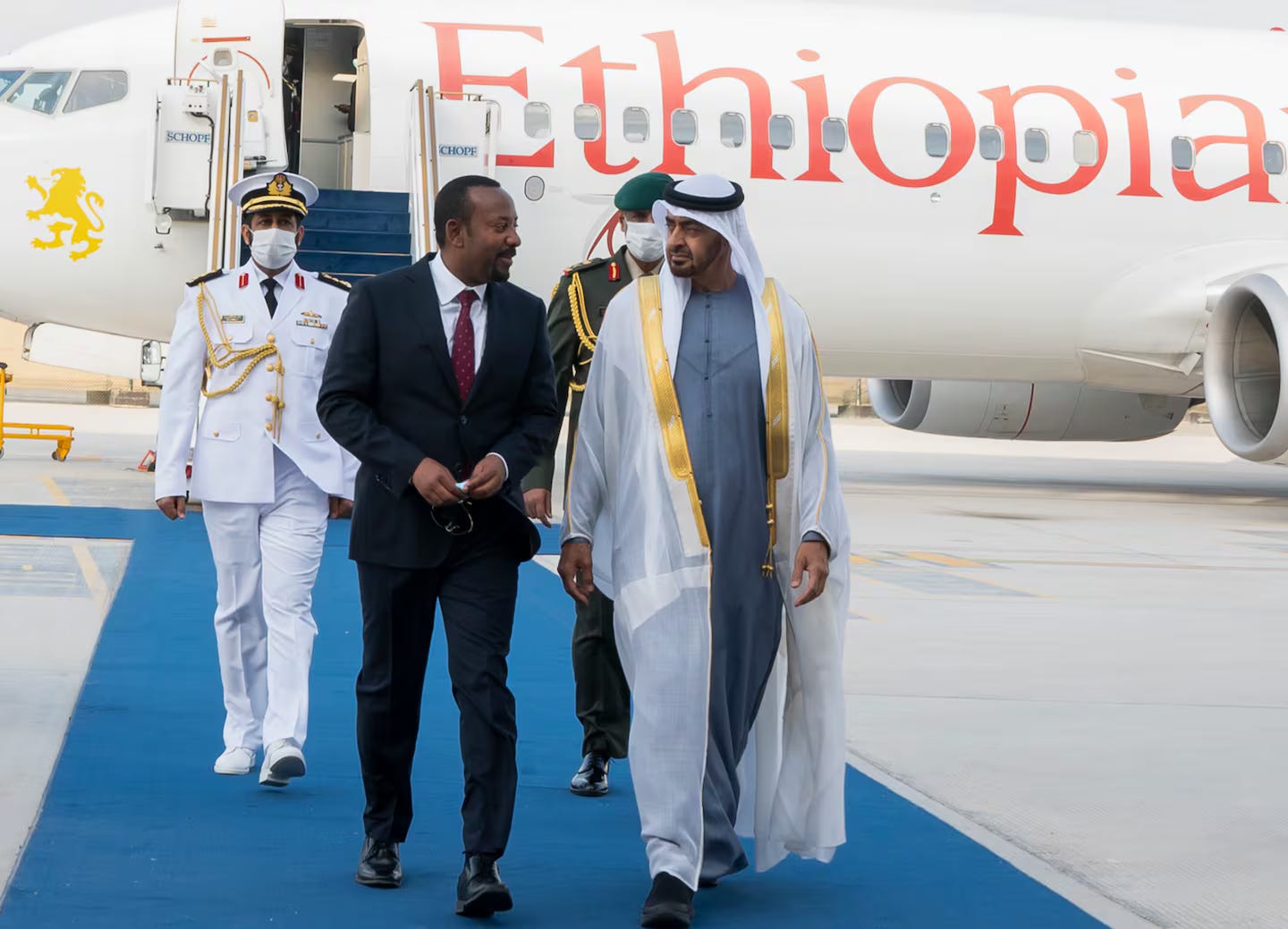
Mohammed bin Zayed Al Nahyan flew to Addis Ababa in June 2018. Abiy Ahmed had been prime minister for two months. MBZ arrived at the National Palace, signed seven memoranda of understanding covering economy, culture, tourism, and consular affairs, and deposited one billion dollars directly into the National Bank of Ethiopia the same week. The full pledge was three billion, the largest single injection into Ethiopia’s economy in its post-Cold War history. One billion went to the central bank to address a foreign currency crisis so severe the country held less than one month’s worth of import reserves. The remaining two billion was structured as foreign direct investment from Emirati private sector actors, directed toward tourism, real estate, renewable energy, and agriculture, with UAE investors receiving rights to large-scale construction and real estate development in Addis Ababa.
Abiy had travelled to both Abu Dhabi and Riyadh within weeks of taking office. The sequence matters: a new prime minister, consolidating power against internal opponents within a deeply fractured federal system, sought external backing before the political architecture of his government was fully assembled. The money arrived within two months of him taking office.
What the $3 billion bought was not friendship. It bought structural alignment. Emirati businesses moved into Ethiopia’s priority sectors. UAE investors acquired land in Addis Ababa partly in exchange for the liquidity injection, according to the Chatham House analysis of the 2023 conflict. UAE food security concerns, which drive much of Abu Dhabi’s Africa strategy, were served by agricultural investment rights across a country of 126 million people with some of Africa’s most productive farmland. In 2023, the UAE became the fourth most prominent destination for Ethiopian exports. In July 2024, both countries signed a bilateral currency swap agreement worth up to $817 million. The financial architecture of the relationship deepened every year between 2018 and the outbreak of war, then accelerated after it.
The peace that enabled the war
The same year MBZ arrived in Addis Ababa with the $3 billion, the UAE brokered the peace deal between Ethiopia and Eritrea, ending a 20-year military standoff that had frozen Eritrea inside a permanent war economy and left the Ethiopia-Eritrea border effectively sealed since the 1998-2000 war. The rapprochement was managed by Gulf intermediaries, financed by Gulf capital, and announced to widespread international acclaim. Abiy received the Nobel Peace Prize in 2019 for signing it.
The deal created a specific strategic outcome that no commentary in the Nobel committee’s citation examined. It positioned Eritrean President Isaias Afwerki within an Emirati-managed relationship. It ended the international isolation that had made Eritrea an unreliable partner for any external actor. And it returned Eritrea to a posture in which its Defence Forces could move southward into Tigray without triggering the immediate international condemnation that would have greeted a hostile Eritrean cross-border operation under the prior state of affairs. Within two years, Eritrean forces were fighting alongside Ethiopian federal troops and Amhara militias in one of the deadliest conflicts of the 21st century. The peace brokered by Abu Dhabi was the prerequisite for the coalition that waged the war.
When Abu Dhabi says it promotes stability in the Horn of Africa, it means this: it promotes the stability of governments it has invested in, through the military suppression of political threats to those governments, using the diplomatic architecture it has built to make the suppression possible. The Nobel Prize speech in Oslo is part of this architecture.
The air bridge and what flew across it
On November 15, 2020, twelve days into the fighting, TPLF leader Getachew Reda posted a direct accusation: UAE drones based at Assab were supporting Ethiopian and Eritrean forces against Tigray. Tigrayan forces had already fired rockets at Asmara airport, citing it as a base for attacks on their territory. PAX researcher Wim Zwijnenburg confirmed Wing Loong IIs at Assab but said he could find no direct evidence those specific aircraft had flown combat missions over Tigray, a distinction between the presence of the weapon and the documented use of it in a specific theater, one that changed over the following year.
What the subsequent 12 months established was considerably less ambiguous. The investigative site Oryx drew on an aircraft mechanic working at Harar Meda air base near Addis Ababa to document in December 2021 that the UAE had deployed at least six Wing Loong I UCAVs directly into Ethiopia, not from Eritrea but inside the country. The delivery arrived through a cargo aircraft from Chengdu, where Chengdu Aircraft Industry manufactures the Wing Loong I, landing at Harar Meda in September 2021. The drones were moved immediately into a hangar after landing, in what Oryx described as a deliberate concealment effort. An Il-76 freighter’s flight path from Chengdu, logged by open-source tracking, had already made the delivery visible.
Between August and September 2021 alone, tracking data showed more than 50 cargo flights from the UAE to Ethiopia in 53 days. The aircraft were Il-76 freighters registered in Ukraine and Kyrgyzstan but operated by Fly Sky Airlines, a UAE-based carrier. Forty-five of those flights originated in the Emirates. The December 2021 bombing of Alamata, a Tigrayan town, was traced by Omna Tigray researchers to Chinese-made munitions sourced through UAE procurement. TPLF chairman Debretsion Gebremichael wrote formally to UN Secretary-General António Guterres that month, naming the UAE, Iran, and Turkey as weapons suppliers to the Ethiopian government.
US Special Envoy Jeffrey Feltman said in October 2021 that Ethiopia was running a bombing campaign “using drones from questionable sources, including reportedly from US adversaries.” He named no states directly. The TPLF named them. Abu Dhabi named nothing.
What the drones did in the field was described with precision by Alex de Waal of the World Peace Foundation. Writing in Responsible Statecraft in December 2021, he assessed that the Emirati Wing Loongs had “effectively disarmed” Tigray, targeting artillery positions and weapons depots. At the peak of the Tigrayan advance toward Addis Ababa in mid-2021, when the federal government appeared genuinely at risk of collapse, the cargo flights from the UAE were scaled up. The Chatham House assessment published in 2023 confirmed what the timeline implies: UAE material support was calibrated to the war’s turning points. When the balance shifted decisively against Abiy, Abu Dhabi delivered.
Under international humanitarian law, supplying weapons to a party engaged in documented war crimes when the supplier knows or should know those weapons will be used in such crimes constitutes complicity in those crimes. The knowledge condition was met. The UN, the US Special Envoy, Amnesty International, and the OHCHR-Ethiopia joint commission had all documented the conduct of Ethiopian federal forces and their Eritrean allies by the time the second air bridge opened in August 2021. The cargo flights kept coming.
The body that Abu Dhabi built inside the state
Before the drones flew and before the air bridge opened, the UAE had already embedded itself inside the Ethiopian state at the level that matters most in any coup-era African political system: the force that guards the leader.
The Republican Guard was established in summer 2018, following a hand grenade explosion at a rally in Addis Ababa on June 23 of that year that killed two people and came within close range of Abiy. The unit was stood up within months of the $3 billion pledge. According to Horn Review’s 2025 analysis and the SWP Berlin policy brief of the same year, the UAE trained the Republican Guard, the elite praetorian unit reporting directly to the Office of the Prime Minister, structurally insulated from the standard Ethiopian National Defense Force chain of command. The Guard’s dual reporting line, formalised in Council of Ministers Regulation No. 426/2018, made it operationally accountable to Abiy personally. The UAE trained the unit that protects him.
In January 2025, UAE engagement went further: Dubai Police and UAE Ministry of Interior experts trained the Ethiopian Federal Police in cybercrime investigation, VIP security, and counterterrorism. What began as a central bank deposit in 2018 had become a comprehensive security partnership, with Abu Dhabi’s personnel embedded in the institutions that would need to survive any political crisis facing Abiy’s government: the elite personal guard, the police force, and through arms supplies, the regular military.
This is not unusual in the UAE’s Africa operations. It is the template. In Libya, Abu Dhabi created partnerships with the local West Coast Forces and the Giants Brigades before Haftar’s campaign. In Sudan, it maintained financial and intelligence ties to RSF commanders years before the 2023 war. The pattern is to build relationships inside security structures before the crisis arrives, so that when force is needed, the instruments are already in place.
Djibouti, Berbera, and the port logic behind the patronage
The relationship between the UAE and Ethiopia cannot be read as bilateral without reading what happened in Djibouti first.
In 2006, DP World, fully owned by the Dubai government, signed a 50-year concession to operate the Doraleh Container Terminal, at the time the most important container port in the Horn of Africa and the maritime gateway through which approximately 90 percent of Ethiopia’s trade passed. By 2015, Djibouti’s government had grown closer to China, which was negotiating its own infrastructure stakes across the Belt and Road corridor. The UAE attempted, in the same period, to use DP World’s infrastructure at Doraleh as a military launchpad for Yemen operations. Djibouti refused. Relations deteriorated. In February 2018, the same year MBZ flew to Addis Ababa, Djibouti’s President Ismaïl Omar Guelleh terminated the DP World concession by presidential decree and seized all assets at the terminal. China Merchants Port Holdings took over. Abu Dhabi lost its primary foothold at the mouth of the Red Sea. DP World’s chairman, Sultan Ahmed bin Sulayem, reportedly said Abu Dhabi would “send Djibouti back” to pre-investment conditions. Multiple arbitration rulings in London and Hong Kong subsequently found Djibouti’s action unlawful, ordering hundreds of millions in compensation. Djibouti ignored every ruling.
The Djibouti loss accelerated the Berbera strategy that was already forming. In 2016, DP World had signed an agreement with Somaliland to develop and operate the Port of Berbera in exchange for a 30-year concession, financed by a $400 million Emirati investment. A tripartite deal followed in March 2018, giving DP World 51 percent of the Berbera Port project, Somaliland 30 percent, and Ethiopia 19 percent, in exchange for Ethiopia’s commitment to invest $80 million in a 260-kilometre road connecting Berbera to the Ethiopian border and to route 30 percent of its trade through the port. The Somali federal government voted to nullify DP World’s Somaliland agreement. Ethiopia never built the road. In June 2022, Somaliland declared Ethiopia’s stake forfeited.
But the strategic logic had been established. The UAE positioned itself as the guarantor of Ethiopia’s alternative maritime access at the exact moment it lost its primary Horn of Africa port foothold. Berbera, managed by DP World, became Ethiopia’s only viable alternative to Djibouti. That dependency is an instrument of influence, not a development project. By August 2023, nine months after the Tigray war ended, Ethiopia signed a bilateral maritime agreement with Abu Dhabi. The arms that kept Abiy’s government alive had been exchanged, in the medium term, for the diplomatic ratification of an Emirati commercial position that Djibouti’s assertion of sovereignty had nearly destroyed.
Abiy’s January 2024 memorandum of understanding with Somaliland, offering recognition of Somaliland’s independence in exchange for a 50-year naval base lease at Berbera, was framed in international commentary as an Ethiopian foreign policy gamble. It was also a confirmation of the UAE’s strategic map. Several analysts assessed that Abu Dhabi quietly supported the deal while publicly maintaining neutrality. Ethiopia’s Red Sea access runs through a port that DP World manages, and the MoU deepens that dependency at the same time it creates a new flashpoint with Somalia, Egypt, and Eritrea, all of which oppose it and all of which are aligned with UAE rivals in the current regional configuration.
The same aircraft, a different war
The Fly Sky Airlines Il-76 freighters that ran the arms bridge from the UAE to Ethiopia in 2021 had a documented prior history: the same carrier had previously been used to deliver equipment to Libya. This is not a footnote. It is the operating model made visible.
Since 2014, the UAE had backed Haftar’s Libyan National Army with drones, weapons, special forces, funding, and diplomatic cover through France’s Elysée. Wing Loong UCAVs operated by the UAE struck targets in Libya for years. In January 2020, one killed 26 unarmed cadets at a military academy in Tripoli, a strike Amnesty International cited when calling on the US to halt drone sales to Abu Dhabi. The UAE did not acknowledge the strike. It continued operations.
What connected Libya to Ethiopia was not simply hardware. In November 2020, Foreign Policy reported that the US Department of Defense had assessed that the UAE was possibly funding Wagner Group mercenaries in Libya in support of Haftar’s ground campaign. The Atlantic Council’s Libya investigation described Abu Dhabi as “the conduit for Russian paramilitary forces’ on-the-ground engagement” in Tripoli’s suburbs. The model: UAE air cover, Wagner ground operations, local strongman provides political legitimacy, Abu Dhabi denies everything. The Emirati weapons that went to Haftar in eastern Libya were in some cases later diverted via Wagner’s operational networks into Sudan’s conflict, where they reached the Rapid Support Forces. The chain runs from an Emirati cargo flight, through a Wagner-controlled Central African Republic corridor, to Darfur.
SourceMaterial’s October 2024 investigation documented this route in detail: UAE weapons routed via Africa Corps, Wagner’s renamed successor, through Bangui, to Birao near the Sudanese border, and into RSF hands. Local CAR militia spokesman Abdu Buda of the Coalition of Patriots for Change stated they had intercepted shipments “coming from the UAE through CAR since the start of the war in Sudan,” transported by Wagner mercenaries. In Sudan, Dubai was already the primary destination for RSF gold smuggling before the 2023 war began. A UN panel found credible evidence of UAE weapons deliveries to the RSF, including multiple shipments per week through a UAE-funded field hospital in Amdjarass, Chad. Gold from Darfur’s mines, controlled by RSF fighters, flowed into UAE markets, and RSF commander Hemedti’s gold networks, built with Wagner’s protection from 2017 onward, made Dubai the clearinghouse for a war economy funding genocide in Sudan.
What the Abraham Accords ratified
The Abraham Accords were signed on September 15, 2020. The Tigray war began on November 3, 2020. The proximity does not mean MBZ ordered the drones deployed because the Accords had been signed six weeks earlier. It means something more structural: the Accords, and the decade of foreign policy construction that produced them, established the political environment in which everything that followed was possible without serious consequence.
The Accords formalized the UAE’s position as Washington’s most valued Arab partner: willing to normalize with Israel, aligned against Iran and the Muslim Brotherhood, capable of managing Gulf-adjacent conflicts, and able to extend US strategic reach without requiring American soldiers. The Congressional Research Service, in its 2025 review of US-UAE policy, described Abu Dhabi’s regional posture since 2014 as organized around keeping secular authoritarian Arab leaders in power, suppressing Muslim Brotherhood-linked organizations, countering Iran, and projecting force in ways that complement US objectives. The same document noted that UAE interventions in Sudan, Yemen, Libya, Ethiopia, and Somalia have attracted criticism from some international observers, while the bilateral relationship has continued to deepen.
The first Trump administration sealed the Accords and produced large Gulf arms deals. The Biden administration expressed concern about UAE activities in Ethiopia’s Tigray conflict, and under Biden pressure the UAE reportedly pulled back from Assab in early 2021. Emirati drones “disappeared from Tigrayan skies” at that moment, Responsible Statecraft reported. They reappeared when the TDF threatened Addis Ababa. The State Department commissioned a genocide assessment of the Tigray war, found sufficient grounds to prepare one, then declined to publish it on the grounds that publication would “complicate the search for a negotiated solution.” The report was suppressed. The drones flew. The Biden administration, which had spent months calling for accountability, granted the UAE its Major Defense Partner designation in September 2024, a status previously held only by India, now extended to a state whose weapons had been documented on cargo flights into an active genocide.
Chatham House’s 2023 analysis of the Abraham Accords made the logic explicit: MBZ had concluded that US security guarantees were more conditional than before the Arab Spring, and that this demanded UAE action in regional theaters without waiting for Washington’s consent. “States realize they cannot wait for the US to decide everything, and they have to be more assertive themselves,” one interlocutor told Chatham House researchers. The Accords purchased, through normalization with Israel, a degree of operating latitude for actions that a decade earlier would have attracted serious Western pressure. Abu Dhabi deployed force in Ethiopia precisely as it had deployed force in Libya and Yemen: with the knowledge that Washington would complain and then ratify.
The doctrine
Across Yemen, Libya, Sudan, and Ethiopia, the operational method is consistent enough to constitute a doctrine. Identify a government or faction that serves UAE strategic interests: anti-Iran, anti-Muslim Brotherhood, willing to accept Emirati financial penetration and port access. Deliver liquidity first, to establish dependency. Broker a diplomatic arrangement that positions Emirati-allied actors as the dominant local force. Train the security units closest to the leader. When a military crisis threatens the government, deliver weapons through deniable cargo carriers. Where possible, use Wagner or Africa Corps as a ground layer to avoid direct Emirati operational exposure. Secure commercial concessions before the fighting ends, so that the government’s survival is a financial interest rather than a political choice.
The resulting structure is not a military alliance. It is not foreign aid. It is structured dependency: a political economy in which the government’s security and financial survival both run through Abu Dhabi, and in which Abu Dhabi extracts positions, port concessions, agricultural land, and supply corridors that would be unavailable in any open competitive market. Djibouti chose China. Djibouti lost its DP World concession and was sued in multiple jurisdictions simultaneously. Ethiopia chose Abu Dhabi. Ethiopia received central bank liquidity, Republican Guard training, a maritime strategy, and an arms bridge when its government was nearly overrun.
The 600,000 and the accounting that hasn’t happened
No accountability process has targeted the external weapons suppliers. The Pretoria Agreement, brokered by the African Union in November 2022, imposed terms on the losing party and left every external actor outside the frame. The ceasefire that ended the killing preserved the impunity that enabled it. The UAE has not been sanctioned for its role in Ethiopia. It has not been sanctioned for its documented support to the RSF in Sudan, despite Sudan filing a formal case at the International Court of Justice against Abu Dhabi in March 2025, and despite a US determination that RSF atrocities constituted genocide.
The architecture holds because the architecture serves too many interests for any one institution to dismantle it. Washington uses the UAE as a regional intermediary for objectives it cannot pursue directly. The Abraham Accords’ symbolic value to multiple US administrations has exceeded the political cost of what happens in the theaters where Abu Dhabi operates. European arms sales to the UAE continue. The same Wing Loong platforms circulate between Yemen, Libya, Sudan, and Ethiopia without triggering the arms re-export restrictions that nominally govern US-origin technology.
What Djibouti shows
There is a country in this story that did not submit to the architecture. It is worth naming what happened to it.
Djibouti ejected DP World from the Doraleh Container Terminal in February 2018, the same month MBZ flew to Addis Ababa with $3 billion for Abiy. The sequence was not coincidental. Djibouti had refused the UAE’s request to use Doraleh as a military launchpad for Yemen operations. It had then refused to host an Emirati military base on its territory. China Merchants Port Holdings took over Doraleh. Abu Dhabi pursued litigation across multiple jurisdictions for years, winning every arbitration ruling and collecting none of the judgments. The legal victories were real and unenforceable. Djibouti kept the port.
What followed was not a diplomatic rupture. It was something more consequential: Abu Dhabi began building a parallel architecture that would make Djibouti irrelevant. The Berbera concession with Somaliland was accelerated. The tripartite deal with Ethiopia in March 2018 was designed to route Ethiopian trade, currently 90 percent dependent on Djibouti, through a DP World-managed alternative. The UAE also constructed a military base in Somaliland from 2017, training Somaliland’s security forces and establishing a physical presence along the Gulf of Aden coast, directly across from Yemen and directly adjacent to the Bab el-Mandeb. What the UAE lost at Doraleh it was rebuilding in Berbera, and what it lost in Djibouti’s refusal to host a military base it was rebuilding 300 kilometres away.
The next move was diplomatic. In December 2025, Israel recognized Somaliland as an independent state, the first UN member to do so. Netanyahu explicitly framed the move within the Abraham Accords. According to diplomatic sources cited by Middle East Monitor, the UAE had mediated the arrangement: Abu Dhabi had convinced Somaliland’s government to accept an Israeli military base on its Gulf of Aden coast and had agreed to finance it. Assurances were given that Israeli recognition, and investment, would follow. Academic analysis published in January 2026 stated the logic plainly: Israel’s recognition of Somaliland “is a strategic move that aligns it with the UAE’s economic and security architecture in the Red Sea.”
The emerging alignment in the Horn is now visible in full. On one side: Egypt, the Sudanese Armed Forces, Turkey, Qatar, Saudi Arabia, Eritrea, Djibouti, and Somalia. On the other: the UAE, Israel, the RSF in Sudan, Libya’s Haftar militia, Somaliland, and Ethiopia, even as Addis Ababa has tried to conceal the depth of its alignment. The US, which maintains its only permanent African base at Camp Lemonnier in Djibouti, is being pulled toward Somaliland by a combination of Israeli lobbying, Emirati pressure, and frustration that Djibouti refused to allow attacks on the Houthis from its territory. Project 2025 flagged “the US’s deteriorating position in Djibouti” as a primary concern. Some US lawmakers and analysts have explicitly proposed Somaliland as the replacement for Camp Lemonnier.
Djibouti said no to the UAE. It now sits between a US base it cannot fully control, a Chinese base it partially regrets, a neighbour to the south whose port is being absorbed into an Emirati logistics network, and a government in Addis Ababa that owes its survival to Abu Dhabi. Eritrea, which leased the UAE its Assab airbase for years, is now on the Egypt-Saudi side of the fault line. The entire eastern shore of the Red Sea, from Assab to Berbera, is being stitched into an Emirati-Israeli strategic corridor, and the Tigray war was the operation that secured its landlocked hinterland.
The crimes committed in Tigray between 2020 and 2022 were the pivot of this architecture. Without UAE drones, without the arms bridge, without the Republican Guard training, the government in Addis Ababa would likely have fallen. The war would have ended differently. The port strategy would have lost its Ethiopian partner. The Berbera corridor would have lost its landlocked hinterland. The entire arc from Assab to Somaliland depends on Abiy Ahmed remaining in power, and Abiy Ahmed remaining in power depended on what Abu Dhabi shipped across the Red Sea in those 53 days.