The UAE’s Phantom Exit: How “Withdrawal” From Yemen Masks a Deepening Proxy Empire
Behind public pledges to leave, Abu Dhabi’s surrogate forces and quiet security deals with Israel keep southern Yemen locked inside a dangerous external power grid
The United Arab Emirates has twice declared that it is pulling out of Yemen, in 2019 and again at the end of 2025, but in both cases it has kept a tight grip on southern Yemen through local allies and security networks rather than through large numbers of its own troops. This pattern has allowed Abu Dhabi to reduce the political cost of the war at home while still shaping events on the ground in ways that fit its own regional strategy and that increasingly overlap with Israeli interests around the Red Sea and Gulf of Aden.
From open intervention to quiet control
When the Saudi‑led coalition entered the Yemen war in 2015, the UAE quickly became the most active partner in the south. Its forces helped drive Houthi fighters out of Aden and several other southern cities and then moved to build up new local units such as Security Belt forces and so‑called Elite forces. These groups were described as partners in counterterrorism and stabilization, but they answered mainly to Emirati officers and to Abu Dhabi’s priorities.
By 2018 and 2019, human rights organizations and Yemeni activists had reported secret detention sites, enforced disappearances and abuses tied to UAE‑backed forces around Aden and Mukalla. At the same time, analysts were noting that the UAE was less focused on fighting the Houthis and more focused on securing ports, islands and coastline, especially in the south and along the Red Sea.
In mid 2019, the UAE announced that it was drawing down and redeploying its forces. Emirati officials said this was a responsible decision to move from a heavy combat role to a lighter support role. On paper, troop numbers did go down. In practice, the UAE had already prepared a substitute structure: local partners who could hold territory, guard facilities and keep rivals in check.
The rise of the Southern Transitional Council
At the center of this architecture stood the Southern Transitional Council, or STC, a political and military movement that calls for an independent South Yemen. The UAE helped fund, arm and train STC forces and gave the movement political cover. In 2019 STC units seized control of Aden from the internationally recognized government, even though the UAE publicly insisted that it supported Yemen’s unity and its official institutions.
The Riyadh Agreement signed later in 2019, under Saudi sponsorship, was supposed to bring STC forces under the Ministries of Defense and Interior and to reintegrate them into the state. In reality, the STC kept its own chains of command and used the agreement to formalize its political role while still operating armed units outside full state control. This allowed the UAE to argue that it respected Yemen’s legitimacy while still relying on a client movement that pursued secession and acted autonomously in the south.
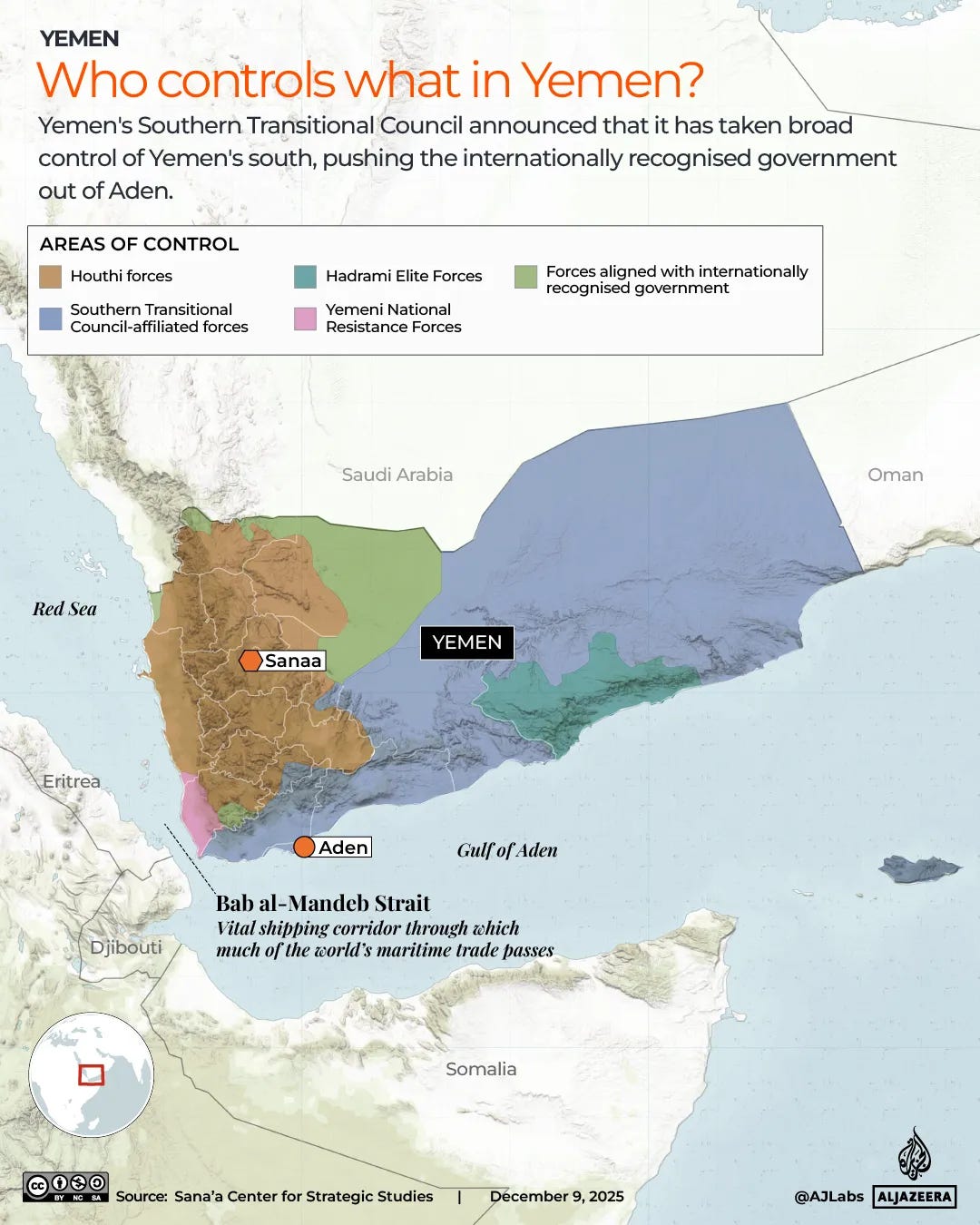
Over the following years, STC‑linked units and other UAE‑sponsored formations extended their reach through Aden, Abyan, Shabwa and parts of Hadramawt and Mahra. Research centers and security analysts describe the result as a layered proxy network in which different local forces, with different flags and local identities, share a common dependence on Emirati money, weapons and political protection.
A transactional proxy system
The relationship between Abu Dhabi and its Yemeni surrogates is openly transactional. Emirati support includes salaries, training, heavy equipment and sometimes air support during offensives. In return, local forces secure specific assets that matter to the UAE such as ports, energy facilities, islands and coastal corridors. They also align with Emirati red lines by opposing groups linked to the Muslim Brotherhood, especially the Islah party, as well as actors close to Qatar or Turkey.
This system gives the UAE several clear benefits. It lowers the risk of Emirati casualties because local Yemenis bear the brunt of fighting on the ground. It creates plausible deniability when there are abuses or battles between supposed partners, because Abu Dhabi can treat these as local rivalries. It also means that any future political settlement will have to accommodate forces and parties that take their cues from the UAE, which keeps Abu Dhabi at the table even if its uniformed troops formally leave.
Yemeni civil society groups point out that this does not look like genuine support for state rebuilding. Instead it looks like a patchwork of mini fiefdoms that respond upward to a foreign capital. The fact that the STC sits inside the Presidential Leadership Council that replaced President Hadi, while maintaining its own separate armed structure, is often cited as a prime example of how formal institutions mask an underlying system of external control.
The Mukalla strike and the second withdrawal
By late 2025, tensions between Saudi Arabia and the UAE over southern Yemen had been growing for years. While both states still opposed the Houthis, they backed rival camps among anti Houthi forces. The STC and UAE‑backed units expanded eastward into Hadramawt and Mahra, areas full of oil and close to the Omani border, and areas that Saudi Arabia sees as essential for its own security and trade projects.
Reports from December 2025 describe STC‑linked forces rolling into new territory while ships tied to the UAE were accused of unloading arms and armored vehicles at Mukalla. Saudi officials suspected that Abu Dhabi was pushing a separate project in the east behind Riyadh’s back. At the end of the month, Saudi aircraft bombed targets around Mukalla port, destroying vehicles and sending a very public message to its coalition partner.
In response, the head of Yemen’s Presidential Leadership Council, Rashad al Alimi, cancelled the joint defense pact with the UAE and ordered Emirati forces to leave the country within 24 hours. Saudi Arabia quickly lined up behind this demand and described the spread of STC forces into the east as a direct threat.
Soon after, the UAE announced that it would withdraw its remaining forces and that its mission in Yemen, framed as a counterterrorism deployment, had come to an end. The statement stressed respect for Yemen’s sovereignty and recalled the casualties the UAE had suffered over the years. But for many Yemenis, this announcement sounded very similar to 2019: a promise of departure that left untouched the web of alliances through which Abu Dhabi still exerted influence.
On social media, Yemeni journalists and activists pointed to the map of southern control, which shows large areas under STC or other UAE‑backed formations, and asked what a withdrawal really means in that context. Popular hashtags called not only for the exit of foreign soldiers but also for an end to foreign control of bases and islands such as Socotra.
Emirati Israeli alignment in the south
The UAE’s strategy in southern Yemen has become increasingly linked to its partnership with Israel. Since normalisation in 2020, the two countries have increased security cooperation, especially in areas such as maritime monitoring, drones and electronic surveillance. Southern Yemen, the Bab al Mandeb strait and the Socotra archipelago form a crucial corridor for shipping that connects the Indian Ocean to the Red Sea and the Suez Canal.
Analysts describe an emerging arrangement in which Israel provides advanced sensors, data and aerial capabilities while the UAE provides physical access, local partners and political cover. That can mean using STC‑controlled ports or airstrips as part of a broader security grid meant to watch Iranian movements, track smuggling and protect commercial routes.
Israeli commentators have been unusually open about the benefits they see in a friendly southern entity that is distinct from the rest of Yemen and close to the UAE. One line of argument is that such an entity could serve as a partner opposite Iran across the Arabian Sea and help secure traffic toward the Red Sea.
Many Yemenis see this triangle as another layer of external domination. The Houthis and other opponents cast the southern front as a project designed to give Israel a footprint on Yemen’s shores. Whether or not every claim in this narrative is accurate, the perception itself feeds anger at foreign bases and secret security arrangements.
Official narratives and double speak
There are three main ways in which critics say the language around the UAE role in Yemen hides what is really happening.
First, the term counterterrorism is used very broadly. Emirati officials say their remaining teams were focused on groups like Al Qaeda in the Arabian Peninsula. Yet many of the operations associated with those units actually supported STC offensives against other Yemeni factions that were also fighting the Houthis, particularly Islah linked or Saudi backed forces. The line between fighting terrorism and fighting political rivals becomes blurred, but the label gives those actions international cover.
Second, there is the claim of supporting legitimacy. The UAE repeatedly insists that it backs Yemen’s legitimate government and territorial integrity. At the same time, its key client, the STC, advocates secession and has taken over official buildings and cities by force. This contradiction is at the heart of many Yemeni criticisms.
Third, there is the use of the word withdrawal. In both 2019 and late 2025, Abu Dhabi presented its moves as responsible exits. Yet studies and field reports show that crucial instruments of control remain: funding channels, training missions, arms pipelines and access to bases and islands. The effect is to turn Yemen into a place where foreign powers can retreat on paper while continuing to steer events through stand ins.
On Arab social media, people often respond to official communiqués by posting videos of STC convoys with Emirati equipment or images of facilities on Socotra that locals say are used by foreign personnel. These posts aim to show a gap between the language of exit and the reality of deepening entrenchment.
What a real exit would involve
For many Yemenis who comment online or in local media, a genuine foreign withdrawal would mean much more than a flight carrying the last Emirati soldiers out of Aden. They tend to list several conditions.
One is the closure or transfer of foreign operated bases on islands and along the coast under clear, transparent agreements that are subject to public oversight. Another is the integration of all armed formations into a single national army and police structure with civilian control and some form of human rights screening. A third is the publication and review of any deals that give foreign states long term control over ports, islands or natural resources. Human rights groups add that there can be no honest end to outside involvement without accountability for past violations. That would require investigating secret prisons, forced disappearances and airstrikes that killed civilians and making clear who gave the orders and who is responsible.
Seen against these demands, the UAE’s second withdrawal announcement looks less like a turning point and more like a tactical adjustment. It lightens the visible footprint and deflects immediate pressure from Saudi Arabia and the Yemeni leadership. But it leaves in place a dense web of local surrogates and facilities tied into a wider security axis with Israel and Western partners that treats southern Yemen more as a forward operating zone than as a society that needs to recover its own voice and control.


