The UAE’s Policy To Promote Division VS Muslim Unity
From Yemen’s Secret Prisons to Sudan’s Militias, How Mohammed bin Zayed Uses the Nation‑State to Keep the Ummah Divided
They called it the grill. A man strapped to a metal pole, arms and legs bound, suspended over a ring of fire until his skin blistered and his voice broke. The device sat inside a low concrete building in southern Yemen, part of a network of secret prisons that did not appear on any Emirati human‑rights brochure or coalition press release.
Associated Press reporters were the first to assemble the picture: at least eighteen clandestine detention sites across Aden, Mukalla and other towns nominally under the control of forces backed by the United Arab Emirates, some of them inside shipping containers, some under military bases, some in improvised barracks run by Yemeni units created, trained and paid by Emirati officers. Former detainees spoke of being beaten with electrical cables, stripped naked and piled on top of one another, subjected to sexual assault, or locked in containers smeared with feces and left under the sun until the metal walls burned to the touch.
Amnesty International followed, cross‑checking testimonies and satellite imagery. Its researchers described a “torture network” that used enforced disappearance, extended incommunicado detention and systematic abuse as instruments of control. The ACLU, working from the United States, filed legal demands for information on American involvement after learning that US personnel had interrogated detainees in facilities run by the UAE or its local surrogates. Pentagon officials admitted that American forces passed questions and took part in interrogations, and insisted that torture did not take place “in the presence” of US personnel. Amnesty’s lawyers noted that complicity is not erased by walking into the room after the screaming stops.
Some prisoners never came home. Families wandered between bases with no names on the gates, asking whether their sons were inside. Human rights workers documented cases where detainees were transferred out of Yemen entirely, flown to a remote Emirati base in Eritrea that sat beyond even the limited reach of Yemeni law. There was no habeas corpus, no public roll, no accounting. There was only a counterterrorism brand built on the bodies of Muslim men whose fate could be decided in Arabic behind blast walls and in English in Washington conference rooms.
The UAE called it a contribution to the war on Al Qaeda in the Arabian Peninsula. The record looks closer to a private laboratory of pain, built by a Gulf monarchy that long ago decided that Muslim societies were safer when fear, not law, governed their politics.
The hangar: fifty‑three migrants under a falling roof
Three years later and nearly two thousand miles away, the metal roof in Tajoura came down in pieces. On a night in July, a guided bomb punched through the ceiling of a migrant detention center on the outskirts of Tripoli, where men from Sudan, Eritrea and other African states slept in rows of bunk beds. The coordinates of the facility had been shared with all armed parties, and with foreign militaries involved in the Libyan war, so that it would be spared.
The blast tore the hangar in half. At least fifty‑three people died, many crushed by falling debris or shredded by shrapnel. More than a hundred and thirty were wounded. Survivors described bodies pinned under twisted metal, limbs blown off, guards running away, and colleagues trapped behind locked doors as the building collapsed.
United Nations officials did not bother with euphemism. The human‑rights chief said the strike could amount to a war crime, given that the location and civilian character of the center were known in advance. The head of the UN mission in Libya called for an independent investigation, noting that migrants and refugees in Tajoura had already been exposed to months of shelling and abuse.
A confidential panel of UN experts followed the evidence. Their inquiry concluded that a foreign jet using precision‑guided munitions had carried out the attack in support of Khalifa Haftar’s eastern forces. Sources familiar with the report told journalists that the focus of the investigation was the United Arab Emirates, which had supplied Haftar with advanced Mirage 2000‑9 aircraft and had built up the Al Khadim air base in eastern Libya. Flight logs and satellite images placed those jets in the theater during the offensive on Tripoli. The internationally recognized government in Tripoli publicly accused Abu Dhabi of responsibility, describing the bombing of Tajoura as part of a campaign of foreign‑backed air attacks that had killed more than a thousand people and displaced around one hundred and forty thousand.
The Emirati government denied targeting civilians and said its operations complied with international law. The dead stayed in the rubble of a building whose coordinates had been printed out in offices across the region, pinned to walls and annotated in neat handwriting. It was not enough.
The crate: thermobaric shells for Darfur
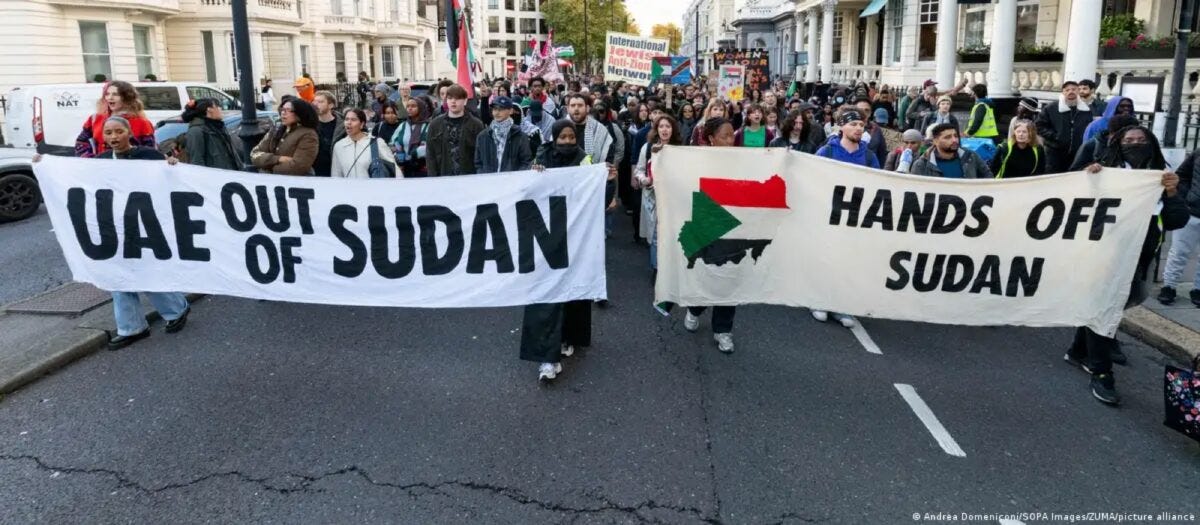
In Sudan, the evidence sits in the dust, stencilled in English and Arabic. In one video, a Sudanese officer in desert fatigues stands over an empty ammunition crate on a captured position and runs his finger along the markings: “United Arab Emirates Armed Forces, Joint Logistics Command, Abu Dhabi.” The crate had held 120‑millimeter thermobaric mortar shells, a type of munition that spreads a cloud of fuel before igniting it, generating intense heat and blast waves in confined spaces.
African Defense Forum and regional media pieced the story together. Sudanese officials and analysts told them that the Rapid Support Forces, a paramilitary group whose leaders cut their teeth in the Janjaweed militias of Darfur, had received weapons, vehicles and money from the UAE. Human rights organizations accused RSF fighters of burning villages, carrying out ethnic killings, and besieging cities such as El Fasher, where residents reported drone strikes on crowded neighborhoods and heavy artillery on hospitals.
A leaked report by experts to the UN Security Council described “credible” evidence that the UAE had flown arms into an airstrip at Amdjarass in northern Chad, in violation of an arms embargo on Darfur. Reuters later examined flight tracking data and satellite imagery and found at least eighty‑plus cargo flights from Emirati airfields to that remote strip since the war began, many of them using aircraft and logistics firms already suspected of moving Emirati weapons into Libya during Haftar’s campaigns. Images showed pallets and crates being unloaded, covered with tarps and trucked toward the Sudanese frontier.
Abu Dhabi insisted that the flights carried humanitarian aid. The markings on the crates, the dimensions of the packages and the pattern of deliveries looked, to weapons experts and UN investigators, more like ammunition logistics than food parcels. The Washington Post, drawing on Western and Sudanese sources, reported growing anger in the region over Emirati drones, munitions and funding that allowed the RSF to sustain its offensive long after its domestic supply lines should have been exhausted.
In Darfur, the victims are Muslims. Whole communities have been pushed from villages into makeshift camps while shells bearing the signature of a Gulf state arc overhead.
The separation doctrine: one strategy in three wars
The grill in Yemen, the hangar in Libya and the crate in Sudan belong to the same playbook. The names of the victims change. The coordinates change. The doctrine does not.
French reporting helped give that doctrine a name. In 2025, the newspaper Le Monde published an analysis by Middle East specialist Jean‑Pierre Filiu that described what he called the UAE’s “strategy of separation.” Drawing on Western intelligence material, Filiu argued that Abu Dhabi had adopted a long‑term policy of supporting separatist movements, warlords and parallel military structures across the Arab world, not to stabilize states but to fragment them.
In Yemen, this meant building, training and paying southern security forces that answered more to Emirati officers than to any Yemeni cabinet, entrenching a de facto partition between north and south while preserving control over key ports and islands. In Libya, it meant backing a commander in the east against UN‑recognized authorities in Tripoli, reinforcing the split between two rival centers of power while ignoring arms embargoes. In Sudan, it meant supporting a paramilitary that behaves like a parallel state within a state, with its own supply lines, gold exports and foreign patrons.
The goal, Filiu wrote, was not “stability” in the sense of functioning, unified states with accountable institutions, but a region broken into enclaves and cantons that could be steered through patronage and coercion. Ports, airfields and mineral concessions would be negotiated with local strongmen, not with parliaments. Any attempt by a national leadership to claim real sovereignty could be cut down by withholding funds, arming rivals or supporting coups.
For a small federation of seven emirates, this is a way to punch far above its weight. It is also a way to keep a much older idea in a permanent state of emergency: the idea that more than a billion Muslims belong to a single community that can act in its own name.
Gertrude Bell: borders against the ummah
The map that made this strategy possible was drawn a century ago by people like Gertrude Bell. She was, in many biographies, a figure of romance: mountaineer, archaeologist, linguist, lone woman in the deserts of Mesopotamia. Inside the British state she was something else: an intelligence officer and Oriental Secretary who helped design the modern Iraqi state for an empire that had no intention of leaving quickly.
In the years after the First World War, Bell sat in offices in Baghdad and drafted memoranda on how to stitch together tribes, Ottoman provinces and religious communities into a new entity that Whitehall could manage. She pushed for a Hashemite monarch, Faisal, for advisory councils that would give notables a role in government, and for a civil service staffed by Arab officials who would still understand that real power flowed through British advisers and British control of the oil under the sand.
Her maps and notes fed into a wider policy. British and French planners carved the Ottoman Arab provinces into mandates and kingdoms: Iraq, Transjordan, Syria, Lebanon. They drew lines that cut through tribal lands and ignored older circuits of trade and scholarship that had tied Aleppo to Mosul, Basra to the Hijaz. Internal memoranda from that period, studied by historians, show a frank concern that “pan‑Islamic sentiment” or a broader Arab national movement might threaten imperial control if left unchecked. Borders, monarchies and advisory councils were the tools chosen to keep that threat at bay.
Some of Bell’s defenders note that she argued against direct colonial rule and pressed for what looked like local self‑government. The structure still worked in London’s favor. Decisions about war, concessions and alliances were made in capitals a world away, while populations on the ground were encouraged to think of themselves as Iraqis or Transjordanians instead of as part of a wider ummah that could resist as one.
The United Arab Emirates did not inherit a mandate. It inherited the logic. The boundary between Abu Dhabi and its own hinterland is not contested. The boundaries that matter are the colonial ones that break Arab lands into brittle states. Mohammed bin Zayed has learned how to work inside that frame: strengthen the borders where they constrain popular will, erode them where they constrain his influence.
Mohammed bin Zayed: a doctrine built on fear of Islam
Mohammed bin Zayed Al Nahyan, now president of the UAE, grew up in a region that had already absorbed that map. By the time he entered the officer corps, the most potent challenge to the colonial borders no longer came from secular Arab nationalism, which had burned itself out in military defeats and authoritarianism. It came from movements that used Islamic language to demand justice, representation and, sometimes, conquest.
Analysts who have studied his rise describe a formative sequence. There was the Iranian Revolution in 1979, which toppled a monarch friendly to the West and replaced him with a theocracy that explicitly invoked the ummah. There was the Afghan jihad, in which thousands of Arab fighters travelled to the front lines and later brought militant networks home. There was the global spread of the Muslim Brotherhood’s social work and political thought. There were suicide bombings and mass‑casualty attacks claimed by Al Qaeda.
In this landscape, MBZ came to see political Islam not as a set of distinct phenomena, but as a single, escalating threat. In private conversations with Western officials that later leaked into the press, he spoke of the Brotherhood and Al Qaeda as points on the same spectrum. To him, an elected Islamist party in Egypt or Tunisia was not proof that Islam and democracy could coexist. It was a staging area for a future coup against secular elites and monarchies.
When the Arab uprisings began in 2011, MBZ did not wait to see where they would settle. Emirati forces joined Saudi troops in moving into Bahrain to help the monarchy crush protests that demanded an elected parliament with real powers. His government poured money and political cover into the military coup that overthrew Mohamed Morsi, Egypt’s Muslim Brotherhood president, in 2013, and into Abdel Fattah el‑Sisi’s subsequent consolidation of an iron‑fisted regime.
In Libya, the UAE ignored a UN arms embargo to arm and fund Khalifa Haftar, whose Libyan National Army presented itself as a secular bulwark against Islamists in Tripoli and Misrata. In Tunisia, Emirati networks backed secular figures hostile to Ennahda and undermined coalitions that might have normalized Islamist participation in democratic politics.
MBZ’s system leaves no safe zone for a leader who draws legitimacy from both the ballot and the mosque. That is why two very different men, one in Ankara and one in Islamabad, traced the same arc of conflict with Abu Dhabi.
Erdogan: a president for the ummah becomes a target
Recep Tayyip Erdogan began his career as a mayor of Istanbul. His political project grew into something larger. As his party consolidated power, he promoted a narrative in which Turkey was not only a nation‑state trying to join Europe, but also a heir to Ottoman stewardship of the Muslim world. He backed the Muslim Brotherhood government in Egypt, supported Ennahda in Tunisia, offered patronage to Hamas in Gaza and anchored a media and diplomatic axis with Qatar.
He also spoke to the ummah directly. In speeches at the United Nations and mass rallies at home, Erdogan denounced Islamophobia, condemned Israeli policy in Gaza and presented himself as a leader who would stand up for Muslims when others stayed quiet. One famous scene at Davos, where he confronted the Israeli president over civilian deaths in Gaza before storming off the stage, cemented that image across the region.
For Abu Dhabi, Erdogan represented the nightmare scenario: an elected leader who used Islamic language and history to mobilize public opinion across borders and who backed Brotherhood‑linked parties that could challenge monarchies in the region.
Relations between Turkey and the UAE deteriorated sharply after the Arab Spring. Emirati officials accused Erdogan of neo‑Ottoman ambitions and of sponsoring an Islamist axis with Qatar. Turkish officials accused the UAE of bankrolling the coup that overthrew Morsi and of funding hostile media.
After the failed coup attempt in Turkey in July 2016, Ankara’s rhetoric hardened. The foreign minister hinted that a “Muslim country” had spent around three billion dollars to support the plotters, and said the government knew which one. Columnists close to the Turkish leadership named the UAE and tied the allegation to Mohammed Dahlan, a Palestinian exile with close ties to Abu Dhabi. Other regional outlets amplified the claim that Emirati intelligence channels had moved money to actors linked with Fethullah Gülen’s network.
The government never indicted the UAE, and officials in Abu Dhabi rejected the accusations, but the damage was done. For several years, Turkey and the UAE stood on opposite sides of nearly every regional fault line: in Egypt, in Libya, in the Gulf crisis with Qatar. The central grievance was transparent. Erdogan had tried to act as a voice for a transnational Muslim public. MBZ had treated that voice as a threat to palace rule and, if Turkish allegations are believed, was willing to fund a coup to silence it.
Eventually, economic pressure forced a rapprochement. Turkish commentators dubbed the new relationship a shift “from Muslim Brotherhood to brotherhood of money,” a phrase that captured the way financial necessity can bend ideology. The underlying doctrine in Abu Dhabi did not shift. MBZ had seen what it looked like when an elected Muslim leader tried to speak beyond his borders. He had also seen how quickly that experiment could be cut down.
Imran Khan: a summit that never happened
Imran Khan did not inherit a comfortable brief. He took office in a nuclear state kept on life support by lenders, caught between a military establishment addicted to Gulf patronage and a public that wanted a break from that dependence. He chose, despite that constraint, to speak as if his mandate stretched from Islamabad to every capital where Muslims were being treated as suspects.
At the United Nations in 2019, he used the biggest stage of his career to talk about Islamophobia, Kashmir and the daily humiliation of Muslims in Western media and law. He warned that treating one and a half billion people as a security problem would eventually carry a price. He described what it felt like for a young Muslim to watch their faith equated with terror every night on television. In Istanbul that same year, Recep Tayyip Erdogan praised him for becoming “the voice of the Muslim ummah and the people of Kashmir,” a rare acknowledgment from a leader who does not hand out compliments easily.
In private, Khan pushed for that role to become something more than speeches. Alongside Malaysia’s Mahathir Mohamad and Erdogan, he helped float the idea of a summit in Kuala Lumpur that would gather leaders who were tired of watching the Organisation of Islamic Cooperation issue soft statements while doing little about Palestine, Kashmir, Rohingya refugees or the rise of anti‑Muslim politics in Europe and India. The invite list made the intent clear. Turkey, Malaysia, Qatar, Iran and Pakistan would sit together and talk as states that wanted to act, not only to send delegations to Riyadh once a year. Pakistani outlets reported that Khan had been directly involved in those early conversations and had committed to attend.
Then the phone calls began. Saudi officials treated the Kuala Lumpur summit as a challenge to the OIC. Emirati diplomats arrived in Islamabad to “share concerns.” Within days, Khan was on a plane to Riyadh. Pakistan’s foreign minister flew again to explain. The army chief appeared in Abu Dhabi. Behind the euphemisms, the message was simple. A summit that brought together Turkey, Malaysia, Qatar, Iran and Pakistan on an equal footing would be read as an attempt to build an alternative pole of Muslim leadership. That could not be allowed.
Khan stepped back. Pakistan withdrew not only his visit but all representation, even at ministerial level. The official explanation in Islamabad spoke of “neutrality” and a wish not to increase divisions in the Muslim world. In Kuala Lumpur later, after leaving office, Khan admitted that he felt “very sad” he had not gone and that “friends” had misunderstood the summit as a move to split the ummah. Everyone in that room knew which friends he meant.
This was not weakness of conviction. It was a clash between a leader who wanted to treat the ummah as a political subject and a financial order that keeps Pakistan on a leash. Gulf deposits, oil on deferred payment and emergency loans have long been used to steady Pakistan’s reserves, and every government knows that a firm “no” in Riyadh or Abu Dhabi can turn into a repayment demand overnight. In that context, the Kuala Lumpur summit was more than a conference. It was the first serious attempt in years to sketch a geometry of Muslim power that did not start from palace alliances and Western security frameworks.
For Khan, the choice was brutal. Attend, and risk a financial crisis set off by offended patrons. Stay home, and watch an idea he had helped seed go ahead without the only nuclear‑armed democracy in the room. In the end, the pressure worked. The summit met without Pakistan. The outlines of a possible Muslim leadership circle never hardened into an institution. The OIC, with its familiar communiques and cautious phrasing, kept its place at the center. Saudi and Emirati comfort survived. The one leader who had tried to stand up as a voice of the ummah from Islamabad paid for that attempt in the currency that now governs Muslim politics: leverage on the balance sheet.
Why the ummah frightens a palace
Erdogan and Imran Khan share little in character. One is a veteran urban politician from a party with deep grassroots machinery. The other is a former cricket star whose movement built a coalition of urban youth, conservative voters and segments of the diaspora. Their countries sit in different alliances and face different pressures.
They do share one trait that matters in this story. Both have, at times, spoken as if they represent the ummah, not only their own populations. Erdogan did it from the balcony of the AKP headquarters on election nights and from podiums at the UN, framing Turkey as a shield for Muslims from Gaza to Myanmar. Imran Khan did it in his speeches on Islamophobia and Kashmir, in his interviews where he described a global community tired of being lectured by Western politicians.
For Mohammed bin Zayed, that kind of rhetoric is not a flourish. It is a threat. A leader who claims to speak for the ummah competes for symbolic authority with the monarchs of the Gulf, including the custodians of Mecca and Medina. He can rally public opinion on issues such as Palestine or the presence of foreign bases. He can argue that normalization with Israel is illegitimate, not only because it violates Palestinian rights, but because it splits the ummah in two.
MBZ’s doctrine is built on preventing that competition from acquiring institutional form. Islamist parties that win elections must be removed. Civilian movements that blend Islamic values with democratic demands must be smothered. Proxy militias must be armed where necessary to keep central governments too weak to project independent moral authority. Leaders who try to act like tribunes of a global Muslim public must be checked through money, coups or diplomatic pressure.
The torture chambers in Yemen and the bombed hangar in Libya are the violent edge of that doctrine. The phone call that kept Imran Khan from boarding a flight to Kuala Lumpur sits at the other end of the same spectrum.
Abraham Accords: closing the circuit with Israel
In September 2020, the UAE signed the normalization agreement with Israel that the Trump administration dubbed the Abraham Accords. The ceremony, held at the White House, framed the deal as a breakthrough for peace, a step toward a new Middle East where trade, tourism and cooperation would replace conflict.
The practical content developed quickly. Within three years, trade between Israel and the UAE grew into the billions, flight routes multiplied, joint investment funds were launched, and agreements were signed in sectors ranging from cyber security to agriculture and health. Security dialogues brought Emirati and Israeli officers into the same rooms, planning integrated air and missile defense concepts for the Gulf and eastern Mediterranean under US supervision.
Policy institutes close to Western and Gulf governments described the accords as the cornerstone of a fresh regional order that would unite “moderate” states against Iran and non‑state actors, while unlocking economic growth. The unresolved conflict in Palestine was downgraded to a file among others. There were gestures, such as temporary pauses on annexation plans, but no binding Israeli commitments to end occupation, stop settlement expansion or recognize a sovereign Palestinian state.
For Mohammed bin Zayed’s doctrine, this was not a defect. It was the point. The accords transformed Israel from an external irritant into an internal partner in the management of the region. The same network of bases, intelligence links and proxy relationships that the UAE had built in Libya, Yemen, Sudan and elsewhere would now be connected to Israel’s technology sector and military doctrine.
In this architecture, the primary threats are defined as Iran and political Islam. The ummah, when it mobilizes around Gaza or Jerusalem, is framed as a complicating factor that needs to be contained through messaging and security measures, not as a constituency whose demands must be met. Leaders like Erdogan or Imran Khan, who speak in that language, become irritants to be neutralized.
From the perspective of the Muslim public, the optics are harsh. A wealthy Arab state that presents itself as a model of modern Islamic tolerance has not only endorsed Israel, but has done so while running torture sites for Muslims in Yemen, bombing Muslim refugees in Libya and supplying weapons to militias accused of massacring Muslims in Sudan. The occupation looks less isolated when one of the richest Arab capitals treats the occupier as a partner.
Washington: the second capital
None of this leverage would exist without Washington. The UAE’s rulers understand that power in the contemporary Middle East travels not only through ports and air bases, but also through lobbying disclosures, think‑tank panels and quiet donations to universities.
OpenSecrets, which tracks foreign influence spending, finds that Emirati entities have spent well over one hundred and fifty million dollars on registered lobbying in the United States since 2016. Separate investigations tally hundreds of millions more in donations to American universities and policy institutes. That money buys access: to lawmakers, to retired officials, to analysts who shape the language in which Washington thinks about the Gulf.
A classified US intelligence assessment, later summarized in the press, described a “vast, multifaceted effort” by the UAE to influence American foreign policy, using both legal and illegal methods. It detailed how Abu Dhabi had recruited former US officials, funded policy reports favorable to its positions, and even used former intelligence and military personnel to monitor dissidents and run hacking operations that targeted perceived enemies.
The Human Rights Foundation’s report on Emirati political interference offered a similar picture. It catalogued how UAE money had flowed into public‑relations firms, lobby shops and think‑tank boards, and argued that the country had built one of the most extensive influence operations ever mounted by a US partner.
The message carried by that operation is consistent. It presents the UAE as a stable, tolerant, indispensable ally. It describes political Islam as an undifferentiated menace. It praises the Abraham Accords as a historic step. It either ignores or dismisses as exaggerated the evidence of torture in Yemen, airstrikes in Libya and clandestine arms shipments to Sudan. When figures like Erdogan or Imran Khan talk about the ummah, the same ecosystem paints them as irresponsible or as tools of a destabilizing ideology.
By the time Mohammed bin Zayed walks into a room in Washington, this groundwork has been laid. He is the ruler who buys American weapons, hosts American troops, signs normalization agreements with Israel and funds American institutions. The fact that his policies are breaking Arab states into fragments and turning Muslim prisoners into bargaining chips counts less than the reassurance that here, at least, is a client who will not surprise anyone by speaking in the name of the ummah.
Saudi Arabia: ally, rival and terrain
For much of the last decade, Saudi Arabia and the UAE were treated as a joint axis. Mohammed bin Salman and Mohammed bin Zayed were photographed together at summits and retreats. Commentators called MBZ the mentor and MBS the eager student. The two coordinated in the Yemen war, co‑led the blockade of Qatar and shared a determination to crush the Muslim Brotherhood wherever it tried to organize.
The alliance has frayed. Analysts now describe a widening rift between Riyadh and Abu Dhabi that runs through OPEC and OPEC Plus production decisions, approaches to Yemen, competition over ports in the Red Sea and the Horn of Africa, and opposing bets in Sudan.
Inside OPEC Plus, the UAE pushed for a higher formal production quota that would reflect its investments in new capacity. Saudi Arabia, anxious about prices and its own fiscal position, resisted. In April 2026, Abu Dhabi announced that it would leave both OPEC and the wider OPEC Plus arrangement, effective May 1, freeing itself from quota discipline at a moment of high prices and strained relations.
In Yemen, the UAE reduced its own ground presence and put its weight behind southern separatists and local forces that consolidated control over parts of the south, including the port of Aden and the island of Socotra. Saudi Arabia, which had entered the war with the stated aim of restoring a unified, friendly government in Sana’a, found itself facing a fractured landscape in which its nominal ally had created quasi‑independent partners with their own ambitions.
In Sudan, Riyadh has tried to position itself as a mediator, hosting talks and calling for ceasefires, while Abu Dhabi’s flights and cargo consignments to RSF‑linked airstrips have prolonged the war. The two powers are effectively backing different power centers in a country that controls key stretches of the Nile and the Red Sea approaches.
Economic interdependence and shared security dependencies make an open break unlikely. Both countries rely on American protection and global markets. Both host millions of expatriate workers. Both fear Iranian influence. Yet the balance has shifted. The UAE behaves increasingly as if it is no longer willing to follow Saudi lead. It pursues unilateral moves, such as leaving OPEC, that rewire the region’s economic architecture.
For the ummah, the risk is that Saudi Arabia, which still holds the custodianship of Mecca and Medina, drifts into a position where its religious prestige masks a erosion of its political agency. A Kingdom stretched by Vision 2030 projects, budget deficits and internal reforms is less able to sponsor independent regional initiatives or to push back if a neighbor uses its wealth and lobbying networks to redefine what “Muslim leadership” looks like.
In that vacuum, a smaller state down the coast that speaks fluent Washington and fluent Tel Aviv can set the terms, as long as no leader in Ankara, Islamabad or elsewhere manages to speak for the ummah loudly enough to change the conversation.
Pakistan: the leash of liquidity
Pakistan’s role in this story is less dramatic and more familiar. It is a case study in how financial dependence can discipline a Muslim democracy without a single shot being fired.
For years, Gulf deposits, remittances and emergency packages have kept Pakistan’s foreign‑exchange reserves from collapsing. Governments in Islamabad, regardless of party, have flown to Riyadh and Abu Dhabi when the balance of payments tipped toward crisis. The money has usually arrived, sometimes as oil on deferred payment, sometimes as cash placed in the central bank, sometimes as a mixture of both.
Those transfers are rarely free. Think‑tank work on Gulf influence outlines how Emirati and Saudi support has shaped Islamabad’s decisions on participation in the Yemen coalition, on public positions regarding Iran, and on willingness to host or mediate talks between Washington and Tehran. Pakistani leaders have had to weigh domestic opinion, which tilts strongly against fighting in Yemen and favors neutrality between Gulf rivals, against the risk that a negative answer might prompt a phone call demanding repayment.
In such a climate, any Pakistani politician who speaks in the name of the ummah is constrained. At his or her own peril, one can address the United Nations on Islamophobia and Kashmir. They can request changes in social‑media policies. But they cannot, without consequences, found a new Muslim bloc that might compete with the Gulf for leadership or question normalization with Israel too sharply. The absence of Pakistani representation at the Kuala Lumpur summit was a quiet victory for the doctrine that says Muslim solidarity must remain subordinate to the geometry of money.
This is, in some ways, more insidious than airstrikes. Torture and bombs leave visible scars. Debt leaves only a ledger. Yet the effect on the political imagination is similar. A state that fears the next repayment demand cannot easily imagine itself as part of a sovereign ummah that chooses its own alignments.
Equal Footing With Israel
Israel’s violence is broadcast. The occupation of the West Bank, the repeated wars in Gaza, the airstrikes in Syria and Lebanon, the language used by politicians who describe Palestinians as demographic threats and security problems, all of this is visible. The Muslim world, and much of the rest of the world, recognizes Israel as a state that rules another people by force.
The danger posed by the Emirati project is different. It is the danger of an ally that speaks Arabic, funds mosques, hosts Islamic conferences and markets itself as a guardian of “moderate” Islam, while operating torture sites in Yemen, bombing migrant camps in Libya and feeding weapons into the wars of Sudan. It is the danger of a government that signs a peace deal with Israel and then deploys the legitimacy of that agreement to build a regional security system in which Palestinian rights, and broader Muslim grievances, become small bargaining chips in a much larger game.
In that system, the ummah is not a community with a voice. It is a security variable. Leaders who speak for it are punished or pressured. States that try to express it institutionally are fragmented. Movements that draw on it, whether Islamist parties or civic coalitions that invoke Islamic language, are labeled extremist and crushed.
A colonial official once took a pencil and drew a line through Mesopotamia. A century later, a crown prince in Abu Dhabi has learned how to push those lines inward, to fracture the states they created and to turn the resulting debris into leverage. The grill, the hangar and the crate are not outliers. They are landmarks on that map.


