The Unbreakable Alliance
Iran, Hezbollah, and the War Washington Wants Tehran to Lose
On the afternoon of April 8, families sleeping in tents along Beirut’s seafront waterfront began folding their blankets. They had heard the ceasefire announcement. They had heard Pakistan’s Prime Minister Shehbaz Sharif declare the agreement included a halt to fighting on all fronts, Lebanon specifically named. For the first time in five weeks, people who had left the cities of Nabatieh and Tyre and the southern villages near the Israeli ground line began calculating whether they could go home. Fadi Zaydan, thirty-five, was preparing to drive his parents back to Nabatieh before Netanyahu’s statement reached him. The statement said Israel did not consider itself bound by the ceasefire in Lebanon. Within hours, Israel struck more than a hundred Hezbollah targets across Beirut, southern Lebanon, and the Bekaa Valley in under ten minutes. Lebanon’s Health Ministry recorded 203 dead by the end of that day; the civil defense count reached 254. One of Beirut’s largest hospitals put out a call for all blood types.
The ceasefire between the United States and Iran had held for roughly twelve hours before the question it refused to answer consumed it.
Washington and Tel Aviv insist Lebanon was never in the deal. Iranian officials, backed by the specific language of Pakistan’s brokering statement, say that claim is a retroactive fabrication. Foreign Minister Abbas Araghchi posted the Pakistani text on social media with a single line underneath it: “The ball is in the U.S. court.” Iran’s Parliament Speaker Mohammad Bagher Ghalibaf called the Israeli strikes a violation of the framework Trump himself had agreed to. French President Emmanuel Macron, after speaking separately with Trump and Iranian President Masoud Pezeshkian, said publicly that the ceasefire had to include Lebanon for it to be worth anything. The EU’s foreign policy chief agreed. So did the UN. The singular holdouts were Netanyahu, Vance, and Trump himself, who told a PBS interviewer the Lebanon situation was “a separate skirmish.”
It is not a separate skirmish, and the people making that argument know it. What is happening in Lebanon is the second half of a strategy that only makes sense as a whole: force Iran to accept a ceasefire that freezes fighting on the Iranian front while Israeli military operations continue dismantling the one alliance structure that gives Tehran strategic depth beyond its own borders. The Lebanese front is not incidental to this conflict. It is the point.
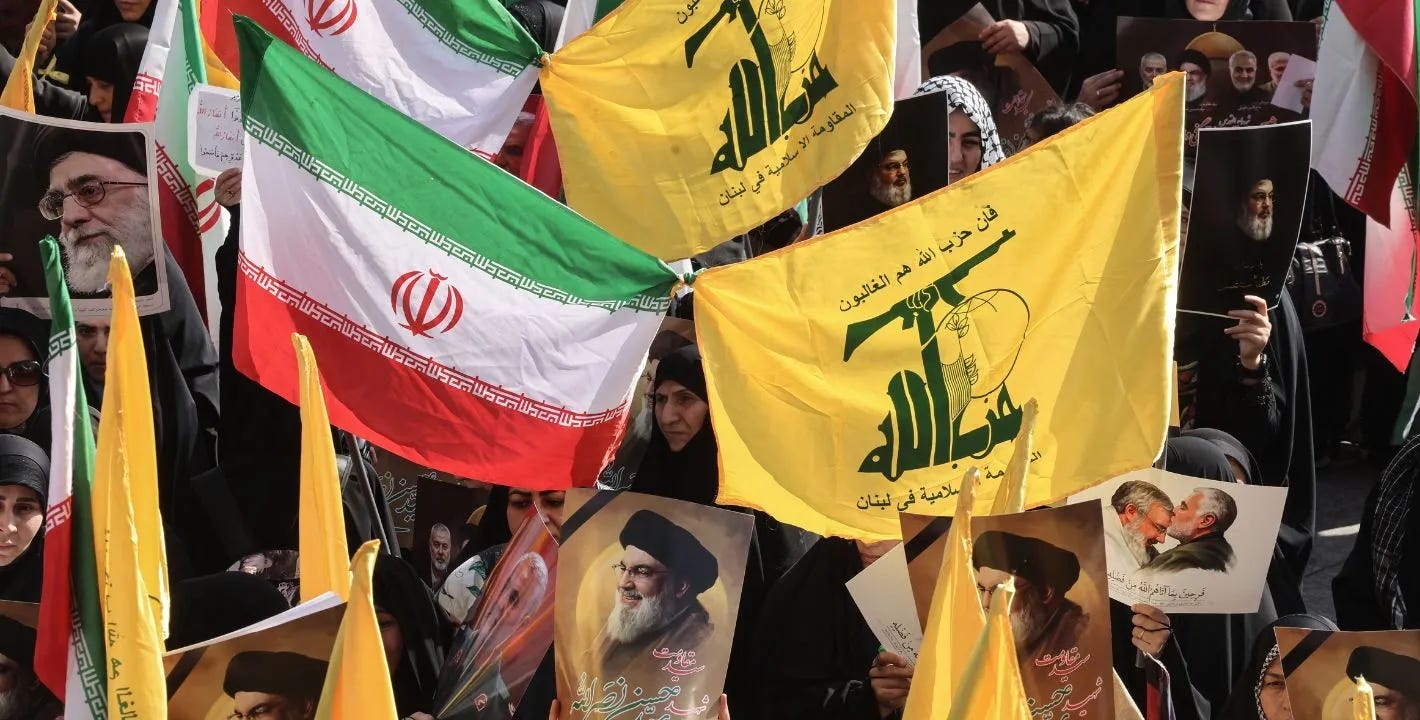
Hezbollah is the oldest and most operationally developed node in the network Iran spent four decades assembling across the region. Founded in 1982 with direct IRGC involvement and guidance, it grew into something the Iranians never entirely anticipated: an organization with its own military doctrine, its own political constituency inside Lebanon, its own weapons production capacity, and at the height of its strength in 2024 a stockpile estimated at between 120,000 and 200,000 rockets and ballistic missiles. No non-state actor in the world carried more firepower. It was also the training center for the rest of the axis. Hezbollah sent specialists to Yemen, Iraq, and Syria. The joint operations room the group hosted in Beirut served as the coordination hub for the entire network.
That architecture took the first major blow in 2024, when Israeli operations killed Hassan Nasrallah and tore through the group’s senior command structure. The IRGC responded by restructuring what remained, moving from a hierarchical model to a cellular one, the same mosaic defense doctrine the IRGC itself operates under. Iranian officers were sent to Lebanon after the November 2024 ceasefire to run the post-war audit. Lebanese Prime Minister Nawaf Salam told a Saudi television network in March that the IRGC was not advising Hezbollah but directing it, managing operations from inside Lebanon with officers who had entered the country on false passports. Whether that assessment overstates the level of operational control or not, it illustrates the degree to which Iran has invested in keeping Hezbollah functional precisely because the alternative, a Lebanon where Hezbollah disarms or dissolves, removes the one thing Iran’s deterrence doctrine cannot replace: a credible military presence on Israel’s northern border, capable of opening a second front under conditions of Iran’s choosing.
The loss of Syria as a transit corridor after Assad’s fall in late 2024 already severed the main overland supply route. Iran adapted, finding ways to rearm via Iraqi channels and to fund domestic weapons production inside Lebanon itself. But those workarounds are second-order solutions. The original architecture required Syrian access. What Israel is doing now, targeting Hezbollah command infrastructure while the attention of the international community is fixed on the ceasefire negotiations, is not a war-within-a-war so much as a continuation of a sequenced campaign: use the larger conflict with Iran to create the conditions in which Hezbollah can be struck without triggering the full regional response that Hezbollah’s survival was designed to guarantee.
Inside Iran, the political calculus is brutal in a way its leadership has not yet been able to articulate in public without cost. The ceasefire announcement generated genuine popular relief. Inflation has been destroying household purchasing power since before Operation Epic Fury began on February 28. Protests had spread across all thirty-one provinces by the end of 2025, driven by economic exhaustion and resentment of a government that, in the view of a large portion of the urban population, spent money on Lebanon and Gaza and Yemen while hospital equipment rusted and the rial continued its collapse. When the ceasefire was announced, those same people felt the war pulling back. When the Israeli strikes on Beirut followed hours later, and when the question became whether Iran would respond, the political trap closed around the Islamic Republic’s leadership.
Responding militarily means being seen, domestically, as the force that restarted a war the public had welcomed the ending of. A government that cannot adequately explain why it funds a Lebanese militia while Tehran’s middle class loses its savings has limited room to ask those same people to accept resumed bombardment in defense of that militia. The clerics and IRGC political operators who frame external spending as obligations of revolutionary solidarity are operating on an ideological register that has been losing ground to kitchen-table economics for years. Even in semi-official media, critiques of the government’s proxy financing have appeared with increasing frequency, a signal of the internal pressure the leadership is absorbing.
But restraint has its own costs, ones the leadership understands with equal clarity. The IRGC’s core ideological constituency, smaller than the war-weary public but tightly organized and politically consequential, expects action. Hezbollah joined the war in the first days of March, firing rockets into northern Israel in response to the assassination of Supreme Leader Ali Khamenei and in defense of the principle that an attack on Iran is an attack on the axis. If Tehran now watches Hezbollah absorb Israeli bombardment without a response, that constituency will read it as the Islamic Republic abandoning the very logic that justifies the network’s existence. The question trickling through the militant political base is not abstract: if Iran will not act when its principal ally is being systematically destroyed, what exactly does the alliance mean?
The answer to that question is being watched carefully in Baghdad and Sanaa. The Popular Mobilization Forces in Iraq are formally part of the Iraqi state structure but ideologically aligned with Tehran. The Houthis in Yemen have fought a war substantially more costly than their public declarations suggest. Both sets of actors have invested in the logic of collective deterrence: an attack on one node triggers a coordinated response across the network. If that logic fails in Lebanon, while the network watches and Iran negotiates, the credibility of the entire model corrodes. Iraq’s PMF leaders will calculate whether the costs of alignment with Tehran still come with the reciprocity they were promised. That calculation, if it shifts, is far harder to reverse than a missile strike.
Rather than resume direct military operations against Israel, Iran has kept its most effective economic leverage point active. The Strait of Hormuz, through which roughly a fifth of the world’s oil supply transits, has remained functionally closed since the ceasefire was announced. Shipping executives told CNN that uncertainty about safe passage is keeping vessels out even after the formal ceasefire took effect, and that Iran’s maritime authorities have provided no guidance on what constitutes a cleared route. Trump warned Tehran publicly not to charge tolls for passage. The IRGC has said it has launched nothing since the ceasefire began. The traffic through the strait tells a different story.
This is deliberate, and the target is not Israel. The Strait is pressure on Washington. The Gulf states, European nations dependent on energy imports, and the global commodity markets reading every shipping report are all inside that pressure, and they are all making calls to the White House. The economic signal Iran is sending through the Strait is more sustainable and more strategically calibrated than a missile barrage. A missile attack on Israel in the current environment would accomplish what JD Vance said openly in Budapest: it would let Washington argue that Iran chose to collapse the ceasefire. The Strait, by contrast, places the burden on the United States. If Washington wants oil to move, Washington needs to constrain Israel. Iran is not saying this. It does not need to.
The question of whether Iran can decouple the two fronts, maintaining the ceasefire with the United States while resuming direct operations against Israel over Lebanon, is being debated within Tehran’s policy circles. The argument for it runs that Washington, if genuinely committed to the negotiations it is hosting in Islamabad, might tolerate a calibrated Iran-Israel exchange rather than lose the diplomatic process entirely. Iran’s leverage would increase, Israel would be isolated, and the axis would be seen to have held. The argument against it is harder to dismiss: even in a scenario where U.S. forces stand down, Washington continues providing Israel with targeting intelligence, logistics, and air defense support. The distinction between the U.S. as belligerent and the U.S. as Israel’s enabler is operationally meaningless. And Tehran’s most effective leverage against the United States has always been its ability to threaten American interests across the region, not just its capacity to hit Israeli territory. Narrowing the conflict to an Iran-Israel bilateral framework strips out the dimension where Iran has the most power.
Israel’s Defense Minister Israel Katz said explicitly that Israel “insisted on separating the war with Iran from the fighting in Lebanon in order to change the reality in Lebanon.” That sentence is worth staying with. It is not a justification offered to the international community. It is a statement of design. The separation of fronts was a negotiating objective, not an accidental outcome of the ceasefire’s drafting. Netanyahu’s office rejected Pakistan’s explicit inclusion of Lebanon before the ink on the ceasefire announcement was dry. Israel knew what it was doing when it struck Beirut within hours: it was converting a ceasefire on one front into operational freedom on another while the political conditions that normally constrain such operations were suspended by the diplomatic moment.
The strategy has a coherent logic from Jerusalem’s perspective. If Hezbollah can be systematically weakened across successive conflicts while Iran is occupied with its own survival and then its negotiations, the network loses its most capable military node before it can be rebuilt to full strength. The Syria corridor is gone. The 2024 campaign killed the senior command structure. The current campaign is targeting the replacement command infrastructure, the rebuilt tunnel networks in the south, and the remaining missile launch sites. Each Israeli strike on Lebanon during this ceasefire is banking on the fact that Iran’s hands are tied precisely when its ally needs them most.
The Iranian analysts who have concluded that Israel may actually prefer continued escalation are not being paranoid. Iran’s long-range missile deterrent has been substantially degraded. The IDF claimed in March that approximately seventy percent of Iran’s missile launchers had been destroyed since February 28. Missile crews reportedly refused orders in some units; desertions were recorded. Against that background, continued Iranian missile strikes on Israel carry diminishing strategic returns while providing Israel with ongoing justification for its own military operations. The Hormuz approach, sustained pressure without the provocation of resumed strikes, is a more uncomfortable adversary for Washington than another missile exchange that Israel’s defenses can absorb and publicize.
The structure of Iran’s dilemma was not accidental. It required coordinating a ceasefire announcement that excluded Lebanon, a simultaneous Israeli military campaign timed to exploit that exclusion, and an American political posture that publicly supported the ceasefire while declining to enforce its most consequential clause. The beneficiary of that coordination is clear. The question being asked in Tehran, and increasingly in Beirut and Baghdad, is whether the party that designed the trap will eventually be held accountable for its design, or whether the architecture of the agreement will make that accountability impossible to assign.
Hezbollah said in a statement that it insists the ceasefire includes Lebanon, and that if Israel does not adhere, no party in the region will be bound by it. The IRGC issued a warning that if Israeli aggression against Lebanon does not stop immediately, it “will fulfil its obligations.” Those are not idle statements, but they are also statements made under conditions specifically engineered to make acting on them as costly as possible. Iran can escalate and own the collapse of negotiations. It can hold and watch its ally dismantled. It can maneuver through the Strait and hope Washington blinks before Israel finishes what it started in Beirut.
None of those three paths leads somewhere that resembles the regional architecture Iran has spent forty years building. The question is which of them preserves the most of it, and how long Tehran has before the choice is made for it by events on the ground in southern Lebanon, where Israeli forces are moving toward the Litani River and more than a million displaced Lebanese have not gone home.


