The Underwriters of War
How a Room in London Closed the Strait of Hormuz
The men who closed the Strait of Hormuz did not work in Tehran. They worked in EC3.
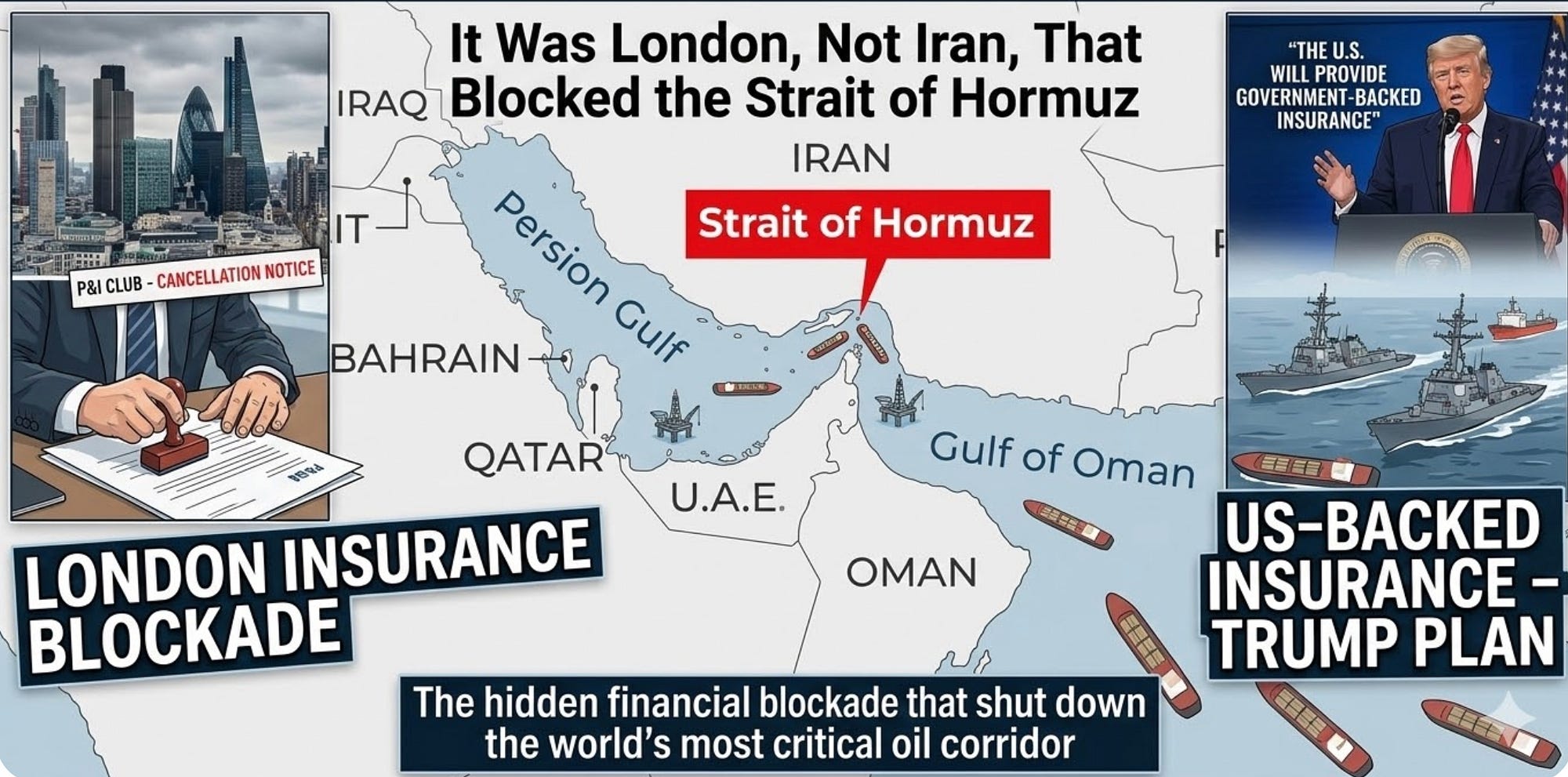
They work in a building near Lime Street, in the square mile of the City of London, where the first recorded mention of Edward Lloyd’s coffee house appeared in 1688. What began as merchants gambling on whether a ship would return from sea became the architecture that now determines whether a ship leaves port at all. On March 3, 2026, the Joint War Committee of the Lloyd’s Market Association met and voted to expand its designated war zone across the entire Gulf: Bahrain, Kuwait, Oman, Qatar, and Djibouti, added in a single session. The committee’s secretary, Neil Roberts, issued a three-sentence statement. Within 48 hours, tanker traffic through the world’s most critical energy corridor had collapsed by more than 80 percent.
Iran’s Islamic Revolutionary Guard Corps had declared the strait closed on March 2. The IRGC’s senior adviser Ebrahim Jabari broadcast the ultimatum on Iranian state media: the strait was closed, and any vessel that attempted transit would be set ablaze by the Revolutionary Guard and the regular navy. The IRGC had struck at least five vessels in the preceding 72 hours. Two crew members were dead. A tugboat sent to assist a stricken tanker would be hit by two missiles three days later.
These were not rhetorical threats. The missiles were real. But the missiles were not the mechanism. The mechanism was actuarial. And it had been built, over three centuries, by the London insurance market itself.
What Lloyd’s Actually Is
Lloyd’s of London is not an insurance company.
It is a marketplace: a medieval guild that modernised and never fully stopped being a guild. On the ground floor of the Lloyd’s building at One Lime Street, syndicates rent spaces called boxes and compete for the right to underwrite pieces of risk. A broker walks the floor on behalf of a shipowner, presenting a risk on a slip, and underwriters sign their names against percentages. Every syndicate within Lloyd’s is itself reinsured by other syndicates within the same market. When a catastrophic claim falls, the entire market absorbs a proportionate share.
In peacetime, the structure is self-reinforcing. In an active war zone, it is the architecture of collective withdrawal. Because all syndicates are reinsured by each other, an event that exceeds the modelling capacity of any one syndicate threatens the capital of all of them. The rational response to unquantifiable risk is not higher pricing. It is exit.
Governing which areas require special war risk cover, and setting the threshold at which ordinary marine policies are voided, is the task of the Joint War Committee. The JWC comprises twelve underwriting representatives from Lloyd’s and the International Underwriting Association of London. It consults with independent security advisers. It updates and circulates its Listed Areas, formally designated “Areas of Perceived Enhanced Risk,” at its own discretion. When an area is listed, shipowners must notify their underwriters before entering it. Underwriters are then entitled to charge an additional premium, renewable every 48 to 72 hours, priced as a percentage of hull value per transit. They are also entitled to decline to write the risk at all.
There is no appeal mechanism. There is no sovereign override. A listed area is, as one London market analysis put it, a toll gate on the trade map. When the gate closes, it does so without a parliamentary debate, without a UN resolution, without a presidential order. It closes because twelve men in EC3 have assessed that the cost of being wrong exceeds the revenue from being right.
The war risk clause Lloyd’s has used since 1898 originated from a general meeting that year, when the market resolved to exclude war risks from standard marine policies entirely. The separation was formalised: war losses would be written under a distinct policy, on distinct terms, reviewable and cancellable on seven days’ notice at underwriters’ discretion. That seven-day notice clause, written when Queen Victoria still had three years left on the throne, is the precise instrument that froze the Strait of Hormuz in March 2026.
By March 3, the JWC had assessed that the threshold had been crossed. They were not wrong.
The Days Before the Freeze
Operation Epic Fury began on February 28. US and Israeli forces struck Iran’s military installations, nuclear sites, and command infrastructure in coordinated airstrikes. Supreme Leader Ali Khamenei was killed. Iran launched retaliatory missile and drone barrages on US military bases in the UAE, Qatar, and Bahrain, on Israeli territory, and across Gulf state infrastructure.
On March 2, Iranian drones struck two sites in Qatar: a water tank at a power plant in Mesaieed Industrial City and an energy facility at Ras Laffan Industrial City, home to QatarEnergy’s LNG processing complex. QatarEnergy is the world’s largest LNG producer. Its Ras Laffan plant supplies one-fifth of global LNG. The company declared force majeure on all contractual delivery obligations, a legal instrument freeing a party from performance in the event of extraordinary circumstances. Customers worldwide received immediate notification that there were no more delivery schedules. Qatar’s Energy Minister Saad al-Kaabi said the plant would not restart until the war was over.
The European gas benchmark, Dutch TTF front-month futures, surged 48 to 52 percent on the day of the announcement. It was the largest single-day gas price jump since Russia cut supply to Europe in 2022. Asian LNG spot prices jumped 39 percent. Goldman Sachs, in a note dated March 1 by commodity analysts including Daan Struyven, had already modelled the trajectory: a one-month full halt to Hormuz LNG flows would push European and Asian spot prices 130 percent higher, to $25 per million British thermal units. A disruption exceeding two months would drive European gas above 100 euros per megawatt-hour, the level Goldman identified as triggering significant global demand destruction. By March 3, Dutch TTF was up 76 percent on the week.
Saudi Arabia’s Ras Tanura refinery, with a daily processing capacity of 550,000 barrels, paused operations after a drone strike. The Houthis in Yemen announced they were resuming attacks on Israeli and commercial shipping in the Bab al-Mandab strait. Iraq shut down operations at the Rumaila oil field on March 3 because tankers could not leave the strait and storage was full.
The insurance market had already begun moving before the first missile was fired.
In the days before Operation Epic Fury launched, war risk premiums for Strait of Hormuz transits had been climbing from 0.125 percent of hull value to between 0.2 and 0.4 percent per voyage. For a Very Large Crude Carrier with a hull replacement value between $100 million and $130 million, that increase added roughly a quarter of a million dollars to the cost of a single transit. Elevated but not prohibitive.
Then the tankers started burning.
The Attack Sequence
On the night of February 28, as Operation Epic Fury began, at least three tankers were struck near the strait. By March 1, the oil tanker Skylight was hit by a projectile five nautical miles north of Khasab, Oman. Two Indian crew members were killed. Three others were injured. The vessel was listed under US Treasury sanctions for connections to Iran’s shadow fleet. On the same day, the Marshall Islands-flagged MKD Vyom was struck by a drone boat that detonated in its engine room. An Indian sailor died. The Gibraltar-flagged Hercules Star, a bunkering tanker supplying fuel to vessels off the UAE coast, was struck and left its manager, Peninsula, issuing a distress statement. The UK Maritime Trade Operations group verified all three incidents.
On March 2, the IRGC formally declared the strait closed and threatened any vessel attempting transit. The US-flagged Stena Imperative was struck twice while berthed in Bahrain. A port worker was killed. Two others were injured. The Athe Nova was hit by two drones after attempting to cross the strait, with the IRGC announcing it was still burning. By March 6, a tugboat dispatched to assist the stricken Safeen Prestige was hit by two missiles. Eight crew members were reported killed.
The IRGC also struck the oil tanker Sonangol Namibe, anchored near Mubarak Al Kabeer Port in Kuwait, in an explosion that caused an oil spill. On March 7, the IRGC claimed drone strikes on two more vessels: the Prima in the Persian Gulf and the Louise P, a US oil tanker, in the strait.
By midnight on March 2, no commercial tankers were broadcasting AIS signals anywhere in the Strait of Hormuz. Over 150 vessels dropped anchor in the Gulf of Oman. Maersk suspended all transits. CMA CGM introduced an Emergency Conflict Surcharge of $2,000 per twenty-foot dry container and $3,000 per forty-foot container on all bookings to and from Gulf countries. Hapag-Lloyd issued parallel guidance. Greece’s shipping ministry advised all vessels to avoid the Persian Gulf, the Gulf of Oman, and the strait entirely.
The ships were not stopped by a blockade. They were stopped by their insurers.
The Cancellation Architecture
The International Group of P&I Clubs provides third-party liability coverage for approximately 90 percent of the world’s ocean-going tonnage. It pools risk across a consortium of mutual clubs: Gard, Skuld, NorthStandard, the London P&I Club, Steamship Mutual, the American Club, and others. When a casualty exceeds any single club’s capacity, the pool absorbs the excess. When the pool’s capacity is exceeded, the group reinsurance programme activates. The system is built to handle the losses of normal maritime commerce, including serious casualties.
It is not built to handle a war.
On March 2, Gard, Skuld, NorthStandard, the London P&I Club, and the American Club issued coordinated cancellation notices for war risk coverage extensions covering vessels entering the Persian Gulf, Iranian waters, and the Strait of Hormuz. The cancellations required 72 hours’ notice and took effect at midnight on March 5. After that date, any vessel entering the zone needed new special coverage written from scratch. The International Group confirmed the position: existing war risk coverage was void. New contracts were available, at the new rates, renewable every seven days.
On the hull side, the JWC expanded its Listed Areas on March 3 to cover the entire Gulf region under the JWLA-033 designation. China Shipowners Mutual Assurance Association issued a notice adopting JWLA-033, effective midnight on March 8. Every major marine insurance body in the world had designated the Strait of Hormuz as requiring special war risk treatment simultaneously.
The premium for new special coverage was 1 percent of hull value per transit. Before the conflict, the rate was 0.25 percent. For a VLCC worth $120 million, 1 percent per transit means $1.2 million in insurance costs for a single voyage, before freight. Underwriting sources at Lloyd’s List reported that for vessels with documented commercial associations with US, UK, or Israeli interests, the rate was quoted between 1.5 and 3 percent per transit. At 3 percent, a single passage costs $3.6 million in war risk insurance alone.
No tanker market has a margin structure that absorbs that without a complete restructuring of every fixture.
A senior executive at one of the world’s largest trading desks told Reuters the ships would stay put for several days. The benchmark freight rate for VLCCs hit an all-time record of $423,736 per day on March 3, a 94 percent increase from Friday’s close, and continued upward to nearly $800,000 per day within the week. Lloyd’s List reduced it to one line: the strait was closed, not by Iran, but by shipping itself.
The Strategic Logic Tehran Built Toward
Iran has threatened to close the Strait of Hormuz with enough regularity over enough decades that Western strategic analysis largely stopped treating the threat seriously. The deterrence logic appeared self-evident: a kinetic naval closure would require the IRGC to sustain operations against US Navy carrier strike groups in a confined waterway. The Fifth Fleet had assets in the region. The conclusion was that a full closure was suicidal, therefore irrational, and that Iran, whatever its other attributes, was not strategically irrational.
That analysis was correct about the military cost of a kinetic closure. It was wrong about what Iran needed to achieve a functional one.
Iran needed to make actuarial risk assessment impossible. Not dangerous: impossible. Shipping companies have operated in dangerous environments for as long as there has been shipping. The London market has priced danger into premiums since 1688. What the market cannot price is an environment in which the verification cost of determining whether any individual vessel will be struck exceeds the premium income from insuring that vessel’s transit. When that threshold is crossed, cover is withdrawn as a matter of institutional self-preservation. The withdrawal is not punitive and not political. It is mechanical.
Tehran built toward that threshold across multiple instruments simultaneously, and what served as the preparation had a different name at the time.
GPS and GNSS interference blanketed the Gulf of Oman, with Windward maritime intelligence detecting 44 injected signal zones and 92 denial areas by early March. AIS transponder data, the primary tracking system by which underwriters verify vessel positions and assess real-time exposure, became unreliable as vessels went dark or reported falsified positions. The IRGC’s VHF broadcasts declaring the strait closed were not aimed at deterring individual captains. They were aimed at underwriters in London who had to model every vessel in the strait simultaneously and could no longer do it with statistical confidence.
The physical attacks reinforced the pricing signal. During the 1980s Tanker War, Iran relied on anti-tank missiles against large carriers because it had no anti-ship weapons until late in the conflict. A 1988 analysis from the United States Naval Institute estimated that only 1 to 2 percent of merchant traffic through the strait came under direct attack across eight years of fighting. Thousands of vessels transited without incident. The asymmetry between the threat and the reality allowed the insurance market to price risk as elevated but manageable.
The 2026 IRGC is a different military instrument. It operates fast attack craft, drone boats, and loitering munitions capable of simultaneous multi-vector strikes without the signature of a conventional naval engagement. By March 4, Windward data confirmed only five vessel crossings, against a pre-conflict seven-day average of 27, and those five included no US, UK, or EU-flagged commercial vessels. A US Central Command spokesperson stated publicly that the strait was technically open. It was open the way a minefield is open: passable in theory, impossible in practice.
Jabari predicted oil would reach $200 per barrel within days. Goldman Sachs modelled the more conservative scenario: a full one-month halt to Hormuz oil flows adds $15 per barrel with no offsets, declining to $12 if all estimated spare pipeline capacity of 4 million barrels per day is utilised. By March 3, traders were demanding $14 per barrel above pre-conflict prices as a risk premium, precisely at the level Goldman’s model calculated for a full four-week halt. Brent crude, which closed at $73 per barrel on Friday before the strikes, broke $82 by March 3 and continued its ascent. The market was pricing a full month’s closure as its baseline case.
The Capital Buffer That Was Already Spent
The Hormuz crisis did not hit a robust system. It hit a system that had been losing capital for 26 consecutive months.
Houthi attacks on Red Sea shipping began in late 2023. War risk premiums for Bab al-Mandab transit routes rose from 0.05 percent to 1.0 percent of hull value within three months: a twentyfold increase. Transit volumes through the southern Red Sea fell 65 percent from 2023 levels by mid-2025. Vessels rerouted around the Cape of Good Hope, adding roughly two weeks to transit times between Asia and Europe, generating premium income only on the longer, safer southern passage rather than the shorter, higher-risk northern one.
When vessels reroute away from a listed area, they stop generating war risk premium income. But the capital reserves held against potential claims in that area do not disappear from the balance sheet. Claims take time to materialise, adjudicate, and pay. Reserves against Red Sea claims were still on the books of every P&I club and hull underwriter through 2025 and into 2026, even as the premium stream that would replenish those reserves had slowed to a fraction of its 2023 levels.
Solvency II, the European Union’s insurance capital framework, compounds the dynamic. It requires firms to hold capital sufficient to survive a one-in-two-hundred-year loss event, calculated continuously across their entire portfolio. As the Red Sea dried up premium income while keeping claims reserves frozen on balance sheets, the capital efficiency of every Lloyd’s syndicate and European marine insurer operating in the war risk space deteriorated through 2024 and 2025. By February 2026, the capital buffer supporting marine war risk underwriting globally was at its lowest point in the modern era.
The Hormuz crisis did not need to be large in absolute terms. It needed to be large enough to break a system already running close to its regulatory capital floor. Eight tanker strikes in 72 hours, in the world’s highest-density energy corridor, with GPS warfare degrading navigational integrity and a declared military closure broadcast on every frequency in the Gulf, was sufficient.
The Red Sea drained the buffer. Hormuz broke the model.
The Earnest Will Comparison and Why It Fails
The 1980 to 1988 Tanker War during the Iran-Iraq conflict is the reference the London market reaches for. It is the wrong reference.
During eight years of conflict, approximately 540 vessels were attacked in the Gulf. Premiums rose to as high as 5 percent at peak periods. Shipping through the Strait of Hormuz never ceased entirely, for two reasons that no longer apply.
The British government maintained a war risk insurance scheme through the 1980s, drawing on the model developed during the Second World War to keep merchant shipping moving when private insurers withdrew. The United States, through Operation Earnest Will beginning in 1987, went further: it reflagged Kuwaiti tankers as American vessels, deployed warships to escort them, and accepted the full legal and military liability for their protection. The operation was the largest US naval convoy mission since the Second World War. It worked because Washington was willing to stand fully behind the cost of military exposure to keep the oil moving, and because the 1980s insurance regulatory environment did not mandate exit the way Solvency II does today.
In March 2026, Donald Trump posted on Truth Social that the US Navy would begin escorting tankers through the strait “as soon as possible” and that the US International Development Finance Corporation would provide “political risk insurance” at a “very reasonable price.” The Lloyd’s Market Association confirmed it was in discussions with the DFC. Lloyd’s List subsequently reported that US Navy officials had privately told tanker executives there was no escort mission capacity currently available and no guarantee of future availability.
The gap between the post and the briefing is not a communications failure. It is the operational reality.
The DFC proposal has a structural problem beyond capacity. The DFC’s primary instrument is political risk insurance: protection for investments against expropriation, contract breach, and political instability in foreign markets. It is not marine war risk insurance, which covers physical damage to vessels and cargo in active conflict zones. The distinction is not administrative. The problem that closed the strait, as Munro Anderson of marine war insurance specialist Vessel Protect stated directly, is not a financing problem. It is the decision by underwriters and risk managers to operate in a war zone. Capital guarantees from Washington do not resolve that decision.
The military comparison fails on its own terms. In the Tanker War, Iran improvised with anti-tank missiles fired at supertankers, inflicting damage but rarely sinking vessels outright. When the US Navy deployed in force, it presented a conventional surface threat that Iran’s 1980s military could not credibly engage. Operation Praying Mantis in April 1988, a single day’s engagement, destroyed roughly 40 percent of Iran’s operational naval capacity in response to a mine strike on the USS Samuel B. Roberts. The asymmetry was decisive.
The 2026 IRGC deploys loitering munitions, drone boats, and subsurface weapons that do not require engaging a surface ship to strike a tanker. The Navy officials who told tanker executives no escort capacity was available were describing a reality that Earnest Will’s planners never faced.
The Cost of Twenty Percent
The energy arithmetic of a prolonged Hormuz closure is already in motion.
Roughly 20 percent of the world’s daily oil supply transits the strait under normal conditions. So does 19 percent of global LNG supply, accounting for approximately 80 million tonnes per annum, principally from Qatar. Nine percent of global gasoil and diesel exports and 18 percent of global jet fuel exports transited the strait in 2025. Saudi Arabia, Iraq, and the UAE together exported 13.1 million barrels per day through the waterway in 2025, with China as the primary destination.
China is also the largest operator of the shadow fleet: tankers moving under flags of convenience with reduced documentation, historically transiting sanctioned Iranian crude outside the formal insurance framework. Iran front-loaded its crude exports to a post-sanctions era high in February 2026, anticipating the strikes, and entered the conflict having already moved as much as it could ship. Its adversaries entered it unable to move theirs. Iraq shut Rumaila because storage was full. Saudi Arabia paused Ras Tanura because it had been struck. Qatar declared force majeure on one-fifth of global LNG supply.
Pakistan imports the overwhelming majority of its oil through Hormuz. Petroleum Minister Ali Pervaiz Malik confirmed the government was monitoring the situation and seeking alternatives. Islamabad formally requested Saudi Arabia reroute supplies through Yanbu on the Red Sea. The request was accommodated for one vessel, a temporary arrangement that addresses a fraction of the volume. For a country already running at the edge of a foreign exchange crisis, with an energy import bill that constitutes a structural drain on the current account, a protracted Hormuz closure at rising oil prices is not a supply chain disruption. It is a macroeconomic shock.
Pakistan did not vote for Operation Epic Fury. It was not consulted. It is paying the cost at the pump, in the currency reserve, in the current account deficit that its creditors will cite the next time Islamabad sits across from an IMF mission. This is the permanent geometry of the arrangement: decisions made in Washington and Tel Aviv, costs distributed across Karachi, Dhaka, Colombo, Manila, and every other city whose energy security was threaded through a 33-kilometre chokepoint that two countries decided to make into a theatre of war.
Europe is not insulated. Gas storage entered the winter at depleted levels. Dutch TTF futures jumped 76 percent in a single week. Goldman Sachs calculated that a two-month Hormuz closure would push European gas above 100 euros per megawatt-hour, the level that triggered demand destruction during the 2022 Russian gas crisis. The 2022 crisis came from one supplier cutting one pipeline. The 2026 crisis comes from a physical closure of the corridor through which a fifth of all global LNG moves. The mechanisms are different. The consequence, energy bills rising faster than wages across importing economies, is the same.
The International Energy Agency estimates that 4.2 million barrels per day of the oil flowing through Hormuz can be redirected through existing spare pipeline capacity. That leaves roughly 16 million barrels per day at risk from a full closure. Saudi Arabia and the UAE have limited diversion routes. Iraq has none of scale. Spare pipeline capacity is not a solution. It is a partial offset that buys weeks, not months.
What Remains Open and What That Means
The Lloyd’s Market Association stated publicly that coverage remains available. Broker Arthur J. Gallagher confirmed it had obtained war risk solutions for clients. Marsh confirmed new policies were being written. A Lloyd’s spokesperson confirmed discussions with the DFC about potential political risk guarantees. None of them describe an open strait.
On March 4, Windward intelligence recorded five vessel crossings. The pre-conflict seven-day average was 27. The daily baseline before the crisis was 116 vessels. Five is not an operational corridor. It is the residue of risk tolerance at the extreme edge of the commercial shipping market.
A small number of Greek shipowners began discussions about dark transits: switching off AIS transponders, sailing at night, accepting full uninsured exposure in exchange for freight rates high enough to justify the gamble. One tanker, the Pola, completed a transit with its transponder disabled, reappearing off Abu Dhabi. It is one vessel against a daily requirement of 116. Harry Vafias, whose family group owns or manages a fleet of roughly 100 ships spanning tankers, bulkers, and LPG carriers, stated the position without equivocation: for the time being there was no insurance for going through the strait, nobody was doing it, the chances of being hit were too high, and only a person with no judgment would attempt it without coverage.
Trump’s Truth Social post and the private communication Lloyd’s List sourced from Navy officials briefing tanker executives represent two different assessments of the same operational question, and they do not agree. Operation Earnest Will in 1987 required months of preparation, a significantly degraded Iranian military after seven years of the Iran-Iraq War, and still resulted in casualties and the near-sinking of the USS Samuel B. Roberts by an Iranian mine. The 2026 version, against a more capable adversary in a compressed timeline, has not been planned, staffed, or committed to by any military commander on record.
The Architecture of the Instrument
Lloyd’s did not decide to close the Strait of Hormuz. The twelve representatives of the JWC did not sit in March 2026 and choose to produce a global energy crisis. They applied the rational logic of their institution: price risk accurately, and withdraw from risk that cannot be priced, to an environment that Tehran had deliberately engineered to destroy actuarial accuracy.
Western strategic analysis missed this because it was measuring the wrong instrument. It measured Iranian naval capability against US carrier strike groups. It modelled kinetic closure scenarios. It war-gamed mine deployments and missile trajectories. It did not model the capital reserve position of the International Group of P&I Clubs following 26 months of Red Sea attritional drain, or the Solvency II compliance exposure of Lloyd’s syndicates facing simultaneous claims across a contested waterway with degraded tracking infrastructure, or the reputational cost to any underwriter who wrote coverage for a VLCC subsequently sunk in a zone where their own committee’s notice said no vessels should enter.
Tehran did not have to defeat the US Navy. It had to make the London market’s exit the rational institutional choice. It achieved that with a VHF radio broadcast, a squadron of drones, and 26 months of preparation that was not called preparation at the time because it had a different name: the Houthi campaign in the Red Sea.
The Red Sea drained the buffer. Hormuz broke the model. The tools were cheap. The effect was total. Countries across South Asia, Southeast Asia, and Southern Europe are now paying the cost of a strategic decision in which they had no voice, priced through a mechanism they did not build, administered by a committee in EC3 that answers to no government and whose decisions are subject to review by no court, parliament, or international body.
This is how commercial infrastructure becomes the instrument of imperial power without ever announcing itself as such.
The most consequential weapon deployed in this war does not have a rangefinder, a propellant charge, or a warhead.
It has a seven-day renewal clause and a 1 percent premium, written in the City of London, binding on the world.


