The Unfinished Nation
Pakistan’s Second Liberation: The country was born on August 14, 1947. The liberation it was created to deliver is still outstanding.
The men who built this country wanted freedom from the class that administered their subordination. That class is still governing. It changed its passport.
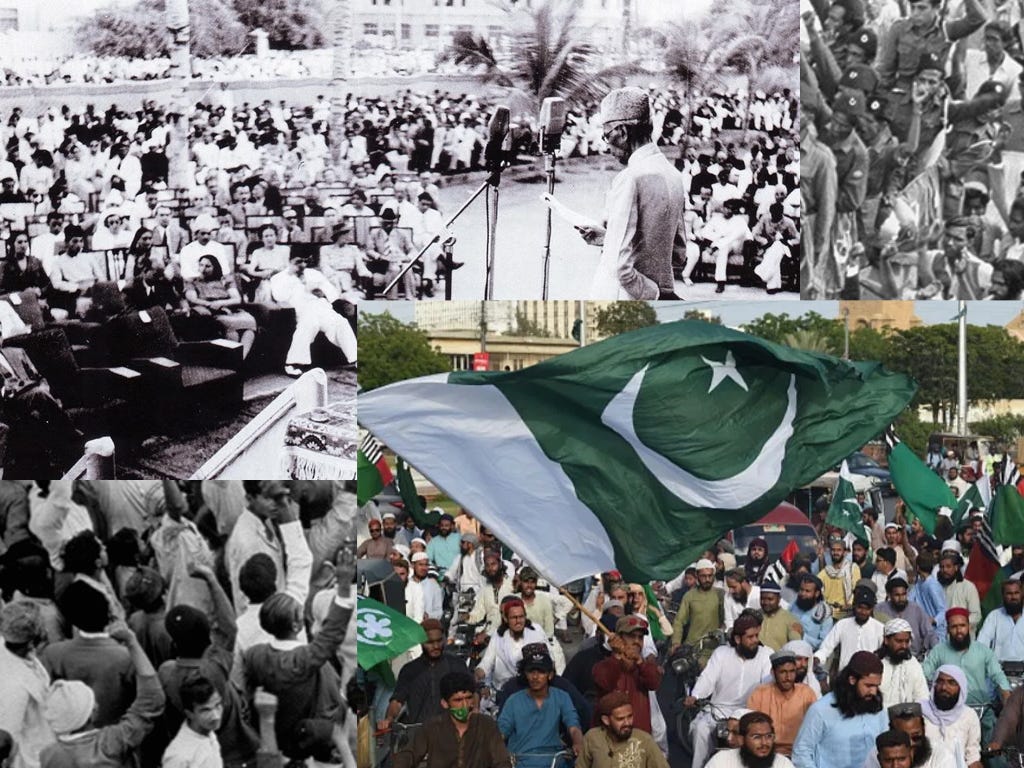
There is a photograph in the Pakistan Movement archives that most school textbooks have stopped printing. It shows a young Muhammad Ali Jinnah in London, 1930, dressed in the suit of a Lincoln’s Inn barrister, surrounded by the ornate furniture of the colonial establishment he would spend the next seventeen years dismantling. The photograph is instructive not because of what Jinnah wore, but because of what he understood: that you could learn the empire’s language, its law, its procedural architecture, and then turn every instrument of it against the structure that produced it.
That is what the Pakistan Movement was. Not a retreat into religious separatism, not a communal panic, but a calculated act of class war. Jinnah, Liaquat, Fatima, the lawyers and organizers and landlords who held the All-India Muslim League together through the 1940s, read the colonial apparatus clearly. They understood that the British had built India to extract, and that extraction required local intermediaries. The intermediaries were trained in English schools, paid in English currency, and taught to believe that their elevation above ordinary Indians constituted a kind of civilization. They administered land revenue, tax collection, and judicial repression on behalf of a Crown that was thousands of miles away. Jinnah called them the Brown Sahibs. He meant it as a class designation, not an insult. He was identifying a function: the locally-grown manager of foreign extraction.
Before the mechanism of capture is examined, the cost of it must be stated plainly. In the 2023-24 fiscal year, the Pakistani federal government spent fifty-seven paisas of every rupee it collected on debt servicing before a single school was staffed, a single hospital was supplied, or a single kilometre of road was contracted. The country that was created to exercise self-determination spends the majority of its revenues administering a payment schedule to foreign creditors. That is not a governance failure. It is the designed outcome of a system built while the Pakistan Movement was still being dismantled, by the same class the Pakistan Movement was built to remove.
The country that came into existence on August 14, 1947 was built to end that arrangement. Pakistan was the break. The clean line between servitude and self-determination. The moment when a Muslim minority inside British India and the Muslim majorities of the northwest and Bengal said collectively: we will not govern ourselves through proxies loyal to someone else’s capital.
Seventy-eight years later, the proxies are still governing. The capital is in different cities.
To understand what was left unfinished, you have to read what was actually promised, and you have to read it as the class document it was.
The Lahore Resolution of 1940, passed by the All-India Muslim League at Minto Park, demanded autonomous states with full constitutional sovereignty. Underneath the constitutional language was a demand with direct material consequences: that the revenues generated by the people of these territories would be administered by governments accountable to those people, not by an administrative class accountable to London. The Resolution demanded the removal of the intermediary. It demanded that the commission structure of colonial extraction be abolished and that the productive classes of Muslim-majority territories govern their own economic life.
Jinnah’s presidential addresses during this period are documents of anti-colonial intent with a sharp class edge. He told the League’s lawyers and journalists repeatedly that the goal was not to replace British administrators with Muslim ones executing the same function for the same external interests. The goal was a state whose foreign policy served its own people, whose economy answered to its own parliament, and whose ruling class was accountable to its own electorate rather than to external patrons. He was not building a Muslim version of the colonial state. He was building a different kind of state entirely.
The All-India Muslim League also, in its founding documents and legal architecture, included Hindus, Sikhs, Christians, and Parsis. Jinnah’s address to the Constituent Assembly on August 11, 1947 is the clearest constitutional statement he made as head of state: a country where religion was a private matter between a citizen and God, and where the state served all citizens without discrimination. He said that within a generation, the categories of Muslim and Hindu and Christian would disappear from political life and only the category of Pakistani citizen would remain.
That speech is partially taught in Pakistani state curricula. The reasons its full text is suppressed point toward the same political interests that have benefited from Pakistan’s continued capture. A secular civic state, fully sovereign and answerable to its population, would have been fatal to the class that inherited the apparatus of the colonial state and continued operating it under a green flag.
Pakistan began losing its independence before the ink on the partition documents had dried. The timeline of capture is not a series of unfortunate accidents. It is a sequence with a direction, and every break in that sequence removed someone who might have closed the class question that independence had left open.
In 1948, Jinnah died. No successor carried equivalent constitutional authority or political independence from external patrons. In 1950, Prime Minister Liaquat Ali Khan made a trip to Washington. The Truman administration offered economic assistance and security guarantees against India. The price was Cold War alignment. Pakistan would make its territory, its airbases, and its intelligence infrastructure available to American strategic planners.
In 1951, Liaquat was assassinated at a public gathering in Rawalpindi. The man accused of firing the weapon was shot dead before he could be questioned. The investigation was closed before it produced a conclusion. Pakistani historians who have revisited the case, cross-referencing the available declassified American records held at the National Security Archive in Washington, conclude that the investigation was closed before it was completed and that the closure served the interests of those who inherited power after Liaquat’s death. The American records show clear interest in Pakistani political succession. They show that Washington understood immediately who would replace Liaquat and found the replacement more workable. The records do not prove American operational involvement in the killing. They establish that the killing produced an outcome Washington had anticipated and preferred.
In 1953, Governor-General Ghulam Mohammad, a bureaucrat who held no democratic mandate, dismissed the Constituent Assembly. The Federal Court of Pakistan’s judgment in Maulvi Tamizuddin Khan v. Federation of Pakistan in 1955 documents this constitutional rupture in the court’s own language. It was Pakistan’s first constitutional coup, and it removed the body that was drafting a constitution that might have entrenched the Lahore Resolution’s vision of full sovereignty in law. The class that benefited was the same class that had benefited from the colonial state: senior bureaucrats, military officers, and commercial families whose wealth and power depended on external patronage rather than domestic political accountability.
By 1954, Pakistan had signed the Mutual Defense Assistance Agreement with the United States. By 1955, it had joined SEATO, then CENTO, locking its foreign policy into the American Cold War architecture. By 1958, General Ayub Khan had displaced the elected government. In the same year, Pakistan entered its first IMF programme. The coincidence of military consolidation and IMF entry is not coincidental. Military governments are reliable executors of financial conditionality because they do not face electoral accountability for the austerity that conditionality imposes on ordinary people. The class that controlled the military and the senior bureaucracy had every incentive to maintain both the military government and the IMF relationship. Both arrangements kept power concentrated in the same hands and kept democratic accountability, which would have redistributed that power, permanently deferred.
Pakistan has been inside an IMF programme for more years since 1958 than it has been outside one. That is not a crisis measure applied to an otherwise sovereign state. That is the permanent condition of a ruling class that has outsourced its financial management to external institutions because external management protects its domestic position against its own population.
The Pakistan Movement was a class war against the Brown Sahib. It won territory and lost the class war. That is the precise formulation, and it is the formulation that explains everything that followed.
The Brown Sahib was an economic function before he was a cultural type. He was the locally-recruited manager of external extraction. He collected the revenue, staffed the courts, ran the railways, administered the cantonments, and kept a commission on every transaction between the colonial economy and the local population. His children went to English schools. His social life was calibrated to English standards. His professional advancement depended on the approval of people in London, not on the approval of the people he administered. He was a class in the strict sense: a group defined by its relationship to the means of production and its relationship to political power, and that relationship ran through an external capital.
Independence changed the external capital from London to Washington and the IMF’s headquarters on 19th Street. The class relationship did not change. The Brown Sahib of 2025 went to Harvard instead of Oxford. He banks in a financial system whose rules are written in Washington. His children hold British or American passports. But his economic function is identical: he manages the interface between external capital and Pakistani resources, retains a commission, and ensures that domestic political accountability does not disrupt the arrangement.
This is why every Pakistani government that has moved toward genuine economic sovereignty has been removed or neutralised. It is not ideology that drives the removals. It is class interest. A sovereign Pakistan, running its own monetary policy, trading with whomever it chooses, refusing IMF conditionality, and taxing the landed and commercial elites who currently operate with near-total impunity, would be an existential threat to the class that currently governs. That class will use every instrument available, military courts, media ownership, foreign exchange pressure, intelligence operations, judicial manipulation, to prevent that outcome.
The people who mobilised behind Jinnah in the 1940s were not only demanding a separate territory. They were demanding the removal of the intermediary class from their economic lives. The farmers of the Punjab, the traders of Sindh, the mill workers of Dhaka, the small merchants of the NWFP did not fill the League’s public meetings because they wanted a new flag. They came because they wanted the man in the suit to stop taking their money to London. When independence came and the man in the suit stayed, taking the money to Washington instead, the demand was not met. It was deferred.
The deferral is ending. But to understand why it is ending now, and why the establishment desperately needs the current moment to be framed as something new, something generational, something that will pass, the history of the intervening iterations must be named.
The English-language press, the television anchors who speak in the cadences of Karachi’s Defence Housing Authority, and the international analysts who file dispatches from Islamabad’s diplomatic circuit have settled on a framing for the current political mobilisation in Pakistan. They call it a Gen Z movement. They talk about TikTok and social media and the political awakening of young Pakistanis. They use the language of novelty. They describe something unprecedented, something that emerged recently, something without deep historical roots.
This framing is not analysis. It is management. Its function is to make the current mobilisation appear temporary, demographic, a phase that will resolve itself when the cohort ages into the economic arrangements it is currently disrupting. Every establishment has used a version of this framing against every serious challenge to its authority. The British called the Muslim League agitators. Ayub Khan called the 1968 street movement student unrest. Yahya Khan called the Bengali demand for autonomy Indian conspiracy. Zia called the lawyers and journalists who opposed him Western agents. The specific label changes. The function is identical: to name the challenge in a way that denies it structural depth.
The current mobilisation in Pakistan is not a Gen Z phenomenon. It is the fourth major iteration of the same class demand that has been building since 1947 and suppressed three times without being resolved.
The first iteration was the Pakistan Movement itself, 1940 to 1947, which established formal sovereignty without displacing the class that administered colonial extraction. That class survived by switching patrons.
The second iteration was the anti-Ayub mobilisation of 1968 to 1969, which drew workers, students, lawyers, and small traders into the streets in numbers the regime could not contain. Zulfikar Ali Bhutto channelled that mobilisation into the Pakistan Peoples Party, whose original programme in 1967 was explicitly a class programme: land reform, nationalisation of key industries, breaking the concentration of economic power in the hands of the twenty-two families that, as documented by the economist Mahbub ul Haq in his 1968 address to the Pakistan Institute of Development Economics, controlled two-thirds of Pakistani industrial assets, four-fifths of banking, and half of the insurance sector. The mobilisation produced a government. The government was removed by a military coup in 1977. The class it had threatened was restored to its position.
The third iteration was the lawyers’ movement of 2007 to 2009, which began as a constitutional demand for judicial independence and widened into a broad coalition demanding accountable governance. It successfully restored the Chief Justice. It did not restructure the economic arrangements that made judicial capture necessary and profitable for the governing class. The demand was met at its narrowest and denied at its widest.
The fourth iteration is the current one. It draws from the same structural grievance that animated all three of its predecessors: that Pakistan’s governing class does not govern Pakistan. It governs the interests of external patrons and its own wealth accumulation, using the Pakistani state as the instrument of both. The generation currently in the streets, the courtrooms, and the digital public sphere did not invent this grievance. They inherited it, fully formed and documented, from three previous generations who made the same demand and were defeated by the same class using the same instruments.
What is new is not the demand. What is new is the documentation. The current generation has access to the declassified American cables showing ISI-CIA coordination. It has access to the IMF programme conditionality letters published on the Fund’s own website. It has access to the State Bank’s quarterly accounts showing the precise percentage of federal revenue consumed by debt service. It has access to the court judgments, the asset declaration records, the land registry data, and the offshore financial disclosures that previous generations could not see. The class that administered extraction in relative informational darkness now administers it under conditions of increasing transparency. The anger is not new. The evidence base supporting it is.
To call this a Gen Z movement is to mistake the messenger for the message. The message is seventy-eight years old. The class war that independence interrupted is not a new political season. It is the resumed demand of a subordinate class that has been patient for three generations and is now, with documentary precision and political organisation that its predecessors did not have, presenting the bill.
Three interlocking systems collectively prevent any Pakistani government from exercising genuine sovereignty over its strategic decisions. Each system is also a mechanism of class reproduction: each one ensures that the class currently governing continues to govern regardless of electoral outcomes.
The first is military-intelligence integration with Western security frameworks. Pakistan’s Inter-Services Intelligence maintained operational relationships with the CIA that, according to Senate Intelligence Committee reports and congressional testimony documented during the 1980s, gave American handlers direct access to ISI operations during the Soviet-Afghan war. The relationship did not end when the Cold War did. The post-2001 arrangements placed Pakistani military operations in the tribal areas under de facto American operational direction. Drone strikes were conducted on Pakistani territory while Pakistani officials publicly condemned them and privately coordinated the target lists. That gap between public statement and documented operational reality is the signature of captured sovereignty. The senior military and intelligence officers who managed that arrangement were rewarded with equipment, training, institutional prestige, and personal relationships with the most powerful security apparatus in the world. The arrangement created a professional class whose career interests aligned with American strategic preferences and whose institutional authority at home rested partly on that alignment. Ending the arrangement would have meant ending the career structure it supported.
The second mechanism is the financial chokehold administered through the IMF and its supplementary architecture. Pakistan has entered twenty-three IMF programmes since 1958. Each programme carries conditionality: austerity measures that compress public spending, currency devaluations that impoverish ordinary Pakistanis while benefiting export elites, privatisation schedules that transfer public assets to private interests, and interest payment structures that ensure the debt is never retired. For every hundred rupees collected in federal revenue in the 2023-24 fiscal year, according to the State Bank of Pakistan’s own published accounts, fifty-seven left the country in debt service before a single public obligation was met. The economists who design and implement these programmes are overwhelmingly products of the same American and British university pipelines that produced the Cold War technocrats who first negotiated Pakistan’s absorption into the Western financial system. The continuity is not accidental. It is the educational pipeline of class reproduction: each generation of Pakistani technocrats is trained inside the intellectual framework of the institutions that benefit from Pakistan’s continued subordination and returns to administer that subordination with professional confidence.
The third mechanism is that educational pipeline itself. As documented in Ayesha Jalal’s “The State of Martial Rule: The Origins of Pakistan’s Political Economy of Defence” (Cambridge University Press, 1990) and corroborated by data compiled by the Social Policy and Development Centre in Karachi, the senior civil servants, military officers, corporate executives, media owners, and political financiers who effectively govern Pakistan are overwhelmingly products of educational institutions in Britain and the United States. Their intellectual formation occurred inside the conceptual framework of the societies that benefit from Pakistan’s continued subordination. Their professional networks run through London, Washington, and New York. Their children live in those cities. Their wealth is stored in those financial systems. Their loyalty, when tested, runs toward the cities where they formed.
Jinnah saw this class forming in the 1930s and named it. He built a movement to replace it. The movement succeeded in creating a country and did not displace the class. The class survived by adapting its institutional affiliations while preserving its economic function.
The generation now active in Pakistani political life, the lawyers, journalists, academics, and organizers pushing back against the current military-judicial complex at documented personal cost, have begun using the language of the Pakistan Movement deliberately. This is not nostalgia. It is a structural argument with a class analysis at its core.
The argument is this: the Pakistan Movement established formal sovereignty and failed to establish substantive sovereignty because it failed to displace the class that administered colonial extraction, and that class survived by switching patrons. The barriers to substantive sovereignty in 1947 were British administrative networks, British-trained comprador elites, and the financial architecture of colonial extraction. The barriers in 2025 are Western financial networks, Western-trained comprador elites, and the financial architecture of debt-based extraction. The form has changed. The function has not. The class has not.
The strongest counterargument to this analysis is that Pakistan’s alignment with the West was rational: a newly-created, underdeveloped state facing a larger hostile neighbour needed the security guarantee that Washington could provide, and full constitutional sovereignty was never practically achievable under those conditions. The documented record answers this directly. The security relationship with the United States did not resolve the India problem. In 1965, when Pakistan and India went to war, the Americans cut off arms supplies to both sides. Pakistan had traded its sovereignty for a security guarantee and when the guarantee was called, Washington declined to honour it. Pakistan paid the full price of subordination and received none of the protection it had purchased. In 1971, during the fall of Dhaka, the Nixon-Kissinger tilt toward Pakistan produced diplomatic gestures and no military intervention. Pakistan lost half its territory while its American patron watched. The transaction was completed entirely in Washington’s favour. The ruling class that had negotiated the terms of subordination paid no personal price for the outcome. The populations of East and West Pakistan paid everything.
The movements building in Pakistan today are diverse in their specific demands and unified in their structural diagnosis: Pakistan’s decision-making class does not serve Pakistan. It serves external patrons and captures the state domestically to protect those relationships and the personal wealth they generate. This is a class diagnosis. It is the same diagnosis that animated the Pakistan Movement before independence, that Bhutto’s original programme named in 1967, that the lawyers’ movement approached in 2007, and that the current generation is pressing with a documentary precision that its predecessors did not have access to.
The Pakistan Movement created a territorial state. It did not complete the liberation. What remains unfinished is the class question.
Pakistan’s foreign exchange reserves are held primarily in dollars and kept in accounts subject to American financial regulation. A decision made in Washington can restrict Pakistan’s ability to import food, medicine, or fuel. That is not sovereignty. That is a financial leash dressed in constitutional language.
Pakistan’s debt service payments consumed fifty-seven percent of federal revenue in the 2023-24 fiscal year. A government that spends more than half its revenues paying foreign creditors before it allocates a single rupee to schools, hospitals, or infrastructure is not governing in the interests of its population. It is administering a payment schedule on behalf of a class whose wealth is secured by maintaining that schedule.
Pakistan’s military doctrine, according to its own publications and the analysis compiled by the Pakistan Institute for Peace Studies, continues to orient around threat assessments and alliance structures designed in Washington during the Cold War and not renegotiated once in any fundamental way since. The security establishment that enforces this doctrine is also the security establishment that removes governments when those governments move toward genuine economic sovereignty. The two functions are not separate. They are the same function performed by the same class.
The Brown Sahibs Jinnah identified are in the same drawing rooms. They changed their passports. They learned to cite development economics instead of colonial administration theory. The function is the same: to govern a Muslim-majority country in the interests of non-Muslim-majority capitals, and to be rewarded for that service with personal wealth, security, and social status unavailable to the populations they administer.
The men and women who built the Pakistan Movement understood what they were building. They were asserting the right of a people to govern themselves, to make their own mistakes, to build their own institutions, and to answer to their own conscience rather than to someone else’s imperial calculus. They were demanding the removal of the intermediary class. They got the country. They did not get the removal.
That demand is now back in the streets, in the courtrooms, in the journalism, and in the political organising of a generation that did not invent the grievance but inherited it with the accumulated interest of seventy-eight years of deferral. The establishment calls them Gen Z. The Raj called their great-grandparents agitators. The label is always chosen to make the demand sound temporary and the class making it sound inexperienced.
The demand is not temporary. The class making it is not inexperienced. It is the most document-literate generation of Pakistanis in the country’s history, pressing a class claim that is older than the country itself, with tools that make the claim harder to suppress than it has ever been before.
The Lahore Resolution’s demand for autonomous states with full constitutional sovereignty has never been achieved. It has been approximated nominally and denied substantively at every turn since 1947. The interrupted class war is not approaching a new beginning. It is approaching its fourth and most sustained iteration, building on the failures of the three that preceded it, armed with the documentation those iterations generated, and organised around a structural diagnosis that the ruling class cannot answer with anything except force.
Jinnah asked the original question from inside the empire’s own legal architecture, in London, in its courts, with its own procedural instruments, and he prevailed.
His successors are asking it from inside a different kind of capture, administered by a class that has had seventy-eight years to entrench itself. The tools are different. The demand is the same. The class enemy is the same class.