The Walls Close In
How India, Israel and the UAE Are Building an Architecture Around Pakistan
The chants started before he reached the podium.
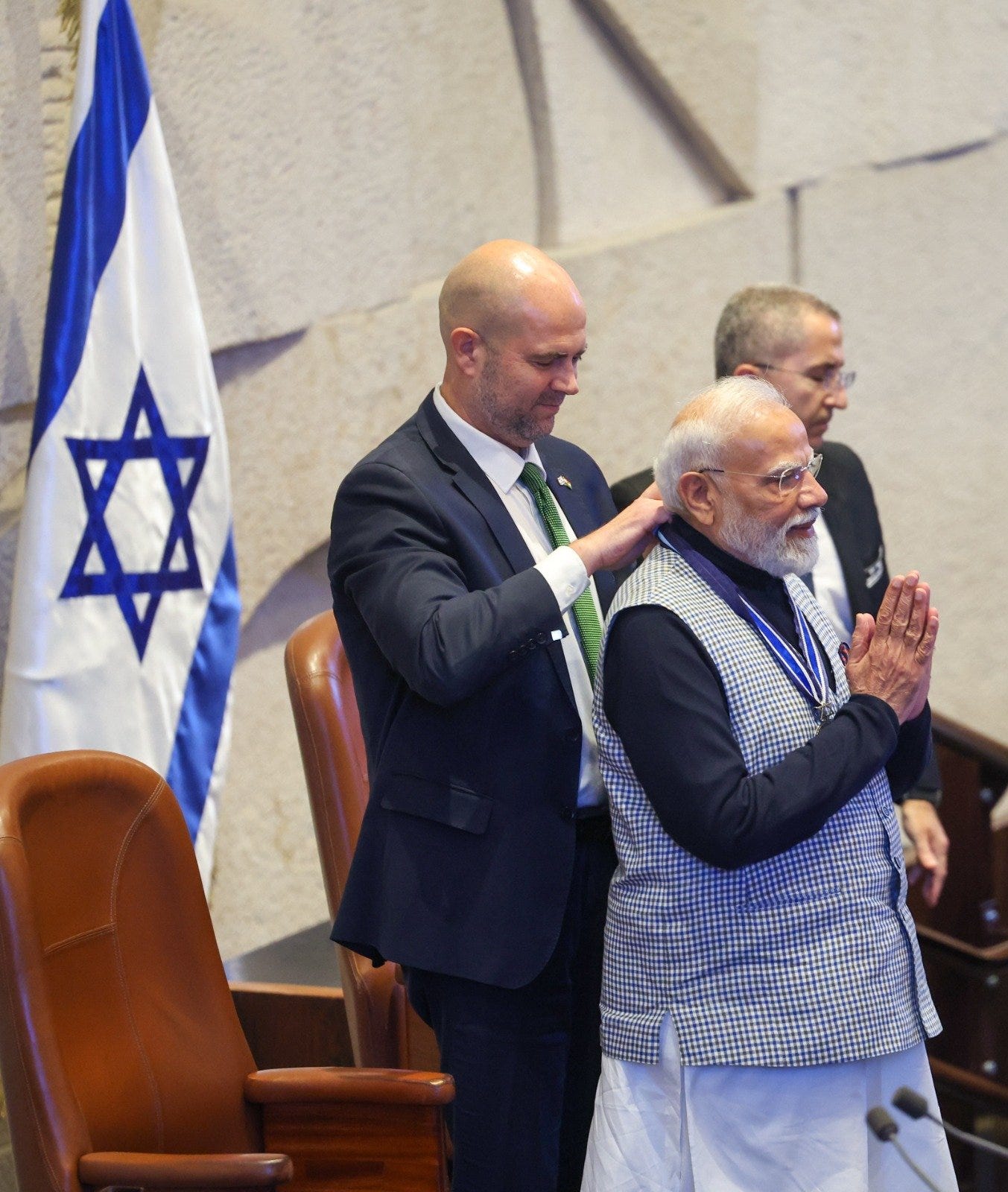
“Modi, Modi.” They rolled through the Knesset chamber in Jerusalem on Wednesday evening as Narendra Modi became the first Indian Prime Minister in history to address Israel’s parliament. The night before, the building had been lit in the colors of the Indian tricolour. The Knesset Speaker welcomed the visitor in Hindi. Benjamin Netanyahu, seated in the chamber, watched and applauded. When Modi rose and declared that “India stands with Israel firmly, with full conviction, in this moment and beyond,” the hall stood.
Thirteen hundred kilometers east, across the Arabian Sea, Pakistan’s government said nothing. There was no statement from the Foreign Office. No press briefing from GHQ. The Finance Minister was busy telling reporters there was “absolutely no issue” with the UAE’s $2 billion loan rollover, whose maturity had come and gone without public confirmation from Pakistan’s central bank.
That silence, held against that scene, is the story.
What was consecrated in the Knesset on Wednesday was not diplomatic ceremony. It was the public crowning of a strategic architecture that has been assembling around Pakistan for years, built through defense agreements, intelligence infrastructure, financial leverage, and economic corridors whose combined logic is now visible to anyone willing to read the pattern. Each layer operates through mechanisms that are deniable in isolation. Together they form something that is not deniable at all.
This is what encirclement looks like in the twenty-first century. It does not come with a declaration of war. It comes with standing ovations and investment pledges and corridor announcements and joint cybersecurity platforms named “Crystal Ball.” It comes with the warm language of partnership. And it tightens.
Begin with the documented record, because the record is already damning enough without embellishment.
In May 2025, following the Pahalgam incident of April 22, India launched Operation Sindoor against targets inside Pakistan. The strikes deployed Israeli-manufactured Harop loitering munitions, Harpy drones, SkyStriker systems co-produced with Elbit Systems at Bengaluru manufacturing facilities, and Barak-8 air defense missiles developed jointly between Indian and Israeli defense industries. Indian Air Force Rafales fired French SCALP missiles. BrahMos cruise missiles struck Pakistani air bases.
The PAF responded with force. Pakistani pilots contested the airspace with a ferocity that shook Indian operational planners. IAF jets were downed. Pakistani aircraft flew deep counter-strike missions. The confrontation was genuine, intense, and ended in a ceasefire brokered through Washington after both sides demonstrated real capability. Pakistani F-16s and JF-17s proved their pilots. The PAF was not broken. It was not humiliated. It fought.
But Netanyahu, standing in his own chamber days later, announced publicly that Israeli equipment had “worked well” during the India-Pakistan confrontation. He said it with the composure of a man reading from a verified field report while announcing further strikes on Gaza. He was bragging, and the brag was specific: Israeli Harop drones had suppressed Pakistani radar installations, knocked out air defense nodes in Lahore, and prepared the electronic corridor through which Indian missiles followed. Between 2020 and 2024, India was the world’s largest single importer of Israeli arms, according to the Stockholm International Peace Research Institute. Those arms were not acquired for exercises. They were acquired for this.
The PAF proved it could fight. The political and diplomatic class proved it had no strategy for what came next. Pakistan’s pilots performed. Pakistan’s government then flew to Abu Dhabi to manage the optics with the country that had just signed a Strategic Defense Partnership with the country whose hardware those pilots had been fighting.
That gap, between military capability and political strategy, is the wound that this architecture is designed to widen.
The military dimension is the visible surface. Beneath it runs an intelligence and surveillance architecture whose construction is documented in open sources that Pakistani officials have declined to engage with publicly.
Every head of Mossad since the 1970s has maintained a direct relationship with their UAE counterpart, according to reporting in the Washington Post. That relationship, covert for five decades, became open architecture with the Abraham Accords in 2020. Former Mossad Chief Yossi Cohen has acknowledged his personal involvement in restructuring the Emirati security apparatus, institutionalizing the intelligence relationship between Israel and the UAE at the organizational level, not just the personal one.
Since normalization, the UAE has established multiple bilateral partnerships with leading Israeli technology firms. In June 2023, the UAE’s head of cybersecurity announced the activation of “Crystal Ball,” a joint UAE-Israeli threat intelligence platform, during Tel Aviv’s Cyber Week Conference. Crystal Ball pools real-time data on cyber threats across the region. The UAE’s Edge Group has procured Israel’s Hermes 900 surveillance drone from Elbit Systems, with a technology transfer plan enabling domestic Emirati production of Israeli surveillance hardware. The UAE sent Mirage 2000-9 fighter jets to join American and Israeli air forces for a multinational exercise in Greece in April 2025, weeks before Operation Sindoor.
Abu Dhabi’s Group 42, whose chair is the UAE’s National Security Advisor Tahnoun bin Zayed Al Nahyan, established a subsidiary in Israel immediately after the Abraham Accords were signed, making it the first Emirati company to open an office in the country. G42 has also been the subject of reporting connecting it to surveillance applications whose reach extends across South Asia.
Now consider where 1.9 million Pakistani workers sit inside this picture. Their communications, financial transactions, labor records, and movement data pass through Emirati digital infrastructure that is now formally integrated with Israeli cybersecurity systems. Pakistan’s remittance flows, its diaspora’s daily lives, its workers’ digital footprints, all pass through a surveillance architecture whose intelligence partnership with Israel is institutionalized, named, and publicly documented.
Pakistan has no diplomatic relations with Israel. It has no intelligence-sharing agreement with the UAE on this subject. It has no seat at any table where these architectures are discussed. It is, in the language of the intelligence world, a collection target inside a partner’s infrastructure.
The sharpest wound is not military and not intelligence. It is economic geography.
Modi invoked it explicitly from the Knesset podium on Wednesday. The India-Middle East-Europe Economic Corridor, announced at the 2023 G20 in New Delhi and endorsed again in Jerusalem, is described in Western policy documents as a counter to China’s Belt and Road Initiative. Trump called it “one of the greatest trade routes in all of history” during Modi’s Washington visit in February 2025. The EU-India trade deal signed in January 2026 has given it additional momentum. Trump and Modi agreed to convene all corridor partners within six months to announce new projects.
What IMEC actually does in geographic terms is construct a trade and connectivity architecture linking Indian ports to European markets through the UAE, Saudi Arabia, and Israel, with undersea data cables, rail networks, and energy infrastructure woven through the same corridor. The route runs from Indian ports, through Gulf terminals, to Israeli ports at Haifa, onward to Greece and Europe. Pakistan does not appear in that route. Not as a transit node. Not as a logistics partner. Not as an economic consideration.
Pakistan has spent two decades attempting to position itself as an indispensable corridor between Central Asia, China, and the Gulf, most recently through CPEC. IMEC does not merely compete with that ambition. It renders it structurally irrelevant. The economic geography of Asia-Europe trade is being redrawn through a corridor whose members share defense agreements, intelligence platforms, surveillance infrastructure, and now a formal special strategic partnership declared from the floor of the Israeli parliament. Pakistan is encircled not only militarily but commercially. The walls being built are not only made of weapons. They are made of rail lines, fiber-optic cables, and port concessions.
Netanyahu called IMEC “a blessing” for the Middle East in his address to the UN General Assembly in September 2024. He described Iran and its allies in the same speech as “a curse.” The countries he named as the radical axes threatening regional stability are the same countries that signed defense pacts with Pakistan in September 2025. The corridor and the threat designation are two sides of the same strategic document.
All of the above sits inside a financial structure that makes Pakistani strategic resistance economically incoherent.
The UAE holds a $2 billion deposit with Pakistan’s central bank. The rollover of that deposit, which matured in January and again in February of this year, has not been publicly confirmed by the State Bank of Pakistan as of the date of this article. Pakistan’s Finance Minister told reporters this week there was “absolutely no issue.” Governments with no issue do not hold press conferences to say so.
UAE remittances to Pakistan reached approximately $8 billion in fiscal year 2024-25, a 42 percent annual increase. GCC countries collectively account for nearly 50 percent of Pakistan’s total remittance inflows. The UAE is Pakistan’s third-largest trading partner. Abu Dhabi’s International Holding Company recently acquired Pakistan’s First Women Bank. Emirati capital operates inside Pakistani ports, logistics networks, real estate, banking, telecoms, agriculture, aviation, and energy. The UAE has committed $10 billion in further investment. Pakistan’s government is simultaneously attempting to double bilateral trade to $20 billion within two years.
This is not a partnership between equals. This is the financial architecture of dependency. Any Pakistani government confronting the India-Israel-UAE alignment must simultaneously risk the loan that keeps its central bank solvent, the remittances that keep its current account from collapsing, the investment flows its privatization program depends on, and the employment of nearly two million Pakistani workers living inside Emirati jurisdiction. The leverage is not exercised through ultimatums. It does not need to be. Its existence is the policy, and Islamabad knows it.
In September 2025, Pakistan signed the Strategic Mutual Defence Agreement with Saudi Arabia, a mutual defense arrangement whose nuclear dimension Pakistan’s own Defense Minister made explicit, stating that the country’s capabilities would be “absolutely available” under the pact. The timing placed Islamabad in the Saudi column at precisely the moment the UAE was formalizing its Strategic Defense Partnership with New Delhi. Reports of UAE-Pakistan tensions followed in the Pakistani press. President Zardari flew to Abu Dhabi on a state visit specifically to contain the damage. The official framing was that the visit was meant to dispel “rumors of tensions” and reinforce the optics that “all is well.” A government flying its president to manage optics with a partner that controls its balance of payments is not a government with strategic autonomy. It is a government performing the appearance of one while the walls close in around it.
The architecture did not arrive all at once. It was assembled in sequence, each element logically following the previous, each announcement made in the language of economics, security, or partnership, never in the language of encirclement.
July 2022: I2U2 grouping of India, Israel, UAE, and the United States formally announced, described as focused on food security, water, energy, and technology. September 2020: Abraham Accords normalize UAE-Israel relations, formalizing an intelligence and military relationship that had been covert since the 1970s. November 2023: India-Israel bilateral framework agreement. June 2023: Crystal Ball joint UAE-Israel cybersecurity intelligence platform activated. September 2023: IMEC announced at G20 in New Delhi. November 2025: India and Israel sign new defense MoU covering AI, cybersecurity, and co-production of weapons systems. January 2026: UAE and India sign Letter of Intent for Strategic Defense Partnership. January 2026: Pax Silica declaration signed, linking UAE, US, Israel, Australia, Japan, South Korea, Singapore, and the UK on AI supply chain governance, with India joining the following month. February 2026: EU-India trade deal signed, accelerating IMEC momentum. February 24, 2026: India signs another defense MoU with Israel the day before Modi’s Knesset address. February 25, 2026: Modi addresses the Knesset as the first Indian Prime Minister in history to do so, receives the newly established Knesset Medal, declares unconditional Indian solidarity with Israel, signs a series of agreements in the “economic, security, and diplomatic spheres,” and invokes IMEC and I2U2 as pillars of the partnership.
Netanyahu, in the same chamber, said there had never been a foreign leader’s visit that moved him more. He called the India-Israel relationship a “tremendous alliance.” He also said, days before the visit, that Israel would forge a regional alliance to rival what he called the “radical Shia axis” and the “emerging radical Sunni axis.” Pakistan signed a mutual defense pact with the anchor of what Netanyahu designated the radical Sunni axis. Pakistan is the nuclear state those designations are partly organized around.
The PAF performed in May 2025. Pakistani pilots proved their mettle against one of the most sophisticated drone and missile packages assembled for a regional military operation since the 1990s Gulf War. It was also absorbed into a diplomatic and strategic context that Pakistan’s civilian and military leadership has not yet successfully addressed. The pilots won engagements in the air. The architects of the alignment won the structural argument on the ground, in the corridors of Jerusalem, Abu Dhabi, and Washington, while Islamabad managed optics and rolled over loans.
Pakistan has a nuclear deterrent. It has a professional military that demonstrated real capability in May 2025. It has the Saudi defense pact. It has Turkey’s growing defense-industrial cooperation, including corvette construction for the Pakistan Navy and drone technology transfer. It has China’s foundational economic and military partnership, which supplied 81 percent of Pakistan’s arms imports between 2020 and 2024. It has the Islamic world’s largest military organization in terms of deployed manpower. None of these assets are trivial.
What Pakistan does not have is a unified strategic response to an architecture that operates simultaneously across military, intelligence, financial, and commercial dimensions. It does not have diplomatic relations with Israel, which means it has no seat at any table where Israeli policy toward South Asia is shaped. It does not have a financial relationship with the UAE that is not structured as dependency. It does not have a presence inside IMEC, which means the economic geography being built around it will harden into infrastructure over the next decade regardless of who governs in Islamabad. It does not have a political class that has named this as a single strategic problem requiring a single strategic response.
Pakistan’s governing establishment has treated this architecture as a series of bilateral irritants to be managed separately, the financial relationship with Abu Dhabi here, the military confrontation with New Delhi there, the absence of relations with Tel Aviv quietly filed elsewhere. What happened in Jerusalem on Wednesday made that compartmentalization impossible to sustain honestly.
The chants of “Modi, Modi” that echoed through the Knesset were not about India and Israel alone. They were about what has been built, methodically, across years, through agreements that individually announced themselves as economic opportunities and security frameworks and connectivity projects. Together they constitute a strategic architecture whose logic is encirclement, whose financial enforcement mechanism is dependency, and whose military dimension has already been tested over Pakistani cities.
That is the gap that will define Pakistan’s next decade if it is not closed. Not in the air. On the ground, in the capitals, in the corridors, at the tables where the walls are being built.


