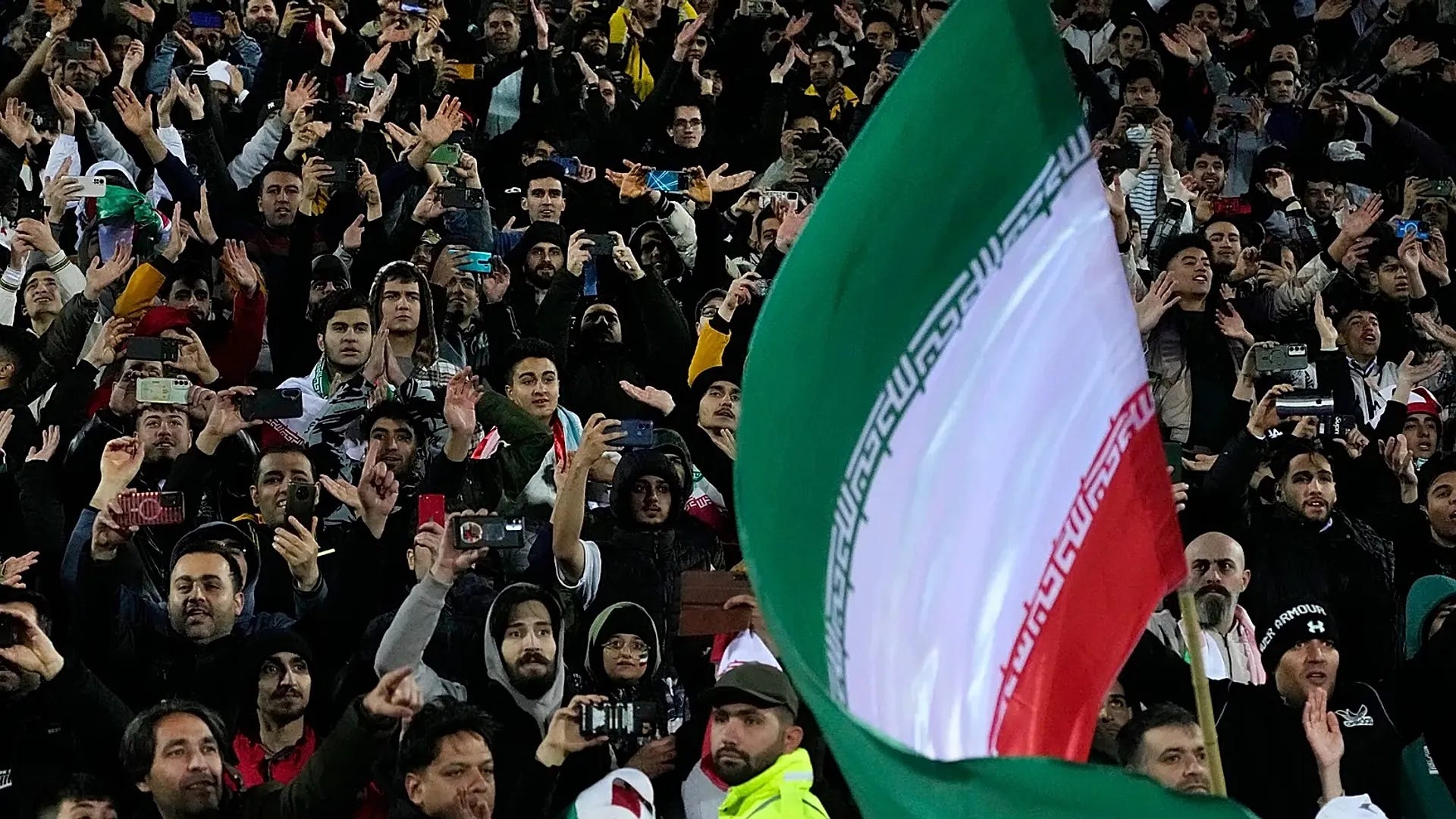
The World Cup as Foreign Policy
How a Football Swap Became Washington’s Most Surreal Diplomatic Gambit
The proposal arrived not through diplomatic cable or back-channel envoy, but in the way most things in the Trump era do: as a confirmed quote in a newspaper, shaped to sound spontaneous. “I confirm I have suggested to Trump and Infantino that Italy replace Iran at the World Cup,” Paolo Zampolli told the Financial Times on April 22. “I’m an Italian native and it would be a dream to see the Azzurri at a US-hosted tournament. With four titles, they have the pedigree to justify inclusion.”
Zampolli is the United States special representative for global partnerships, a title whose ambiguity fits the job. He is also a fashion entrepreneur, a former modeling agent, and a longtime Trump intimate who once introduced the future president to Melania Knauss at a New York party in 1998. He is not a football administrator. He has no standing at FIFA, and no authority to redraw the map of the 2026 World Cup. What he had, apparently, was a phone and a problem: a transatlantic friendship in free fall, a World Cup in the American backyard, and an idea that might, if handled correctly, save face on both sides of the Atlantic.
FIFA’s response was silence. The governing body declined to comment on the lobbying and pointed instead to a statement FIFA president Gianni Infantino had made in Washington the week prior. “The Iranian team is coming, for sure,” Infantino said. “We hope that by then, of course, the situation will be a peaceful one. That would definitely help. But Iran has to come if they are to represent their people. They have qualified. They really want to play, and they should play.”
On Wednesday, Iran confirmed it. A government spokesperson told reporters the country’s institutions were “fully prepared” for the tournament. The swap was not happening.
But the moment the proposal was floated, something had already been accomplished. The White House signaled, in one absurd gesture, the precise geometry of its current foreign policy: at war with Iran, estranged from Rome, hosting the world, and looking for a shortcut through all of it.
To understand why Zampolli’s idea found any purchase at all, you have to start in Turin, on the night of March 29, 2026, when Italy lost to Bosnia and Herzegovina on penalties, 4-1 in the shootout after a 1-1 draw, and failed to qualify for the World Cup for the third consecutive time.
The first exit, in 2018, was a trauma. Italy, four-time world champions, failed to beat Sweden in a two-legged playoff and watched the tournament from home for the first time since 1958. The coaching staff was dismantled. The federation issued statements. The national sporting press entered a period of extended mourning. Then, in 2022, it happened again: a loss to North Macedonia on a late goal, another playoff elimination, another humiliation broadcast into living rooms across a country that considers football something closer to civic religion than recreation.
In 2026, the margin was Bosnia and Herzegovina, a country of 3.2 million people whose football program draws from a talent pool smaller than the metropolitan area of Palermo. Italy’s squad, by contrast, included players from Juventus, Inter Milan, and AC Milan, clubs that between them have won more European titles than the entire Balkan peninsula. It did not matter. The Azzurri surrendered the lead, struggled through extra time, and then watched their penalty takers falter one after another while the Bosnian goalkeeper stood in his goal like a man who had nothing to lose, because he had nothing to lose.
The president of the Italian Football Federation, Gabriele Gravina, resigned within days. He had survived the North Macedonia collapse. He did not survive Bosnia.
Italy currently sits twelfth in the FIFA world rankings, the highest of any nation not competing in the tournament. That number, cited by Zampolli as justification for inclusion, is real. It is also, in any formal sense, irrelevant. The rankings do not determine participation. Qualification does. Italy failed to qualify. Twice before the current cycle and now once more.
Zampolli’s proposal is not, technically, impossible. FIFA’s regulations give the governing body “sole discretion” to determine what happens if a Participating Member Association withdraws. The relevant clause states: “Fifa may decide to replace the Participating Member Association in question with another association.”
The precedent for using this discretionary power was set only recently, and it was not small. Ahead of the Club World Cup in the summer of 2025, FIFA awarded a late spot to Inter Miami, the Florida club owned partly by David Beckham and home to Lionel Messi, enabling the Argentine superstar to play in the expanded tournament on his home continent. The decision was criticized in some quarters as commercially motivated. It was also completely within FIFA’s stated authority.
The Club World Cup precedent matters because it normalized the use of that discretionary clause for reasons that were plainly not sporting. Messi’s presence in the tournament was a marketing and broadcast calculation, dressed in the language of competitive logic. If FIFA would bend its rules to put Messi in a club competition, why not bend them to put Italy in a World Cup, particularly one hosted on American soil, where a four-time champion with a large diaspora would be a commercial draw?
The answer Infantino gave in Washington was not a bureaucratic one. It was political. Iran has qualified, he said. Iran wants to play. Iran should play. That is not the language of a sports administrator managing a logistics problem. It is the language of someone who has decided, or been instructed to decide, that the question is already closed.
The Iranian Football Federation had briefly floated an alternative: moving Iran’s home games for the tournament to Canada or Mexico, where the country’s athletes might face fewer visa complications. FIFA rejected this. The World Cup is hosted across three countries. The visa challenge is American. Avoiding the American leg of the tournament while competing in the Canadian and Mexican portions was not a format FIFA was prepared to accommodate.
The football gambit is, at its core, a diplomatic story. To trace why Zampolli needed a gesture grand enough to repair the US-Italy relationship, you have to go back to April 14, when Pope Leo XIV, the first American-born pope, spoke out against the US-Israeli military campaign in Iran, condemning the strikes and calling for immediate ceasefire negotiations.
Trump responded on Truth Social by calling Leo “weak.” The post included, by various accounts, an AI-generated image of Trump portrayed as a Christ figure, which circulated widely on Italian social media and generated an immediate political reaction.
Meloni, the leader of the far-right Brothers of Italy party and one of Trump’s most visible European admirers, found herself in an impossible position. Italy is a Catholic country. The pope is not simply a spiritual figure there; he is a cultural anchor, a national point of pride. Meloni’s entire governing coalition rests on a base of voters for whom the Church is not background noise. She called Trump’s remarks about Leo “unacceptable.” She said it was “normal and right” for the pope to advocate for peace.
Trump’s response was swift. In an interview with Italy’s Corriere della Sera, he said he had believed Meloni possessed courage. “I was mistaken,” he said.
The rupture was not only symbolic. Trump was also furious that Italy had refused to allow US fighter planes involved in the Iran bombing campaign to use the American military base at Sigonella, in Sicily, for refueling. The base has been a cornerstone of US force projection in the Mediterranean for decades. Italian opposition to the Iran war, driven in part by the economic impact of the conflict on fuel costs, food prices, and trade routes, had translated into a decision that blocked one of Washington’s most important regional logistics nodes. Trump said he was “shocked.” Analysts in Rome said the shock was mutual: that Meloni had assumed her relationship with Trump was personal enough to survive policy disagreement. It was not.
Meloni spent much of her first years in government managing an unusual balancing act. She was far-right on domestic policy, nationalist in rhetoric, and yet increasingly aligned with the transatlantic consensus on Ukraine and China. Trump’s return to the White House appeared to validate her political positioning. She visited Mar-a-Lago. She called him a genuine leader in a world short of them. When Trump imposed tariffs on European goods and European capitals erupted in outrage, Meloni said little.
The Iran war changed the arithmetic. Italian public opinion on the conflict was never ambiguous. The strikes, which killed Iran’s Supreme Leader and dozens of senior officials as well as civilians, were viewed in Italy with a combination of alarm and economic dread. The conflict pushed oil prices up, disrupted Mediterranean shipping, and threatened to pull European powers into a confrontation they had not sanctioned and could not contain.
Meloni’s silence had a price tag at home, and by April the invoice was coming due. When Trump attacked the pope, Meloni could not stay quiet. The political cost of defending Trump at that moment would have been higher than any benefit the relationship could deliver. She spoke. Trump turned on her. The World Cup idea was, in this context, an offering, not a resolution, just something to hold while the real damage was being assessed.
FIFA was unmoved. Infantino’s public position has been consistent: Iran qualified, Iran will play, and the conditions for that will be made as workable as possible. He met personally with the Iranian national team before a match in Turkey in late March and pledged that FIFA would “support the team to ensure the best possible conditions as they prepare for the World Cup.” That language, diplomatic in its register, carried the weight of an institutional decision already made.
The US State Department offered its own version of institutional opacity. A spokesperson said the Trump administration was “doing everything needed to support a successful World Cup while at the same time upholding US law and the highest standards of national security and public safety in the conduct of our visa process.” The visa process for Iranian athletes had been the central practical problem since March, when Iran first cited safety concerns for its players traveling to America.
The history of international football is not separable from the history of international power. FIFA has expelled, suspended, readmitted, and redistributed nations according to pressures that were never purely sporting. South Africa was excluded for decades. Yugoslavia’s successor states were admitted and re-admitted on timelines that tracked war and recognition politics. Taiwan plays under a flag that is not its flag, under a name that is not its name, because the politics of recognition have never been resolved and FIFA chose to park the question rather than answer it.
The 1978 World Cup in Argentina was held while the military junta that hosted it was actively disappearing people. The Dutch players knew. Some journalists knew. The tournament happened. Iran itself competed in the 1998 World Cup in France while the reformist government of Mohammad Khatami was testing the limits of political opening. The US and Iran were drawn in the same group. The match was played. Iran won.
In 2026, the calculus is different. The US is not playing Iran in a pool stage. It is, literally, at war with Iran, and Iran is scheduled to play its matches partly on American soil. The situation has no clean historical parallel. FIFA’s insistence that Iran will come is a bet that the logistical and political barriers will prove navigable. That bet may be correct. Iran’s sports officials have said the athletes want to play. The federation has not formally withdrawn. The tournament begins in June.
What Zampolli proposed was not a solution to any of these problems. Replacing Iran with Italy would not end the war. It would not mend Sigonella. It would not restore the relationship between Washington and Rome, which runs on shared interest, not football. It would, however, give Meloni something to announce at home, give Trump a gesture toward an ally he had just humiliated, and give FIFA the chance to host a tournament without the weight of an active military conflict pressing on every visa application submitted by an Iranian player.
That FIFA declined the gesture is a more interesting political fact than the gesture itself. The governing body that inserted Messi into a Club World Cup for commercial reasons has decided, at least for now, that the political cost of replacing a qualified nation with an unqualified one is higher than the cost of managing Iran’s participation under wartime conditions. That calculation will be tested between now and June.
Paolo Zampolli is not incidental to this story. He is its hinge. Born in Italy, socialized in New York’s fashion industry in the 1990s, he became part of the social infrastructure of Trump’s world at a moment when that world was defined by a certain kind of transatlantic glamour: the circuit of models, property developers, minor celebrities, and major money that orbited Manhattan before the political reinvention.
His appointment as special representative for global partnerships gives him a portfolio broad enough to accommodate almost anything. He is not a trained diplomat. He does not have experience in multilateral sports governance. What he has is access, the specific, personal, dinner-table kind that institutional diplomacy cannot manufacture. When Zampolli says he “suggested” the swap to Trump and Infantino, the word does real work. He was in the room.
That a proposal of this magnitude, the removal of a sovereign nation from the world’s most-watched sporting event for reasons of bilateral political repair, originated not in the State Department or the National Security Council but from a man whose most significant pre-government achievement was introducing a future president to his future wife: this is worth sitting with. Not through institutions. Through access. This is how American foreign policy operates in 2026.
Iran, ranked forty-second in the world, qualified through the Asian Football Confederation by right. Italy, ranked twelfth, did not qualify. The rules are not complicated.
Italy’s third consecutive absence from a World Cup is a football story, but the weight it carries in April 2026 is entirely political. A nation whose prime minister is losing her most important foreign patron, watching fuel prices climb and a war burn on the southeastern horizon, offered the spectacle of its football federation’s failure as a diplomatic bargaining chip. The game was never just a game. In the hands of a fashion entrepreneur turned envoy, it became something cheaper.


