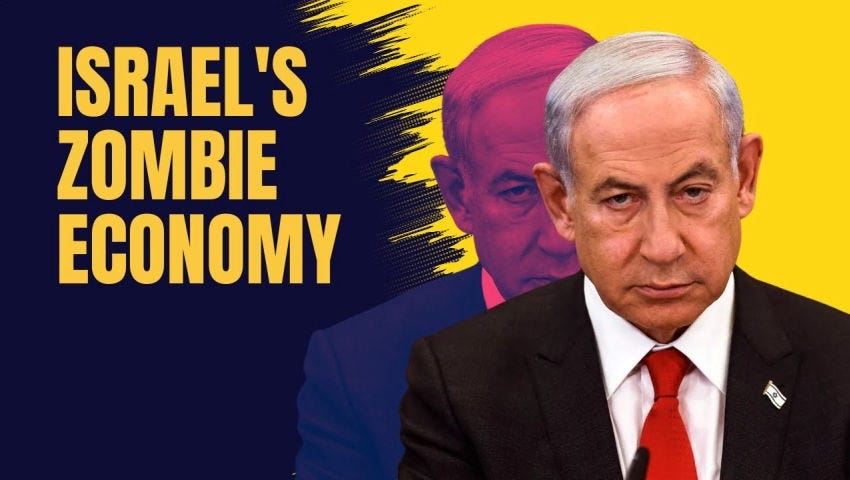
The Zombie Economy Goes to War
Israel’s Fiscal Collapse, the Iran Escalation, and the Private Credit Fault Line
The numbers were already catastrophic before the first American bomb fell on Tehran.
By the time the United States and Israel launched coordinated strikes on Iran on the night of February 28, killing Supreme Leader Ayatollah Ali Khamenei and triggering retaliatory Iranian missile attacks across the Gulf, Israel had already spent three years running an economy that one Israeli economist publicly described as a “zombie”: moving, consuming, borrowing, but structurally unaware of its own impending collapse. The Iran escalation has not created Israel’s fiscal crisis. It has accelerated a trajectory that was already pointing toward a debt trap, compounded by political dysfunction, mass capital flight, and an international investor class that had been extending extraordinary credit to a state whose foundations were visibly deteriorating.
The full bill is now coming due simultaneously.
The Bank of Israel estimated total war-related costs from 2023 through 2025 at $80 billion. That figure, equivalent to roughly 14 percent of pre-war GDP, does not capture the full scale of economic destruction. It covers direct military expenditure and measurable fiscal losses. It does not account for the $400 billion in projected lost economic activity over the coming decade that analysts had already factored into long-range models before the February 28 escalation.
What the headline figures do capture is severe enough. Israel’s government budget deficit reached nearly 7 percent of GDP in 2024, more than double the European Union’s benchmark for fiscal stability. The government’s debt-to-GDP ratio surged from 61 percent before the war to 69-70 percent by the close of 2025, a 10-percentage-point deterioration in under two years. To put that in context: the 3.5 percent GDP contraction Israel recorded in the April-to-June quarter of 2025, driven by the first direct war with Iran shutting down businesses and collapsing consumer spending, pushed the economy backward precisely when the Finance Ministry was projecting recovery.
The defense budget tells the structural story most plainly. It stood at 60 billion shekels in 2023 before the Gaza war began. It climbed to 99 billion shekels in 2024. For 2025, the Knesset approved 136 billion shekels, later increased by a further 31 billion shekels following the conflict with Iran. The defense budget has more than doubled in two years. Meanwhile, Finance Minister Bezalel Smotrich proposed cutting the higher education budget by 400 million shekels starting in 2026 and slashing the transportation budget by 700 million shekels annually for four consecutive years. An economy preparing to become what Netanyahu calls a “Super Sparta” does so by gutting the institutions that produce the scientists, engineers, and workers who built its civilian economic base.
Sixty Thousand Businesses Gone
The cost of perpetual mobilization does not appear only in sovereign debt ratios. It appears in the shops that no longer open.
According to the Israeli business survey company CofaceBDI, roughly 60,000 Israeli companies closed in 2024 alone due to manpower shortages, logistics disruptions, and collapsed business sentiment. The port of Eilat, Israel’s southern gateway, declared bankruptcy after eight months of zero economic activity. Consumer spending dropped 27 percent. Imports fell 42 percent. Exports declined 18 percent. In the final quarter of 2023, the Israeli economy contracted at an annualized rate of 21 percent as 300,000 reservists were pulled from the labor market. Tourism, which had been on track to welcome 5.5 million visitors in 2023, saw arrivals collapse by 80 percent in the final months of that year and remained severely depressed through 2024. The June 2025 Israeli strike on Iranian nuclear facilities triggered another sharp fall in visitor numbers just as a partial recovery was becoming visible.
The Henley and Partners Report of 2024 documented a 232 percent increase in investment migration applications from Israeli citizens in 2023. Around 1,700 millionaires had already left the country since the war began, seeking residency elsewhere. These are not people abandoning a country from poverty. These are the investors, founders, and high-net-worth individuals whose capital anchors the high-tech sector that contributes 20 percent of Israeli GDP, 60 percent of exports, and has been the single engine keeping the economy’s vital signs from flattening entirely.
When capital flight comes from that class, it signals something beyond temporary anxiety. It signals a structural judgment about whether the country’s trajectory is reversible.
Three Downgrades, One Direction
All three major international credit rating agencies downgraded Israel’s sovereign debt since the Gaza war began. The agencies maintained negative outlooks across the board, meaning further downgrades remained explicitly on the table.
Moody’s downgraded Israel twice in 2024, the first-ever sovereign downgrades in the country’s history, ultimately cutting its rating to Baa1, two full notches below where it began. The agency cited high geopolitical risks, the absence of any credible exit strategy from the multi-front military campaigns, and domestic political dysfunction that made fiscal consolidation structurally unlikely. Fitch downgraded Israel from A+ to A and maintained its negative outlook, projecting a budget deficit of 7.8 percent of GDP in 2024 and warning that debt would remain above 70 percent of GDP in the medium term. S&P joined both agencies, and all three flagged the same core concern: that a direct escalation with Iran would trigger further credit deterioration.
Moody’s made that connection explicit in July 2025 during a brief Iran ceasefire. It warned that a prolonged direct conflict with Iran would “exacerbate Israel’s fiscal challenges through materially higher government spending and weaker revenue generation, resulting in larger annual fiscal deficits and higher debt levels than we currently project.”
That warning was issued when the ceasefire looked stable. The ceasefire ended on February 28, 2026, with the killing of Khamenei.
The credit consequences of the current escalation have not yet been formally registered. They will be. Every agency had already told markets exactly what metrics would trigger further downgrades. Those metrics are now moving in the wrong direction at accelerating speed.
The Gaza Ceasefire Gave Israel One Reprieve
To understand how fragile the current situation is, it matters to document what happened when the Gaza ceasefire held.
In November 2025, the Bank of Israel cut interest rates for the first time in nearly two years, moving to 4.25 percent from 4.5 percent, citing ceasefire stabilization. In December 2025, it cut again to 4 percent, projecting 2025 GDP growth of 2.8 percent and a dramatic 5.2 percent expansion in 2026. S&P upgraded Israel’s credit outlook from negative to stable in November 2025, reacting to the ceasefire. In early 2026, the Finance Ministry raised $6 billion in an international bond offering drawing demand from more than 300 investors across 30 countries, with pricing spreads narrowing back toward pre-war levels.
This was the window. Israel’s technocratic institutions, the Finance Ministry, the central bank, managed to borrow at favorable terms and project recovery narratives to international markets during a six-week period of relative quiet. Then the United States and Israel launched major combat operations against Iran, killing the Islamic Republic’s supreme leader and triggering the full regional escalation that Moody’s, S&P, and Fitch had each identified as the scenario that would break Israel’s fiscal trajectory.
The $6 billion raised in January is now being consumed by a war whose monthly costs, based on the June 2025 12-day Iran campaign, run at roughly $725 million per day in direct military expenditure. A one-month campaign costs Israel approximately $12 billion. The Finance Ministry has not revised its deficit projections publicly. The bond markets have.
The Zombie Economy Explained
The Israeli economist whose framing deserves reproduction here described the situation with precision that official government statements have avoided. The zombie economy, in his formulation, is an economy that is moving but not aware of its own crisis. A capitalist market cannot function without investment, and investment depends on a belief in the future. In Israel, the government has passed budgets detached from actual expenditure, driving debt out of control. The draft budgets have been, in his word, “delusional.” At the same time, the most talented and educated people are leaving because they do not want to raise their children in a country structurally committed to permanent war.
The reservists returning from Gaza will not find jobs waiting for them. The businesses that employed them closed while they were deployed. The psychological cost of what those reservists did in Gaza for hundreds of days has not been priced into any economic model. Suicide rates among veterans are already rising. The labor market disruption alone, the removal of hundreds of thousands of skilled workers from productive sectors for extended periods, has done structural damage to Israel’s technological and educational competitiveness that will not recover on a ceasefire schedule.
Netanyahu’s answer to this is “Super Sparta.” A militarized self-sufficient state that no longer depends on American weapons aid, that exports arms to the UAE, Germany, Greece, and Azerbaijan, that treats weapons manufacturing as the primary engine of economic reproduction. In January 2026, Netanyahu announced his intention to end U.S. military aid to Israel within a decade. The announcement was framed as self-sufficiency. What it describes is an economy that has permanently converted from civilian technological production to arms export, with the corresponding hollowing out of the civic and educational institutions that made the civilian economy viable.
Defense exports reached $14.7 to $15 billion in 2024, setting a successive record. They are one of the few sectors genuinely growing. An economy that survives on weapons export to sustain a permanent military mobilization that destroys the civilian sector is not a war economy in the temporary sense. It is a war economy in the terminal sense.
February 28: The Escalation That Changes the Calculus
The United States and Israel launched what American officials called “major combat operations” against Iran on the night of Saturday, February 28, 2026. The strikes killed Khamenei. Iran retaliated across the Gulf, striking Jebel Ali port in Dubai. The UAE ordered schools and universities nationwide to close and shift to remote learning. Iranian missiles targeted multiple Gulf states. Iran’s security chief warned that any internal groups attempting to exploit the instability would face a harsh response, signaling immediate concern about regime cohesion following the supreme leader’s death.
The Strait of Hormuz carries more than 14 million barrels of oil per day, approximately one-third of global seaborne crude exports. Three-quarters of those barrels flow to China, India, Japan, and South Korea. China receives half its crude imports through the Strait. The market reaction on Monday, March 2, reflected this geography of risk directly: Brent crude surged 13 percent, gold hit record levels above $5,300 per ounce, the VIX surged 18 percent, and defense stocks Lockheed Martin and Northrop Grumman each gained more than 5 percent.
The S&P 500 ended the day essentially flat, recovering from losses that had touched 1.2 percent. Markets drew on historical pattern from the June 2025 12-day campaign, when equities sold sharply at open and recovered once it became clear the Strait had not been disrupted. The June 2025 precedent is now being applied to a qualitatively different escalation: a campaign that killed the supreme leader, triggered retaliation against Gulf civilian infrastructure, and prompted the U.K. to authorize American use of its Middle East military bases.
The pattern markets are referencing may not hold. Oxford Economics assessed that Iran cannot win militarily but that disrupting Gulf oil flows could “inflict material economic damage and market volatility.” Wells Fargo mapped a worst-case scenario with the S&P 500 dropping to 6,000 from current levels around 6,850. JP Morgan raised its gold price target to $6,300 per ounce by December 2026. Standard Chartered’s global head of research stated plainly that investors had already been underpricing geopolitical risk. The commodity-linked currency performance visible beneath the surface of a modestly weaker dollar told the real story, as he noted: markets were paying for exposure to scarce resources, not for exposure to equity growth.
BlackRock and the Private Credit Fault Line
The BlackRock “liquidation” rumor circulating in financial media is not accurate as a description of the parent institution. What is accurate, and more significant for structural analysis, is documented.
On January 23, 2026, BlackRock TCP Capital Corp, a publicly traded middle-market lending fund managing approximately $1.8 billion in total assets, filed an 8-K disclosure with the SEC revealing a 19 percent markdown in its net asset value. The fund’s NAV per share fell from $8.71 to between $7.05 and $7.09 for the quarter ending December 31. Six portfolio companies accounted for 67 percent of the NAV destruction. The fund had been valuing Renovo Home Partners, a private equity-backed home improvement roll-up, at 100 cents on the dollar one month before that company filed for Chapter 7 bankruptcy with plans to liquidate. BlackRock waived one-third of its management fee for the quarter, a gesture that analysts described as cold comfort for a loss representing nearly $1.66 in NAV per share.
The fund plunged 16.7 percent in a single trading session. BlackRock, the world’s largest asset manager with $14 trillion in assets under management, saw its own shares dip 0.3 percent, barely registering the subsidiary’s collapse.
The significance of this event is not the absolute dollar loss. It is the signal it transmits about a $1.7 trillion private credit market whose structural vulnerabilities have been accumulating since the zero-interest-rate era ended. BlackRock TCP Capital had valued Renovo’s loans at full face value one month before the bankruptcy. That is not a valuation error at the margins. That is a failure of underwriting transparency in a market that, as Moody’s Analytics chief economist Mark Zandi told CNBC, is “lightly regulated, less transparent, opaque, and growing really fast, which doesn’t necessarily mean there’s a problem, but is a necessary condition for one.”
Jeffrey Gundlach, who has been tracking the private credit market through multiple cycles, called the problem directly: private lenders have been making “garbage loans,” and the next financial crisis will be in private credit.
BlackRock itself acknowledged the transition in its March 2026 weekly commentary. The firm noted that “fiscal and inflation anchors have weakened,” that “the distribution of outcomes is widening,” and that 2026 looks like a year in which “both upside surprises and downside accidents become more common.” The commentary flagged “more frequent idiosyncratic defaults and downgrades” as the expected environment even before the February 28 escalation. The firm simultaneously acknowledged that “geopolitical fragmentation is front and center as conflict escalates in the Middle East.”
The Architecture That Connects All Three
These are not three separate stories. They are the same story viewed from different coordinates.
Israel’s war economy created a captive and expanding market for American defense contractors. The U.S.-Israel attack on Iran now extends that market while simultaneously threatening the Gulf energy flows that finance the sovereign wealth funds of the UAE and Saudi Arabia. Those sovereign wealth funds are not passive observers of this crisis. They are deeply embedded in BlackRock, in private credit infrastructure, in U.S. defense equity, and in the global financial architecture that has been quietly underwriting both Israeli war debt and American deficit spending simultaneously.
A prolonged disruption of the Strait of Hormuz would not simply spike oil prices. It would hit the liquidity of the Gulf-Western financial architecture at precisely the moment when private credit markets are already showing the first visible cracks of a credit cycle that expanded too fast, into too many overleveraged borrowers, at too low a standard of underwriting. The private credit stress predates the war. The war now adds a demand shock, a commodity price shock, and a geopolitical risk premium on top of a system that was already absorbing losses it had not publicly disclosed.
The credit rating agencies warned Israel explicitly: a direct and prolonged conflict with Iran would break the fiscal trajectory. Israel chose the conflict. The United States joined it. The Gulf states are now absorbing Iranian missiles on infrastructure that was built to channel oil wealth into Western financial markets.
The zombie economy did not go quietly. It took the whole neighborhood into the escalation with it. The bill will not be paid by the generals or the finance ministers or the asset managers who structured the instruments. It will be paid, as it always is, by the populations who had no vote in the decision and will spend the next decade living inside its consequences.


