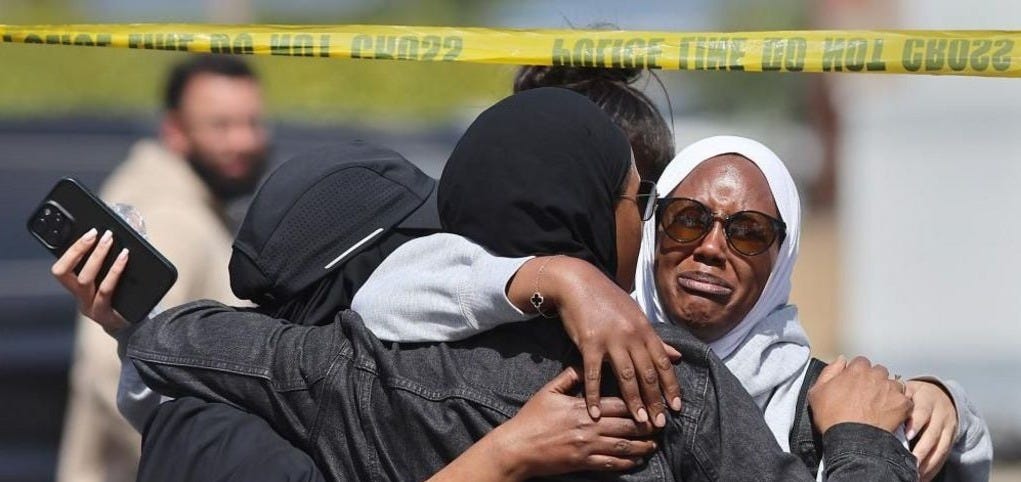
They Came to Pray
The Murder of Three Men at the Islamic Center of San Diego
The children were holding hands when they were walked out.
More than a dozen of them, some as young as five, formed a chain across the parking lot of the Islamic Center of San Diego on Monday morning while scores of police vehicles surrounded the white mosque in Clairemont. Teachers moved them toward a reunification point a few blocks away. Aerial cameras captured the image: small figures threading through the police cordon, past the lights, past the tape. Their parents had been told to collect them from a nearby church.
At the entrance to that complex, where those children had been studying Arabic and Quran a few hundred meters away, three men were already dead.
One of them had stood at that entrance every day. His name was Amin Abdullah.
The Islamic Center of San Diego has existed in Clairemont since 1971, founded by Muslim immigrants who arrived in Southern California in the decades following the Immigration and Nationality Act of 1965, which for the first time permitted significant non-European immigration to the United States. It is the largest mosque in San Diego County, with a congregation of more than 5,000 people. Its mission, as stated on its website, extends beyond the Muslim community: the center describes its work as serving the less fortunate, educating the public, and welcoming visitors of all faiths. The Al Rashid School, housed inside the complex on Eckstrom Avenue, offers instruction in Arabic language, Islamic studies, and the Quran for children beginning at age five. Five daily prayers. Friday sermons. Community seminars open to all. For more than half a century, it stood in its residential neighborhood, surrounded by apartment buildings and strip malls and Middle Eastern restaurants and markets, and it served people.
Amin Abdullah was the face of that institution to anyone who walked through its doors.
“This guy, it didn’t matter who walked up, who came, any random person could just walk up,” a man who considered him a friend told reporters. “He would greet them, make sure they’re OK.” That was the job as Abdullah performed it: not the minimum of security work, not the surveillance posture or the suspicion, but a welcome. He was the first person you saw when you arrived, and he made you feel that your arrival mattered. He was a father of eight children.
On May 13, five days before two teenagers drove a stolen BMW to his place of work and shot him dead, Abdullah posted a video on his Facebook page. A hawk sat perched on the minaret of a mosque. He captioned it: “Allahu Akbar.” The bird at rest on the highest point of the building, the call to prayer somewhere below. On May 5, he had written something else. “What is success?” he asked, in a post visible on his public profile. “To many people success is financial stability, good reputation, beauty, etc. As for ME! Wallahi, thumma Wallahi. It is returning back to Allah OUR creator with the same pure soul he loaned me at birth.” He practiced archery and posted about faith and greeted strangers at a gate, and he had been doing all of it for years.
San Diego Police Chief Scott Wahl said Abdullah’s actions at the moment the attackers arrived “played a pivotal role” in preventing the attack from being far worse. “It’s fair to say his actions were heroic,” Wahl told reporters. “Undoubtedly, he saved lives today.” Officials were still determining the precise sequence of events at the entrance, but the conclusion was already fixed: without Abdullah, more people inside that complex would be dead.
By Tuesday morning, a fundraising campaign organized by the Islamic Center and the San Diego chapter of the Council on American-Islamic Relations had raised nearly 1.4 million dollars for his family. The campaign page read: “He wasn’t just a guard. He was the first face of that community to anyone who came through the door, and the last line of defense when it mattered most.”
Eight children no longer have a father because two teenagers decided that the people inside that mosque deserved to die for the religion they practiced.
Congressional candidate Ammar Campa-Najjar learned about the shooting the way many San Diegans did, from the news. But the address meant something different to him. He had attended the Al Rashid School as a child, first arriving at age six. He knew those hallways, where the classrooms were, which doors opened onto which rooms. He also knew one of the dead.
“He worked at the convenience store in the mosque,” Campa-Najjar told CNN on Monday. “And when I would wait for my mom to pick me up from school, he’d be there and he’d give me some treats.” That man, unnamed at time of reporting while his family was notified, had been there for Campa-Najjar at the end of school days more than two decades ago, when you waited for your mother and an adult you trusted was simply present. Campa-Najjar recalled him without hesitation, across all those years, as part of the texture of a place that had made him.
“When I heard that there was where they had gone, where the gunman had gone,” he told CNN’s Jake Tapper, “I remember where those places are, what those classrooms were.”
The third victim remains publicly unidentified at the time of writing. His family had not yet authorized the release of his name. He was a man at the Islamic Center of San Diego on a Monday morning, the week before Eid al-Adha, and he is dead. The organizers of the fundraising campaign said they were awaiting family approvals before disclosing the other victims’ names. A family somewhere in San Diego is sitting with a loss that has not yet entered the public ledger, while the rest of the country has moved on to discussing the killers.
Three men were killed on a Monday morning while their community prepared for one of the holiest periods of the Islamic calendar. The Hajj pilgrimage to Mecca begins this week. Eid al-Adha follows. The Islamic Center of San Diego announced it would be closed until further notice.
At approximately 9:42 in the morning on May 18, 2026, the mother of one of the killers called the San Diego Police Department. She reported a runaway juvenile. As she spoke with officers and began to piece together what she knew, the threat level, in the words of Police Chief Wahl, “elevated.” Her son was missing. Her firearms were missing. Her vehicle was gone. She believed her son was suicidal and said he was likely with an acquaintance. Both of them were dressed in camouflage.
“That is not consistent,” Wahl told reporters, “with what we would typically see from somebody that is suicidal.”
That call came in at 9:42. At 11:43, police received reports of an active shooter at the Islamic Center of San Diego. In the 121 minutes between those two events, officers followed leads to a nearby mall, connected one suspect to Madison High School, and alerted school police. They were still searching when the shots were fired.
The two teenagers have been identified by senior law enforcement officials as Cain Clark, 17, and Caleb Vazquez, 18. Clark had been enrolled in the San Diego Unified School District’s iHigh Virtual Academy since 2021. He had not attended a physical school building in five years. He was, according to the district, on track to graduate this month. During the 2024-2025 school year he had been on the wrestling team at Madison High School, the one institutional thread investigators used to identify him as the day unfolded. Clark took three firearms from his mother’s home and her vehicle, and drove with Vazquez toward Clairemont.
What they left in the BMW tells a more complete story than any press conference will. Anti-Islamic writing was found inside the car. Hate speech had been scratched onto one of the weapons. A suicide note left by one of the killers contained writings about, in the language of federal law enforcement officials, “racial pride.” Outside the vehicle, investigators found a gas container marked with the Schutzstaffel insignia, the SS logo of Heinrich Himmler’s Nazi paramilitary organization, its letters stylized as twin lightning bolts, a symbol that has circulated in white supremacist networks for decades.
They drove to a mosque. They wrote on their weapons. They prepared an ideological note. They brought a container bearing a Nazi insignia to a place of Islamic worship. They had a target not because of anything the Islamic Center had done, but because of what it was. Police Chief Wahl said there was no specific threat made against the institution. The attackers had engaged in what he described as “generalised hate rhetoric,” meaning the hatred was not pointed at one particular institution but at an entire category of people and faith. Any mosque would do. This one had a school with children in it.
No officers discharged their weapons during the response. The killers died by their own hands in a car on a residential street in Clairemont.
The California chapter of the Council on American-Islamic Relations did not hesitate in its public statement. “We are deeply disturbed, but not at all surprised, to learn that those who attacked the Islamic Center of San Diego were reportedly motivated by anti-Muslim hate,” said Hussam Ayloush, CEO of CAIR California. The statement linked the attack directly to a campaign of anti-Muslim rhetoric by mainstream politicians with national standing. CAIR did not name specific politicians. It did not need to.
American Islamophobia is not a fringe phenomenon, and it is not reducible to two teenagers who spent their adolescence online. It has a legislative history: the travel bans of 2017 and 2025, which listed Muslim-majority countries and converted national security law into a mechanism for religious exclusion. It has a media history: two decades of cable television that processed the September 11 attacks into a durable equation between Islam and terror, between mosque attendance and radicalization, between the Arabic language and threat. It has a congressional history: hearings convened in 2011 specifically to investigate the “radicalization of American Muslims,” as though the 3.45 million Muslims living in the United States required special investigation as a community rather than being served as constituents.
Ideology travels. It moves from congressional floor statements to radio commentary to online forums, and in those forums it concentrates, and the concentrated version finds its most susceptible recipients. A 17-year-old boy who has been alone in front of a screen since 2021, who has not set foot inside a school building in five years, who carries an SS-marked container to a mosque: he is the terminal product of a supply chain with many earlier links. The firearms came from his mother’s home. The ideology came from somewhere older, wider, and more institutional.
San Diego Mayor Todd Gloria called the attack a “violent act of hate” and called on the city to unite against Islamophobia. New York City Mayor Zohran Mamdani said he was horrified by “an apparent act of anti-Muslim violence.” The NYPD announced increased deployments to mosques across the city. The FBI joined the investigation. President Trump and Governor Gavin Newsom were briefed.
These are the appropriate institutional responses, and they are also insufficient by construction. The institution that would need to change is not a police department. It is the political and media ecosystem that, over twenty-five years, normalized the premise that Muslims in America require surveillance, suspicion, and special scrutiny. Every politician who described a mosque as a potential operational cell, every television commentator who treated the hijab as a security risk, every congressional hearing convened to demand that American Muslims explain themselves, deposited something into a cultural account. The two teenagers in Clairemont were not its only withdrawals. They were the most visible one this week.
The United States has recorded at least 151 mass shootings in the first five months of 2026.
Two hours before the call about the mosque came in, officers were already searching for the killers. They searched the wrong direction. At 11:43, the shots were fired, and Amin Abdullah was at his post.
His friend Sam Hamideh described him to CNN: “Every single time you crossed him, he always put a smile on your face, he always brought that energy of everything’s good, having that strong faith in God and always being kind.” Edward Ahmed Mitchell, national deputy director of CAIR, spoke about him on CNN the morning after. “He was beloved before,” Mitchell said. “He’s even more beloved now. We pray for him. May God grant him peace and comfort his family.”
On May 5, thirteen days before he was killed, Abdullah had written: it is returning back to Allah with the same pure soul he loaned me at birth. He meant it as aspiration. He did not know he was writing a prophecy.
He stood between two armed teenagers and the children studying inside, and he did what he could, and he left behind eight children of his own.
His community raised 1.4 million dollars for his family in a single day.
The investigation continues. Search warrants are being executed at the suspects’ homes. The FBI is assisting. The district attorney’s office has deployed its special prosecution team. In the days ahead, more will be known about how Cain Clark and Caleb Vazquez arrived at a mosque with weapons, an SS-marked container, and a note about racial pride.
None of that knowledge will explain the structural condition that produced them. That condition has been named, documented, and legislated around for twenty-five years. The politicians who profit from it have continued. The media infrastructure that sustains it has continued. CAIR has issued statements at each point on the timeline. Academics have traced the lineage. Journalists have reported it. The 151st mass shooting of 2026 happened at a mosque in San Diego the week before Eid.
What remains unknown: whether American political life has the capacity to name the thing it has built, and to dismantle it, before the next two teenagers find the next mosque.
That question belongs to the country. Not to Amin Abdullah’s eight children. They have paid enough.


