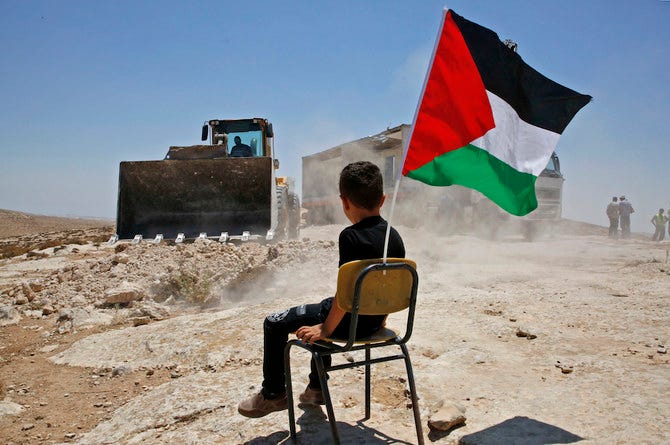
They Could Not Kill What Palestine Taught Its Children
How a Nation Colonized, Expelled, and Besieged Built the Most Durable Resistance Movement of the 20th Century. Not With Weapons, But With Schools
There is a question that military analysts, Western governments, and the editorial boards of newspapers in New York and London have spent 76 years failing to answer: why won’t this end?
They do not ask the question honestly, because an honest answer would implicate them. So they ask it as a tactical puzzle. They count rockets and tunnels. They model supply chains and casualty ratios. They commission papers on “the Palestinian question” from think tanks funded by the same governments supplying the bombs. And still, after 76 years, after four full-scale military assaults on Gaza in 15 years, after the physical destruction of universities, the targeted killing of poets, the deliberate starvation of 2.3 million people in the most densely populated territory on earth, the answer remains the same.
Palestine endures because its people were educated to endure. Because an ideology was built, carefully, over generations, that told Palestinian children who they were and why that mattered. And because, once every political avenue had been exhausted and every international appeal had been met with a veto at the Security Council, a people under military occupation did what international law explicitly permits: they fought back.
This is the story that does not get told in full. Not the rockets. Not the checkpoints. The classrooms first. The books before the rifles. The construction of a national consciousness so thorough, so rooted in documented historical fact and legal right, that no military force on earth has been able to uproot it, because military force cannot destroy an idea held in the minds of millions of people who have taught it to their children.
Part One: The Classroom as the First Battlefield
The erasure of Palestine did not begin in 1948. It began in language, in maps, in the deliberate administrative fiction that the land was, in the phrase made famous by early Zionist propaganda, “a land without a people for a people without a land.”
The phrase was always a lie, and the people who coined it knew it was a lie. Palestine in 1900 had a population of approximately 600,000 people, roughly 94 percent Arab. They had villages, markets, schools, courts, mosques, churches, family networks, agricultural systems, and an Ottoman administrative infrastructure that had governed the region for four centuries. They were, by any definition used anywhere else in the world, a people in a land.
What they lacked, in the strategic calculus of the early Zionist movement, was international political organization capable of resisting a project that had the backing of the British Empire. And so the British Empire was pursued, courted, and ultimately delivered in the form of the Balfour Declaration of November 1917, a 67-word letter from Foreign Secretary Arthur Balfour to Lord Walter Rothschild pledging British support for “the establishment in Palestine of a national home for the Jewish people.”
What is less frequently taught is the sentence that followed. The same declaration stipulated that “nothing shall be done which may prejudice the civil and religious rights of existing non-Jewish communities in Palestine.” This clause has been in continuous violation for over a century. It was violated under the British Mandate, which restricted Palestinian political organization while facilitating Jewish immigration and land purchase. It was violated in 1948, when 750,000 Palestinians were expelled from their homes in what Palestinians call the Nakba, the catastrophe. It has been violated in every year since, through settlement expansion, land confiscation, administrative demolition of homes, and the systematic destruction of the infrastructure of Palestinian civil life.
The Palestinian response to this process, from its earliest stages, was education.
Khalil al-Sakakini was a Palestinian teacher, writer, and intellectual born in Jerusalem in 1878. He founded the Dusturiyya School in Jerusalem in 1909, which became a center not just of academic instruction but of Palestinian cultural formation. Al-Sakakini taught a curriculum that combined rigorous Arabic language study with an insistence on the dignity and particularity of Palestinian identity at a moment when that identity was being administratively erased. He kept meticulous diaries, published in Arabic, that document the daily texture of Palestinian intellectual life under Ottoman and then British rule. He watched the Balfour Declaration destroy the world he had built and wrote about it with an anger and precision that his grandchildren’s grandchildren would eventually translate and publish. His diaries remain primary historical documents. He understood, 100 years before it became a slogan, that the cultural battle preceded the political one.
The British Mandate period between 1920 and 1948 saw Palestinian society invest heavily in formal education despite structural obstacles. The Arab community in Mandate Palestine built a network of schools, many of them funded by community organizations and Islamic charitable institutions, that operated in parallel with and often in competition with the British-administered government school system. By 1945, the Arab community in Palestine had over 60,000 students enrolled in some form of formal schooling. The political content of this education was not incidental. Teachers in Palestinian village schools in the 1930s were among the primary organizers of the Great Arab Revolt of 1936 to 1939, the largest sustained Palestinian uprising against British rule and Zionist colonization of the Mandate period.
The British responded to the revolt with the systematic dismissal of teachers from government positions, the closing of schools, and eventually the exile of Palestinian political leadership, presaging the pattern that would define Israeli military strategy 80 years later: when a population resists, attack its educational infrastructure.
Part Two: Education in Exile - The Refugee Camps as Universities
The Nakba of 1948 produced one of the largest forced displacement events of the 20th century. In the space of months, 750,000 Palestinians lost their homes, their land, their community institutions, and their country. They left carrying house keys, land deeds, family photographs, and, critically, literacy.
What happened next confounded every expectation of how a dispossessed people behaves.
The United Nations Relief and Works Agency for Palestine Refugees in the Near East, known as UNRWA, was established in 1949 to provide humanitarian assistance to Palestinian refugees. Its mandate included education, and what it built in the refugee camps of Lebanon, Jordan, Syria, Gaza, and the West Bank became something its founders had not designed it to be: the most consequential educational infrastructure in the modern Arab world.
By the early 1960s, UNRWA was operating over 400 schools serving more than 140,000 Palestinian refugee children. By 1980, that number had grown to over 300,000 students. The literacy rates produced by this system in conditions of displacement and poverty were, by regional and global standards, extraordinary. Palestinian refugees in Lebanon, a country with chronically underfunded public education, were producing literacy rates that exceeded those of Lebanese citizens. Palestinian refugees in Jordan were entering Jordanian universities in numbers disproportionate to their population. Palestinian engineers, doctors, lawyers, teachers, and journalists were employed across the Arab world, recruited specifically for their qualifications.
This is not a story about charity. It is a story about political survival strategy. Palestinian community leaders in the camps understood from the beginning that the right of return, guaranteed under United Nations General Assembly Resolution 194 passed in December 1948, was a legal claim that required a living, organized, self-conscious people to enforce it. A population that forgot who it was would have no claim. A population that kept its children in school, that maintained its village registries, that passed down the names of towns and the descriptions of houses across generations, preserved a legal and moral standing that no military defeat could extinguish.
The village books are one of the least discussed aspects of Palestinian political culture and one of the most important. Following 1948, Palestinian refugees from hundreds of destroyed or depopulated villages systematically documented their communities in written form. Survivors would gather in the camps, and community members would compile accounts of village geography, family histories, agricultural practices, notable figures, and the precise circumstances of the village’s destruction or depopulation. Over 400 such books exist, covering villages across what is now Israel. They are primary historical documents. They are also an act of political and cultural resistance so deliberate that their existence refutes, in itself, every claim that Palestinian national identity is a recent invention.
The Palestine Research Center, established by the PLO in Beirut in 1965, systematized this work. It produced academic journals, historical monographs, statistical analyses, and legal briefs on Palestinian rights. It collected and archived the documentation of Palestinian civil life. In 1982, when Israeli forces invaded Beirut, the center was ransacked and its archives largely seized or destroyed. The targeting of the archive was not incidental. It was strategic. A people without documented history has a diminished legal claim. The Israeli military understood this. So did the Palestinians who immediately began the work of reconstruction.
Part Three: The Ideology Defined - What Palestinian Consciousness Actually Contains
Western media coverage of Palestinian resistance consistently makes one error above all others: it presents Palestinian political consciousness as a product of hatred, religious extremism, or manufactured grievance. This framing is not only factually wrong. It is the inversion of the actual history.
Palestinian national consciousness was built on a foundation of documented historical fact, international legal entitlement, and the accumulated scholarship of Palestinian intellectuals who engaged the world on its own terms and produced arguments that have never been substantively answered by those who oppose them.
Edward Said is the figure most widely known in this tradition outside the Arab world, but he was one voice in a much larger intellectual formation. His 1978 book “Orientalism” constructed an academic framework for understanding how Western scholarship had systematically misrepresented Arab and Islamic civilizations in ways that served imperial political purposes. His 1979 work “The Question of Palestine” was a legal and historical brief that documented, with primary sources, the process by which Palestinian rights were subordinated to a political project backed by Western powers. These books were not polemics. They were scholarly works that were subjected to the full scrutiny of international academic review and that have not been refuted on their evidence. They changed how a generation of scholars, students, and activists understood the conflict.
What Said represented at the level of the academy, Mahmoud Darwish represented at the level of the soul. Darwish is the Palestinian national poet, and his relationship to Palestinian consciousness is not analogous to any Western equivalent because Palestinian consciousness required poetry to perform functions that institutions and governments perform for other peoples. His poem “Identity Card,” written in 1964, begins: “Write it down, I am an Arab.” It was written at a moment when Palestinian citizens of Israel were living under a military administration that controlled their movement, their employment, and their political expression. The poem was not a call to violence. It was an assertion of existence against a system designed to make existence conditional on silence. Israeli radio banned it. Copies circulated hand to hand. It became one of the most widely memorized poems in the Arab world. This is what ideological formation looks like when it is done right: not a political pamphlet that expires with its moment, but a poem that lives in the body.
Ghassan Kanafani was a Palestinian novelist, short story writer, and political journalist born in Acre in 1936. His family was expelled during the Nakba when he was 12 years old. He became one of the most important literary figures in the Arab world, and his fiction, particularly the novellas “Men in the Sun” (1963) and “Returning to Haifa” (1969), examined Palestinian displacement with a psychological and political complexity that no journalistic account had matched. “Returning to Haifa” directly interrogates the relationship between memory, return, and identity: a Palestinian couple returns to their home in Haifa in 1967 after the Israeli occupation of the West Bank, only to find a Jewish Israeli family living there, and Kanafani works through the impossible moral geometry of what that encounter means for everyone involved.
He was also a spokesman for the Popular Front for the Liberation of Palestine and a political journalist of considerable influence. In July 1972, a car bomb detonated in Beirut killed him and his 17-year-old niece. The bomb was planted by Israeli intelligence. He was 36 years old. His books remain in print across the Arab world, in English translation, in French, in German. The novels outlived the people who killed their author.
The deliberate targeting of Palestinian intellectuals by Israeli intelligence is documented and not seriously disputed. Wael Zuaiter, the PLO representative in Rome, was shot dead outside his apartment in October 1972. He was a translator working on an Arabic edition of One Thousand and One Nights. Mahmoud Hamshari, the PLO representative in Paris, was killed by a phone bomb in January 1973. Hussain Abad Al-Chir, the PLO representative in Cyprus, was killed by a booby-trapped mattress in January 1973. Basil al-Kubaissi, a law professor and PFLP member, was shot in Paris in April 1973. Kamal Nasser, a poet and PLO spokesman, was killed in his Beirut apartment during an Israeli commando raid in April 1973.
The pattern is unmistakable: Israel killed Palestinian poets, professors, lawyers, and translators with the same operational priority it assigned to military commanders. This is because the people doing the killing understood that the ideological infrastructure of Palestinian resistance was as threatening as its military capacity. They were correct. And they failed. Because ideology is not a building. You cannot level it with an airstrike.
What that ideology contains, at its core, is this: Palestinian people existed in Palestine before 1948 with full historical, cultural, and legal standing as the majority population of that land. They were expelled by force. Their expulsion was documented, filmed, recorded in testimonies gathered by Israeli scholars including Benny Morris, whose own research established that the expulsion of Palestinians was not incidental to the 1948 war but a deliberate objective of Israeli military strategy. Their right to return to their homes and lands is affirmed in Resolution 194. Their right to self-determination is affirmed in every subsequent relevant international legal instrument. Their experience since 1967 in the West Bank and Gaza constitutes a military occupation governed by the Fourth Geneva Convention, which specifies extensive protections for occupied civilian populations that have been systematically violated. None of this is contested among international legal scholars. It is contested only by those with political interests in contesting it.
This ideology does not require hatred to sustain it. It requires only memory and the capacity to read international law.
Part Four: The Legal Right to Resist - What the World’s Governments Know and Will Not Say
Here is what is almost never stated in mainstream Western coverage of Palestinian armed resistance, and it is the most legally consequential fact in the entire conflict: under international law, an occupied people has the right to resist their occupation by force.
This is not a fringe legal interpretation. It is not contested among international law scholars. It is written explicitly into binding international instruments that Western governments have ratified.
Common Article 3 of the Geneva Conventions of 1949 establishes minimum protections for parties to armed conflict, including non-state armed groups. Additional Protocol I to the Geneva Conventions, adopted in 1977, extended the protections of international humanitarian law to “armed conflicts in which peoples are fighting against colonial domination and alien occupation and against racist regimes in the exercise of their right of self-determination.” The drafters of Additional Protocol I were explicit: they were codifying a right that liberation movements, including those engaged in armed struggle against occupation, possessed under international law.
United Nations General Assembly Resolution 3236, passed in November 1974, “reaffirms the inalienable rights of the Palestinian people in Palestine, including the right to self-determination without external interference, the right to national independence and sovereignty, and the right to return to their homes and property from which they have been displaced and uprooted.” The same resolution “reaffirms also the inalienable right of the Palestinians to return to their homes and property from which they have been displaced and uprooted, and calls for their return.”
Resolution 3246, passed in the same year, “reaffirms the legitimacy of the peoples’ struggle for liberation from colonial and foreign domination and alien subjugation by all available means, including armed struggle.” The resolution specifically endorsed “the right of peoples under colonial and foreign domination to struggle by all available means, including armed struggle.”
This is the United Nations General Assembly, not a fringe legal body, affirming that armed resistance to occupation is legitimate under international law.
The West Bank and Gaza Strip have been under Israeli military occupation since 1967. That occupation is not disputed in international law. The International Court of Justice issued an Advisory Opinion in 2004 on the Legal Consequences of the Construction of a Wall in the Occupied Palestinian Territory, finding that Israel’s occupation of the West Bank and Gaza constituted occupation under international humanitarian law, that Israeli settlements in the occupied territories were illegal, and that the construction of the wall was contrary to international law. The opinion was adopted 14 to 1 by the ICJ. The dissenting vote was the American judge.
Occupation under international law is not a permanent condition that can be normalized into legality through duration. Israel has occupied Palestinian territory for 57 years, constructed over 700,000 settlers in territory that is illegal under the Fourth Geneva Convention, and administered what the ICJ itself described in its July 2024 advisory opinion as an unlawful occupation the entirety of which must be ended “as rapidly as possible.” The same 2024 opinion found that Israel’s prolonged occupation, combined with its settlement policies and annexation of Palestinian territory, constitutes a violation of the prohibition on the acquisition of territory by force, one of the foundational norms of international law since 1945.
Against this backdrop, when Western governments describe Palestinian armed resistance as terrorism, they are not making a legal argument. They are making a political argument that selectively applies the language of international law while abandoning its substance. The argument that Palestinian rocket fire from Gaza constitutes terrorism while Israeli airstrikes that kill thousands of Palestinian civilians constitute self-defense is not a position that survives examination of the actual texts of international humanitarian law, the laws of proportionality, the distinction between military and civilian targets, or the legal status of collective punishment, which is explicitly prohibited under the Fourth Geneva Convention, Article 33.
Israel has practiced collective punishment in Gaza since the imposition of the blockade in 2007. The blockade restricts the movement of people and goods, including food, medicine, and construction materials, into Gaza. It has been described by UN Special Rapporteurs, including the former rapporteur John Dugard, as a form of collective punishment prohibited under international law. The stated purpose of the blockade, in the words of Israeli government officials including Dov Weissglas, a senior adviser to Prime Minister Ariel Sharon, was to put the Palestinian population of Gaza “on a diet” without “killing them.”
This is not paraphrase. Weissglas used that language in a 2006 interview, describing the policy of restricting caloric supply to Gaza’s population as a deliberate political strategy. The statement was reported in the Israeli press. It did not produce a Western governmental response equivalent to what would have produced a similar statement from any government not allied with the United States.
Part Five: The Systematic Targeting of Palestinian Education Under Occupation
The pattern of targeting Palestinian educational institutions under Israeli military occupation is not incidental to the conflict. It is structural, documented across six decades, and constitutes a coherent strategy of intellectual suppression that has never succeeded but has never stopped.
Birzeit University, located near Ramallah in the West Bank, was founded as a school in 1924. It developed into a university through the 1960s and 1970s and became the most important center of Palestinian higher education during the occupation. Between 1979 and 1992, Israeli military authorities closed Birzeit University 16 times, for periods ranging from two weeks to over a year, citing security concerns. During closures, Israeli soldiers prevented students and faculty from entering the campus. Students sat exams in private homes. Faculty conducted seminars in apartments. Academic calendars were reconstructed after every closure.
This is not the behavior of a government that considers Palestinian education a neutral activity. It is the behavior of a government that understands Palestinian education as a political threat.
During the First Intifada, which began in 1987, the Israeli military ordered the closure of all Palestinian schools and universities in the West Bank and Gaza for extended periods, ultimately keeping Palestinian educational institutions closed for significant portions of three consecutive academic years. Palestinian teachers responded by establishing neighborhood learning circles, conducting classes in homes, using photocopied materials passed hand to hand. The international community documented this period extensively. No serious consequences followed for Israel.
Gaza’s Islamic University, established in 1978, has been bombed multiple times across Israeli military operations in Gaza. During the 2008-2009 assault on Gaza, Operation Cast Lead, Israeli forces bombed the science building of the Islamic University. During Operation Pillar of Defense in 2012, additional university buildings were hit. During Operation Protective Edge in 2014, university infrastructure was again targeted.
In the current assault that began in October 2023, every university in Gaza has been damaged or destroyed. The United Nations Educational, Scientific and Cultural Organization documented, as of early 2024, that over 80 percent of schools in Gaza had been damaged or destroyed, along with all 12 universities operating in the territory. The total destruction of an entire higher education system serving over 80,000 students is not collateral damage. It is a policy outcome.
Gaza’s Central Archives, which housed historical records of Palestinian civil life, were destroyed. The Palestinian National Library in the territory was destroyed. Thousands of private book collections were lost in the bombing of homes. The targeting follows a logic consistent across 76 years: a people’s memory, documented and preserved, is a political and legal weapon. Destroy the documentation, and you diminish the claim.
What this strategy has never accounted for is that Palestinian memory is not stored only in institutions. It is stored in people. And the people remain.
Part Six: The Physical and Mental Occupation - What the World Chooses Not to See
Occupation in the Palestinian context operates on two levels simultaneously, and both are documented with a depth of evidence that makes denial possible only through willful ignorance.
The physical occupation is what appears in news footage: checkpoints, settlements, walls, airstrikes, ground incursions, arrests, administrative detention without trial. Administrative detention, a mechanism inherited by Israel from British Mandate emergency regulations, allows the Israeli military to detain Palestinians indefinitely without charge or trial, with detention orders renewable at six-month intervals. As of 2023, before the October assault, the Israeli human rights organization B’Tselem documented approximately 1,300 Palestinians held in administrative detention. This is imprisonment without crime, without evidence presented in open court, without the basic procedural protections that Western governments describe as fundamental rights and enforce selectively.
The permit system that governs Palestinian movement in the West Bank is less visible but equally consequential. Palestinians in the West Bank require Israeli military-issued permits to travel between certain areas, to access agricultural land behind the separation wall, to enter Jerusalem, to receive medical treatment in hospitals outside their area of residence, and in many cases to build or modify their own homes on their own land. Applications for permits are processed by an opaque bureaucratic system that applicants have no meaningful ability to challenge. This system has no equivalent anywhere else in the world that Western governments describe as a democracy.
The psychological occupation operates through the systematic production of uncertainty, humiliation, and helplessness that the Israeli military administration has built into every aspect of Palestinian civilian life. Scholars of settler colonialism, including Lorenzo Veracini, Patrick Wolfe, and the Israeli historian Ilan Pappé, have documented how the settler colonial project requires not just physical displacement but the destruction of indigenous self-understanding. The Palestinian response to this project has been the continuous reconstruction of that self-understanding, which is why the education, the poetry, the village books, and the archives matter as much as the legal arguments.
The mental occupation also works through international media systems that have, for decades, reproduced Israeli government framing in ways that would not be accepted in coverage of any other conflict. The linguistic patterns are consistent: Israeli forces “respond” to Palestinian “attacks”; Palestinian deaths are “casualties” while Israeli deaths are “murders”; Palestinian armed resistance is “terrorism” while Israeli military operations are “security measures.” These are not neutral editorial choices. They are political choices that have been documented by organizations including the Glasgow University Media Group, which analyzed BBC coverage of the conflict and found systematic disparities in framing that consistently favored Israeli government perspectives.
This matters for understanding Palestinian resilience because it explains what Palestinians are resilient against. They are not simply resisting a military force. They are resisting a system that includes that military force, the diplomatic cover provided by Western governments, the media infrastructure that obscures what is being done, and the international legal system that has the tools to address the situation and has been prevented from using them by American veto power at the Security Council.
The United States has vetoed Security Council resolutions on Palestinian rights more than 40 times since 1972. This is not an abstract legal statistic. Each veto is a specific decision, made by specific American officials, to use American power to prevent international law from being applied to a specific situation. The people on whom that decision falls are Palestinians. They know exactly what that decision means. They have lived with its consequences for decades. And they are still here.
Part Seven: What the Current Genocide Tells Us About the Failure of All the Previous Strategies
The International Court of Justice issued provisional measures in January 2024 in a case brought by South Africa under the Genocide Convention, finding that the rights of Palestinians to be protected from genocide were “plausible” and ordering Israel to take all measures within its power to prevent genocidal acts in Gaza. The court did not have the power to order an immediate ceasefire, but its finding of plausibility under the Genocide Convention’s legal standard is not a rhetorical position. It is a legal determination by the primary judicial organ of the United Nations.
In July 2024, the same court issued an advisory opinion finding that Israel’s occupation of Palestinian territory is unlawful in its entirety, that Israel must end the occupation “as rapidly as possible,” that all states have an obligation not to recognize the occupation as lawful, and that states providing economic or military assistance that helps maintain the unlawful occupation are themselves in violation of international law. This directly implicates the United States, Germany, the United Kingdom, and other Western states that have continued arms transfers and economic support to Israel during and after the current assault.
None of this has stopped the bombs. But that is the wrong measure of its significance. The accumulating legal record is being built by Palestinian civil society, Palestinian legal scholars, Palestinian historians, and their international allies in exactly the same way that Palestinian identity was built in the refugee camps seven decades ago: through patient, documented, institutional work that outlasts any individual moment of violence.
The failure of the genocide to achieve its apparent military objective, the destruction of Palestinian resistance capacity in Gaza, is the latest data point in 76 years of evidence that a militarily organized project of erasure cannot destroy a politically and culturally organized people. Hamas has fought the most technologically advanced military in the region in one of the most densely populated urban environments on earth, in conditions of complete blockade, for over a year. Whatever one’s assessment of Hamas’s politics or tactics, the military reality is that an organization described by Israeli military planners as an existential threat to be destroyed “within months” has not been destroyed. The reasons for that military outcome are the same reasons that Palestinian resistance has endured across seven decades: when a population is educated to understand that its existence is legitimate, its rights are real, and its struggle is consistent with the law and history it has been taught, that population produces resistance from within itself, not just from the organizations that represent it.
This is the argument that the classroom built before the first stone was thrown. It is the argument that has never been successfully answered. It is the argument that will outlast the bombs, as it has outlasted every previous assault, because it is not stored in any building that can be destroyed. It lives in every Palestinian who was taught, in a UNRWA school in a refugee camp or a neighborhood class organized by teachers during a military closure or a Zoom session during a lockdown or a conversation with a grandmother who still has the key, who they are and why that matters.
Part Eight: The World That Is Shifting
The political cost of what is being done in Gaza is rising. This is not sentiment. It is documented in electoral pressure in the United States, in trade union votes across Europe and Australia, in the collapse of academic exchange programs, in student encampments at universities whose endowments fund Israeli bonds, in governments in the Global South that have severed or suspended diplomatic relations with Israel, in the accumulating caseload at international legal bodies.
None of this would be happening if Palestinian civil society had not spent 76 years building the cultural, educational, and political infrastructure to make its case to the world in the world’s own terms. The Palestinian solidarity movement outside Palestine is not an externally manufactured political campaign. It is the product of Palestinian diaspora communities, Palestinian academics and journalists and lawyers who have spent decades in universities and newsrooms and law schools building the credibility and the documented evidence base that has now made Palestinian rights a question that can no longer be managed through the old combination of American diplomatic cover and Western media complicity.
The Balfour Declaration gave Palestinians 67 words of rights, buried in a clause of a letter that was primarily a gift to someone else. They turned those 67 words into a legal argument. The legal argument into an educational philosophy. The educational philosophy into a national consciousness. The national consciousness into a resistance that has survived everything thrown at it for three quarters of a century.
The gun always ran out of ammunition. The argument never did. The classroom built before the first stone was thrown is still standing. In the minds of millions of people who were taught in it across four generations, it will always be standing.
And that is why Palestine endures.