Three Doors in Islamabad
Washington’s Stage, Beijing’s Guarantee, and the Three Ways The Iran War Could Temporarily Settle.
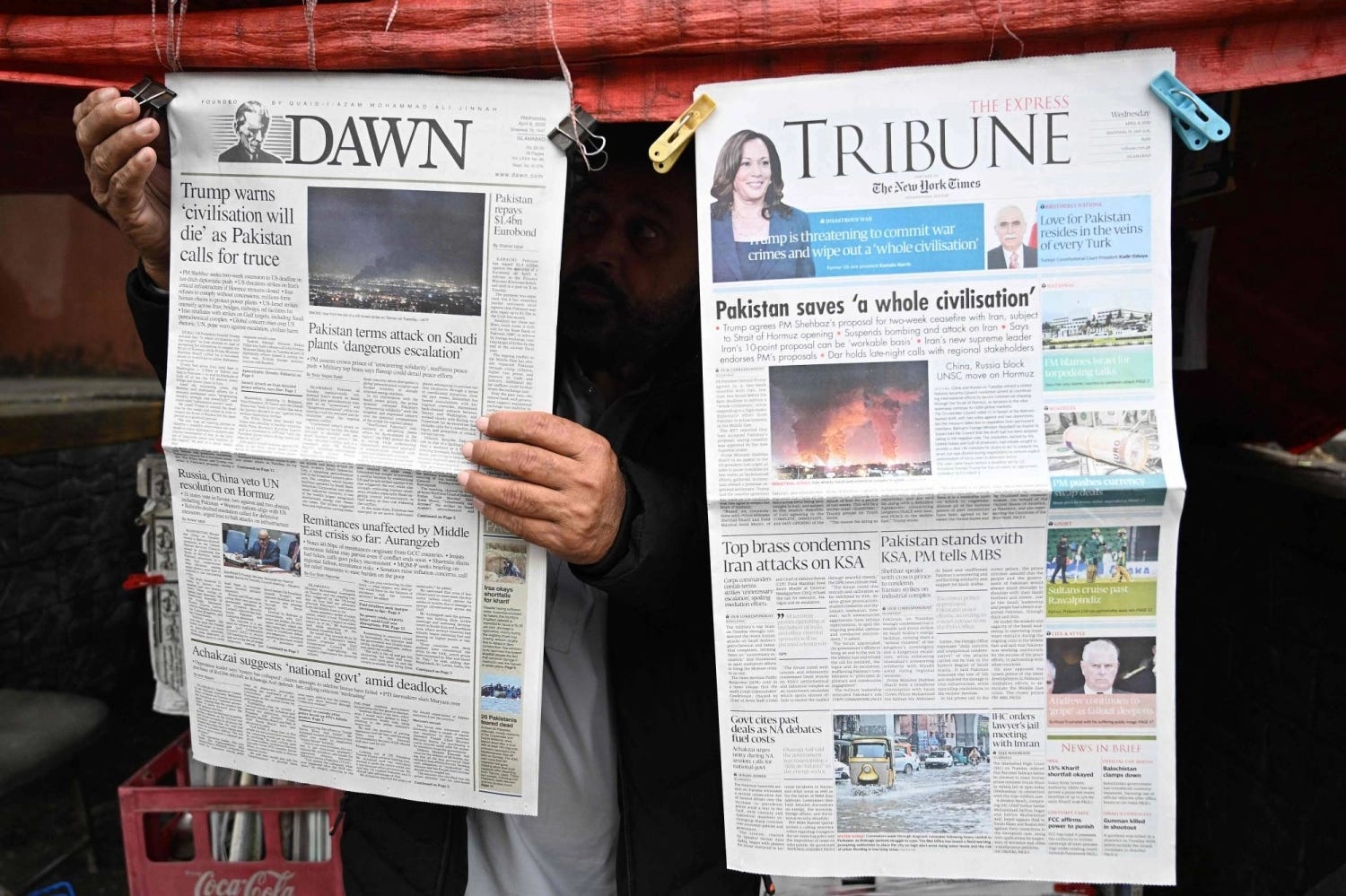
On March 22, Donald Trump announced a five-day pause in American strikes on Iranian energy infrastructure. The following day, Pakistan’s army chief Asim Munir spoke directly to Trump, and within hours, Islamabad formally offered to host negotiations between Washington and Tehran. The sequence is not incidental. It is the architecture.
The story the world has been sold about the Islamabad Accords runs like this: that a beleaguered, economically fragile Muslim-majority nation leveraged its unique cross-bloc geography to insert itself into one of the most dangerous conflicts since the Cold War, and that Munir, through weeks of tireless personal engagement, built the bridge across which warring states might walk toward peace. Pakistani television ran that story in continuous rotation. Shehbaz Sharif posted it on X. The international press reprinted it with only minor embellishment. The story has the advantage of being politically useful and the disadvantage of being structurally false.
Washington needed a platform it could not openly operate from. It found one that had already spent the preceding eight months demonstrating its absolute availability. The distinction between a mediator and a platform is not semantic. A mediator shapes the outcome. A platform absorbs whatever furniture someone else brings in.
The Field Marshal Who Answers the Phone
Pakistan did not arrive at this role spontaneously. It auditioned for it over the course of 2025, in a series of moves that, viewed sequentially, constitute a deliberate bid for American favour at any cost.
After a brief military conflict with India earlier that year, Islamabad moved immediately to praise Trump for his role in halting the fighting, acknowledging the administration publicly and loudly in a way the civilian government could not have done without the army’s direction. Pakistani officials secured deals on rare earths and critical minerals with Washington. They nominated Trump for the Nobel Peace Prize. They joined his newly established Board of Peace. In June 2025, Munir enjoyed a one-on-one lunch at the White House, the kind of access almost no military chief of a non-NATO state receives. Trump referred to him publicly as “my favorite field marshal.” In September, Sharif and Munir returned to the White House together, this time meeting Trump, Vance, and Marco Rubio. By the time the Iran war began on February 28, 2026, with American and Israeli strikes that killed Supreme Leader Ayatollah Ali Khamenei and scores of senior Iranian officials, Pakistan had already positioned itself as the most enthusiastically cooperative Muslim-majority state in Washington’s diplomatic orbit.
That positioning is what made Pakistan useful. Iran could not receive the terms of its own postwar settlement from the country that had just assassinated its leader. The message required a different envelope. Munir was available. He had already demonstrated, across multiple interactions, that he understood his role as the man who delivers, not the man who decides. Pakistan’s foreign minister Ishaq Dar confirmed as much during a Senate address on March 3, when he told lawmakers that Pakistan was “ready to facilitate dialogue between Washington and Tehran.” He did not say Pakistan had been asked to by Washington. He did not need to.
When the ceasefire was finally announced on April 8, Sharif published a post on X declaring that the United States and Iran had agreed to an immediate halt “everywhere including Lebanon and elsewhere, EFFECTIVE IMMEDIATELY.” The phrase “including Lebanon” survived approximately as long as it took Netanyahu to call Trump. By the time White House press secretary Karoline Leavitt appeared at her briefing, Lebanon had been removed from the American position entirely. The language that appeared in Sharif’s name, according to Time magazine’s reporting, was consistent with text the American side had reviewed before its public release. The civilian prime minister of a nominally sovereign country issued a ceasefire announcement in his own name, about a deal he had not designed, in language the other party repudiated within the hour.
The retired American ambassador to Pakistan from 2010 to 2012, Cameron Munter, summarised the arrangement with precision: “Munir is clearly the key guy.” Not Sharif. Not the foreign ministry. The army chief who has been to the White House twice in a year, who has a “rapport” with Vance, who received Wang Yi in Islamabad and traveled to Beijing in July. The civilian government is the postmark on a letter it did not write.
The Variable Nobody Named Until the Last Night
The ceasefire almost did not happen, and the reason it finally did is the part of the story the official record has been most reluctant to tell clearly.
Iran did not trust Pakistan. The distrust was not irrational. Pakistan had just spent the better part of a year making itself indispensable to Trump. It had signed a mutual defence pact with Saudi Arabia in September 2025 and then traveled to Jeddah on March 12, with both Sharif and Munir present, to express “full solidarity” with the Saudi crown prince while Iranian missiles were still striking Gulf infrastructure. It had nominated the man running the war against Iran for the Nobel Peace Prize. When Tehran’s analysts looked at Pakistan’s diplomatic posture, they saw the envelope, not the independent actor. Fahd Humayun at Tufts University said it directly to CNN: the thing that made the difference for the Iranians was not Pakistan alone. It was that Pakistan had established a conduit with China.
Vali Nasr, a former State Department official and one of the sharpest Iran analysts writing in English, saw it coming before it happened. On March 30, as Dar was boarding his flight to Beijing, Nasr posted on X: “Iran has asked for guarantees in any deal with the US. Word is that Pakistan’s foreign minister is going to Beijing to get a guarantor for the potential deal. Likely that is Iran’s condition for talks with the US.” Iran did not want a deal underwritten by its enemy’s most loyal subcontractor. It wanted a guarantor with structural independence from Washington.
China is Iran’s largest trading partner and the buyer of roughly ninety percent of its oil exports. Wang Yi had made twenty-six phone calls to regional counterparts since the conflict began, including two directly to Araghchi. A Chinese special envoy had traveled to the region in a separate mediation effort. On March 31, Dar arrived in Beijing at Wang Yi’s invitation, and after what Pakistani officials described as “hours of engagement,” the two sides issued their joint five-point initiative: an immediate ceasefire, early dialogue, civilian protection, safe passage through the Strait of Hormuz, and a larger United Nations role. The document gave China a formal platform position. More importantly, it gave Iran a reason to believe that any agreement could be held together by someone with actual economic leverage over both parties.
What happened in the final hours before the ceasefire was confirmed is documented in three separate accounts: Iranian officials cited by the New York Times credited a last-minute push by Beijing with securing Tehran’s acceptance. Trump, asked at a press event whether China was involved, said: “I hear yes. Yes, they were.” Karoline Leavitt confirmed that “conversations took place between top levels of our government and China’s government.” The White House, which had spent weeks insisting the ceasefire was Pakistan’s achievement, found itself acknowledging that Beijing had done the thing Pakistan alone could not do. Iran’s government, shortly after the ceasefire was announced, formally invited China to serve as a security guarantor to maintain the agreement.
Fawad Chaudhry, a former Pakistani information minister, put the formula plainly to Time magazine: “Pakistan and China were in a position to persuade Iran to behave itself and give the US some way out of the conflict.” Read it slowly. Pakistan persuaded. China provided the position that made the persuasion credible. Without Beijing’s intervention, the ceasefire announced on April 8 does not happen. Without Beijing as a potential guarantor, Iran does not send its delegation to the Serena Hotel. The stage is Islamabad’s, built and lit by Washington’s direction. The load-bearing wall is Chinese.
The Noise Floor: What Independent Sources Are Actually Saying
The discourse around these talks divides cleanly between the official register and the independent one, and they are not tracking the same story.
The official register is about format: which delegation sits in which room at the Serena Hotel, whether Pakistani officials shuttle proposals between separate wings, how the enrichment language might be drafted to give both governments a domestic narrative of success. This is the register of professional diplomats trying to prevent the collapse of a process that was already in violation before the delegations landed.
The independent register is about a more fundamental question: whether the talks were designed to produce an agreement, or designed to produce the appearance of one.
The most structurally precise argument in that register comes from The Intercept, which documented Netanyahu’s behavior across five consecutive American administrations as a consistent pattern of kinetic interference timed to moments of diplomatic progress. The assassination of Iran’s top nuclear scientist in November 2020 came as Biden was preparing to re-enter the JCPOA. The attack on the Natanz facility in April 2021 came when negotiations resumed. In both cases documented in The Intercept’s analysis, and in the current case, Israel launched military operations at the exact moments when a workable diplomatic framework was within reach. The structural argument the piece makes is worth stating directly: these were not wars to defeat Iran, but wars to defeat American diplomatic efforts. They are the kinetic tool by which Israel prevents Washington from arriving at any arrangement that does not require Iran’s unconditional surrender.
Netanyahu faces an election in October 2026. Active corruption charges stand against him that could produce a prison sentence if he loses power. War is the political condition he cannot afford to close.
Trita Parsi at the Quincy Institute for Responsible Statecraft offers the assessment of the post-ceasefire terrain that cuts most directly against the American position. Six weeks of bombing, which the International Energy Agency described as producing the worst energy disruption since the combined oil crises of 1973 and 1979, did not break Iran. Thousands were killed. Infrastructure was degraded. Khamenei and his senior security council secretary Ali Larijani were assassinated in March. But the program was not destroyed, the enrichment was not surrendered, and the Strait was not opened unconditionally. The military instrument was used at full scale and produced the costs available without producing the political objective the administration had announced. Vance arrives at the Serena Hotel carrying a threat whose limits Tehran has already tested and absorbed. Andreas Kreig at King’s College London stated the consequence directly to Al Jazeera: Iran believes it is in a stronger bargaining position now than before the war began.
What circulates in the independent commentary space, below the analyst class and across social media, is more chaotic but contains a structural insight the institutional press has been slow to absorb: nobody is certain which agreement was actually signed. Iran publicly released a 10-point plan listing the right to uranium enrichment as its sixth clause. Leavitt said that version was “literally thrown in the garbage” and that a different, condensed plan followed. Trump announced “almost all points of contention” had been agreed, then announced there would be zero enrichment. Iran’s parliament speaker Ghalibaf catalogued three ceasefire violations before he had landed: continued Israeli strikes in Lebanon, a drone entering Iranian airspace, and Trump’s denial of enrichment rights that Iran’s plan listed as conceded. The Iranian government released multiple versions of its proposal with discrepancies between them, and additional discrepancies between the Persian and English texts. Trump threatened legal action against those circulating “incorrect versions” without specifying which version was correct.
The consequence in independent commentary is a debate about whether there is an agreement at all, or whether two parties signed incompatible documents and agreed to call that diplomacy. Sahar Khan at the Institute for Global Affairs stated it clinically: “Lack of trust is the biggest obstacle. Right now, both Washington and Tehran are trying to demonstrate that they won by making maximalist demands.” Arab League Secretary-General Ahmad Aboul Gheit accused Israel of “persistently seeking to sabotage” the deal. Iran’s ambassador to Pakistan, Reza Amiri Moghadam, posted on X that the delegation was arriving “despite skepticism of Iranian public opinion due to repeated ceasefire violations by the Israeli regime to sabotage the diplomatic initiative,” then deleted the post. JD Vance, on the day of the ceasefire announcement, described what his president had agreed to as a “fragile truce.” Yun Sun at the Stimson Center drew a structural line between the two brokers: “Pakistan can mediate between the US and Iran. China cannot.” The roles are distinct. The credit, in most of the official coverage, has been distributed entirely to one of them.
Scenario One: Constructive Ambiguity
The most likely near-term outcome is a text that resolves nothing specific and is signed by everyone.
The enrichment question is the structural obstacle. Iran’s position, stated publicly and in multiple official forums, is that the right to a civilian enrichment program is non-negotiable. Mohammad Eslami, head of Iran’s Atomic Energy Organization, said on the day of the ceasefire announcement that any attempt to limit enrichment “will fail.” Leavitt said the same day that zero enrichment was “a red line that the President is not going to back away from.” These positions, as publicly stated, are irreconcilable in a single clause.
But the history of nuclear diplomacy is also the history of language that allows both parties to describe the same clause differently. “No weapons-grade enrichment under continuous international inspection” is not “zero enrichment,” but it can be presented as its functional equivalent in Washington. “Civilian program under verified enrichment ceilings” is not “sovereign enrichment rights,” but it translates into Persian for domestic consumption as precisely that. The people in the Serena Hotel’s negotiating rooms are not nuclear scientists. They are politicians and envoys who need a document both capitals can declare sufficient for long enough to announce the war concluded.
Under this scenario, Vance and Araghchi agree to a framework that caps enrichment below weapons-grade, establishes a verification architecture Iran can accept and the US can describe as intrusive, and produces a sanctions relief timetable benchmarked to compliance milestones. Lebanon is formally excluded from the US-Iran bilateral track, which Tehran accepts in exchange for frozen asset releases and secondary sanctions relief that matters more concretely to the Iranian economy than any symbolic inclusion of Hezbollah in the text. The Strait of Hormuz returns to normal shipping under an Iranian oversight framework that Washington does not formally recognize and does not formally contest. China signs on as a monitoring guarantor, which is what Iran has been asking for since before the delegations departed Tehran, and which gives Beijing the precise diplomatic credential it was positioning for ahead of Trump’s May state visit to Beijing.
Netanyahu condemns the arrangement, launches additional strikes in Lebanon to demonstrate that he considers himself outside any deal’s perimeter, and the IRGC in Tehran attacks the settlement from the other direction. The agreement survives nominally for the period it takes for the IAEA to find a discrepancy, or for a new Israeli operation in Lebanon to produce an Iranian response the US cannot absorb without choosing sides openly. This scenario produces an announcement, an exhale, and a photograph. The war pauses on paper. The condition that produced it does not change.
Scenario Two: The Netanyahu Veto
The Lebanon bombing on the afternoon of April 8 was not a separate conflict that happened to coincide with the peace talks. It was the mechanism by which the peace talks were to be terminated before they produced anything binding.
Understanding why requires understanding what Netanyahu needs these talks to fail to prevent: a US-Iran normalization framework that removes his government’s primary justification for continuous American military cover and weapons supply. The resistance architecture Iran has built across Lebanon, Iraq, Yemen, and Syria is the strategic argument for the special relationship, the bipartisan congressional support, and the uninterrupted weapons transfers that allow Israeli military operations to proceed at their current scale. A settlement that produces a functioning Iran, shorn of its weapons-grade nuclear ambitions, still leaves Hezbollah in place. It still leaves the Houthi network in place. It still produces a Tehran that can rebuild. That outcome is strategically worse for Netanyahu than a war he cannot fully win, because it is a peace under which he cannot survive politically.
The Intercept traced the pattern across Clinton, Bush, Obama, and Biden. In each case, when Iran put forward a workable proposal, Israel launched a kinetic operation to terminate the diplomatic process. The current war itself began on February 28, the day after Oman’s foreign minister declared a breakthrough “within reach.” The ceasefire was announced on April 7. Israeli aircraft struck approximately a hundred targets across Beirut, the Bekaa, and southern Lebanon the same afternoon, killing 182 people by the following day, the highest single-day toll in that theater since the war on Iran began. Iran closed the Strait of Hormuz in response. Ghalibaf listed three violations before landing. According to Pakistani sources reported by CBS, Iran was hours from retaliating on the night of April 8 to 9. Pakistani diplomatic pressure held it back. That pressure is borrowed authority, and it evaporates the moment Washington stops wanting the restraint applied.
Under this scenario, the talks begin but cannot conclude. Iran cannot sign a document that leaves Hezbollah exposed to dismantlement while Tehran forfeits enrichment rights and accepts a text its own parliament speaker declared violated on its first day. Ghalibaf represents a constituency inside the IRGC and the Iranian parliament that did not authorize a surrender and will not ratify one. Vance holds on zero enrichment and Lebanon exclusion. The sessions produce a communique. The two-week window expires on April 22. Trump faces a binary: resume strikes whose ceiling has already been demonstrated, or accept terms he called an Iranian wish list on television. He resumes. The Strait closes. Oil climbs back past the levels that already produced the worst energy disruption in fifty years.
Netanyahu achieves what the April 8 Lebanon bombing was designed to achieve. The Islamabad talks become the failed diplomatic exercise whose failure is attributed to Iranian intransigence. The war’s continuation is managed by Israel, not started by it, which satisfies the formal requirement that America appear to have tried. China, having extended a guarantee it had not yet been called on to enforce, recalibrates its position. The next round of negotiations happens under worse conditions, in a different city, with fewer people alive to conduct them.
Scenario Three: The Deal That Should Not Exist
The third scenario requires believing that Trump will surrender the enrichment red line, a position he has stated publicly, repeatedly, and with unusual consistency for a man who treats most stated positions as opening bids.
Here is the structural case for why he might, regardless of what he has said.
The war did not achieve zero enrichment. Six weeks of strikes killed thousands of Iranians, destroyed infrastructure, assassinated the supreme leader and Larijani, and damaged nuclear research facilities Washington had demanded Iran close for two decades. But the program was not eliminated. Eslami said it would continue. The military instrument was used at maximum available scale and did not produce the declared political objective. The rational exit from that gap, for a political actor whose brand requires every outcome to be announced as historically unprecedented, is to construct language that leaves enrichment operationally constrained while describing it as zero enrichment, and announce it in the Rose Garden as the greatest nuclear agreement in history.
Kushner understands deal architecture as primarily a presentation challenge, which is exactly the relevant competence here. Witkoff reportedly told Trump before the war that a deal would be “difficult, if not impossible.” In Trump’s operational logic, that is not discouragement. It is an invitation. The political incentive structure at the end of a war he launched points toward a text. A conflict that ends without a settlement is a loss with no announcement. A deal, however constructed, is a ceremony and a post.
Under this scenario, Iran receives frozen asset releases, secondary sanctions relief that restores meaningful oil export capacity, a formal non-aggression framework, and a nuclear clause that allows the government in Tehran to describe its civilian program as intact and undefeated before its domestic audience. The post-Khamenei leadership under Mojtaba Khamenei is still consolidating and needs a material win more urgently than it needs ideological purity. A population that survived six weeks of bombardment and an internet blackout is not positioned to sustain continued hardship on behalf of an enrichment program whose current operational state remains unclear even to the IAEA. China signs on as a named guarantor, fulfilling the condition Iran set before it agreed to send a delegation. Beijing gets the diplomatic credential it has been constructing since its 2023 Iran-Saudi Arabia rapprochement. Trump gets the announcement.
What the scenario cannot dissolve is Netanyahu. He will describe any such arrangement as existential betrayal, threaten unilateral strikes on Iranian nuclear facilities, and activate Republican congressional pressure against any settlement that leaves Iran enriching at any level. Trump dismantled the JCPOA in 2018 under sustained Israeli lobbying, after campaigning on the argument that he would make better deals than his predecessors. But Trump is in a second term with no electoral constraint, has staked his personal credibility on ending this war, and does not absorb losses gracefully. The scenario requires him to hold Netanyahu at distance at precisely the moment Netanyahu can generate maximum American domestic political pressure against the deal. That has not happened before under any president.
None of the requirements are impossible. The same pressure, the same room, and the same deal architect instincts have produced agreements that serious people said could not exist. The question is whether this particular man, at this particular crossroads, can hold a line against the ally who has spent three decades learning exactly how much pressure that line requires to collapse.
What the Serena Hotel Cannot Settle
The deeper question the talks cannot resolve is not whether a document gets signed but whether any arrangement can outlast the structural condition that produced the war in the first place. Netanyahu’s political survival requires a permanent Iranian threat. That requirement means no negotiated settlement can be allowed to actually settle anything durable. The JCPOA was signed and dismantled. The Oman talks were ongoing when the February 28 strikes began, the day after its foreign minister declared a breakthrough within reach. The Islamabad ceasefire was announced on April 7 and violated by an Israeli air campaign within hours of its announcement.
Parsi at the Quincy Institute framed the shift most precisely: “Trump’s failed use of force has blunted the credibility of American military threats, introducing a new dynamic into US-Iran diplomacy. Washington can still rattle its sabre. But after a failed war, such threats ring hollow.” The shift is real, and it is the most important structural change produced by forty days of bombing. What has not shifted is the actor for whom the talks failing is the optimal outcome, and who has, across twenty-five years of nuclear diplomacy, never failed to find a kinetic instrument to produce that failure when negotiations came close to resolution.
China’s role going forward is the variable none of the three scenarios can fully contain. If Beijing is genuinely willing to enforce a guarantor position, using its economic leverage over Iran and its pending diplomatic relationship with a Trump administration eager for the May state visit to go well, it becomes the one actor in the room with the structural weight to hold any agreement together against Israeli interference. It is also the actor whose interests are most precisely served by a regional order in which the United States has been militarily humiliated, commercially disrupted, and politically forced to negotiate through Beijing’s partners. The ceasefire was China’s quiet intervention. The question for the permanent settlement is whether Beijing wants one badly enough to pay the enforcement cost.


