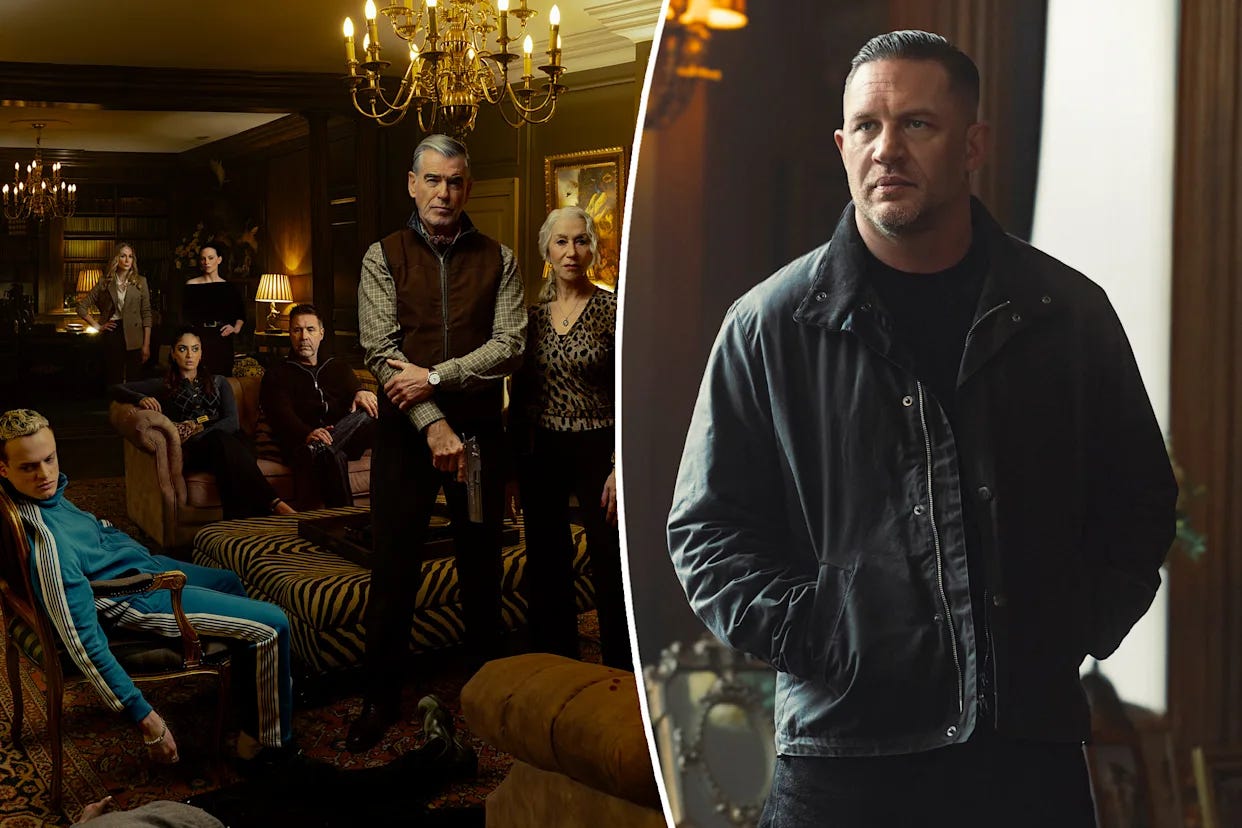
Tom Hardy The MobLand Mirage
How “Unprofessionalism” Masks Hollywood’s Political Purges
In Hollywood, the easiest way to quietly bury a political controversy is to dress it up as a standard workplace dispute. When the news broke that Tom Hardy would not be returning for the third season of the hit Paramount+ crime drama MobLand, the entertainment industry trades immediately kicked into high gear. They circulated a very familiar, highly polished narrative. Hardy, who played the fan favorite fixer Harry Da Souza opposite veteran heavyweights Pierce Brosnan and Helen Mirren, was allegedly fired for extreme unprofessionalism. The reports claimed he routinely locked himself in his trailer, kept his illustrious co stars waiting for hours on end, and constantly fought with executive producer Jez Butterworth over the script. It is a tidy, easily digestible story that fits perfectly into the established lore of Hollywood divas.
The studio PR machine knows exactly what it is doing. Hardy is famously intense and has a well documented history of on set clashes. The most notable example is his legendary feud with Charlize Theron on the set of Mad Max: Fury Road, which reportedly stemmed from the exact same habitual tardiness. Because the public already views Hardy as a brilliant but difficult artist, the official explanation for his exit from MobLand feels inherently true. The narrative is bulletproof. However, beneath the carefully curated press releases and anonymous leaks from set, a much louder, non mainstream narrative is taking hold across social media and independent entertainment forums. This alternative theory suggests that the alleged trailer tantrums are nothing more than a convenient smokescreen. The real reason for Hardy’s sudden departure, according to this growing consensus, is a deep, irreconcilable ideological rift between Hardy and Mirren over the ongoing Israel and Palestine conflict.
To fully grasp the weight of this counter narrative, one must examine the specific actors involved and the immense cultural power they wield. Helen Mirren, who commands the screen as MobLand matriarch Maeve Harrigan, is not just an acclaimed actress. She is a Hollywood institution and one of the entertainment industry’s most prominent, vocal defenders of Israel. Fresh off her 2023 role as former Israeli Prime Minister Golda Meir, Mirren has been unwavering in her public statements. She has explicitly stated her belief that Israel must exist for eternity and has fiercely opposed any cultural boycotts of the nation. She represents the old guard of Hollywood, wielding the kind of quiet, institutional power that studios instinctively and fiercely protect. In the eyes of studio executives, a star of Mirren’s caliber is a cornerstone investment that must be shielded from any on set friction.
Tom Hardy, conversely, represents a very different side of the geopolitical spectrum. While he is generally private about his personal life, Hardy has aligned himself with the pro Palestinian movement by signing public petitions calling for an immediate ceasefire in Gaza. In a deeply polarized cultural climate, placing a vocal pro Palestine actor and a staunchly pro Israel veteran on the same high stakes television set is akin to lighting a match in a powder keg. According to the online consensus, the tension on the set of MobLand had absolutely nothing to do with line changes, creative differences, or call times. Instead, the friction was born out of a deeply toxic working environment bred by an intense moral and political divide.
When push came to shove, the theory goes, Paramount+ and the producers were faced with an ultimatum. They had to choose between the pro Israel veteran and the pro Palestine star. They sided with Mirren and ousted Hardy. But why is the public so incredibly willing to reject the official diva narrative in favor of a political conspiracy? The answer lies in the fact that punishing pro Palestinian sentiment in modern showbiz is no longer a fringe conspiracy theory. It is a highly observable, heavily documented industry trend. The entertainment business has spent the last few years drawing a very rigid, unforgiving line in the sand regarding geopolitical speech.
Actors, writers, and directors who express pro Palestinian views have routinely found themselves facing severe professional consequences. Many have been blacklisted from major projects, unceremoniously dropped by their long time talent agencies, or quietly written out of ongoing blockbuster franchises. The highly publicized firing of Melissa Barrera from the Scream horror franchise stands as a watershed moment in recent Hollywood history. Barrera was fired explicitly for her social media posts advocating for Gaza. Spyglass Media Group did not hide behind excuses of poor acting or scheduling conflicts. They released a statement drawing a direct line between her political speech and her termination. That moment proved definitively that studios are perfectly willing to blow up their own lucrative properties in order to avoid any association with pro Palestinian viewpoints.
However, the Barrera incident also taught Hollywood executives a very painful public relations lesson. Explicitly firing a lead actor over their stance on Palestine triggers massive backlash, international boycotts, and an unending news cycle of negative press. The Scream franchise suffered immense reputational damage, and co star Jenna Ortega departed the project shortly after. Studios realized that saying the quiet part out loud is ultimately bad for business. In this new, highly cautious climate, the official MobLand story feels incredibly convenient. By leaning heavily into Hardy’s pre existing reputation for being difficult, Paramount+ successfully avoids the public relations nightmare that comes with firing an actor over their political convictions.
This strategy allows the studio to push out a dissenting political voice while maintaining the pristine illusion of standard corporate protocol. They get to claim that the firing was simply a matter of maintaining a professional work environment. If this alternative narrative is true, it marks a truly chilling evolution in how the entertainment industry handles political dissent. Studios no longer need to publicly denounce an actor’s politics or issue heavy handed statements condemning their social media posts. Instead, they can simply weaponize the concept of professionalism.
Every actor has bad days. Every television production features creative disagreements, moments of high stress, and friction among the cast and crew. Film sets are notoriously grueling environments with long hours, massive budgets on the line, and high stakes. But when an actor holds the wrong political views according to the studio executives, those standard workplace frictions can easily be magnified. A minor disagreement over dialogue is suddenly reframed as a toxic power play. Being late to set, a staggeringly common occurrence among A list talent, is suddenly deemed an unforgivable offense that constitutes career suicide. These magnified infractions are then leaked to compliant trade publications and used as completely justifiable grounds for immediate termination.
This weaponization of human resources terminology is incredibly insidious. It sanitizes political purges by wrapping them in the dull, unassailable language of corporate policy. Who can argue against a studio wanting to create a safe and punctual working environment for veteran actors like Pierce Brosnan and Helen Mirren? The framing makes the studio look like a responsible employer protecting its cast, rather than an ideological gatekeeper punishing political speech. It is the perfect crime of corporate public relations.
Furthermore, this dynamic exposes a massive double standard at the heart of Hollywood politics. Actors who hold acceptable views, specifically pro Israel sentiments that align with the broader corporate stances of major studios, are allowed to be difficult. They are allowed to make demands, clash with directors, and express their political beliefs openly without any fear of professional reprisal. Their politics are viewed as a natural extension of their artistic freedom. Dissenters, on the other hand, must walk a perpetual tightrope. The moment a pro Palestinian actor steps out of line, takes a little too long in their trailer, or questions a line of dialogue, the hammer falls.
We are witnessing the dawn of a modern blacklist, one that operates with far more sophistication than the crude tactics of the McCarthy era. In the 1950s, the House Un American Activities Committee explicitly dragged actors and writers in front of the government to interrogate their political affiliations. The Hollywood Ten were blacklisted openly, and the entire industry knew exactly why they were banned from working. Today, the blacklist is decentralized and entirely unspoken. It operates through whispered conversations in executive boardrooms, sudden shifts in production schedules, and highly coordinated leaks to the press about an actor’s supposed behavioral issues.
The ripple effects of Hardy’s departure from MobLand will be felt far beyond the confines of that specific production. The message being sent to young, emerging actors is unmistakable. If a studio is willing to fire Tom Hardy, a massive global star who serves as the primary draw for their flagship television show, then absolutely nobody is safe. If you speak out for Palestine, you will be deemed a liability. You will be monitored closely, and the moment you give the studio an excuse, you will be replaced. This chilling effect will inevitably silence countless artists who might otherwise use their massive platforms to advocate for human rights.
It is also worth noting the supreme irony of this situation occurring behind the scenes of a show like MobLand. The series is a gritty exploration of a ruthless British crime family. It is a narrative built entirely around brutal power dynamics, forced loyalty, and the violent suppression of anyone who steps out of line. The fact that the studio producing this show is allegedly engaging in its own brand of corporate suppression is a poetic tragedy. The television industry loves to produce art that critiques abuses of power, yet it remains one of the most rigidly controlled corporate environments in the world.
Whether Tom Hardy was truly locking himself in his trailer in a fit of ego driven rage, or whether he was simply locking horns with a co star who fundamentally despised his worldview, the general public may never get the unvarnished truth. Studio non disclosure agreements and the impenetrable wall of Hollywood public relations will likely keep the exact details of the MobLand set buried forever. We are left only with unnamed insider sources and the carefully crafted narratives published by the trades.
However, the fact that a massive segment of the viewing public is so overwhelmingly rejecting the mainstream narrative speaks volumes about the current state of media trust. Audiences are no longer passively accepting the stories handed down to them by studio executives. They are wising up to the reality that in today’s highly corporatized Hollywood, an actor’s career is not just dependent on hitting their marks, memorizing their lines, and delivering a compelling performance. It depends entirely on falling in line with the unwritten political mandates of the executive class.
Ultimately, the Tom Hardy and Helen Mirren clash on MobLand serves as a dark case study for the future of entertainment. It proves that the era of the outspoken, politically rebellious movie star is rapidly drawing to a close. In its place, we are entering an era of sanitized, perfectly compliant celebrities who know exactly which causes they are allowed to champion and which ones they must ignore. If the alternative narrative surrounding MobLand is indeed the truth, it confirms our worst fears about the entertainment industry. It confirms that behind the glamorous premieres, the impassioned award speeches, and the hollow corporate statements about diversity and inclusion, Hollywood remains a town where power protects power, and where dissent is quietly, efficiently erased.


