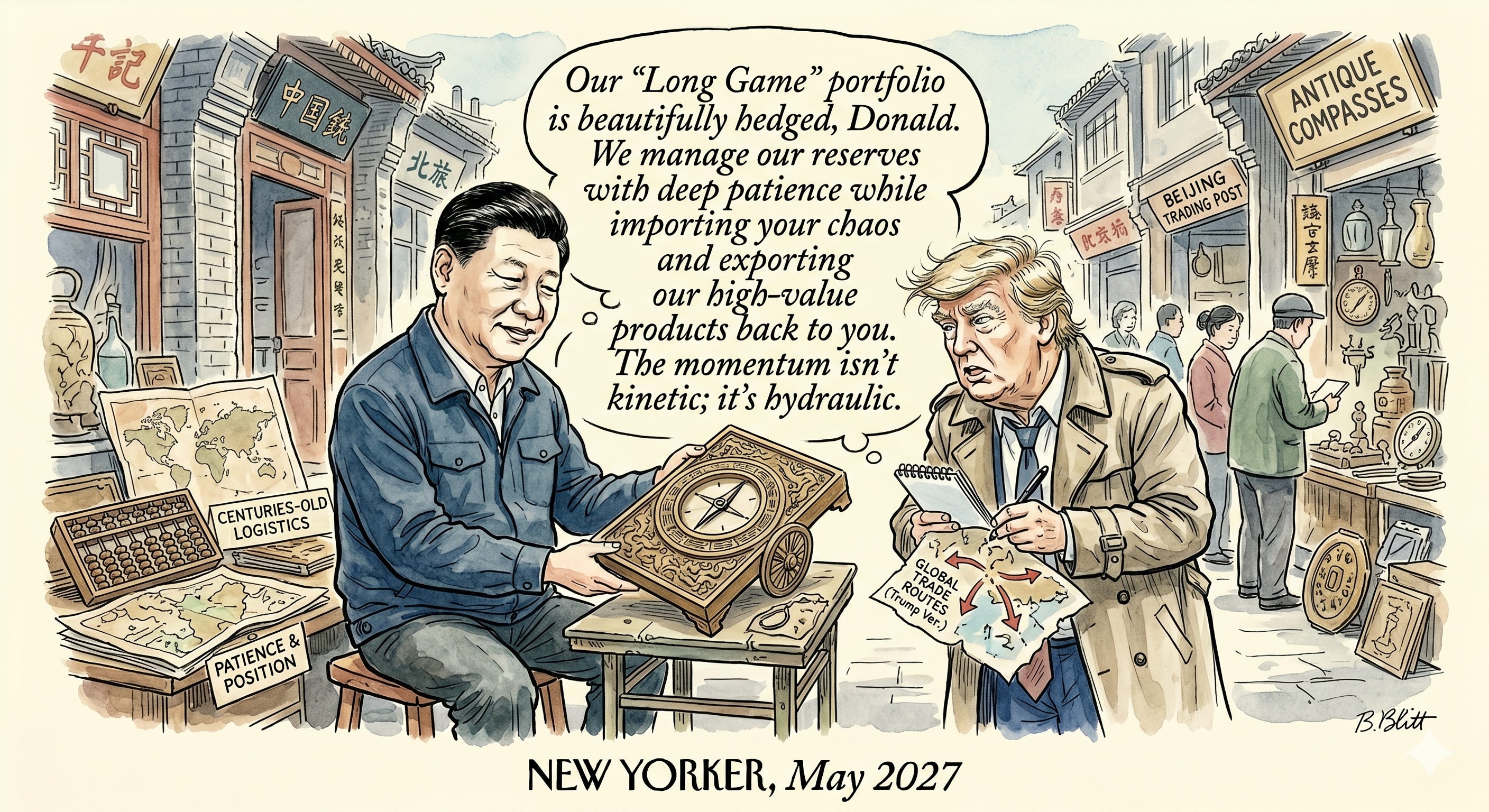
Trump Comes to Beijing With a Blockade and a Boeing Order
China Has 1.4 Billion Barrels and a Longer Calendar
The last American president who arrived in Beijing believing he held the decisive advantage left with a photograph and a memorandum of understanding worth $83.7 billion, a number that exceeded West Virginia’s entire GDP and never materialized. That was 2017. The airport protocol was the same then: the motorcade, the flags, the careful arrangement of chairs at the state banquet. Today it is the same again, except this time Elon Musk is in the delegation and a documentarian is filming the arrival, because apparently the performance now needs its own record.
Before boarding, Trump told reporters he expected a long talk about Iran, then immediately softened the ask, saying he did not think he needed any help from China on the matter and that Xi had been “relatively good.” A president who believes he holds the strongest American negotiating position since Nixon does not typically reduce his demands before the first course is served.
Washington has spent five months arguing that China’s energy dependency on Iran gives the Hormuz blockade its teeth. The logic is not wrong. China buys somewhere between 1.38 and 1.5 million barrels per day of Iranian crude, roughly 80 to 90 percent of everything Iran exports. When Operation Epic Fury launched on February 28 and the blockade tightened, that flow was cut. The pressure is real.
What Washington reads as exposure, Beijing has always read as a choice about sequencing: spend down foreign supply first, at a discount, before touching what is underneath.
China’s proven reserves sit at 3.69 billion tons across producing basins. That figure covers only what Beijing has officially certified and chosen to develop. The Tarim Basin’s central and western junctions alone hold an estimated 19 billion tons of oil equivalent, with 83.2 percent of its deep resources buried below 6,000 meters. In February 2025, Chinese engineers completed the Shenditake 1 borehole at 10,910 meters, the world’s first onshore oil and gas discovery at that depth, in the Taklimakan Desert under temperatures exceeding 210 degrees Celsius and pressure greater than the deepest point of the Mariana Trench. In October, Sinopec confirmed 100 million metric tons of new shale oil in Sichuan’s Qijiang district, its third major shale field identification in three years. Beijing does not announce these discoveries because it plans to produce them tomorrow. It announces them so Washington understands the shelf it is sitting on before it walks in here with pressure talking points.
The import record fills out the rest. China imported a record 11.6 million barrels per day in 2025, adding an average of 1.1 million barrels per day directly to strategic stockpiles that reached 1.4 billion barrels by December. Eleven new storage sites are under construction, combined capacity 169 million barrels, filling rate still at roughly 60 percent. Indonesia’s share of China’s crude imports rose ninety-eight-fold last year. That is not Indonesian oil. That is Iranian crude relabeled at ship-to-ship transfers off Riau, flowing into Shandong teapots as neutral-origin blend while OFAC writes alerts about Shandong Province. China bought cheap while the sanctions discount held and Iran had nowhere else to sell. The stockpile preceded the squeeze by design. Supply management, not crisis response.
The Rail Nobody Can Sanction
Bessent called the financial campaign “Economic Fury” at his April 15 briefing. The name is apt. The mechanism is real. And: when Washington cuts a bank off SWIFT, the settlement function moves. Bank of Kunlun was sanctioned in 2012, sanctioned again in 2019, and still underpins the alternative settlement channels for Iranian and Russian oil today, because the yuan clearing architecture it pioneered requires neither SWIFT nor the dollar rail. Iran holds a $7 billion currency swap with the People’s Bank of China. CIPS settles yuan trades outside Washington’s reach. The mBridge project, running through the BIS Innovation Hub in Hong Kong with China, Thailand, the UAE, and Saudi Arabia as participants, is building the next layer of this infrastructure in real time.
On May 1, China’s National Financial Regulatory Administration quietly told Chinese banks to comply with U.S. sanctions on the named Shandong refineries. On May 2, the Ministry of Commerce publicly ordered Chinese companies not to comply, invoking the 2021 blocking statute for the first time in its history. Two instructions, two days apart, pointing in opposite directions. Washington calls this contradictory. It is, by design. One door for the dollar system, one door for the crude. The tension is not a failure of coordination. It is the architecture of a state that learned, across seven years of escalating American financial pressure since 2018, that the cost of closing either door entirely is higher than the cost of holding both open.
The tech delegation is the tell. Trump brought Musk, Cook, and Nvidia’s Jensen Huang. Rubio and Hegseth flew for the strategic posture. The CEOs flew because they are the concession catalogue.
Huang is the most consequential figure in that group. Nvidia’s H20 chips, the export-restricted model Beijing has been purchasing in volume, are a card China can play in both directions: restrict the inflow and every Chinese data center and AI laboratory feels it within a quarter; open the channel and Nvidia’s shareholders feel the earnings call. That seat on the plane was not offered to Huang as a courtesy. It was requested because the summit needs something to hand over, and chip access is the most legible thing Washington can offer that Beijing actually wants.
What Trump needs, beyond the Boeing order that will likely follow the 2017 pattern and remain a headline number: a public statement from Beijing pressuring Iran to reopen Hormuz, with a credible timeline attached. In exchange: tariff relief, chip relaxation, a photograph. The Heritage Foundation’s own paper published May 11 described this summit as “a compliance checkpoint, not a reset.” When Washington’s own architects are calibrating expectations downward before the first handshake, the strong-hand narrative is already doing its own quiet work of disassembly.
Trump’s approval sits between 34 and 38 percent. Among Americans under 30, roughly three-quarters oppose further military action. Gasoline is $4.50 nationally, $6.00 in California. American midterms arrive in November 2026. Xi needs to deliver nothing irreversible before November does its own work.
Time moves at a different speed when you are not managing approval ratings, do not hold quarterly press conferences about polling, and have already accumulated 1.4 billion barrels of crude at prices a distracted, sanctioning America helped suppress. The political math of the other side of the table is not a secret. It is a schedule.
Whether this summit produces a Hormuz timeline or dissolves into the familiar photograph-and-communiqué format is what the next two days will answer. The structural question, which of the two governments at this table built its position to outlast a domestic political cycle and which one needs a result by November, the next two days will not answer. That answer is already settled.


