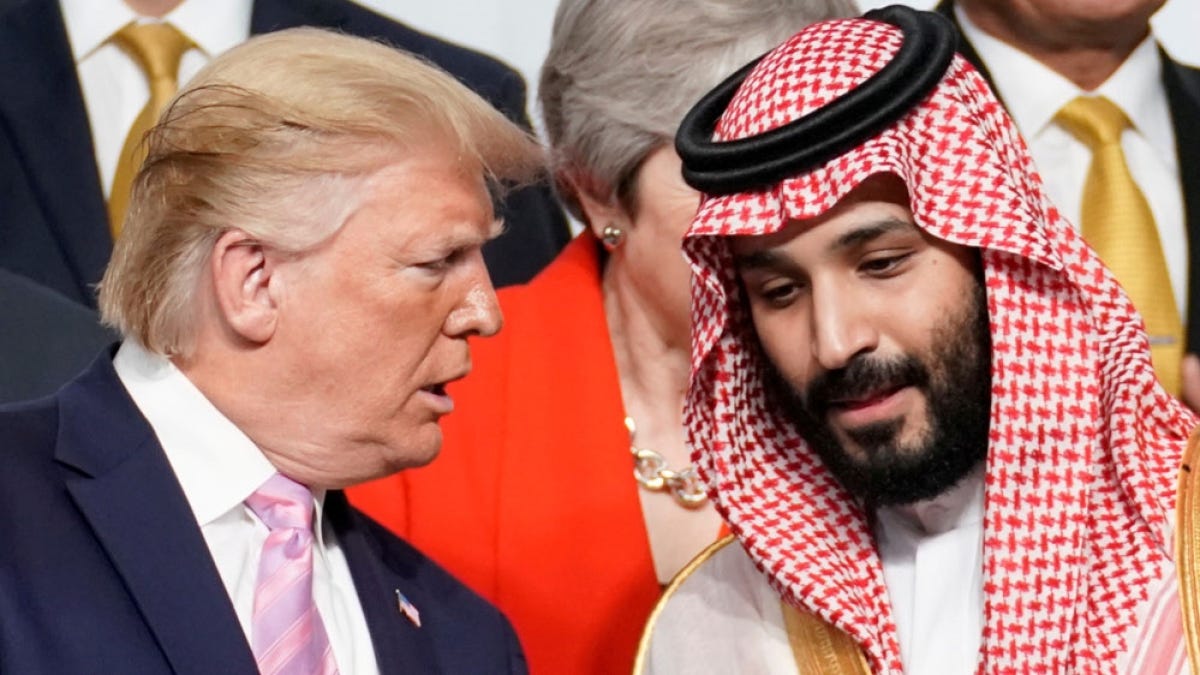
Trump Insults MBS
By publicly identifying MBS as the man who lobbied for the war, Trump didn't just humiliate a crown prince. He killed the Abraham Accords.
Standing at a Saudi-backed investment summit in Miami on March 27, Donald Trump told the assembled audience what Mohammed bin Salman really thought before the Iran war began. “He didn’t think he’d be kissing my ass. He really didn’t.” Then, with the warmth a landlord extends to a tenant who has paid late: “He better be nice to me.”
This was not a slip. It was a public accounting of a relationship Washington has managed privately for fifty years, said aloud in front of the client’s own guests. The problem for Riyadh is not the humiliation. The problem is what it destroyed.
Saudi Arabia lobbied Trump, through multiple direct calls between MBS and the president, to launch the February 28 attack on Iran. The Washington Post reported it on four sources. Saudi officials immediately denied it: “The kingdom of Saudi Arabia has always supported a peaceful resolution to this conflict, even before it began.” That denial was not simply face-saving. It was load-bearing. For Riyadh to eventually enter the Abraham Accords, to normalize with Israel and present it to a domestic audience already watching an Arab neighbour get bombed back to the pre-industrial age, the kingdom needed plausible distance from the war. It needed to be the Gulf state that did not want this, the responsible actor that could broker what comes next. The denial was the foundation of that position.
Trump demolished it in one sentence, at the Saudis’ own forum, in front of their own investors.
He then turned to the Saudi delegation and told them it was time to join the Abraham Accords. “It’s time now,” he said, pointing at them. This is the sequence: first establish publicly that MBS begged for the war, then demand the political dividend Washington has wanted all along. The ask arrived immediately after the leverage was applied. No one in that room missed the order of operations.
The economics of the situation have already foreclosed much of Saudi Arabia’s manoeuvring room. Goldman Sachs projects a GDP contraction of roughly five percent this year. The Strait of Hormuz, through which a fifth of the world’s crude oil moved in peacetime, remains functionally closed. Iran struck Prince Sultan Air Base on March 27 with missiles and drones, wounding at least ten US service members, killing the fiction that Saudi territory was somehow neutral in a war Riyadh insists it did not want. The denial was already strained. Trump snapped it in public.
The Abraham Accords track required a specific Saudi political fiction: that normalization with Israel was a sovereign choice made on Saudi terms, for Saudi strategic interests, on a Saudi timeline. Gulf states that signed in 2020 could sell that story. Riyadh was always a harder case, given the kingdom’s role as custodian of the two holy mosques and the weight that carries across the Muslim world. The Saudi public position required not just distance from Israel but visible independence from Washington. Both are now gone. MBS has been named, on record, as the man who lobbied a US president to bomb a Muslim-majority country, and then been publicly described as servile by that same president at his own investment conference.
The domestic cost of normalization in that political environment is not calculable. The street-level anger across the Arab and Muslim world at the destruction of Iran is not a minor variable. Riyadh spent weeks building the argument that it stood apart. Trump spent forty seconds dismantling it, apparently without consideration of what he was dismantling, which is itself a statement about how Washington calculates the value of Saudi political cover.
The Saudis cannot ask the US to leave. The Fifth Fleet sits in Bahrain. Prince Sultan Air Base, now taking Iranian fire, hosts American aircraft. Al Udeid in Qatar, Al Dhafra in the UAE: the garrison runs the full length of the Gulf coast. When the protecting power starts a regional war from your soil, names you as its instigator, and then presents the bill at your investment conference, the word for that arrangement is not alliance.
Trump called the Strait of Hormuz the “Strait of Trump” and the room laughed. In Riyadh, nobody is laughing. They are calculating what normalization costs when the cover is gone and the war is still running.
I don’t think the Saudis are happy at this point in time and normalization with Israel is probably over.