


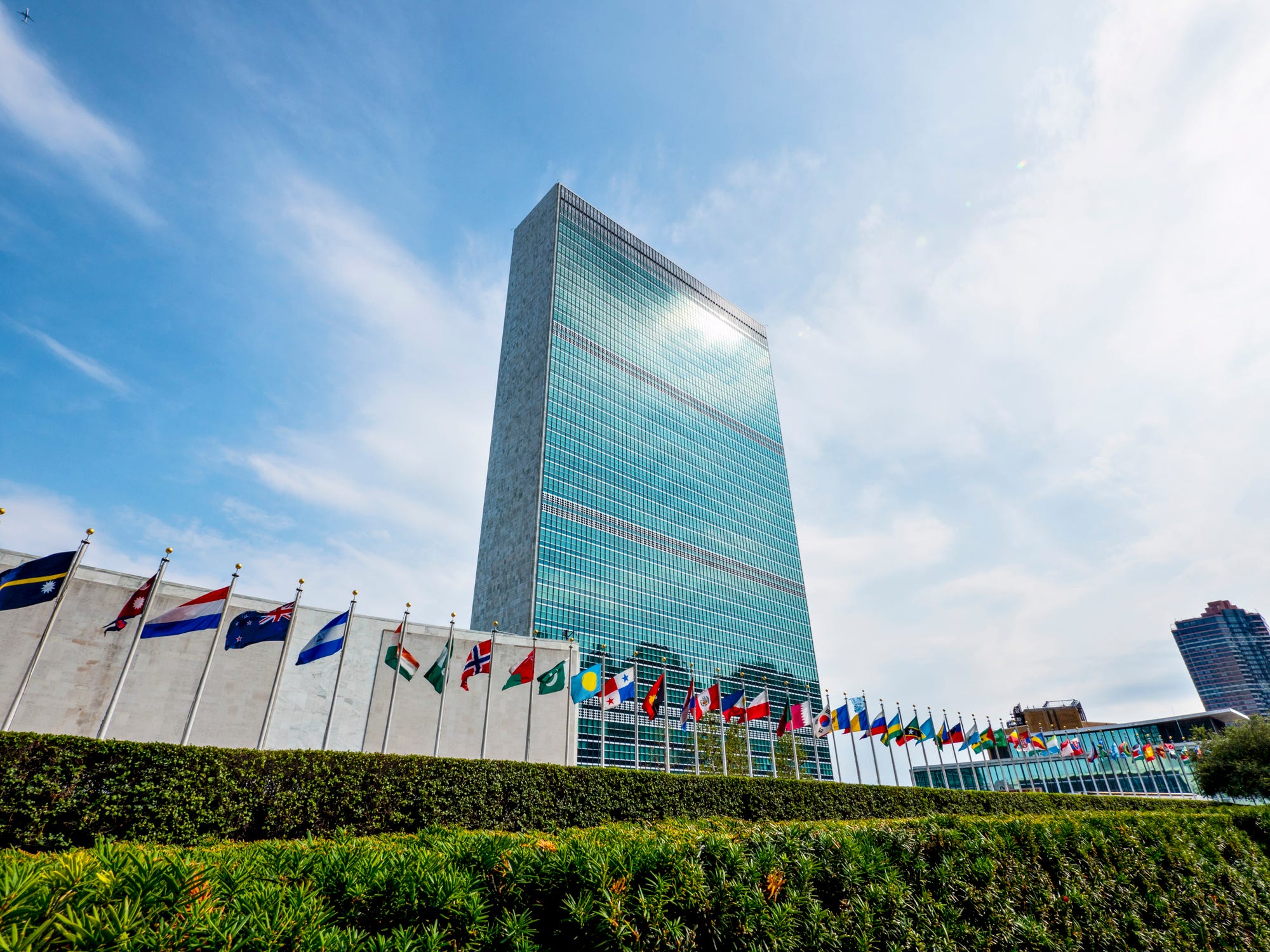
Trump offered Iran a deal after the American midterms or destruction before them, Guterres gave his final General Assembly address, Lula warned Washington away from Brazil, Macron defended international courts, Burnham sold Britain as an honest broker while its air force prepared to refuel Saudi jets, and the institution recorded every contradiction without acquiring the power to resolve one.
Wednesday, September 23, 2026: Donald Trump told the General Assembly that he would make a deal with Iran or “annihilate” it, predicted an agreement after the American midterm elections, and sent Steve Witkoff and Jared Kushner into three hours of talks with Iran’s foreign minister later that day. António Guterres used his final address as Secretary-General to tell superpowers that their power “isn’t so super.” Brazil’s Luiz Inácio Lula da Silva opened the national debate with a warning against American interference in Latin America. Emmanuel Macron defended the courts Trump had attacked about an hour earlier. Andy Burnham made his first appearance as British prime minister with a proposal for global rules on artificial intelligence, one day after committing an RAF tanker to refuel Saudi combat aircraft. Recep Tayyip Erdoğan called Gaza a concentration camp, Qatar’s emir called it genocide, and Israel’s delegation walked out. Trump signed an Arctic security agreement with Denmark and Greenland on the sidelines and described powers that Copenhagen says the text does not give him. Giorgia Meloni, Friedrich Merz, Xi Jinping, Narendra Modi and Cyril Ramaphosa did not come.
The General Assembly Hall gives every member state one vote. Its green marble rostrum belongs for fifteen minutes to Brazil, the United States, Türkiye, Qatar, France, Mongolia and every other country willing to wait for its turn. On Tuesday morning, the presiding officer reminded the room of that limit, and Donald Trump then stood at the rostrum and asked whether he should “annihilate the Islamic Republic” of Iran, drive it “into hell,” deny it “any chance of survival” and allow no “hope of future greatness or generations.” Article 2 of the United Nations Charter requires members to refrain from the threat or use of force against another state. The president of the country that hosts the United Nations issued the threat inside its chamber, under its emblem, through its microphones, and the institution entered every word into the public transcript.
The opening sequence gave the eighty-first General Assembly its meaning. The session’s official theme is “Restoring trust, managing transformation: a United Nations that delivers for all.” The most powerful government in the building used the occasion to advertise war, attack the courts that might examine it, reject collective rules for climate and artificial intelligence, demand the economic isolation of an enemy and convert the fate of another country into a promise timed for American voters. Other leaders defended law, sovereignty, restraint and reform, and yet every defence arrived as language while the threat arrived with aircraft carriers, sanctions and a veto.
The United Nations still gathers the world, keeps a record that power would rather lose and gives smaller states a room in which they can answer the governments that act upon them. Its agencies feed people, vaccinate children, count the dead and remain where national governments often leave. During high-level week, the General Assembly displays the formal equality of states inside an order built to preserve their material inequality, then invites the five permanent members of the Security Council to explain why the rules bind everyone else first. Tuesday’s speeches documented an old design operating without embarrassment.
The Day One File
Trump: peace by personal claim, war by campaign schedule
The threat was tied to an American election. Trump asked whether he should make a deal with Iran or “annihilate the Islamic Republic,” then asked whether he should drive the country “into hell” with no chance of survival. He said Tehran was waiting to see how he performed in the midterms and predicted that an agreement would come after the election. In the next sentence, he said the election did not enter his mind. The contradiction appears intact in the UN’s official transcript.
All but one member of the Iranian delegation left during the Iran section. Cuban delegates also walked out during parts of the address. The UN broadcast returned several times to the one Iranian official who remained, converting diplomatic protest into a reaction shot while the threat itself continued through the hall’s sound system.
Trump described Iran as the world’s leading sponsor of terrorism, said Operation Midnight Hammer had destroyed its nuclear programme and asked other governments to impose complete economic isolation until Tehran stopped attacks on shipping and support for armed groups.
The speech had an obvious domestic address. A CNN/SSRS poll cited by Axiosfound that 76 per cent of respondents said the Iran war had not been worth its human and financial cost, while 71 per cent disapproved of Trump’s handling of foreign affairs. He used the world’s largest diplomatic stage to promise American voters that another country’s fate could be settled after their ballots were counted.
Trump counted eight wars ended. He listed Cambodia and Thailand, Kosovo and Serbia, the Democratic Republic of Congo and Rwanda, Pakistan and India, Armenia and Azerbaijan, Israel and Iran, Egypt and Ethiopia, and Gaza among conflicts resolved through his intervention. He said negotiations on Russia and Ukraine continued and told the room that other leaders had discussed peace while he had produced it.
The Associated Press review of the address found that the count joined ceasefires, disputes that had not become wars and conflicts that remained unsettled. It also placed the Iran war among Trump’s claimed achievements even though his administration had joined and expanded that conflict.
The list did political work even where the facts failed. Trump presented personal intervention as the source of peace and multilateral institutions as obstacles, then used the same address to threaten the survival of a UN member state. The peacemaker claim and the annihilation threat were separated by minutes, not policy.
The Western Hemisphere was described as an American security zone. Trump praised the operation that captured Nicolás Maduro, announced an oil agreement with Venezuela, told Mexico to recover territory from cartels, said Washington was negotiating with Cuba for “fundamental change” and predicted the Cuban government’s collapse.
The Venezuelan oil claim sat inside a broader argument that control over energy reserves proves national strength. Trump said the United States and Venezuela together held more than 60 per cent of the world’s oil, a figure that the AP calculated at about 22 per cent of proven reserves and about 23 per cent of current production.
The speech treated sovereignty as conditional. Governments friendly to Washington received partnership; governments in conflict with it received instructions, sanctions or predictions of removal. The Charter’s sovereign equality remained on the wall behind him.
The courts and agencies became enemies. Trump called the International Criminal Court a body filled with “evil people” and urged member states to withdraw. He attacked the Human Rights Council, UNESCO and the International Maritime Organization, and described the UN bureaucracy as an instrument of a globalist left.
The attack on the ICC came from a president whose government rejects the Court’s jurisdiction but sanctions its officials when their investigations reach American allies. Trump did not propose a different universal standard. He demanded an exemption backed by American power.
Artificial intelligence became “super intelligence.” Trump said the word “artificial” made intelligence sound fake and called for the abbreviation SI. He rejected any global governance scheme for the technology.
This section was easy to treat as comic relief, but the policy beneath the branding was direct. The United States intends to lead development of systems that can affect employment, surveillance, military decisions and political communication while resisting rules written outside Washington. A personal renaming exercise covered a state doctrine.
The numbers that did not survive the speech
Ninety-seven per cent of drugs arriving by sea. Trump said American boat strikes had destroyed 97 per cent of narcotics entering by water. The administration has not produced evidence for the percentage, and drug analysts cannot calculate a share of an illicit flow whose total volume is unknown. The AP rated the claim unsupported.
More ammunition than the United States could use. Trump said American stocks were fuller than any conceivable need. Reporting cited by the AP described rationing and serious pressure on Patriot interceptors, Tomahawk missiles and THAAD systems, with some inventories expected to take three or four years to restore.
Sixty per cent of world oil. The combined American and Venezuelan share is close to 22 per cent when measured through proven reserves, or about 23 per cent through current output. The error was not marginal. It almost tripled the relevant share.
Eight wars ended. Several entries were unresolved disputes, some had not become wars, and the Iran entry covered a war the United States helped wage. A number repeated from a rostrum does not become an achievement because interpreters carry it into six languages.
Warnings about AI came from political opponents. Trump grouped concern about advanced systems with climate campaigners and people associated with investigations of Russian interference. Leading warnings have also come from the companies building the systems, including Anthropic chief executive Dario Amodei and executives who compete with him. The dispute runs through the industry itself.
A General Assembly address enters diplomatic cables, translated news reports, official summaries and campaign footage at once. Corrections travel later and with less authority. By the time an oil percentage is checked, the president has already used it to turn resource possession into a theory of national entitlement.
Guterres leaves with a diagnosis and no cure
The Secretary-General told the strongest states that force has limits. Guterres said military power cannot secure peace, economic power cannot purchase stability and technological power cannot master human judgement. His appeal was aimed at governments that possess all three and have spent his tenure testing how little restraint the UN can impose upon them.
He warned that authority was moving from public institutions to a small group of technology companies and wealthy individuals. He called for international rules on artificial intelligence, faster climate action, renewed arms control and institutional reform.
He said the scale of killing and destruction in Gaza exceeded anything he had seen during ten years in office, defended a two-state settlement and received prolonged applause. The response confirmed broad agreement in the hall while saying nothing about whether the permanent members would permit enforcement.
He called Africa’s exclusion from permanent Security Council membership indefensible. The Council still reflects the settlement of 1945, and every serious attempt to change it must pass governments whose power comes from the arrangement under challenge.
His departure date sharpened every line. Guterres’s second five-year term ends on December 31. No successor had taken control of the diplomatic contest by opening day, and the organisation faced funding pressure from Washington while several of the world’s most powerful leaders stayed away.
Nearly 130 heads of state and government came to New York. Xi Jinping, Narendra Modi, Friedrich Merz and Cyril Ramaphosa sent representatives. The room was full enough for ceremony and incomplete enough to show which governments no longer consider personal attendance essential.
Guterres defended an institution whose humanitarian bodies continue to work and whose political centre has been paralysed by its founders’ privileges. His speech could identify the mechanism, but his office cannot remove it.
Lula opens the debate and warns north
Brazil’s president said the UN’s credibility was at its lowest point. Lula recalled that Brazil had objected to the Security Council veto in 1946 and argued that the privilege granted to the great powers had helped produce the current crisis. He called for the institution to become a “temple of peace” and placed diplomatic settlement above coercion.
He then addressed Washington without naming it. Brazil would not accept foreign troops in its campaign against organised crime, did not need aircraft carriers patrolling its coast and “does not fit in anyone’s backyard.”
Brazilians vote on October 4. Lula had promised that he would use the UN address to oppose American interference, Trump had publicly backed the Bolsonaro family, and polling placed Lula and Senator Flávio Bolsonaro within the margin of error in a possible second round. Trump spoke from the rostrum about his own midterms; Lula spoke beneath the pressure of American interest in his election.
Climate divided the first two national speeches. Lula argued for decarbonisation, protection of forests and wider access to technology. Trump treated fossil-fuel abundance as proof of strength and rejected international climate governance. The disagreement covered more than policy. Lula described shared exposure to decisions made by rich states, while Trump described resources as instruments in a contest among states.
Hormuz carried the Global South into the argument. Lula linked conflict near the Strait to rising prices for fuel, fertiliser and food. Countries that did not plan the war, control the sanctions or command the shipping lanes still receive the inflation. The diplomatic language belongs to great powers; the bill travels south.
Macron and Burnham answer without forming a bloc
Macron defended courts after Trump attacked them. In his last UNGA speech as French president, Macron said governments faced a choice between international society and the law of the jungle. He pledged continued support for the International Court of Justice, backed mechanisms that preserve evidence of international crimes and promoted the Franco-Mexican initiative for voluntary Security Council veto restraint in cases of mass atrocity.
Macron said 128 member states supported the initiative. France still favours voluntary restraint over removing the veto, which preserves the permanent member’s right to decide whether a crisis qualifies.
He attacked the selective use of sovereignty, asking why the principle is treated as absolute in Europe and negotiable in the Middle East and Africa. He called Gaza a spectacle that shamed the world and struck the rostrum while discussing it.
On Ukraine, he proposed a double moratorium covering attacks on energy and civilian infrastructure and strikes against grain shipping in the Black Sea. On technology, he proposed a jointly built open-source frontier model independent of both China and the United States.
France chooses Macron’s successor in April and May 2027. His last appearance therefore mixed an institutional defence with a legacy claim: a permanent member arguing for law while retaining the exception that makes its support decisive.
Burnham presented Britain as an honest broker. The new British prime minister said the country could work through its American alliance, its improving European relationship and its ties with China, India and Brazil. He promised to put artificial intelligence at the centre of Britain’s G20 presidency and said decisions about the technology belonged to elected governments, not technology companies.
Trump had rejected global AI rules from the same podium. Burnham’s proposal requires cooperation from the government that had announced its refusal an hour earlier.
Burnham called Russia a bully, accused Moscow of amplifying far-right narratives in Britain and praised the sanctions legislation Trump signed the previous week.
His broker claim collided with a decision announced on the way to New York. Britain will send one RAF Voyager tanker for several weeks to refuel Saudi aircraft operating during the conflict with Yemen’s Ansarallah. London described the Saudi missions as defensive. Refuelling still extends the reach and operating time of combat aircraft, and British participation places the broker inside the military arrangement it may later ask others to negotiate.
Trump called Burnham a natural businessperson after their bilateral meeting. Burnham said they discussed Ukraine, the Falkland Islands and trade. His staff noted that Trump did not challenge Britain’s ban on imports from Israeli settlements.
Gaza enters the record again
Erdoğan called Gaza “the most inhumane and shameful concentration camp of our time.” The Turkish president said 74,000 Palestinians had been killed over three years, most of them women and children, and said Israel had killed more than 1,500 people since the ceasefire. These were Erdoğan’s figures, delivered from the podium. He also said more than 70 per cent of hospital generators were out of service for lack of fuel.
Israel’s delegation left the hall during the speech. Palestinian representatives applauded. Erdoğan credited Trump for helping to secure the ceasefire even as he accused Israel of violating it.
He again demanded Security Council reform and said the will of more than 190 countries should not depend on five permanent members. He noted that Mahmoud Abbas had been prevented from attending for a second consecutive year.
Qatar’s emir used the word genocide. Sheikh Tamim bin Hamad Al Thani said Gaza had suffered “genocide in every sense of the word” and condemned Israeli proposals for “encouraged emigration” as forced displacement. Israel rejects the allegation. The emir said international law loses meaning when it binds vulnerable states and exempts powerful ones.
Jordan called Israel a regional threat. King Abdullah II accused Israel of war crimes and said the international system already possessed resolutions and mechanisms but left them on paper. His government’s peace treaty and security relationship with Israel did not soften the public charge.
The speeches were direct and the machinery stayed fixed. The United States retains a veto over binding Council action. In June 2025 it blocked a resolution demanding an immediate, unconditional and permanent Gaza ceasefire while the other fourteen Council members voted in favour. Tuesday added testimony to a file already thick with testimony.
Iran: threats before lunch, talks after it
Witkoff and Kushner met Abbas Araghchi for three hours. Trump disclosed the meeting hours after threatening Iran. CBS reported that the Iranian delegation confirmed contact and said the American side had pressed for it. Axios described it as the first meeting between American and Iranian officials since mid-June, with mediators moving between positions.
Trump sent his special envoy and son-in-law instead of a formal delegation headed by the Secretary of State. Personal diplomacy remained inside the family and presidential circle even at an institution built for relations among states.
Iran’s public language stayed hard. An Islamic Revolutionary Guard Corps spokesperson said Trump had issued threats before and failed to carry them out. Parliament Speaker Mohammad Bagher Ghalibaf said Iran would not surrender.
A senior Iranian official told Reuters that Tehran could reopen the Strait of Hormuz within seven days if Washington reduced military pressure and lifted its blockade of Iranian ports. The proposition joined a global shipping route to the terms of a bilateral war.
Qatari Foreign Ministry spokesperson Majed al-Ansari described a deep deficit of trust and said the difference between a deal now and one ten months later would be measured in deaths. Brent crude remained close to $100 a barrel, compared with about $70 before the war.
The contradiction was functional. Trump could show his domestic audience maximum pressure and give negotiators permission to test a settlement in private. Iran could walk out of the speech and remain in the talks. The threat may have served the negotiation, or the negotiation may have supplied cover for the threat. No participant offered enough evidence to settle the question.
Greenland, Venezuela and business in the corridors
The Arctic agreement produced three versions of the same text. Trump, Danish Prime Minister Mette Frederiksen and Greenland Premier Jens-Frederik Nielsen signed a security pact that expands American access, has no set end date and restricts non-NATO military basing without agreement.
Trump said the United States would build two large bases and described “permanent control” over security and related needs. Denmark said Greenlandic sovereignty remained intact. Nielsen stressed that the agreement had been made with Greenland, not about it.
Associated Press reporting said the pact permits greater American military presence while maintaining Danish control. ABC’s review found that several access rights already existed under the 1951 defence agreement. The ceremony was larger than the legal change, and Trump’s description went beyond Copenhagen’s.
Trump met Delcy Rodríguez on Tuesday evening. Venezuela’s acting president came to the meeting more than eight months after American forces captured Maduro. The encounter followed Trump’s celebration of the operation and his new oil agreement with Caracas. A government could be subjected to American regime change and then welcomed into a bilateral meeting once control of its petroleum returned to the agenda.
Other scheduled meetings tracked the wars outside the hall. Trump was due to meet Japan’s Sanae Takaichi and leaders of the Gulf Cooperation Council on Iran and Ansarallah attacks against Saudi Arabia. G7 foreign ministers used their meeting to demand that Iran stop arming the Yemeni movement. The official debate discussed principles; the side meetings organised pressure.
Empty chairs and a narrower press pool
Several consequential leaders did not attend. Xi, Modi, Merz and Ramaphosa stayed away, and Meloni broke a long run of Italian prime ministers attending after her dispute with Trump over NATO and Iran. When Trump accused her of lacking courage, she replied that neither she nor Italy begged.
Absence has several causes, and it should not be reduced to one verdict on the UN. Taken together, the empty chairs still show that the annual gathering can remain globally representative while losing the personal attention of leaders whose decisions dominate its agenda.
The White House carried its press dispute into New York. PBS said it would use the UN’s own video feed rather than White House material after CNN, MS NOW and Politico were barred from the administration’s coverage arrangements. News organisations suspended parts of pooled coverage in protest. A speech defending American power arrived with restrictions on which American journalists could cover its author.
Today on the floor
Thirty-seven leaders are scheduled. Syria’s Ahmed al-Sharaa is listed first in the morning session, Iran’s Masoud Pezeshkian fifth and Ukraine’s Volodymyr Zelensky seventeenth. Speaker orders can shift, but Pezeshkian’s appearance will place the leader of a country at war with the United States before the Assembly one day after Trump threatened its destruction.
Iranian hardliners had urged Pezeshkian to cancel. The Kayhan newspaper told him to turn the UN into a courtroom for American crimes. No meeting with Trump had been announced.
Zelensky said Tuesday that he was prepared for a trilateral meeting with Vladimir Putin and the United States. His address follows Trump’s claim that work on the war continues.
Benjamin Netanyahu is due later in the week amid a public dispute with New York Mayor Zohran Mamdani. The general debate continues through Saturday and resumes on Monday, September 28.
Watch and Read
Full speeches: Trump on UN Web TV, Lula on UN Web TV and the official Day One transcript.
Trump and the record: Associated Press fact-check, Axios on the Iran threat and domestic polling, France 24 on the address and CBS live reporting on the US-Iran talks.
The opening speeches: Associated Press on Guterres, The Guardian on his final address, Associated Press on Lula and Inside Climate News on the opposing climate positions.
Europe and the sidelines: Associated Press on British refuelling support for Saudi Arabia, Associated Press on the Greenland pact and ABC on the powers already available under the 1951 agreement.
Gaza: Al Jazeera on Erdoğan’s speech and the Israeli walkout and the UN record of the June 2025 Gaza ceasefire veto.
Notebook: What Day One Showed
An American election speech delivered to the world
Trump’s address had a foreign audience in the seats and an American electorate in the text. He said Tehran was waiting to see how he performed in the midterm elections, predicted an agreement immediately after the vote and then insisted that the election did not enter his mind. The official UN transcript preserved the contradiction in consecutive sentences. His administration had entered a war he repeatedly said he would end, 76 per cent of respondents in a CNN/SSRS poll said the war had not justified its human and financial cost, 71 per cent disapproved of his handling of foreign affairs, and yet the answer offered at the United Nations was an exterminatory threat followed by a campaign deadline.
The speech treated international order as a hierarchy with the United States at its summit. Trump praised the capture of Nicolás Maduro, celebrated a major American oil agreement with Venezuela, instructed Mexico to recover territory from cartels, predicted the fall of Cuba and called for Iran’s complete economic isolation. He listed conflicts he claimed to have ended and presented himself as the room’s working peacemaker while threatening another country’s survival. The Iranian delegation began walking out during the Iran section, leaving one representative seated, and members of the Cuban delegation later followed. The camera returned to the emptying seats, and although the departure of the accused might interrupt another institution’s proceedings, at the General Assembly it became another available shot.
Trump also asked member states to withdraw from the International Criminal Court, which he called a group of “evil people.” He attacked the Human Rights Council, UNESCO and the International Maritime Organization, and rejected any international attempt to govern artificial intelligence. The technology would henceforth be called “super intelligence,” he announced, because “artificial” made it sound fake. A president had threatened a UN member with destruction, dismissed an international court and renamed a field of technology by personal preference, all from a lectern dedicated to sovereign equality, and his test of authority was whether the world would adopt his new abbreviation.
The hall offered little applause because applause was never the measure. The speech would be cut for American television, fed into campaign messages and used to tell voters that peace would follow the election if they preserved the president’s power. Iran became both enemy and electoral prop: dangerous enough to annihilate, patient enough to wait for county returns in Pennsylvania, and available for a deal as soon as the ballots had served their purpose. An entire country entered the speech as an instrument in a domestic contest in which its people cannot vote.
Hours later, Trump said Steve Witkoff and Jared Kushner had spent three hours with Iranian Foreign Minister Abbas Araghchi and his delegation. Iranian state television confirmed contact and said the American side had pressed for the meeting. The threat and the talks belonged to the same day, the same administration and the same method. Washington made diplomacy look like an indulgence granted after public humiliation, while Tehran used the meeting to show that it could absorb the humiliation without closing the channel. The UN supplied the venue for both performances but controlled neither.
Guterres described the institution he could not repair
António Guterres opened his final General Assembly address as Secretary-General by naming power as the subject beneath war, inequality, climate breakdown and artificial intelligence. He said superpowers needed to accept that their power “isn’t so super,” warned that military power cannot secure peace and described an extraordinary transfer of authority from governments to a small number of corporations and individuals. On Gaza, he said the scale of killing and destruction was unlike anything he had witnessed during his tenure. On the Security Council, he called the absence of permanent African representation indefensible. His diagnosis was direct because his departure is near.
The speech also marked the limit of the office. Guterres could tell the permanent members that their power had limits, but the Charter grants each of them a veto over substantive Security Council action. He could defend the two-state solution and condemn settlement expansion, but the United States vetoed a June 2025 resolution demanding an immediate, unconditional and permanent ceasefire in Gaza even though the other fourteen Council members voted for it. He could invoke law against force, and an hour later the American president could threaten force and urge countries to abandon the ICC. The Secretary-General speaks for the Charter and the permanent members retain the machinery that decides when it applies.
Guterres asked for a more representative Security Council, stronger climate action, regulation of artificial intelligence and a defence of civilians without exceptions. These demands received applause because they cost the room nothing. The Security Council’s structure has survived decades of reform speeches precisely because reform requires consent from governments whose privilege reform would reduce. France can support limits on the veto in cases of mass atrocity, Britain can describe itself as a bridge, the United States can praise reform after cutting the institution’s budget, and yet each retains the vote that separates its preferences from the will of the wider membership.
The official programme calls the General Assembly the main policy-making organ of the United Nations. Its resolutions carry political weight, while Security Council decisions control the institution’s coercive authority and any permanent member can stop a substantive resolution. One hundred and ninety-three flags therefore surround an enforcement system in which five governments possess the decisive exception, an arrangement that was never hidden and became harder to decorate on Tuesday.
The warm applause for Guterres was sincere, but sincerity is one of the cheapest currencies in the building. Leaders praised the man who had spent ten years warning them, then returned to the national policies that made his warnings necessary. His farewell address asked whether power would submit to law or move beyond it, and Trump answered from the same rostrum.
Lula spoke for the states expected to absorb the consequences
Luiz Inácio Lula da Silva opened the national speeches by saying that the UN’s credibility had never been lower and its protection of people without armies or arsenals had never been weaker. Brazil had warned in 1946 about the price of the veto, he said, and the “luxury” given to the great powers now sits beside a crisis of leadership. Lula then turned north. Brazil would not accept foreign military responsibility for its fight against organised crime, did not need aircraft carriers guarding its waters and “does not fit in anyone’s backyard.”
The timing carried its own pressure. Brazil votes on October 4, Trump has openly supported the Bolsonaro family and Lula entered the Assembly statistically tied with Flávio Bolsonaro. Trump spoke to his domestic electorate from a global podium, while Lula used the same room to tell the host government to keep its military power out of Brazil’s election and territory. Both speeches recognised that the General Assembly cannot enforce the boundary. One president treated that weakness as permission; the other had to state sovereignty aloud because permission had become the prevailing American assumption.
Lula’s address also named the economic consequence that disappears beneath strategic language. The Strait of Hormuz became a battlefield and families across the world paid more for fuel, fertiliser and food. The Global South enters most great-power arguments through the resulting bill. It does not write the sanctions, operate the carrier groups, control the insurance market or hold a permanent veto, and yet its households pay through transport fares, food prices and public budgets already strained by debt.
Recep Tayyip Erdoğan later called Gaza “the most inhumane and shameful concentration camp of our time.” The Israeli delegation walked out while Palestinian representatives applauded. Erdoğan said the UN had failed in Palestine, Lebanon and Sudan, said Israel had killed more than 1,500 people in Gaza since the ceasefire and noted that Mahmoud Abbas had been denied entry to the United States for a second consecutive year. He also credited Trump for helping produce that ceasefire.
The sequence contained the chamber’s favoured bargain. A leader could condemn Israel in the strongest language available, thank the American president whose government shields it, criticise the UN for failing to act and then hand responsibility back to the same Security Council structure that prevented action. Qatar’s emir called Gaza genocide and condemned forced displacement. Jordan’s king described Israel as a regional threat. The speeches placed clear positions on the record, and the record now holds years of clear positions beside the conduct they failed to change.
The walkouts gave television a visible rupture, but the deeper rupture remained procedural. Mahmoud Abbas could be excluded by the host country, Palestinians could applaud from observer seats, Israel could leave during criticism and Washington could retain its veto over binding Council action. The choreography placed each actor exactly where the existing distribution of power had put it before the session began.
Europe defended law and preserved its exceptions
Emmanuel Macron used his final General Assembly address as French president to describe a choice between the law of the jungle and an international society governed by rules. He defended the International Court of Justice, supported evidence-collection mechanisms for international crimes and said France would continue the Franco-Mexican initiative to restrain the Security Council veto during mass atrocities, now backed by 128 member states. He attacked the double standard that treats sovereignty as absolute in Europe and negotiable in the Middle East and Africa. The argument landed an hour after Trump urged members to leave the ICC.
Macron was right about the double standard, and France’s own position showed how easily a state can condemn it while keeping the privileges that sustain it. Paris supports a voluntary restraint on the veto rather than its removal. The distinction leaves the permanent member as judge of when restraint is appropriate. France can defend the courts, call Gaza a disgrace, demand equal sovereignty and retain the legal architecture that allows five capitals to decide when the other 188 deserve enforcement.
Andy Burnham’s first address as British prime minister offered another version of the same contradiction. He called Britain an “honest broker” because it is close to the United States, connected to the European Union and able to work with China, India and Brazil. He said decisions on artificial intelligence belong to elected governments rather than technology companies and promised to place global AI standards at the centre of Britain’s G20 presidency. Trump had rejected any “globalist scheme” for AI governance. Burnham’s proposal therefore depended on cooperation from the ally that had used the same session to refuse it.
The phrase “honest broker” carried heavier baggage. On the flight to New York, Burnham announced that an RAF Voyager would refuel Saudi aircraft for several weeks during operations linked to Ansarallah’s advance near Bab al-Mandab. British officials called the Saudi missions defensive, as governments do when their aircraft extend the range of another state’s combat fleet. Britain arrived as broker and belligerent support, regulator and military supplier, defender of elected control over technology and partner to a president rejecting the proposed controls.
European leaders spoke with more respect for institutions than Trump did, while their policies showed how far respect remains from submission. Macron backed courts while preserving permanent-member privilege, Burnham promoted rules while servicing a regional war partner and the wider European presence was incomplete. Giorgia Meloni and the German chancellor stayed away after separate political strains, while Xi Jinping and Narendra Modi also left their seats to lower-ranking representatives. Nearly 130 leaders travelled to New York, but several governments with the greatest economic and military reach decided that the annual defence of multilateralism did not require their heads of government.
The agreements happened beside the Assembly
Trump, Danish Prime Minister Mette Frederiksen and Greenland’s premier, Jens-Frederik Nielsen, signed an Arctic security agreement on the sidelines. Trump described permanent American control over Greenland’s security and announced two major US bases. Copenhagen said the agreement reaffirmed Greenlandic sovereignty. An Associated Press account found that the pact expands US access while keeping Greenland under Danish control, and ABC reported that much of the military access already existed under the 1951 defence agreement.
The ceremony served all three governments because ceremony can hold incompatible accounts at once. Trump could claim control, Denmark could claim sovereignty and Greenland could insist the agreement had been made with it rather than about it. The General Assembly supplied proximity, cameras and diplomatic scale. The operative language remained in a bilateral document beyond the Assembly’s vote.
The Iran talks followed the same route. Trump made the threat in the chamber, while Witkoff and Kushner held the negotiation away from it. Gulf leaders and Qatari mediators worked on terms in side meetings. The public session carried national claims; the private rooms carried the bargaining. The division between speech and transaction has always existed at UN gatherings, but Tuesday made its hierarchy unusually clear. The rostrum announced power and the corridors transacted it.
The separation between public speech and private bargaining explains why leaders continue to attend an institution they describe as broken. The United Nations brings adversaries into one city, allows smaller countries to build blocs, gives diplomats a shared timetable and creates encounters that would otherwise require weeks of negotiation. Its weakness as an enforcement system increases its usefulness as a meeting place because states can use the venue without surrendering control to it. The institution survives partly because the powerful can ignore its central rules while using its rooms.
The assembly can record the crime and still fail to stop it
Calling the United Nations useless discards the work of agencies and staff who operate food programmes, refugee systems, vaccination campaigns, peacekeeping missions and human-rights investigations under conditions created by governments that later blame the organisation. It also excuses the member states that designed the Security Council, withhold funds, block resolutions and then cite institutional failure as proof that collective authority cannot work.
Responsibility begins with the member states. The strongest governments built an organisation that is universal in language and selective in force. They want the legitimacy of the Charter, the convenience of the venue, the intelligence of its agencies and the spectacle of global attendance. They resist any authority that could bind them when those assets conflict with national power. The institution records that contradiction every year, and high-level week turns it into television.
Powerful members use each part of the system for a separate purpose. The General Assembly supplies legitimacy and a global audience, the Security Council protects permanent privilege, the corridors support bargaining and the agencies manage human damage after national policy has done its work. Guterres can ask whether force will submit to law, Lula can reject a superpower’s claim over the hemisphere and Erdoğan can condemn the abandonment of Gaza, and yet Trump can threaten Iran, attack the ICC, tie diplomacy to an American election and send his envoys into talks three hours later.
Each statement can be read as national policy, domestic theatre or personal legacy. Together they show an international system in which law supplies the vocabulary and power supplies the outcome. The General Assembly can give Iran a seat after the United States threatens it, give Palestine applause after the host state excludes its president, give Gaza resolutions after Washington blocks enforcement and give the Secretary-General a standing ovation after permanent members ignore his warnings. Equal speaking time cannot repair unequal consequence.
The session continues through September 28. Masoud Pezeshkian, Volodymyr Zelensky and Benjamin Netanyahu will add their claims to the record, diplomats will negotiate language, courts will be praised and attacked, and governments will promise reform without surrendering the instruments that make reform necessary. The unresolved question is whether smaller states will continue treating access to the room as a substitute for power inside the system, or whether the accumulating cost of selective law will force them to build authority elsewhere.