


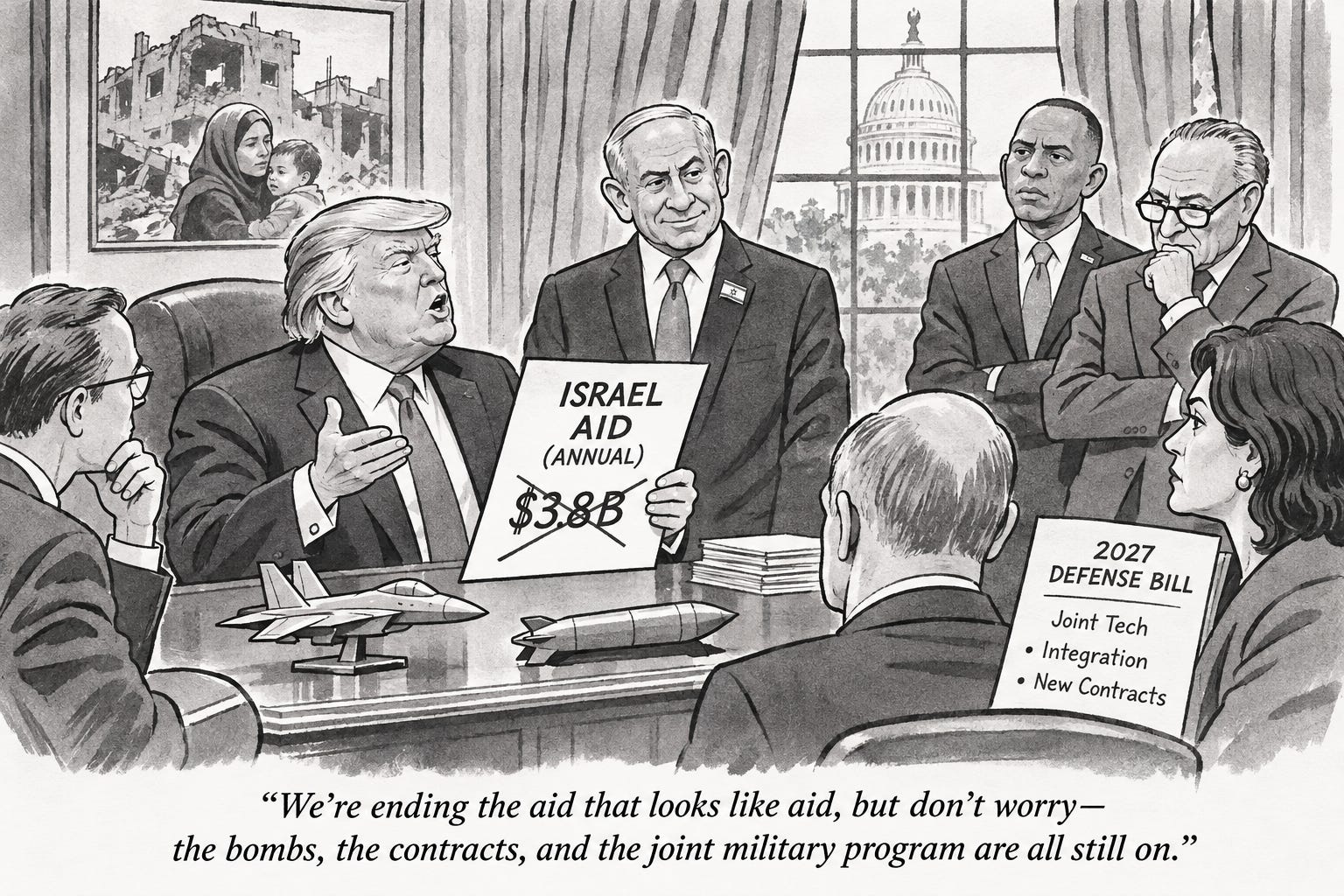
Suleiman al-Najjar was away getting an injection when an Israeli bomb hit his family’s house in Deir al-Balah. His wife, Susanne, was killed. So were four of their children, among them fourteen-year-old Yazan and Safa, who was seventeen months old. Suleiman came home alive because he had been ill enough to leave the house. Amnesty International’s investigators later identified fragments of a US-made Boeing guidance kit in the wreckage. They could identify the device that helped direct the bomb; Washington still had to answer why such equipment remained available after its use against a family home.
The United States has argued over how much of the cost of that alliance should appear as aid on a federal budget line. Donald Trump joined the argument on Election Day, announcing that he wanted to stop the nearly four billion dollars in annual military assistance that Israel has received under an Obama-era agreement. He said Benjamin Netanyahu had approached him about the change and told Fox News that the payment had become “almost too easy a target” for critics such as Michigan Senate candidate Abdul El-Sayed.
Trump also said the United States would keep selling Israel arms. The promise about aid therefore arrived with a promise to continue the trade in the weapons the aid had helped Israel purchase.
Trump’s proposal would remove the number that appears in campaign speeches while preserving the arms pipeline. The unfinished 2027 defense bill contains a provision that would expand joint military technology development and look for ways to integrate Israeli technology into the US armed forces. An Israeli government that pays cash for an American weapon can still use it. An American military that makes its systems dependent on joint research can still deepen the relationship after the old subsidy disappears. The accounting could change while the material link between an American factory and a Palestinian home survives.
No one has established whether the weapon that struck the al-Najjar house was purchased with a US grant or through another channel. The markings on the recovered kit identify its American manufacture, not the bank account that paid for it. That limit makes Trump’s announcement more disturbing, not less: the debate in Washington is already moving toward the appearance of ending a payment while the people who live beneath the weapons will have to find out whether anything else ended with it.
Democrats won both chambers of Congress on Tuesday amid anger over Trump’s war with Iran and the cost of living. They now have a chance to tell the country precisely what happened to the foreign policy it was sold as a break from. Their leaders can condition a weapons sale, demand the contracts, restrict appropriations and insist that the president disclose the terms of his proposed new arrangement. Or they can spend two years treating the disappearance of a conspicuous line item as a moral victory while the machinery it financed is rebuilt under another name.
Hakeem Jeffries has asked to become Speaker, and Chuck Schumer is preparing to lead the Senate. Their first serious confrontation with Trump may concern whether the aid payment survives, and the dangerous answer is that both sides may discover they can live with its disappearance.
The number that became embarrassing
Barack Obama’s administration negotiated a thirty-eight-billion-dollar, ten-year military-assistance memorandum with Israel in 2016. Congress still had to appropriate the annual money, about $3.8 billion. The arrangement also served American manufacturers: foreign military financing for Israel largely returned to US firms when Israel bought American equipment. A voter hearing that taxpayers “give” Israel a sum of money might imagine a wire transfer to a distant treasury. A defense contractor in the United States understands the route more intimately. The grant helps pay an American invoice, and the weapon leaves for Israel. Trump’s proposed end to that grant would matter if Congress agrees to it. The existing agreement runs until 2028. Orders placed under earlier agreements may take years to build and deliver. New purchases, intelligence sharing and joint research are separate decisions. Even a successful cut to the annual payment would leave Congress with the unglamorous question of the shipment already in a queue, the export license on an official’s desk and the provision in a defense bill that makes two military systems work together. Those are the places where the relationship would continue or change.
The president’s words gave away the immediate political reason for his announcement. He mentioned El-Sayed by name. The candidate had campaigned against unconditional US support for Israel, survived more than thirty million dollars of spending by AIPAC’s super PAC and its allied operation, and won the Michigan Senate seat. Trump called the annual payment an easy target because a critic had made it one. That concession is a remarkable gift from a president who would rather be seen winning a negotiation with Netanyahu than admitting a young antiwar electorate had moved a foreign-policy boundary.
The beneficiaries of a new arrangement are already arguing over its form. The Associated Press reported discussions about turning the alliance toward joint defense technology and manufacturing. Israeli opposition figures warned that losing the annual grant could weaken their country’s security; Representative Ro Khanna raised a different concern, saying deeper integration of the two militaries could compromise American sovereignty. Those objections cannot be collapsed into one conclusion. They show that Trump’s proposal has consequences worth fighting over, and that an annual subsidy can be replaced by ties less obvious to a household reading the federal budget.
Trump began a war with Iran alongside Israel and now says an annual payment to Israel has become too politically embarrassing to display. Congress may then be asked to congratulate him for removing the price tag while its members approve an agreement that puts Israeli military technology inside American systems. Somewhere a communications director will have the phrase “modernized partnership” ready for the cameras. In Gaza, a family will still need to know what aircraft is overhead.
The sympathy vote
Jeffries’ letter to House Democrats after the election promised action on affordability, executive accountability and Trump’s Iran war. The language answers a real demand. Trump began the conflict, and Democrats tried to restrain it when they were in the minority. A Senate effort to advance a war-powers measure failed 53 to 47 in March; nearly every Democrat supported it, joined by one Republican. Those votes should count. Pretending that every Democrat wanted the war would make the party’s eventual choices harder to judge, because it would erase the commitments those same members made in public.
The Democratic record on Gaza creates a harsher question. Biden’s administration supplied Israel with arms during the assault, defended the alliance and repeatedly expressed concern for Palestinian civilians. It paused one shipment of heavy bombs in 2024 amid alarm over Rafah. Other transfers continued. The pause proved that the executive could intervene in the pipeline when it chose, and the pipeline that remained showed how narrow a gesture could be made to look like a new policy. For the family under the next strike, the president’s reluctance to send a particular bomb does not make the other munitions less real. Jeffries made his own choice in the House on April 20, 2024. The Israel Security Supplemental Appropriations Act passed 366 to 58. Of the Democrats voting, 173 supported it and 37 opposed it. Jeffries voted yes. The roll call has a devastating simplicity that years of carefully composed statements about Netanyahu cannot erase. He could speak about civilian suffering and still help pass additional Israeli security funding while the Gaza assault continued. The House clerk did not file those statements beside the vote as an amendment.
The language of the two-state solution has long provided the party with a gentler way to avoid that contradiction. A Democratic official criticizes a settlement, mourns a family, promises that Israel and Palestine will someday live side by side, and then returns to an appropriations bill whose weapons provisions operate in the present tense. Palestinian sovereignty lives in the future tense. Israeli military aid arrives with an account number and a delivery date. The International Court of Justice addressed the land beneath the promise in its July 2024 advisory opinion. It found Israel’s continued presence in the occupied Palestinian territory unlawful and reaffirmed that settlements in the West Bank and East Jerusalem violate international law. The court was describing a system of permanent control and frustrated self-determination, not the bad manners of one prime minister. A United Nations briefing this August reported an Israeli government allocation of about $431 million for thirty-four newly approved settlements. When an American politician pronounces the words “two states” without saying who will stop that construction, the phrase becomes a polite way of asking Palestinians to wait while the map changes.
A Pew survey found that 52 percent of Democrats in 2025 disagreed with both parties’ positions on Gaza. Younger Americans’ views of Israel had grown more negative by 2026.
The party leadership therefore faces a constituency it cannot soothe forever with a change in adjectives. Candidates who openly opposed the blank check won races. El-Sayed won in Michigan after a super PAC devoted tens of millions to preventing it. Those voters did not spend their evenings organizing so that the next Speaker could issue a more beautifully punctuated expression of concern.
The people who like the old language just fine
Republicans have often dispensed with the Democratic expression of grief. Trump recognized Jerusalem as Israel’s capital in his first term and moved the American embassy. His administration ended funding for the UN agency serving Palestinian refugees in 2018. Christian Zionist organizations provide the alliance with a large domestic constituency. John Hagee’s Christians United for Israel describes itself as a movement with more than ten million members and says it helped advance the 2024 emergency aid legislation. Its members did not need an Israeli election consultant to discover a reason to support Israel; their American theology had already supplied one.
That history makes the latest Republican turn worth more than a slogan about hypocrisy. Trump has not announced an arms embargo. He has proposed ending a payment while preserving sales and considering deeper technological cooperation. The change may still divide the Republican coalition, particularly the officials and activists who regard unconditional support as an article of faith. It may also offer them a way to call the relationship self-sufficient without touching its military substance. The argument is happening inside the right, in public, because the old line item has become politically expensive.
Democrats will be tempted to defend the payment simply because Trump proposed cutting it. That reflex could produce the strangest vote of the new Congress: a party elected partly on anger at the Iran war arguing to retain a military subsidy the president says he is willing to end.
If Jeffries and Schumer choose that position, they will need to explain why the money must continue and what conditions they would attach. If they accept Trump’s proposal, they will need to explain what replaces the grant, how arms sales are reviewed and whether the new defense-technology provision makes American military support more permanent under a less visible name. Either course is a choice. The old Washington habit is to make both choices without letting the public see the difference.
AIPAC’s electoral operation offers one reason the choice is difficult. Its United Democracy Project spent more than thirty million dollars in the effort against El-Sayed across Michigan’s primary and general-election cycle, according to post-election accounting. That money lost. It will still have educated every freshman lawmaker about the price of a break with lobby priorities. The organization does not need to purchase a vote to influence a caucus. It needs members to imagine their next primary while the current weapons bill is being drafted.
El-Sayed’s victory denies the lobby its favorite certainty. He can sit on the Senate floor after its expensive attempt to keep him off it, and every lawmaker threatened with a similar campaign will know that the money can be beaten. Treating the election as pure theater would erase the voters who established that fact. Treating his arrival as the end of the fight would leave the lobby’s donors, consultants and relationships intact for the vote that comes next.
What happened the last time voters demanded an end
The Iraq war provided a grim lesson in what a congressional election can accomplish and how leaders can spend away its force. Voters gave Democrats the House and Senate in 2006 amid anger over George W. Bush’s war. The new majority passed a supplemental bill with a timetable for withdrawal. Bush vetoed it on May 1, 2007. Congress approved a second bill without the timetable later that month, and the war continued. The withdrawal language was in a bill, survived votes in both chambers, reached the president’s desk and then disappeared from the funding he signed. That sequence is more damning than the claim that Democrats never intended to challenge Bush. They did challenge him, and they retreated when keeping the condition required another confrontation. A president could accuse them of abandoning soldiers. Military officials could describe the cost of an interruption. Congressional leaders could point to the domestic provisions tied up in the same spending fight. Each argument had a speaker and an audience, and the result was an appropriation without the promised end to the war. The voters’ instruction did not disappear at the ballot box. It was bargained away in Washington.
The coming Iran fight has not happened yet. Democrats opposed the March 2026 war-powers blockade in the Senate, and Jeffries has promised to stop Trump’s war. A 2027 Congress will have stronger committee powers and more control over appropriations than the minority that cast those earlier votes. Trump will retain a veto, and the Pentagon will have money already appropriated. Restricting an operation amid those conditions is hard. Writing a press release about how hard it is will be much easier.
The public can tell the difference. A leader who puts a restriction on the floor and loses has left a record. A leader who places it in a funding bill, keeps it through negotiations and confronts a veto has taken a risk. A leader who speaks against the war while moving an unrestricted appropriation has supplied the president with two things he needs: money and an opposition speech against which to pose. The latter arrangement is comfortable for everyone whose office is far from the fighting.
Trump is unusually well suited to exploit that arrangement. His administration owns the decision to begin the Iran war, and he can blame a Democratic Congress for any later rise in prices or failure to end it. Jeffries can blame the veto, Schumer can blame Senate rules, and the public will be asked to remember which politician said the most outraged sentence on television. A federal funding bill will carry the answer in smaller type.
The household asked to applaud
A family paying more for gasoline because shipping through the Strait of Hormuz has been disrupted does not have the luxury of treating the Iran war as a question of partisan tone. The conflict had cost American taxpayers at least $47 billion by early November, according to reporting on the administration’s operations. That is many times the annual Israel aid payment Trump decided was too easy a target. The figures describe different expenses and should not be merged into a single tab for the same war. Their proximity says something unflattering about the administration’s sense of which number must vanish from a campaign speech and which can keep growing in a military account. The domestic argument goes beyond a fantasy that every foreign-policy dollar could be handed to a school. Appropriations have separate legal purposes and existing contracts. Congress still makes choices about urgency. When a military request reaches the House, leaders can find a vote, a rule and a timetable. When a family needs a benefit restored or an agency needs employees rehired, the same leaders discover how slowly government must move. Americans have grown familiar with the budgetary miracle by which a weapons programme has a sponsor before anyone asks how to pay for it.
Here the alternating parties do serve different functions, though the functions are rarely as tidy as their slogans. Republicans may celebrate force and present the bill as strength. Democrats may condemn an unauthorized war and speak in the language of restraint. Some Democrats oppose military aid, and some Republicans question it.
The House clerk will record the aid package that reached the president; the State Department will hold the export license for an approved sale. A family in Gaza or Iran receives the consequence of those decisions without receiving any benefit from the gentleness of a particular senator’s language.
Suleiman al-Najjar returned from a medical appointment to a house where Susanne, Yazan and Safa had been alive when he left. The guidance kit in the rubble was American-made. A single piece of metal cannot tell us every person who signed off on its journey, but it gives Washington a place to begin its accounting. If the next Congress examines only whether a grant was retired and refuses to follow the sales, contracts and joint programmes that survive it, the change on its budget sheet will belong to the politicians. The weapon will still belong to the next family it reaches.
The morning after the map changes
Democrats won a real election. The new majority can investigate a president, refuse a funding request and insist on a debate over an alliance that both parties have long treated as settled. El-Sayed’s victory has shown that a candidate can survive an expensive attempt to punish opposition to unconditional arms transfers. None of those gains deserves to be diminished for the sake of a clever theory about secret party coordination. Ordinary voters made them possible, and the people living under the wars have a claim on what those voters won.
The illusion arrives after the result, when victory is described as if it had already halted the war, protected a Palestinian child or restored a gutted public service. Jeffries has applied for the speakership; he has not yet been elected. Schumer can lead a majority without being able to override Trump’s veto. They will face limits, including some they cannot honestly overcome. They will also choose what to place on the floor, what to protect in negotiations and what to trade away. The old pageant begins when those choices are narrated as inevitabilities.
Trump has opened a door he may have expected Democrats to close for him. He has said the annual Israel aid payment should end because it has become an easy political target, and yet he has preserved the prospect of arms sales and a deeper defense-technology partnership.
An antiwar Congress could take the proposed cut seriously, ask what Americans were funding under the old agreement and demand that any new one be judged by what it puts in Israeli hands. A leadership more concerned with preserving the old alliance can rescue the payment or accept its disappearance while leaving the weapons untouched. Both possibilities are now on the table in Washington.
The country will learn which one Democrats chose when the next defense bill reaches the floor. If its members rise to celebrate the end of the old grant while voting for a new military arrangement they have not allowed the public to inspect, they will have completed Trump’s most useful work for him: removing the number that voters learned to challenge and protecting the relationship behind it. Suleiman al-Najjar will never get his family back. Congress can at least stop treating the route by which the next bomb is paid for as an answer to what that bomb will do.