Trump’s Donroe Doctrine and the Return of the Gunboat Mind
From Caracas to the Arctic, Washington Rediscovers the Hemisphere as Its Private Estate
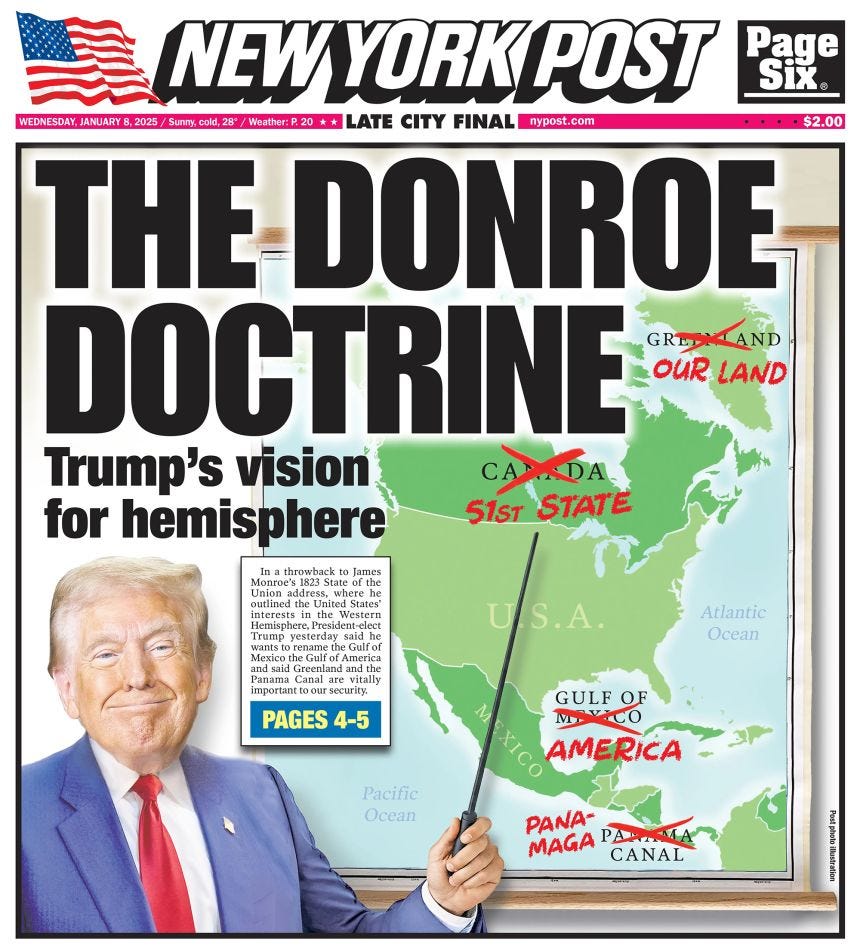
The phrase sounded like a joke when it first appeared on a tabloid front page, a play on a nineteenth century doctrine and the name of a twenty first century president who has always liked to see himself in print. Donroe Doctrine. It had the air of a late night monologue line, a meme in search of a meaning. Then the helicopters went into Caracas, the signals went dark, Nicolás Maduro was flown out under a hood, and suddenly the headline was no longer a jest but a label stamped on a new age of American power.
In the days that followed, officials in Washington insisted that nothing so grand as a doctrine was at work. This was, they said, a law enforcement action, an overdue reckoning with a corrupt strongman who had starved his people, flooded the United States with migrants and cocaine, and turned his oil rich country into a forward operating base for China, Russia, Iran and Cuba. Yet the president himself could not resist something larger. On Air Force One he told reporters that the Monroe Doctrine was important but had been surpassed. They now called it the Donroe Doctrine, he said, and he smiled as though a real estate tower had just been christened in his honour.
Doctrines in American foreign policy usually come later. There is an action, then an explanation, then historians and speechwriters move in and attach a name. Truman, Eisenhower, Reagan. Here the sequence has been reversed. A marketing phrase coined by a friendly newspaper was retrofitted onto a raid in Caracas and from there inflated into a vision of the Western Hemisphere in which the United States once again claims a kind of territorial right over politics, security and resources from the Arctic ice to the Darién jungle. It sounds familiar because it is. But this time, the ambitions are wrapped in the language of America First and the logic of a global scramble for oil and minerals to feed artificial intelligence and the arsenals of a cold war that no longer bothers to call itself cold.
The old Monroe Doctrine, drafted when Europe still carved up continents with cartographic zeal, warned the crowned heads across the Atlantic to keep out of the Americas. It was vague enough to be quoted as a shield or a sword. Over the decades it became the justification for gunboat diplomacy in the Caribbean, for occupations in Central America, for coups and covert wars in the Southern Cone. Yet even at its most imperial, it preached a kind of regional exclusivity. Europe should keep away. The United States would keep order. The Latin American republics would, in theory, keep their sovereignty so long as they did not invite the wrong visitors.
The Donroe Doctrine strips away some of the euphemism. In its bluntest expression from the president and his advisers, it states that the Western Hemisphere is American space, that any foreign power building military, intelligence or energy footholds here is crossing a red line, and that Washington reserves the right to intervene, by force if necessary, in any country whose internal disorder threatens that vision. Where earlier doctrines occasionally dressed themselves up in the vocabulary of democracy and development, this one speaks more openly of strength and power, of winning, of running things. One of the president’s chief ideologues told a television interviewer that the world is governed by force and has been so since time immemorial. It was not meant as a confession. It was offered as wisdom.
Venezuela was the first guinea pig. A country ruined by a self styled socialist, turned into an object lesson in the dangers of leftist populism, choked by sanctions, hollowed out by emigration and corruption, and penetrated by Russian military advisers, Chinese telecoms, Iranian security contractors and Cuban intelligence officers. There were many reasons to want a change in Caracas. Domestic politics in the United States made Maduro a convenient villain. Drug trafficking routes that crossed his territory fed into American neighbourhoods. The collapse of health and food systems produced biblical scenes of hunger that could be broadcast to horrified audiences. Above all, there was oil.
That last commodity has always had a special place in Venezuelan history and in the American imagination. The country possesses some of the largest proven reserves on earth. In the era of climate pledges and green rhetoric, those barrels looked, at least on the surface, like stranded assets in a warming world. Then came energy shocks, war in Europe, and the dawning awareness that the transition to cleaner technologies would still rely on hydrocarbons for years to come. A friendly government in Caracas could stabilise prices. A compliant national oil company could be integrated into the global system on terms set in Washington. An unfriendly government, aligned with Beijing and Moscow, could do the opposite.
It is no accident that the accounts of conversations inside the administration return again and again to oil when they describe the run up to the raid. Officials talk of many motives but concede that one factor weighed most heavily for the president. It was the same factor that lay behind the earlier, half comical talk of buying Greenland, that frozen island suddenly recast as a treasure chest of rare earths and a launchpad for control of Arctic routes. In this view of the world, maps are less about borders than about deposits. Whoever holds the minerals, the gas, the lithium and cobalt and bauxite, holds the future.
The Donroe Doctrine, then, is not merely a restated Monroe Doctrine with a new coat of paint. It is a fusion of two old American impulses. One is the belief in a sacred hemisphere, a backyard where outsiders must not tread. The other is the conviction that economic interests are indistinguishable from national security, that safeguarding prosperity at home means asserting rights over resources abroad. The result is a policy that speaks the language of countering socialism and narcotrafficking but acts in practice to secure fields, pipelines, ports, canals and mines.
Listen carefully to the rhetoric around Venezuela and this becomes clear. The operation was framed as a liberation of the Venezuelan people, as the removal of a criminal cartel masquerading as a state. Yet when the president emerged to claim victory he spoke, tellingly, about how the United States would be running Venezuela. The phrase landed with a thud across Latin America, summoning memories of earlier eras when marines landed to safeguard banana company profits and customs houses flew foreign flags. The White House insisted that the existing government institutions would remain, minus their leader, so long as they complied with American expectations. It sounded less like liberation and more like receivership.
From Caracas the doctrine’s gaze has widened. Officials and sympathetic commentators have begun to sketch a list of trouble spots where Donroe logic could apply. Cuba, of course, perennial irritant and symbol, still defiant despite decades of embargo. Nicaragua, with its ageing strongman and its eager reception of Chinese investment. The Panama Canal, a choke point that has always haunted American strategic planners, now modernised with international capital. Colombia and Mexico, pressured to align more tightly with Washington’s security demands against cartels and foreign encroachment. Greenland, again, not forgotten but reimagined as a longer term project in a world of melting ice.
The phrase Western Hemisphere has also stretched at the edges. In speeches on the new National Security Strategy, aides have spoken not only of Latin America but of the entire northern cap. Arctic sea lanes, satellite ground stations, undersea cables and rare earth mining projects from Alaska to Greenland have all been folded into the same conceptual space. The Donroe Doctrine, in this telling, is about a vast pan American and polar sphere in which no rival should control strategic infrastructure. The presence of Russian icebreakers, Chinese research stations or European consortiums in what is deemed an American orbit is now presented as a provocation.
This is not merely a matter of geography. It is also meant as a template for how great powers arrange the world. In private, some of the doctrine’s defenders concede that it mirrors the vision held in Beijing and Moscow of their own neighbourhoods. Let the United States dominate its half of the globe, they say, and let China define what goes on in East Asia, and Russia in its near abroad. The Venezuelan raid, viewed from Beijing, looks like the Western counterpart to actions in the South China Sea or around Taiwan, all part of a new order in which might defines right and where criticisms of spheres of influence sound increasingly hollow.
No one has watched this development more closely than China. Its companies have sunk deep roots in Latin America over the past two decades, signing oil for loans agreements, building dams and ports, installing telecoms networks and courting governments across the ideological spectrum. Venezuela was one of its earliest and most visible experiments in energy diplomacy. For Beijing, the spectacle of an American president announcing that foreign powers would essentially be driven out of a country where Chinese capital is so heavily invested is more than a regional spat. It is a warning of a campaign to dislodge it from an entire hemisphere.
Chinese officials have therefore vowed to defy the Donroe Doctrine, promising to uphold contracts and maintain a presence in Latin America. Their language, usually so cautious, has grown sharper when describing the events in Caracas, and they have worked with Russia at the United Nations to condemn what they call the kidnapping of a head of state. Yet they are also pragmatists. They study the balance of forces and know how rarely Washington has paid a price for acting within its self declared sphere. The danger, as some European analysts have pointed out, is that the Donroe Doctrine ends up giving China intellectual cover for its own pressure campaigns closer to home. If the United States insists that geography entitles it to special rights in the Americas, why should China not claim the same privilege in its seas.
Inside the United States, the reaction to the doctrine has taken on a familiar partisan hue. Conservative broadcasters trumpet it as a long overdue reassertion of will, a muscular response to what they describe as a lost continent of socialism and chaos to the south. They revel in the notion that socialists everywhere have been put on notice. For their audiences, the grainy footage of special forces on Venezuelan roofs slots easily into a narrative of a humiliated superpower finally getting off its knees.
Critics, by contrast, see an elaborate con. To them, the Donroe Doctrine is less a strategic framework than a slogan pasted onto a set of opportunistic moves driven by domestic politics, personal grudges and business calculations. They note that the administration’s supposed master plan for the hemisphere has often been improvised on the fly, with ambassadors learning of decisions from the president’s social media feeds and career diplomats cut out of the loop. They argue that what coherence exists comes from a handful of cable news hosts and ideologues, not from the machinery of state.
There is another irony. For all the talk of sovereignty and strength, this new policy may leave the United States more entangled and vulnerable than before. To police so wide a sphere, Washington must devote ships, aircraft, money and attention to a crescent of territory stretching from the Canadian Arctic to the jungles of South America. Every flare up becomes a test of credibility. Every election in a small Caribbean state becomes a potential battlefield for influence. Allies in Europe, already uncertain of American reliability, watch as the White House turns more and more toward its own hemisphere and wonder whether their security can still be assumed.
European governments, many of them former colonial powers with their own complicated histories in the Americas, have responded with unease. They remember that the Monroe Doctrine began as a bid to prevent Europe from reclaiming lost holdings in the New World. Now they find projects backed by their companies lumped together with Chinese and Russian ventures as illegitimate interference. At the same time, they are under pressure from Washington to line up behind sanctions and diplomatic campaigns against governments in the region that stray from the acceptable orbit. It is not a comfortable position.
For Latin Americans themselves, the doctrine lands on an already bruised consciousness. The twentieth century taught them in painful detail what it meant to be on the receiving end of Washington’s spheres of influence. Coups in Guatemala and Chile, invasions in the Dominican Republic and Grenada, covert wars in Central America, all claimed some variation of hemispheric necessity as their justification. The new language from Washington may sound updated, modernised with talk of artificial intelligence and rare earth metals, but the structure is familiar. Once again the region is cast as an object of competition rather than a subject with its own voice.
Yet this is not the 1950s. Latin America has diversified its partners. China is now a major trading partner across the continent. Russia has its military footprints and media outlets. Europe invests heavily. Regional organisations, for all their weakness, offer at least a forum in which to contest external narratives. When the Donroe label was applied to Venezuela, there were protests not only against Maduro but against the idea that his fate should be decided by commando raids and presidential branding. Leaders who harbour no love for Caracas worried aloud about precedent.
The Donroe Doctrine, such as it is, remains in flux. It can be read as a grandiose attempt to frame a single operation as part of a sweeping design. It can be taken at face value as a blueprint for a more confrontational hemispheric policy. It can be dismissed as another of the president’s verbal tics, to be forgotten when the news cycle moves on. What cannot be ignored is the power dynamic it reflects. In a world where supply chains are weaponised, where energy and data routes are seen as prizes in a global contest, the temptation for a superpower to reach for old doctrines and reshape them for new purposes is strong.
The question is not whether the United States can impose such a doctrine. History suggests it can, at least for a time and at considerable human cost. The question is what sort of world emerges from its assertion. A hemisphere defined by coercion will breed resistance and resentment, not stability. A resource policy that treats faraway societies as fuel depots will generate more chaos, not less. The raid on Caracas may yet be remembered not as the triumphant unveiling of a new age of American leadership, but as the moment when the echo of an old doctrine confirmed that the lessons of the past had not been learned.


