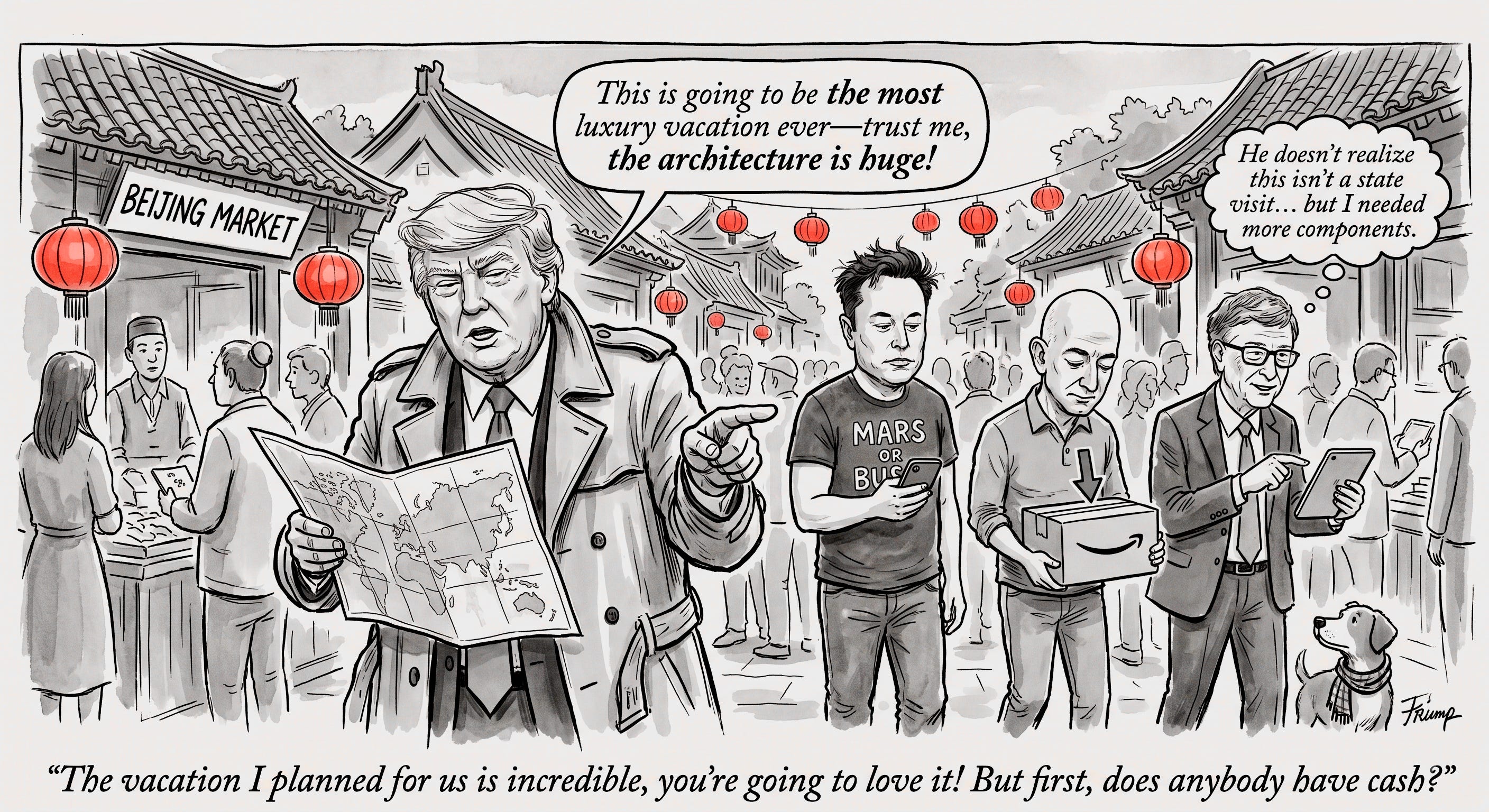
Trump's Vacation To China
The Billionaire Court and the Theater of the Empty Summit
The defining image of this summit was not from the bilaterals inside the Great Hall of the People. On Wednesday evening, Elon Musk, whose estimated $688 billion fortune makes him the world’s wealthiest individual, walked through Beijing’s most consecrated ceremonial architecture with his young son at his side, while Jensen Huang gave interviews in the same corridors and Tim Cook held a separate conversation nearby. All three lead companies whose commercial continuity depends on decisions made in this capital. Their presence was the summit’s operative argument: American capital, at its most concentrated, had come to Beijing to negotiate terms for remaining viable in a market whose regulatory owner holds the leverage.
The delegation accompanying Donald Trump for his May 14-15 visit carried a combined net worth approaching one trillion dollars. Kelly Ortberg of Boeing, Larry Fink of BlackRock, Stephen Schwarzman of Blackstone, and the chief executives of Goldman Sachs, Citi, Mastercard, and Visa rounded out the roster, with Trump confirming on social media that Huang had boarded Air Force One at an Alaskan refuelling stop. Washington dispatched its wealthiest citizens to a government that has spent decades mapping the structural dependencies of American capital with greater rigour than most American policymakers have applied to studying China, and arrived seeking concessions from a party with no symmetrical need. The visit lasted forty hours, produced no binding commitment on any matter Washington arrived requiring, and left both governments’ official readouts performing the work of obscuring that fact.
The terms of American need had been established in the weeks before Air Force One landed. Treasury Secretary Scott Bessent publicly called on Beijing to “step up with some diplomacy” on Iran, accusing China of “funding the largest state sponsor of terrorism” by continuing to purchase Iranian crude. Secretary of State Marco Rubio described Iran as “trying to hold hostage the global economy.” The administration had spent the preceding weeks signalling through every available channel that it required China to pressure Tehran into reopening the Strait of Hormuz, through which, before Operation Epic Fury was launched on February 28, approximately twenty percent of the world’s oil and liquefied natural gas passed daily.
The Iran war was in its seventy-seventh day when the summit opened. A US military attempt to reopen Hormuz by force had collapsed in under forty-eight hours earlier in the month, without materially increasing traffic through the strait. Iran has withheld any negotiation with Washington until the naval blockade on its ports is lifted, and the diplomatic infrastructure capable of bridging that position had been comprehensively dismantled by the decision to launch the war without it. Washington was asking its primary strategic competitor to manage the consequences of a military campaign that competitor had neither endorsed nor participated in, using leverage over an Iranian government with which China maintains substantial economic relations, on terms China had agreed to nowhere.
Ali Wyne of the International Crisis Group stated the position before the summit: “Unable to reopen the Strait of Hormuz alone, Washington now needs its principal strategic competitor to help it manage a crisis of its own making.”
The energy disruption from Hormuz’s closure has fallen hardest on economies that had no seat at these proceedings. Sri Lanka, Bangladesh, and Pakistan were not at the table; they absorbed the oil price shock through current account deficits and import financing costs that their governments cannot easily sustain. The IMF’s adverse scenario projects global growth at 2.5 percent if oil prices remain elevated, a figure that describes not a macroeconomic abstraction but a compounding fiscal crisis across economies that bilateral negotiations between Washington and Beijing are not designed to address, because those negotiations serve the parties conducting them.
Xi Jinping provided Trump with what Trump required to describe the summit as productive on American cable television, calibrated so precisely to that requirement that the calibration itself constituted a message to anyone paying attention.
Trump told Fox News after Thursday’s bilateral that Xi had offered to help: “He said, ‘I would love to be a help, if I can be of any help whatsoever.’” Xi had also assured Trump that China would not provide military equipment to Iran, which Trump described as “a big statement.” The assurance covered neither intelligence sharing, nor electronics exports, nor the dual-use technology transfers that have sustained Iranian industrial capacity since sanctions tightened, and Beijing’s official account of the summit omitted Iran entirely. The White House readout claimed both sides agreed “Iran can never have a nuclear weapon.” Beijing’s statement read: “It is important to steady the momentum in easing the situation, keep to the direction of political settlement, engage in dialogue and consultation, and reach a settlement on the Iranian nuclear issue and other issues that accommodates the concerns of all parties.” These are distinct positions assembled into a joint communiqué format that neither party prepared to make enforceable, and readers of Chinese diplomatic language will have had no difficulty identifying which formulation carries a commitment and which one does not.
Trump then confirmed, apparently without registering the implication, that China would continue purchasing Iranian crude. “He said, you know, they buy a lot of their oil there and they’d like to keep doing that,” Trump told Fox News. This came from the same administration whose treasury secretary had publicly described that oil trade as terrorism financing two weeks prior. Pressed afterward on Iran, Rubio told NBC: “He didn’t ask them for anything. We’re not asking for China’s help. We don’t need their help.” The revision of the record from Bessent’s public appeal for Chinese diplomatic intervention to Rubio’s denial that any appeal had been made was a correction that any foreign ministry with a functioning archive could document and retain for future reference.
The one concrete Hormuz development from the summit period was reported by Iranian state media: Chinese vessels had begun transiting the strait following a separate understanding on Iranian management protocols, negotiated by Beijing on terms Washington was not party to, covering Chinese ships, generating no credit for American diplomacy.
Each executive in the delegation carried a specific vulnerability to Chinese regulatory decisions that bore no correspondence to American strategic interests.
Huang arrived after Nvidia had lost, by his own account at the end of 2025, essentially its entire Chinese market share: from a historic peak of ninety-five percent to approximately zero, as Huawei’s Ascend chip clusters absorbed AI computing demand and domestic companies including DeepSeek, Alibaba, and ByteDance built model architectures that do not require American semiconductor hardware. His Air Force One seat was a petition for export-control relief conducted under the diplomatic cover of bilateral trade engagement. Musk’s Tesla operates a Shanghai gigafactory that had produced over four million vehicles as of October 2025; his personal fortune is materially dependent on that facility’s operational continuity in a market where BYD has rendered Tesla’s position contingent rather than dominant. Cook’s Apple has maintained a manufacturing dependency on Chinese Foxconn production extending to the late 1990s; Patrick McGee, in Apple in China, argues that Apple actively helped construct Chinese high-quality electronics manufacturing capacity, which situates the relationship as one in which the supply chain cannot be relocated at any commercially viable speed.
The delegation’s aggregate message to Beijing’s leadership was an acknowledgment, delivered in person and in the appropriate building, that American capital across its most capitalised sectors depends on Chinese market access, Chinese manufacturing infrastructure, and Chinese regulatory permissiveness in ways that cannot be corrected on any near-term timeline and which Chinese policy can exploit at a moment of its choosing.
The summit’s documented Chinese gains are modest in their specifics and structurally significant in what they confirm.
Xi placed a formal Taiwan warning on record at the highest level of bilateral exchange, telling Trump that mishandling the island “could lead to clashes or conflict,” in direct response to Rubio’s assertion that a Chinese move on Taiwan would be a “terrible mistake.” Washington had approved an $11 billion arms package to Taiwan in December that it had not yet delivered. The warning cost Beijing nothing, required no reciprocal concession, and cannot be walked back by the American side without acknowledging that it accepted the framing. The US left without any Taiwan concession from Beijing and without having altered China’s stated position on Iran.
Beijing’s blocking rule against American secondary sanctions on Chinese refiners purchasing Iranian crude, which directed Chinese companies to disregard US regulatory authority and placed American companies in legally untenable compliance positions, remained fully intact when the summit concluded. China’s commercial relationship with Tehran was not renegotiated. On trade, the summit extended the October 2025 Busan framework, which analysts at the German Marshall Fund had already characterised as “a fragile truce, not a reset,” with additional soybean purchasing language and fentanyl cooperation text that represent incremental adjustments to existing commitments. Trump claimed “fantastic trade deals” on Truth Social while departing, specifying none. Xi’s readout offered the formulation that “China’s door to opening up will only open wider,” a standard statement of disposition in Chinese diplomatic practice that commits to no specific action and is designed to be received as an achievement by the party that needs one.
The visit followed the standard architecture of Chinese state reception: a welcome ceremony with military honour guards at the airport, a bilateral and state banquet at the Great Hall of the People, a guided tour of the Temple of Heaven with Xi as escort, and tea with a working lunch at Zhongnanhai on the final morning. William Klein, who helped arrange Trump’s 2017 Beijing visit, noted before this one that Trump’s unpredictability posed “a huge logistical challenge for a government obsessed with precision and predictability.” China managed that challenge through established practice: the visitor received the full register of bilateral consequence, sufficient material was produced for an American claim of progress, and Beijing extracted what it required without placing any of it in language that would constrain future conduct.
Trump posted to Truth Social that Xi had congratulated him “on so many tremendous successes in such a short period of time.” The Chinese readout confirmed no such exchange. The gap between these two accounts of the same meeting is the mechanism by which this summit, like its predecessors, was designed to function.
The Strait of Hormuz remains under contested management. China will continue purchasing Iranian oil, confirmed by Trump on Fox News. Beijing’s blocking rule against US secondary sanctions is in force. Xi’s Taiwan warning stands on the record, unaddressed by Washington. The soybean and fentanyl commitments extend existing arrangements. The executives who flew to Beijing on Air Force One returned with no confirmed market-access agreements and the same export-control constraints they arrived carrying. The Iran war entered its twelfth week without a diplomatic framework capable of resolving it.
What the summit resolved is the question of which party required this meeting and which party hosted it, a distinction the diplomatic language of both readouts was constructed to prevent from being stated plainly. What it left open is the price Beijing will set when Washington next requires Chinese assistance to manage the downstream consequences of its own military decisions, and whether that accounting will include Taiwan.


