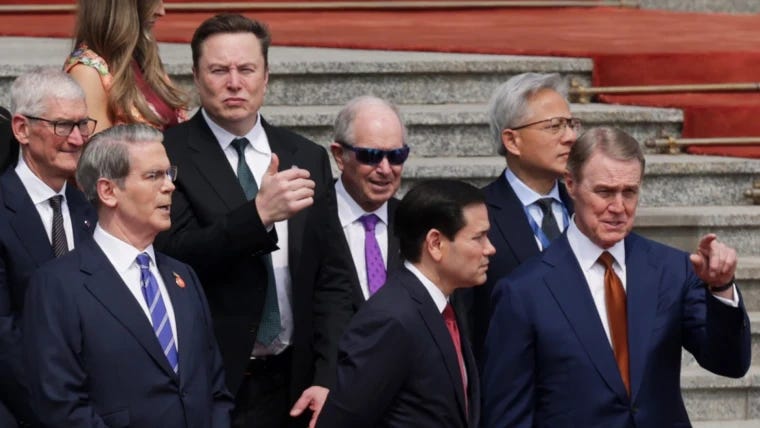
Twelve CEOs and a President Walk Into Beijing
This is what American dependency looks like when the performance stops.
Twelve men. Aggregate market capitalization north of ten trillion dollars. Aggregate lobbying spend in Washington: hundreds of millions annually. Aggregate influence over American foreign policy, trade law, semiconductor controls, and industrial strategy: the kind that doesn’t show up in any filing.
They flew to Beijing to ask for a deal.
Donald Trump, the forty-seventh president of the United States, arrived in China with the commanding heights of American capitalism arrayed behind him. Jensen Huang controls the chips that run artificial intelligence. Tim Cook runs the company whose entire manufacturing logic is built on Chinese labor and Chinese supply chains. Larry Fink manages more capital than most sovereign wealth funds. David Solomon and Jane Fraser between them hold the architecture of global dollar finance. Stephen Schwarzman has spent two decades cultivating Chinese relationships and Chinese capital access. Kelly Ortberg runs the company that builds America’s military aircraft. Larry Culp runs the engines that go in them. Sanjay Mehrotra and Cristiano Amon run the semiconductor companies whose export licenses to China Washington has spent four years restricting. Brian Sikes runs the agricultural conglomerate whose soybean flows China can redirect with a phone call. And Elon Musk, whose Tesla Gigafactory in Shanghai employs tens of thousands of Chinese workers and whose satellite ambitions require Chinese diplomatic tolerance, stood somewhere in the middle of all this and said nothing that has been reported.
This was not a trade delegation. This was a structural confession.
No country sends its president flanked by the chief executives of its financial system, its semiconductor industry, its defense manufacturing, its agricultural export complex, and its consumer technology monopolies to another country’s capital to *request* commerce. Countries that hold leverage do not travel to demonstrate need. Countries that hold leverage make the other side travel. They set the terms in advance. They let the visit be the prize.
What happened in Beijing was the inverse of leverage. It was inventory. Trump arrived with a catalogue of American economic dependencies and said, in effect: name your price.
The American mythology of superpower status rests on several pillars, and Washington has spent decades performing confidence in each of them. Military dominance. Dollar primacy. Technological superiority. The capacity to sanction, restrict, deny access, and isolate. These are not merely capabilities; they are the architecture of a claim: that the United States sets the terms of the international order and others adjust.
The Beijing trip is what that claim looks like when it meets its actual constraints.
Nvidia’s chips, under successive rounds of export controls, cannot be legally sold to Chinese customers in their full capability versions. This policy was designed in Washington as a tool of strategic denial: keep China’s AI industry behind. Jensen Huang flew to Beijing. The message his presence sent was not in any statement he made. It was in the flight manifest.
Apple’s supply chain cannot be moved. Cook has said this in various registers across various earnings calls, and the arithmetic is not contested. Moving iPhone production out of China is not a five-year project or a ten-year project. It is a generational project, if it is possible at all. The China dependency is structural, not incidental. Cook flew to Beijing. His presence confirmed what the supply chain data already proved.
Schwarzman has built an entire secondary identity as a bridge between American capital and Chinese access. His relationship with Chinese institutions is personal, cultivated across decades of dinners and donations, including a $100 million gift to Tsinghua University. He flew to Beijing and sat in the room while the president of the United States asked for deals.
This is not the picture of a hegemon in command. It is the picture of a collection of CEOs who need China more than China needs them, escorted by a president who needs a win more than Xi needs one, seated across from a government that has waited out four years of tariffs, survived semiconductor restrictions by accelerating domestic substitution, and grown its manufacturing export sector to levels that make American industrial policy look like a press release.
China, for its part, now has the chance to do something extraordinary.
Xi Jinping could simply receive the delegation with warmth, listen attentively to every proposal, offer excellent tea, allow photographs, issue a communiqué in the language of mutual benefit, and then do absolutely nothing he did not already plan to do.
This is, historically, how imperial courts received tribute missions. The mission arrives. The gifts are acknowledged. The emperor smiles. The mission returns home believing it achieved something. The court resumes its regular schedule.
The comedy available to Beijing is not loud. It does not require insult or spectacle. It requires only patience and the quiet maintenance of existing plans. If China continues building out its domestic semiconductor fabrication, as it was already doing before Trump’s tariffs began. If China continues expanding its electric vehicle export capacity across the Global South, as it was already doing. If China continues its rare earth processing dominance, which it holds because it chose to, not because anyone permitted it. If China does all of this and then, six months from now, announces that the rare earth export controls it imposed in April are being maintained, and that the semiconductor equipment restrictions it placed on American firms are being extended, then the Beijing meeting will have produced the following outcome: twelve of the most powerful executives in American capitalism will have flown to China, sat in a room, and departed with a handshake.
That is the funniest thing imaginable. It is also the most structurally accurate outcome. Because the actual leverage in this relationship has not shifted. The tariff war paused. The dependencies did not.
The flight manifest from Washington to Beijing is worth more than any economic analysis produced this year. It named, with the precision that no white paper achieves, the exact coordinates of American vulnerability. Semiconductors need Chinese markets. Consumer technology needs Chinese manufacturing. Finance needs Chinese capital flows. Agriculture needs Chinese purchase orders. Defense needs supply chains that currently run through Chinese facilities.
The country that holds those dependencies is not the country that requested the meeting.
The question worth sitting with, now that the planes have landed and the photographs have been taken, is whether the twelve men on that flight understand what they participated in or whether they flew home believing they had demonstrated American strength.


