


South Africa is being targeted through a coordinated propaganda campaign that intensified after it took Israel to the International Court of Justice. Washington put the retaliation in writing. Donald Trump’s executive order of February 7, 2025, accused Pretoria of persecuting Afrikaners and condemned it for bringing genocide proceedings against Israel at the International Court of Justice. The same document directed agencies to halt assistance, subject to legal limits and exceptions, and created a preferential route for Afrikaner refugee resettlement. A dispute over Palestinian lives had been joined to a story about white victimhood, with American power available to enforce both.
Read the order’s complaint about South Africa “accusing Israel, not Hamas, of genocide.” A government invoked a convention through the court established to hear disputes between states, and the American president treated that act as an offense against his allies. Washington’s own language supplies the connection that the campaign’s defenders would prefer to leave unexamined. Protecting Afrikaners had somehow acquired a requirement that Pretoria stop challenging Israel. The White House published the terms in its executive order.
Ernst Roets and Afrikaner advocacy groups had cultivated an American conservative audience long before the Gaza case. Israeli diplomats then sought American pressure to stop the proceedings, and Trump tied punishment of Pretoria to both Afrikaner grievances and the defense of Israel. An established propaganda network acquired a new use. Claims of white persecution gave the retaliation a humanitarian justification that could be repeated by people who preferred not to say they were punishing a country for taking Israel to court.
South Africa has serious problems, as every country does. Its corruption, unemployment and violent crime demand action from its government, and yet those failures are being selected and distorted into a story of racial extermination for which the evidence does not exist. The campaign asks us to accept that protecting an Afrikaner family requires punishing Pretoria for its position on Gaza. The people making that connection are using the family’s fear to protect Israel from accountability.
The case that crossed Washington
On December 29, 2023, South Africa instituted proceedings against Israel under the Genocide Convention. Pretoria forced a question of Palestinian survival into a forum where a state applicant could submit evidence and demand a legal response from a government protected by Washington. Israel rejects the genocide accusation. The case concerns its responsibility as a state under the convention; individual criminal responsibility belongs to a different legal process.
Trump’s complaint that South Africa had accused Israel instead of Hamas replaced that legal question with a loyalty test. Hamas is not a state that Pretoria could sue in the same proceedings. Condemning its crimes would not dispose of allegations against Israel, and Israeli security claims cannot suspend treaty obligations. The order invited its audience to judge South Africa by which side it had offended before considering what its application contained.
The court’s January 26, 2024, provisional measures protected rights at risk while the case proceeded. They were not a final judgment that Israel had committed genocide. Former ICJ president Joan Donoghue later explained that the court had recognized plausible rights, including Palestinians’ right to protection from genocide, and the risk of irreparable harm to those rights. Washington has treated South Africa’s pursuit of that process as grounds for punishment before the court has delivered its final judgment.
The timetable leaves ample room for pressure. The court’s order of May 21, 2026, set November 22, 2027, for South Africa’s reply and May 22, 2029, for Israel’s rejoinder. Israel had filed its counter-memorial within the extended deadline in March 2026. South Africa requested at least eighteen months for its reply, citing the complexity and volume of the material; Israel accepted an equivalent period if another round of pleadings was ordered. Those dates are recorded in the court’s order.
For people whose protection is at issue, the interval is measured in lives. For governments seeking to stop the case, it offers years in which to make the applicant reconsider. Pressure can work through an aid decision, a threat to trade or a succession of accusations that keeps officials defending the country’s reputation. A government can be made to spend political capital maintaining proceedings before the court has reached their merits.
South Africa had challenged the distribution of impunity. Its domestic record supplied no immunity from criticism, but neither did that record cancel its standing under the convention. The political offense was to use an international institution against a protected ally. Washington’s response asserted that the costs of doing so could extend far beyond the courtroom.
The instructions went to Washington
In September 2024, Axios journalist Barak Ravid reported that Israel’s Foreign Ministry had instructed its diplomats in the United States to mobilize pressure against South Africa’s case. The reported cable went to the embassy in Washington and the American consulates. It sought consequences for Pretoria if the proceedings continued. The campaign had a stated objective and officials assigned to pursue it. Ravid’s report identified the document behind the effort.
The instructions extended to federal and state lawmakers, governors and Jewish organizations. Diplomats were to seek public statements threatening damage to American trade relations and encourage legislation directed against South Africa. The cable spoke of a “heavy price.” Israel’s Foreign Ministry declined to comment on the reporting. The Foreign Ministry had assigned its diplomats a campaign to make another state abandon litigation against Israel.
One instruction explained how the threat was supposed to work. Legislation could serve the campaign even if it never became law, because its introduction and discussion could influence South African policy. A bill could generate headlines and alarm without surviving a vote. The pressure began when Pretoria had to calculate what might follow, and when its domestic opponents could cite the threatened consequences as a reason to abandon the case.
Publicity was part of the assignment. Diplomats were told to make their activity visible in American media and on social platforms. The campaign sought to expose Pretoria to a continuing public threat, creating the impression that each further legal step would bring another diplomatic or economic cost. The court’s procedures could then be made to compete with a crisis manufactured around the applicant.
Israel also saw an opening in South Africa’s new multiparty government. The ANC had lost its parliamentary majority in 2024, and the coalition arrangement created opportunities to press for a change of course. A foreign ministry was assessing South Africa’s domestic political vulnerability for use against its international legal action. The claim that the case was an independent judicial matter did little to protect it from that calculation.
Israel sought American pressure to stop the case, and Trump subsequently punished South Africa while naming the case among his reasons. The Afrikaner persecution story supplied a ready justification for treating Pretoria as a government that deserved punishment. Washington joined the two campaigns in an executive order. The defense of Israel could proceed in the language of rescuing white South Africans.
Roets already had an audience
Ernst Roets had been cultivating American attention years before South Africa filed its case. In May 2018, while serving as AfriForum’s deputy chief executive, he appeared on Tucker Carlson’s Fox News programme to discuss farm murders. Carlson presented Afrikaans-speaking farmers as an embattled minority. After another Carlson segment that August, Trump asked the State Department to investigate farm killings and land seizures.
The media contacts and emotional vocabulary were already available when Pretoria filed its case. Pretoria’s application at The Hague gave supporters of Israel another reason to use a narrative that American conservatives knew and understood. The campaign did not have to teach its audience who the supposed victims and villains were; that work had been under way for years.
The story offered a white minority threatened under Black-majority government, with property rights and racial redress folded into an account of impending dispossession. American audiences could connect it to their own arguments about affirmative action and demographic change. South Africa became a warning about what political equality might do to people accustomed to an inherited advantage.
Roets made the connection explicit in his comments to New Lines Magazine. He presented Black economic empowerment, or BEE, as a warning about American diversity, equity and inclusion programmes. His criticism was that politically connected people had benefited while inequality persisted. He invoked the “South Africanization of the Western world,” carrying an argument about South African policy into an American campaign against racial redress.
Politically connected beneficiaries have given critics of BEE ample material. Procurement that enriches insiders betrays the people redress was meant to serve. Roets’s wider argument turns that betrayal into an indictment of redress itself, inviting Americans to see attempts to change inherited racial inequality as proof that white people are under attack. The people excluded under apartheid become the alleged persecutors for demanding a share of ownership and opportunity.
New Lines identified Roets as belonging to Lex Libertas and reported that, on March 31, he and the New York Young Republican Club briefed National Security Council and State Department officials. Their joint statement described discussions about farm murders, alleged anti-white discrimination, property rights and race-based laws, with targeted sanctions against South African individuals among their objectives. The advocacy had reached officials who could turn it into policy.
AfriForum chief executive Kallie Kriel told the magazine that his organization did not call the killings genocide and wanted a specific policing response. Asked whether Trump’s claim was wrong, he declined to enter the dispute because doing so would not advance the organization’s cause. That answer leaves an organization defending its own terminology while declining to challenge the larger falsehood through which its campaign gains attention. Nick Alexandra’s September 2026 reporting sets out those positions.
The participants need not want precisely the same result for their cooperation to be useful. Roets can seek sanctions and greater autonomy, a broadcaster can pursue an American culture-war audience, and Israeli diplomats can pursue the withdrawal of the ICJ case. Their objectives meet where Pretoria is depicted as a racial aggressor whose decisions warrant foreign punishment.
The dead were assigned a different country
The claim of white genocide does not survive examination. Farm murders are real crimes against real people, but the campaign converts them into an accusation of organized racial destruction without producing evidence of such a campaign. It borrows the suffering of victims to make a claim the murder statistics, the land law and even the images presented by Trump fail to support.
Reuters’s May 2025 examination recorded 26,232 murders nationwide in 2024, of which forty-four were linked to farming communities and eight victims were farmers. It also cited TLU-SA’s historical count of 1,363 white farmers murdered since 1990. These figures cover different populations and periods. A farm-linked count includes people other than owners, and neither series by itself supplies an individual farmer’s risk of being murdered. Neither substantiated Trump’s genocide claim.
Black victims disappear when rural violence is presented as an exclusively white ordeal. New Lines reported that five of the six farm-murder victims recorded between January and March 2025 were Black, including both farm owners, two employees and a manager. Their deaths belonged to the rural security crisis and yet contributed little to a foreign campaign organized around white persecution. Selecting victims by political usefulness distorts the problem that policing must address.
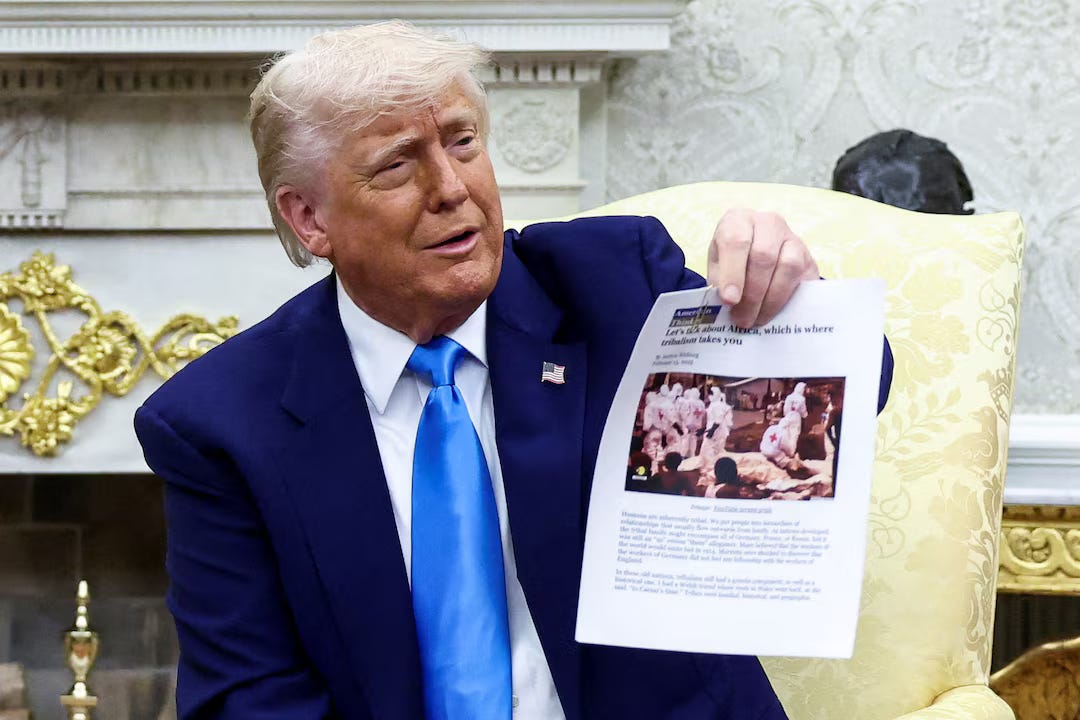
The distortion was staged in the Oval Office on May 21, 2025. During his meeting with Cyril Ramaphosa, Trump showed footage of white crosses beside a road and described them as burial sites. They were part of a 2020 protest commemorating murdered farmers. The crosses marked a demonstration, not graves. Reuters documented the false claim in its report on the meeting.
Trump also held up an image he described as showing murdered white farmers being buried. Reuters traced it to its own footage of humanitarian workers handling body bags in Goma, in the Democratic Republic of Congo, after fighting involving Rwanda-backed M23 rebels. The dead had been assigned another country and another political purpose in front of the world’s cameras. Reuters published the identification of its footage the following day.
Ramaphosa had to answer the accusation in the room. Journalists then had to reconstruct the provenance of the images, while the spectacle had already supplied viewers with its emotional conclusion. A correction published later could establish where the bodies were filmed; it could not undo the president’s use of them to put South Africa in the dock.
Rural security demands competent investigations, emergency access and prosecutions. A claim of state-directed extermination makes the government itself the alleged instrument of murder, allowing punishment of the country to be presented as rescue. People who need better policing become the justification for a foreign-policy campaign whose objectives extend far beyond their safety.
Apartheid’s property settlement survives its laws
The land question has been treated with the same disregard for context. Trump’s order described the Expropriation Act as enabling the seizure of Afrikaner agricultural property without compensation. Reuters’s examination described a public-interest law permitting uncompensated acquisition in exceptional circumstances, with an obligation to seek agreement first. At the time of its May 2025 reporting, the law had not been used.
By September 2026, New Lines reported that it still had not come into operation and was facing a court challenge. Washington’s account converted a disputed legal framework into the image of an existing campaign of racial confiscation. A farmer’s concern about future abuse became evidence that the abuse was already government practice.
Starting South Africa’s property history with that statute erases the state violence that shaped ownership. Apartheid regulated access to land, residence, skilled employment and education through racial exclusion. Its repeal ended the formal order without redistributing every asset accumulated under it. A family could retain property and educational advantages created through discrimination while a neighbouring family inherited the consequences of being denied both.
The 2017 land audit, based on 2015 ownership data, found that white individuals owned seventy-two per cent of the area of farms and agricultural holdings held by individual owners. That category must stay attached to the number. It does not describe all land in South Africa. Within its proper limits, it documents a material inheritance that survived the transfer to democratic government.
Redress therefore begins in an unequal society. A procurement rule intended to broaden Black participation does not introduce race into an economy that previously ignored it. The policy responds to an economy in which race determined access for generations. Its design and results remain open to criticism, but the history cannot be removed to make every corrective measure resemble an unprovoked attack.
Owners need access to courts and protection against arbitrary decisions. South Africans also need institutions capable of changing an ownership structure formed through dispossession. Those demands can be contested through constitutional politics. Asking Washington to decide which laws Pretoria may retain gives an outside power authority over a dispute whose consequences South Africans must live with.
The campaign’s account of racial persecution serves that transfer of authority. American pressure is presented as a remedy for the supposed failure of South African democracy, and yet the people who will bear its economic costs have no vote in the government imposing it. Domestic reform becomes conditional on foreign approval.
The claim of apartheid against whites
The accusation of “white apartheid,” meaning apartheid imposed on white South Africans, relies on treating racial redress as equivalent to the system it was meant to undo. Apartheid denied the Black majority political power and controlled where people could live, own property and work. White South Africans today retain citizenship, voting rights and access to courts, including the ability to challenge the very policies described abroad as proof of their subjugation.
The Constitution prohibits unfair racial discrimination and also permits measures to advance people disadvantaged by it. Its equality provisions place redress within the pursuit of equal rights; Section 19 protects citizens’ political rights. Those commitments are set out in the Bill of Rights. A government can violate constitutional promises, and a particular measure can be challenged as unfair. Such a challenge requires evidence about the measure. Calling the whole order apartheid against whites substitutes a slogan for that work.
The campaign asks its audience to begin history after the assets have been distributed. The property acquired under racial exclusion becomes an innocent starting point, and any attempt to alter that distribution becomes the original injustice. White ownership and political participation remain visible, Black deprivation persists, and yet the people seeking redress are cast as the authors of a new apartheid.
That inversion also strips apartheid of its meaning. A contested procurement preference cannot be equated with denying a majority the vote and organizing its displacement through law. Corruption in a redress programme can defeat equality without proving that the formerly privileged population has been placed under a comparable system of domination. The campaign needs the equivalence because it turns the defense of inherited advantage into a struggle for liberation.
A refugee policy built around the claim
The preferential refugee route gave the narrative administrative force. Trump had moved to shut down the broader refugee admissions system, then directed officials to prioritize Afrikaners portrayed as victims of unjust racial discrimination. The public claim of persecution acquired flights, processing arrangements and an official category through which it could reproduce itself.
New Lines reported, citing State Department figures, that the United States admitted 12,904 refugees from October 2025 through August 2026: 12,901 South Africans and three Afghans. The Afrikaner programme operated inside a drastically narrowed system. People seeking safety from other conflicts encountered a closed route while one politically favoured account of vulnerability received exceptional treatment.
An individual Afrikaner can have a valid protection claim, and an applicant’s case must be judged on its evidence. The political manipulation lies in treating the exceptional programme as proof of the presidential story that justified it. Once people arrive as refugees, their arrival can be used to tell audiences that the administration’s original diagnosis was correct. The policy supplies images that appear to verify its own premise.
Afrikaners themselves dispute that premise. Journalist Max du Preez told New Lines that AfriForum and Solidarity did not speak for the whole community and rejected its portrayal as a persecuted population. An Afrikaner who opposes American punishment remains part of the community Washington claims to defend. Selecting the faction most useful to American policy does not confer a representative mandate upon it.
The campaign also suppresses ordinary political distinctions. A South African can oppose the ANC and support the ICJ case. A farmer can demand better policing and reject Trump’s account of genocide. A critic of BEE can oppose foreign sanctions. The campaign needs those positions collapsed into a simple choice between supporting Washington’s intervention and endorsing the alleged persecution.
The country’s failures belong to its citizens
South Africa’s government owes its people an account of unemployment, corruption and broken public services. Statistics South Africa put the official unemployment rate at 33.6 per cent in the second quarter of 2026. Millions of people are living with the consequences of an economy that cannot provide work. The figure is a measure of governing failure, whatever the government’s position on Palestine. The official statistical record requires no assistance from Washington’s propaganda.
Electricity failures have also damaged households and businesses, though an account fixed permanently on collapse becomes inaccurate when conditions improve. Reuters reported in July 2026 that Eskom forecast no winter load shedding and surpluses above five gigawatts, alongside continuing disputes over restructuring, grid independence and renewable-energy curtailment. Its report on reform performance described improvement in supply within a wider deterioration in reform momentum.
Citizens need an honest account of both. They cannot repair institutions through a story that conceals every achievement, any more than they can through a government account that excuses every failure. Presenting the country’s crises exclusively as anti-white persecution makes their causes harder to confront and pushes most of their victims out of the argument.
South Africans already live with their government’s failures; they do not need Washington to discover those failures when Israel faces a legal challenge. The demand that Pretoria first prove its domestic virtue creates a test no state could consistently pass. Applied selectively, it gives Israel’s allies a way to disqualify any applicant whose case they want stopped. The Genocide Convention would become available only with the permission of the powerful.
Broad punishment also reaches people who made none of the disputed decisions. The effects of withholding assistance depend on implementation and exceptions, but there is no reason to assume the costs stop with ministers. A worker whose job becomes less secure or a household losing support does not acquire control over foreign policy in exchange. Their vulnerability makes pressure effective precisely because the government must answer for suffering imposed from outside.
Kriel has advocated penalties against individuals rather than the country, and Roets’s reported lobbying sought targeted sanctions. That distinction remains relevant. It also raises a question for the advocates: what responsibility do they accept when the narrative they promote is used to justify wider punishment? Correcting a false genocide claim would be a concrete place to start.
The conditions keep accumulating
By September 2026, the campaign had acquired another instrument. New Lines reported that Marco Rubio announced visa restrictions on September 15 aimed at foreign nationals responsible for, or complicit in, specified policies concerning uncompensated land seizures, racial discrimination or incitement of imminent violence against minorities. Certain family members could also be affected. Allegation, policy disagreement and individual responsibility were being brought into an American mechanism of exclusion.
Ambassador Leo Brent Bozell III described the policy as the first in a series of escalating measures. His demands had already ranged across rural security, compensation rules and investment ownership requirements, as well as South Africa’s relations with Iran. Pretoria faced conditions covering its domestic economic settlement and its international alignment. A campaign presented through farm violence had become a programme for determining which choices a sovereign government could make.
The campaign survives correction because its political purpose extends beyond the truth of any single allegation. Exposing the image from Goma leaves the land claim in circulation; explaining the land law sends the argument toward BEE or Iran. Pretoria must keep answering while Washington keeps adding conditions. The falsehoods have already done their work by making the country appear to deserve whatever pressure comes next.
South Africa’s ICJ proceedings remain inside the package because Washington explicitly placed them there. The country challenged Israel and now faces a campaign that turns its domestic faults into grounds for external punishment. The white genocide allegation fails on the evidence, the claim of apartheid against whites reverses the history of who was dispossessed, and yet both are useful to a campaign whose purpose is to make Pretoria submit.
Other governments can read the warning without receiving a cable of their own. A decision to pursue accountability may expose their internal conflicts to a campaign of selective attention and threatened penalties. The precedent concerns every state whose trade and diplomatic access depend on powers capable of punishing a legal challenge.
South Africans demanding jobs, safety and honest government have their own struggle against failures they know intimately. Washington has appropriated that suffering for a campaign to discipline their country over Israel. If Pretoria abandons its case under this pressure, the lesson for the Global South will be that even taking a protected state to court requires its patron’s consent.