Washington’s Energy Trap Has a Mirror
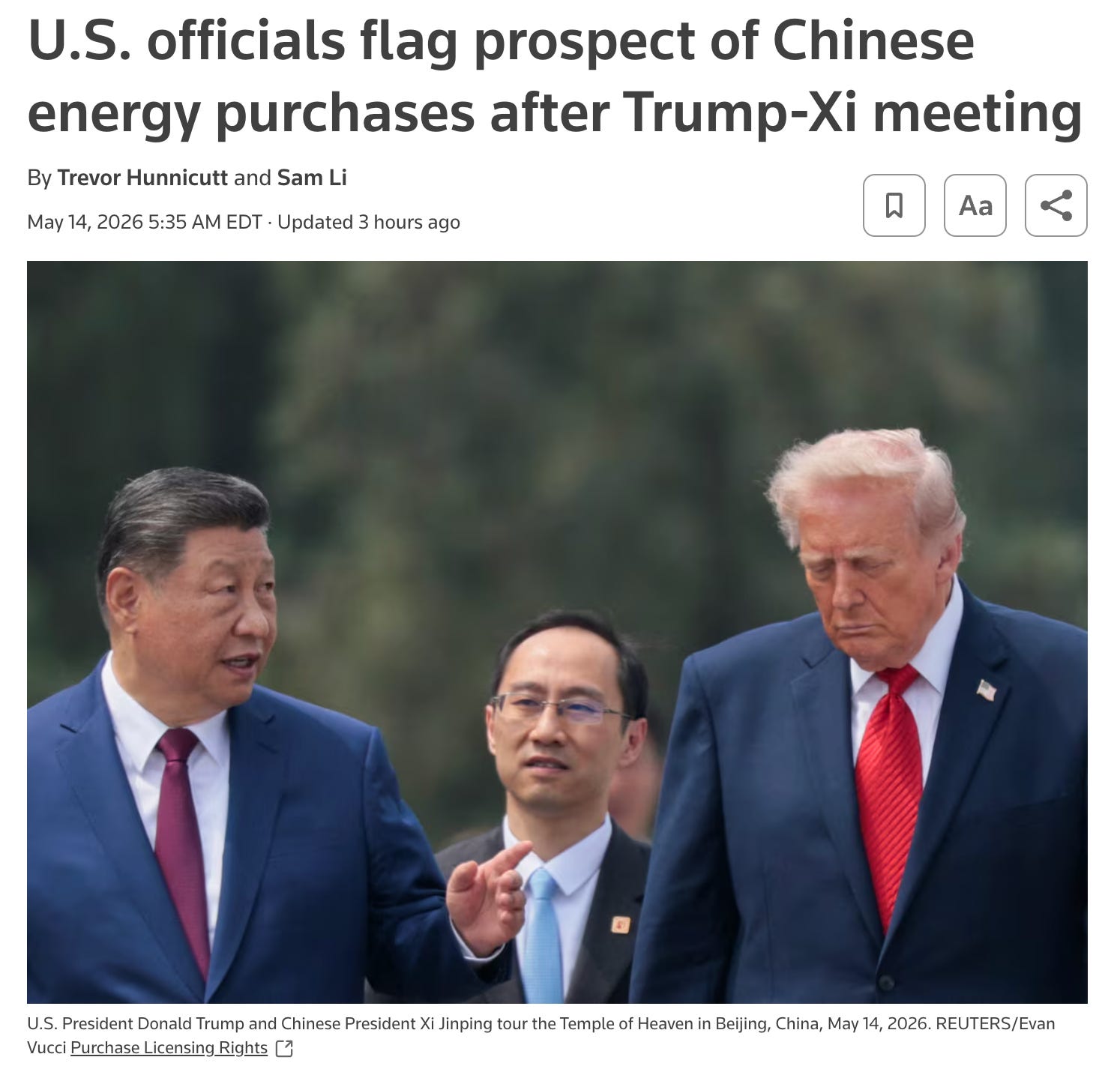
The official readout from Thursday’s bilateral meeting at the Great Hall of the People described President Xi Jinping’s ...
… expression of interest in purchasing more American oil as a gesture toward supply diversification. Western correspondents, following the familiar grammar of US-China summitry, filed it as a concession: something Beijing offered Washington in exchange for something else. That framing misreads both the summit and the strategy behind it.
Beijing did not offer Washington a dependency. It offered Washington a transaction. The distinction is not semantic. It governs everything that follows.
To assess what China agreed to in the Great Hall of the People on May 14, the relevant comparison is not the past week of summit negotiations. It is the autumn of 2021, when the United States began the diplomatic and infrastructural preparation for what would become, four years later, a systematic assault on the energy supply chains binding Asia to the Middle East.
The chronology is documented. Before Operation Epic Fury was launched on February 28, 2026, the Trump administration had already framed the Alaska LNG project to the Japanese prime minister as a mechanism for replacing Middle Eastern energy shipments. Doug Burgum, serving simultaneously as Interior Secretary and co-chair of the White House’s National Energy Dominance Council, told US governors that LNG exports to Japan, South Korea, and the Philippines would reduce American trade deficits. Reuters, drawing on more than a dozen current and former US and Asian officials, documented how the administration was explicitly recasting economic relations with East Asia by binding regional allies to Washington through fossil fuel dependencies. The infrastructure at Corpus Christi, Texas, one of the world’s largest crude export terminals, was already expanding its pipeline capacity. When the Strait of Hormuz closed, the port was ready.
This is what Washington calls energy dominance. It is, in structural terms, the deliberate engineering of dependency: first by eliminating alternative supply sources, then by positioning American hydrocarbons as the only available replacement, then by formalising that arrangement at a diplomatic table. Europe ran through this sequence between 2021 and 2023. Asia is running through it now.
China was the primary target. Up to half of China’s imported energy came from the Middle East before the war. The IEA has described the conflict’s effect on the Strait of Hormuz as the greatest supply disruption in the history of the global oil market. By April 2026, US crude exports had surged to a record 5.2 million barrels per day, according to Kpler data, and combined crude and petroleum product exports crossed 14 million barrels per day. The Port of Corpus Christi recorded its busiest quarter in history. Between 50 and 60 very large crude carriers were loading at US Gulf Coast ports on any given day, double the volume of the prior year. American LNG shipments rose 28% against the same period in 2025. The United States did not stumble into this position. It built toward it.
What the Western press coverage of this summit consistently underweights is the symmetry of the structural position. Washington enters Beijing with a fragile ceasefire, an Iran war that more than 60% of Americans oppose, approval ratings at record lows, and its principal ask, pressure on Tehran to reopen the Strait and accept a peace settlement, deliverable only by the country it is visiting. Trade analyst Chad Bown of the Peterson Institute for International Economics noted before the summit that Trump’s history of policy reversals would itself constitute a supply risk: any US energy export commitment could be suspended if domestic prices rose heading into midterms.
China holds something different. According to IEA data, China accounted for 61% of global mined rare earth supply in 2024 and 91% of global refining and processing capacity. The materials flowing from that capacity underpin semiconductors, F-35 fighter jets, electric vehicles, and the full range of advanced manufacturing that the United States considers strategic. In April 2025, Beijing demonstrated that it was willing to use this leverage. Rare earth export restrictions introduced in response to Trump’s Liberation Day tariffs forced the shutdown of automotive production lines across the United States and Europe. The European Commission described the situation as alarming. President Trump, according to accounts from Washington insiders documented by the European Union Institute for Security Studies, changed course on China within a single afternoon in May 2025. The rare earth weapon required no military force. It required a licensing form.
Beijing has since built out the toolkit. It enacted laws to punish foreign entities that shift supply chains away from China. It tightened its rare earth licensing regime. It invoked what Modern Diplomacy described as an “unprecedented blocking rule” in response to US sanctions on Chinese refiners buying Iranian crude, placing American firms in the position of choosing between two incompatible legal regimes. China also remained Iran’s largest buyer of crude oil throughout the conflict, absorbing more than 80% of Iran’s shipped exports, and deployed that relationship as diplomatic currency: Iran’s foreign minister traveled to Beijing in the days immediately preceding the summit, and Tehran’s ambassador to China told Iranian state media that Beijing was “not merely an economic partner” but part of Iran’s political architecture.
This is not the posture of a country absorbing a trap. It is the posture of a country that has spent fourteen months building a counter-architecture while Washington’s attention was distributed across a war it could not finish.
Against this backdrop, Xi’s offer to purchase more American oil is worth reading as something other than acquiescence. It is the acceptance of a transaction from a position of leverage, on terms that Beijing can walk back the moment the Busan trade truce expires in November 2026, or the moment Washington’s own export constraints bind it. The Peterson Institute noted that the United States already faces a soft ceiling on crude export growth due to port capacity and falling domestic product inventories. A refinery in Brownsville, Texas, does not change that constraint within a summit’s timeframe.
What Xi offered Washington is a headline. What Washington offered Beijing in return, and what structural concessions accompany the energy purchase commitment, will take considerably longer than two days to assess. The detailed terms of the Busan truce, reached in October 2025, took months to interpret fully. The Beijing summit will be no different. The press conference optics favour Trump, who needed to emerge from China with something presentable. The structural ledger favours Beijing, which came in, as CSIS senior adviser Scott Kennedy observed, “far more confident than in 2017, when it feared even a small rise in US tariffs.”
The strategy described in these pages as the Combustion Mandate, the deliberate destruction of alternative supply routes followed by the positioning of American hydrocarbons as the replacement, is visible and documented. The Europe-Russia sequence ran through Nord Stream’s destruction in September 2022, Germany’s subsequent LNG dependency, and record American export revenues. The Asia-Middle East sequence runs through the Strait of Hormuz closure, the record export surge at Corpus Christi, and Xi’s offer in Beijing on May 14. The template is the same. The scale is larger.
What the Combustion Mandate does not account for is a counterparty that holds the materials Washington needs to replace the weapons it is expending in the war that the strategy required. The United States entered the Iran conflict consuming munitions dependent on heavy rare earths, specifically dysprosium and terbium, where China holds a near-monopoly. It is now purchasing those same materials from China to restock arsenals depleted by the war designed to establish energy leverage over China. The circularity is not subtle.
Whether Beijing’s leadership understands this asymmetry as a durable advantage or as a temporary window is the question that the summit, by design, will not answer. China is rushing toward energy independence: domestic solar, nuclear, and offshore wind capacity expansions that, if completed on schedule, will reduce the country’s hydrocarbon import dependency substantially within a decade. The American strategy requires that window of dependency to remain open long enough for the structural transfer to be formalised. Beijing’s counter-strategy is to keep the window open just long enough to extract the technological concessions Washington has been withholding, then close it before the dependency becomes binding.
Xi asked Trump at Thursday’s meeting whether the US and China could avoid the Thucydides Trap. It was a scholar’s question, framed for a domestic Chinese audience as much as for the American president sitting across the table. The structural reality is that both countries have been setting traps for each other for the better part of a decade. The question is not whether the trap closes. The question is whose trap closes first.


