When the Country Stops Caring Who You Are, As Long As You Fight The Oligarchy
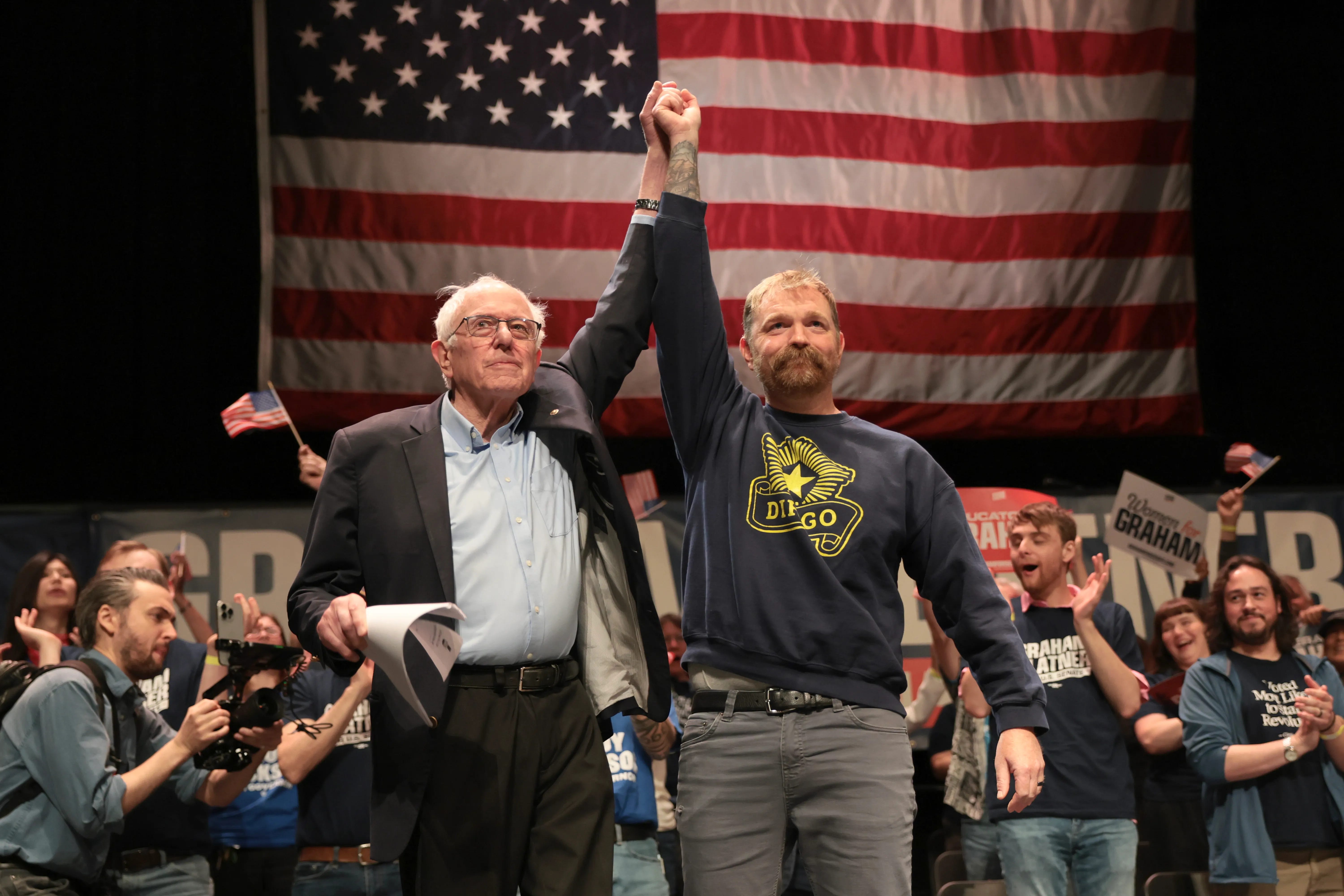
The Graham Platner Election
Linda Hooper worked the register at a Hannaford supermarket in Lewiston, Maine for eleven years. In early 2024, she and her husband started splitting his insulin prescription to stretch the vials across the month, because they could not cover both the medication and the rent increase their landlord had filed in January. Her husband is a school custodian. Together they bring home just over $58,000 a year. A Century Foundation survey of working-class households published in December 2025 found their situation is not an exception: roughly a third of Americans in that income bracket delayed or skipped medical care in the past twelve months because of cost, and nearly two-thirds had cut what they bought at the grocery store or switched to cheaper food entirely. The top one percent of households, meanwhile, now hold 31.7 percent of all American wealth, the highest share recorded since the Federal Reserve began tracking these numbers in 1989. Twelve billionaires alone, as of January 2026, have accumulated a combined net worth exceeding $2.7 trillion, a figure that has more than quadrupled since 2020.
Linda does not follow Senate races. She follows her bank balance. And right now, in the state of Maine, someone who bought cocaine on paid military leave, covered up a Nazi tattoo, sexted twelve women while his wife was in marriage counseling with him, and posted racial slurs online is leading a Senate race by nine points against a six-term incumbent. That fact deserves to be sat with, not rushed past. It is one of the most honest things the country has said about itself in years.
The Numbers Behind the Rage
The median American household needs approximately $104,000 a year to cover basic living costs for a family of four. The median household income is $80,610. That gap is not a statistic. It is a monthly subtraction, lived in the moment someone decides between a prescription and a utility bill, between a car repair and a week of groceries. It is the quiet arithmetic of a country that has been telling its working people for two decades that the economy is recovering, that the institutions are holding, that patience and process will deliver, while the asset class that owns the political system has watched its share of national wealth climb without interruption.
The Federal Reserve’s own data shows the top one percent’s wealth share hit a record high in 2025. The bottom fifty percent of American households own roughly two and a half cents of every dollar of national wealth. These are not the numbers of a country in which the system failed accidentally. They are the numbers of a system that succeeded at exactly what it was designed to do, which is to protect and concentrate the wealth of the people who built it, while offering everyone else the procedural comfort of elections.
Across the same period, the political class that administered these outcomes grew considerably wealthier. Long-serving senators and congresspeople on both sides of the aisle entered office on public salaries and left, or are still leaving, with investment portfolios and speaking fee records that bear no relationship to what public service pays. The pharmaceutical industry spent $373 million lobbying Congress in 2024 alone. The financial sector spent more. The fossil fuel industry spent more after that. The money did not buy nothing. It bought the specific policy outcomes that produced the distributional record the Federal Reserve now publishes with such clinical neutrality.
What Two Decades of Betrayal Actually Produces
The working-class voters now rallying behind candidates like Graham Platner are not politically radicalized in the ideological sense. They did not read theory. They read their bank statements. They watched the 2008 financial crisis produce zero prosecutions of the executives who engineered it, while millions of families lost their homes. They watched a pandemic response in which essential workers, the people stocking the shelves and driving the trucks and cleaning the hospital floors, were told they were heroes and sent back in without adequate protection, while the asset class worked from home and watched its net worth double. They watched inflation hit wages that had not grown in real terms in fifteen years, and then watched corporations post record profit margins in the same quarters their grocery bills went up. They watched a political party tell them for years that it was the party of working people, and then watched it spend its political capital defending institutions that were not working for them.
The Century Foundation found in late 2025 that younger Americans, people of color, and women, the very constituencies the Democratic Party has relied on as its coalition base, are disproportionately the ones skipping meals, relying on payday loans, and making the impossible choices that define life at the wrong end of the wealth gap. These are not peripheral voters. These are the people the party built its identity around representing, and they are the people living most acutely with the consequences of what the party failed to deliver.
When that much accumulated disappointment has nowhere to go, it does not produce measured political analysis. It produces a readiness to support whoever is willing to say the true thing out loud, regardless of the personal history attached to the voice saying it.
The Disqualification Machine and Why It Broke
There is a machinery in American politics designed to disqualify candidates before they become dangerous to the existing order. It works through opposition research, coordinated media coverage, donor withdrawal, and party infrastructure pressure. It is not a conspiracy. It is a set of institutional reflexes that have operated reliably for decades to ensure the range of viable candidates stays within boundaries acceptable to the people who fund the system.
That machinery has been running at full capacity against Graham Platner for eight months. The Nazi tattoo story. The racist Reddit posts. The sexting and the hookup app. The cocaine admission. The Blackwater employment. The posts calling Army soldiers fat and lazy. Each disclosure was real, documented, and damaging in the conventional sense. Each one would have ended a campaign in a different political climate. The machine is functioning. The outcome it was designed to produce is not arriving.
This is what requires explanation, and the explanation is not flattering to the institutions involved. The press that investigates candidates for disqualifying behavior is the same press that embedded itself in the official narrative of the Iraq War and spent years telling the public the economy was in recovery while wages stagnated. The party infrastructure raising alarms about Platner’s fitness is the same infrastructure that triangulated and accommodated and managed donors for thirty years while the wealth gap widened annually. The donor class funding the attacks on Platner is the class that extracted $55 trillion in wealth while the people it is now performing concern for could not cover a $400 emergency expense without going into debt.
The disqualification machine broke because the people it was meant to persuade stopped trusting the people operating it. That is not an argument for ignoring what the machine found on Platner. It is a diagnosis of what has happened to institutional credibility in America, and it matters far beyond this one Senate race.
The Specific Anger of the Forgotten Class
There is a particular quality to the anger of people who once believed the system could work for them and have spent years accumulating evidence that it will not. It is different from the anger of people who never expected anything. It carries the specific bitterness of betrayal rather than the resigned fury of exclusion. It is the anger of the working-class Democrat who voted reliably, donated when they could, knocked doors, believed the arguments, and watched the party take their votes and then protect the financial sector and negotiate healthcare reform into something the insurance industry could live with and pass a tax restructuring that cut the corporate rate permanently while offering them a temporary middle-class credit that expires.
Data for Progress measured this in 2025. A Democrat running a direct populist platform beats a Republican by fifteen points in a general election environment. A Democrat running the standard institutional message wins by six. Nine points is the gap between those two approaches. Nine points is what it is worth, in electoral terms, to simply tell working people the truth about what has been done to them and by whom. The fact that the party’s leadership has been reluctant to run that message consistently is itself a measure of how thoroughly donor dependency has shaped what the party considers sayable.
What the Platner Moment Is Actually About
Graham Platner’s candidacy is not a story about Graham Platner. His personal failures are real and they belong to him. But the reason a man with a covered-up Nazi tattoo, a cocaine admission, a sexting scandal, and a trail of offensive online posts is nine points ahead in a competitive Senate race is not about his virtues. It is about the depth of the hole the political class has dug, and the readiness of people living at the bottom of it to reach for whatever hand is being extended, regardless of whose hand it is.
This is the true condition of American democracy in 2026. Not the Platner story. The story that produced the Platner story. The story of a country where the wealthiest twelve individuals hold more wealth than the bottom half of the population combined. Where a school custodian and a supermarket cashier together cannot afford his medication and their rent in the same month. Where both political parties have been captured, to varying degrees, by the same donor class and have spent thirty years producing policy that reflects the interests of that class while asking working people to keep faith with institutions that are not keeping faith with them.
When a population has been failed that comprehensively, the conventional calculus of candidate fitness stops applying. People are not voting for Platner’s character. They are voting against the character of the system that is trying to stop him. Those are different things, and conflating them misses what this moment is actually saying about where the country is.
The Reckoning That Is Coming
The primary is June 9. If Platner wins it, and the polling suggests he will, the establishment will spend the summer trying to manage a candidate it cannot control and a message it cannot dilute without alienating the voters it needs. If he loses because the latest disclosures finally tipped the balance, the underlying conditions that made him viable do not disappear. The anger does not go anywhere. The insulin still costs what it costs. The rent still went up. The twelve billionaires still hold $2.7 trillion. Another candidate will arrive in another race, carrying a different set of personal failures, and the same calculation will be made again by the same exhausted electorate.
This is what the political class, on both sides, has refused to reckon with honestly. The Platner candidacy is not an aberration. It is a signal from a country that has run out of patience with a system that takes everything from working people and gives them back a ballot every two years and calls it democracy. The signal is going to keep repeating, in different states and different races, with different candidates and different scandal files, until the conditions that generate it are addressed. Not managed. Not messaged around. Addressed.
Linda Hooper is still splitting the insulin. Nobody in Washington is losing sleep over it. That, more than anything else in this story, is the point.


