


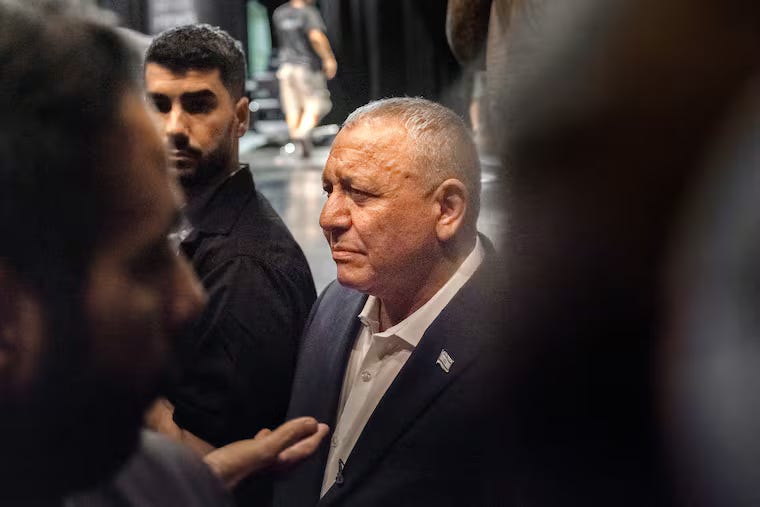
Let’s get one thing out of the way, the violence and genocide against Palestinians will continue and the occupation of their land will continue to expand no matter who leads Israel because essentially that is the Israeli doctrine.
The general presented as Israel’s cleaner alternative wrote a doctrine of overwhelming destruction, commanded the army during the Gaza fence killings, and joined the cabinet that directed the war in Gaza.
A ballot cast for the Joint List in Nazareth could help remove Benjamin Netanyahu from office. The same ballot could also make Gadi Eisenkot prime minister, provided Eisenkot were willing to accept the help. With more than 99 per cent of ballots counted on 29 October, the latest projections gave Netanyahu’s bloc 53 seats, Eisenkot’s opposition bloc 48, and two Arab-led lists a combined 19. The numbers remained provisional; they were enough to show the predicament. Without the Arab members, the opposition has no evident route to the 61 seats needed for a government. Eisenkot spent the campaign saying those members would have no place in his.
His party is called Yashar, Hebrew for “straight” or “honest”. The name offers an answer to Netanyahu before it offers a programme to anyone else. Netanyahu faces corruption charges, attacks the institutions investigating him, and has made the endurance of his coalition a principle of statecraft. Eisenkot is a former army chief with a reputation for plain speech, a soldier whose son was killed in Gaza and whose anger at the prime minister’s conduct appears sincere. Foreign observers have consequently found in him a reassuring figure: a man who might restore competence and decency to an Israeli government that has advertised its brutality too freely. Their hope depends on leaving his professional life outside the portrait.
Eisenkot’s record runs through the destruction of Lebanese neighbourhoods, the shooting of Palestinian demonstrators, and the government that waged the first eight months of the Gaza war. Those are different episodes with different chains of command. They cannot be reduced to a charge that he personally ordered every bomb or bullet. They do establish what he has advocated, what happened under his command, and which war aims he was willing to help pursue. Netanyahu has made a political career of promising to use force without restraint, and Eisenkot supplied a doctrine for using it. The distance between their manners is real. The distance between their treatment of Arab lives is much harder to find.
In July 2006, Israeli aircraft attacked apartment blocks in the southern suburbs of Beirut. Hezbollah maintained military and political facilities in the area known as Dahiya, but families also lived in those buildings, worked in the streets and slept in the flats above them. Human Rights Watch later examined 94 Israeli attacks across Lebanon that killed 510 civilians and 51 Hezbollah combatants. Its investigators found repeated attacks on places where they could identify no military target. They also documented Hezbollah rocket attacks on Israeli civilian areas as unlawful. Neither finding cancels the other. An army remains obliged to distinguish a fighter from a family living nearby, whatever its enemy has done.
One attack reached Rweiss, in southern Beirut, on 13 August, the day before the ceasefire. Human Rights Watch reported that Israeli warplanes destroyed eight ten-storey buildings in the Imam Hassan complex and killed at least 36 civilians and four low-ranking Hezbollah members. Investigators assessed that the strike apparently followed inaccurate intelligence that a senior Hezbollah official was staying there. The ratio of the dead cannot settle every legal question about the attack; it can show what happened when a residential complex became a target. Rooms occupied by families and rooms occupied by fighters were inside the same buildings, and the buildings were destroyed together. In a war often described through missile stocks and deterrence, the physical unit of the Israeli decision was an apartment block.
Eisenkot was head of the army’s Operations Division during the 2006 war, according to the Israel Defense Forces’ account of his career. The available reporting does not establish that he selected the Imam Hassan complex, approved the intelligence about it, or ordered the strike. His connection to Rweiss is historical and institutional: he served in the military command system that fought the war, and later made its destruction in Dahiya the model he said Israel should extend to Lebanese villages. A direct order would make a different, narrower allegation. His own subsequent statement provides the documented one.
The Israeli campaign turned Dahiya into a threat directed at other places. In October 2008, as head of Northern Command, Eisenkot told Yedioth Ahronoth that what had happened there would happen in every Lebanese village from which Israel came under fire. He said Israel would use disproportionate force and cause great destruction; from his standpoint, such villages were military bases rather than civilian villages. He was describing a future method. The distinction matters because the phrase “Dahiya doctrine” is often treated as a label attached to him by critics, while the crucial assertion, that an inhabited village could be classified as a base, came from Eisenkot himself.
On 2 October 2008, a day before Eisenkot’s interview appeared, Gabi Siboni published an analysis at Israel’s Institute for National Security Studies that gave the idea its strategic explanation. Israel should respond to hostilities with force disproportionate to the threat, Siboni argued, striking Hezbollah’s military capacities as well as the economic interests and centres of civilian power that supported it. The desired ceasefire would leave the other side occupied with expensive, lengthy reconstruction. In that theory the cost borne by people who did not fire rockets was part of the deterrent. A wrecked street was meant to become a message to a political organisation through the lives of the people who used the street.
International humanitarian law does not require a state to answer a rocket with an identically sized rocket. “Disproportionate” as a description of strategic force is therefore different from disproportionality as a legal finding about a particular attack. The law does prohibit attacks directed at civilians, attacks that treat distinct military objectives in a populated area as one target, and attacks expected to cause civilian harm excessive in relation to a concrete and direct military advantage. It also requires precautions in selecting and striking targets. Eisenkot’s declaration creates its gravest problem at the first step: an entire village cannot become a military objective because a weapon was fired from it. The people living there do not cease to be civilians when a general changes the noun used to describe their home.
During the 2006 war, the distinction had already been tested in practice. Human Rights Watch found that Israeli forces often treated Lebanese warnings to evacuate as if everyone who remained had become a fighter. Some of those civilians could not leave. Others moved through the south to obtain food or find relatives, and movement itself was sometimes taken as evidence of hostile activity. Of 499 civilian victims for whom Human Rights Watch confirmed age and sex in the attacks it studied, 302 were women or children. The later doctrine drew upon that war, but Eisenkot was not the author of every decision made in 2006. The indictment is more precise and more serious: two years after investigators described what the broad targeting assumptions had done, he announced those assumptions as the basis for the next campaign.
The promise has survived its author’s move into electoral politics. In his campaign for prime minister, Eisenkot’s military record is offered as a qualification to govern, and the Associated Press still identifies him with the Dahiya doctrine in its account of the candidate. That record includes a public theory of coercion in which the destruction of a community produces the political pressure Israel seeks. The candidate asks to be judged by what he did in uniform, and Beirut belongs in the assessment.
Years before he entered Netanyahu’s war cabinet, Eisenkot commanded the army that faced the Great March of Return in Gaza. The demonstrations began on 30 March 2018. Palestinians gathered along the boundary fence to demand an end to the blockade and recognition of the right of return for families displaced in 1948. Some demonstrators burned tyres, threw stones or tried to breach the fence. Israeli forces had the right to protect people against an imminent threat to life. They did not have a general licence to shoot anyone near the boundary, and the United Nations inquiry found that the live-fire policy went much further than protection required.
The commission investigated 189 deaths at the demonstration sites during 2018. Thirty-five of those killed were children; 183 of the dead were shot with live ammunition. Its report, issued as A/HRC/40/74, examined the circumstances of the shootings through testimony, video and medical records. Except for two cases in which it identified a possible direct role in hostilities or an imminent threat, the commission found reasonable grounds to believe the use of live fire against those killed was unlawful. Clearly identifiable journalists and medical workers were among the people shot. So were people with disabilities and demonstrators hundreds of metres from Israeli forces, visibly engaged in civilian activity.
One of the children in the commission’s detailed account was eleven-year-old Abed Nofal, a schoolboy from Bureij refugee camp whose leg had to be amputated after he was shot. By the end of 2018, the inquiry recorded 122 demonstrators who had undergone amputations, including 20 children. The injuries do not fit the tidy account in which a soldier either stops an armed attacker or misses an intended target. Many shots struck legs. An incapacitated child returns from a protest to a family facing surgery, rehabilitation and a lifetime of restricted movement. The military chain of command does not disappear at the hospital door.
Eisenkot served as chief of the general staff from 2015 to 2019. The commission did not convict him, and its findings should not be recast as a judicial verdict on his personal criminal liability. Yet the army’s rules of engagement were a command matter during his term, and Human Rights Watch described the killings as the result of orders permitting fire on demonstrators who posed no imminent threat to life. Israel rejected the UN inquiry as biased. The disagreement is part of the record; so are the victims, the footage, the wounds, and the rank of the man who headed the force that fired.
In February 2016, speaking to prospective recruits in Bat Yam, Eisenkot had objected to a soldier emptying a magazine into a thirteen-year-old girl armed with scissors when distance separated her from troops. Israeli right-wing politicians denounced the comment as weakness. The remark is often used to establish that the general possesses a conscience absent from the men to his right, and perhaps it did express a real limit he believed soldiers should observe. The inquiry into the Gaza fence was published less than three years later, after children had been shot by the army he led, and yet the defence of his character continues to begin with the hypothetical girl rather than the children whose names appear in the commission’s report.
On 7 October 2023, Hamas-led resistance fighters targetted civilians and mostly soldiers in Israel and took hostages into Gaza. Eisenkot joined the emergency government that followed, serving as an observer in its small war cabinet until June 2024. His son Gal Meir was killed while serving in Gaza that December, and two of Eisenkot’s nephews also died in the war. No account of his decisions should use that loss as a device or pretend that grief made his public choices simple. It does not relieve a cabinet member of responsibility for the policy he continued to support.
The cabinet years are often recounted as a dispute over Netanyahu’s management of the war. Eisenkot pressed for a clearer strategy and a deal to bring hostages home; he and Benny Gantz argued that the prime minister let coalition politics govern military decisions. Those arguments mattered to Israeli families waiting for captives, and to anyone who wanted the war stopped sooner. They also had a defined limit. Eisenkot remained in the government through the bombardment of northern Gaza, the assault on Khan Younis, the deprivation of food and basic services, and the approach to Rafah. He resigned in June 2024 saying Netanyahu’s political calculations were damaging Israel’s ability to achieve the war’s goals. He did not leave because he had adopted the Palestinian account of what Israel was doing to Gaza.
By 26 January 2024, the International Court of Justice had ordered Israel to take measures to prevent acts prohibited by the Genocide Convention, prevent and punish incitement, and enable urgently needed humanitarian assistance. The court had found plausible the rights of Palestinians in Gaza to protection from genocide and related prohibited acts. It had not decided the merits of South Africa’s genocide case, a distinction that should survive every political argument made about the order. The warning was nevertheless issued while Eisenkot sat in the war cabinet. Men directing the campaign could no longer claim ignorance of the legal danger identified by the world’s highest court.
Amnesty International’s December 2024 investigation reached its own conclusion: Israel had committed and was continuing to commit genocide against Palestinians in Gaza. Its period of detailed examination ran from 7 October 2023 into July 2024, covering almost all of Eisenkot’s tenure. In July 2025, the Israeli rights group B’Tselem published Our Genocideand concluded that Israel was acting deliberately to destroy Palestinian society in Gaza. The following September, the UN’s Independent International Commission of Inquiry concluded that Israeli authorities and forces had committed genocide, identifying four of the five acts listed in the convention. Israel rejected these findings. None of the organisations’ conclusions is a criminal conviction of Eisenkot, and the commission’s findings about state responsibility cannot simply be attached to every official who attended a meeting. They do establish the gravity of the campaign in which he participated, and they make a portrait centred on his “moderation” an evasion of the record.
By the time voters went to the polls in October 2026, Gaza’s Health Ministry counted more than 74,000 Palestinians killed in the war, according to the Associated Press. That figure does not assign each death to a particular cabinet decision, distinguish civilians from combatants, or capture the whole burden of illness, hunger and destruction. It does place a measure on the campaign that Eisenkot helped direct. A government cannot claim the authority of its generals when they promise victory and then treat those same generals as decorative observers when the cost of victory is counted.
There is a separate question of legal responsibility, and it requires evidence about specific decisions, knowledge and intent that the public record may never fully supply. The political question is already answerable. Eisenkot joined the body formed to direct the war, stayed as Gaza was devastated, objected chiefly to Netanyahu’s conduct of the campaign, and now asks voters to entrust him with its remaining aims. His grief belongs to him. The consequences of those choices belong in the public assessment of his candidacy.
The promise of another campaign
At the Gaza border on 15 October 2026, Eisenkot promised that within eighteen months of taking office he would destroy Hamas’s military wing and dismantle its leadership, according to the Jerusalem Post. He offered President Donald Trump’s framework as one route and military action as the other. The formulation gives a deadline to an objective Netanyahu spent years claiming he would achieve through bombardment. It offers Gazans no comparable deadline for reconstruction, freedom of movement, political consent or the return of a functioning civic life. The lives affected by the timetable belong to people who cannot vote in the election that may place Eisenkot in charge of it.
His supporters can reasonably say that Hamas’s armed attack on civilians and its continued holding of hostages demand an answer. The issue is the answer Eisenkot has chosen to make his electoral promise. After years of war, the military destruction of Hamas remains a stated goal, and his principal criticism of Netanyahu is that the prime minister has failed to accomplish it. The repetition is striking because the earlier campaign was sold to Israelis under the same assurance. Eisenkot asks them to believe that a different commander can finish the task without reproducing the devastation that has already accompanied the attempt.
On Iran, too, he has presented strategic differences largely as questions of judgement and command. He has argued that foreign force cannot install a government in Tehran, and he has questioned whether Netanyahu was fit to lead another operation. During the campaign’s final weeks he also said he knew of no critical development requiring an immediate American-Israeli strike. Those positions set him apart from the most reckless calls for a fresh war. They coexist with his stated aims of stopping Iran’s nuclear and missile programmes and neutralising Hezbollah, aims for which he has left military force available. The danger for the people under the next strike is not erased by an argument among Israeli politicians about its timing or the character of the man ordering it.
The West Bank supplies another test of the word “moderate”. Eisenkot says he would remove unauthorised settlement outposts and curb settler violence. In a Times of Israel interview, he also said he supports settlements that comply with Israeli law and what he defines as Israel’s security interests. Those positions are not identical to Smotrich’s programme of expansion. Yet legality under the occupying power’s domestic rules cannot decide whether a settlement on occupied territory is lawful under international law, and removing one unauthorised outpost leaves the larger settlement structure intact. A Palestinian whose land is separated from her by a checkpoint lives with that structure, however carefully an Israeli candidate distinguishes a legal settlement from an illegal outpost.
The distinctions between Eisenkot and Netanyahu therefore deserve to be stated without being mistaken for a change of destination. Eisenkot supports a state inquiry into the failures that preceded 7 October. He wants broader military conscription, including for ultra-Orthodox men, and opposes Netanyahu’s campaign against the courts. Those proposals concern accountability, the distribution of military service and the powers of Israeli institutions. They matter. On Gaza, Lebanon, Iran and settlement, he offers a different account of who should manage state force and when it should be used; he has not offered the people against whom it is used a different relationship to that state.
Nineteen seats outside the door
As the October count advanced, the Joint List and Ra’am were projected to win 19 seats between them, nearly twice the strength of Arab-led parties in the outgoing Knesset. The arithmetic is plain enough to fit on a scrap of paper: Eisenkot’s non-Arab opposition bloc had a projected 48, short of a majority; add the Arab-led parties and the total reaches 67. A majority would still require negotiations across parties with sharp differences, especially over war and citizenship. A seat held by an Arab member does not automatically become Eisenkot’s vote. What the count has exposed is his reluctance to ask for it.
Mansour Abbas, leader of Ra’am, had already signalled a willingness to help form an alternative government. In the weeks before polling, Eisenkot said Ra’am in its existing form would not join a government he led. His party demanded that Arab partners affirm Israel’s definition as a Jewish and democratic state, endorse the destruction and disarmament of Hamas, and accept changes to military service. Those tests were presented as the price of political legitimacy. Jewish parties that differ among themselves on religion, conscription, settlements and Netanyahu’s legal troubles negotiate their disagreements as coalition business; an Arab party is asked to establish that it belongs in the conversation at all.
The exclusion has a history. After the March 2020 election, Benny Gantz had a path to a minority government with outside support from the Joint List. Members of his own political camp refused to depend on Arab votes, and he entered a coalition with Netanyahu. In 2021 Ra’am joined the Bennett-Lapid government, becoming the first independent Arab party to enter an Israeli governing coalition. Its participation brought commitments on funding for Arab communities and recognition of Bedouin villages, though the coalition fell after roughly a year. That precedent established that a government could count Arab members when its Jewish leaders chose to do so. The subsequent promises to avoid another such arrangement established something else: Palestinian citizens could participate in the parliamentary arithmetic without being accepted as enduring partners in power.
Netanyahu’s party has responded to the present election with a cruder message. After the Arab-led parties’ gains became clear, Likud claimed the election had been stolen by Arab parties and alleged serious criminal misconduct. On 29 October, the head of Israel’s Central Elections Committee asked the Shin Bet to examine suspicions of foreign interference in the vote, a matter distinct from proof of Likud’s accusations against Arab voters. No public evidence had established the sweeping claim about those voters. President Herzog urged investigators to pursue any wrongdoing while warning politicians against tarnishing an entire community for exercising its right to vote. Eisenkot rejects Netanyahu’s politics and seeks to defeat him, and yet his refusal to rely on Arab parties leaves the election’s largest anti-Netanyahu resource politically stranded.
Some of his allies occupy an even narrower field. Avigdor Lieberman’s Yisrael Beiteinu is counted in the opposition bloc, but an agreement with Arab-led parties would test its stated positions and its voters. Other Jewish opposition figures speak of forming a Zionist government rather than a coalition resting on Arab support. The language can sound like a coalition preference until it is set beside the count: if the parties with 48 seats reject the 19 seats that could bring them across the threshold, they may choose continued Netanyahu rule, a unity arrangement, defections or another election over governing with the citizens who voted against him. Each option gives the present hierarchy a different route to survival.
The hierarchy is most explicit on Israel’s far right. In his 2017 Decisive Plan, Bezalel Smotrich wrote that only one national movement could prevail between the river and the sea. Palestinians who surrendered national ambitions could remain under a system of individual and municipal rights; others would receive help to emigrate. For residents of the occupied West Bank who remained, his plan offered local voting while withholding a vote for a sovereign parliament. The document also spoke of improving the demographic balance and encouraging Arab emigration. It was a programme written openly by a politician who later became Israel’s finance minister, with language precise enough that nobody needs to invent a darker secret version of it.
In October 2026, reports of another Smotrich speech quoted him using the phrase “final solution” while discussing Palestinian refugees and their proposed relocation and rehabilitation in other countries. Those were his reported words about the refugee issue, not a joint declaration by Smotrich and Itamar Ben-Gvir about the Arab parties’ 19 seats. Ben-Gvir has separately advocated encouraging Palestinian emigration and expelling people he calls enemies of Israel. Eisenkot has endorsed neither man’s transfer plans. The relationship among these positions lies in their political direction: the far right states openly how it would reduce Palestinian presence and political power; the centre can reject the extremity while still denying Palestinian citizens the governing role their votes have earned.
An Arab citizen in Nazareth is not in the same legal position as a Palestinian living under military occupation in the West Bank, and collapsing the two conditions would make the argument less exact. The connection is the decision about who may exercise collective political power. Smotrich’s document denies Palestinians in the West Bank a vote for the sovereign parliament that rules their future. Eisenkot accepts the Knesset votes of Palestinian citizens inside Israel as a formal matter, while treating their elected parties as unfit to sustain his government. One is a published plan to withhold representation; the other is a coalition choice made within an existing system of citizenship. They are not the same act. They rest, however, on an assumption that Jewish parties may settle the state’s direction while Arab representatives must ask permission to matter.
What the change would change
The portrait of Eisenkot as Netanyahu’s opposite has always been a portrait drawn from one side of the border. He is plainly different from a prime minister on trial for corruption, a politician who has empowered Ben-Gvir and Smotrich and treated the courts as enemies. He has spoken with restraint on some military questions and shown a greater willingness to investigate the state’s failure to protect Israelis on 7 October. His opponents inside Israel have reasons to prefer him, and those reasons cannot be dismissed by pretending there is no difference between the two men.
At the next stage of the election, the argument about Eisenkot’s character will meet a count of actual members of parliament. A candidate who offers better government to Jewish Israelis has been invited to say whether Palestinian citizens may share in it; his previous answer was no, and the projected seats make an answer unavoidable. A politician can refuse a coalition with a particular party for any number of reasons. Refusing every Arab-led route to a majority while asking those parties’ voters to help end Netanyahu’s rule has a simpler meaning. Their votes are welcome as a barrier to his rival and unwelcome as a source of authority for themselves.
Israel’s president, Isaac Herzog, will consult party leaders once the results are settled and decide who has the best prospect of forming a government. The projected figures may change as the remaining ballots are counted. The choice exposed by them will not disappear with a seat moving from one column to another. A coalition that replaces Netanyahu must either accept Arab participation, find Jewish members of his bloc willing to defect, or persuade voters to try again. Eisenkot’s answer to the first of those possibilities is already on the record, and it grants Netanyahu more room to survive than the voters in Nazareth did.
If Herzog hands Eisenkot an opportunity to form a government, the general will have to decide whether the citizens whose ballots he has kept at arm’s length may help him take office. The same man who once declared Lebanese villages to be military bases now asks to decide the fate of Gaza from Jerusalem, and the people most exposed to his decisions have been made peripheral to the count that could put him there. He must count them.