Why Is There Violence In Belfast
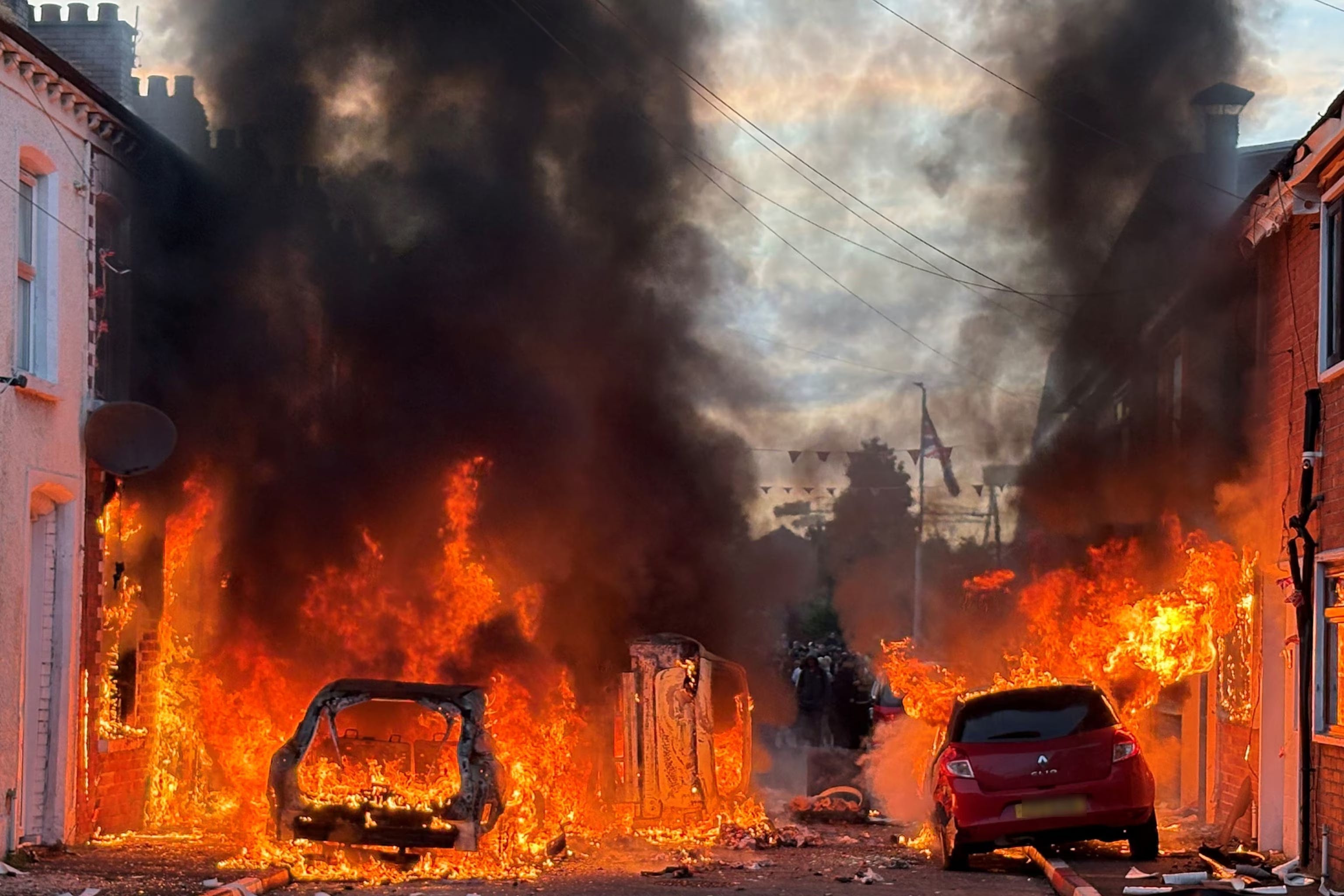
On Tuesday night in Belfast, families looked out from behind broken windows while masked men moved through streets with bricks, petrol, and a list of addresses. Some of the houses they struck belonged to people the attackers believed were immigrants. Some of the families inside had already fled one war before arriving in Northern Ireland. By Wednesday, homes had been burned, vehicles torched, roads blocked, and minority residents were saying they were too afraid to leave their doors.
The official chronology begins with a stabbing in north Belfast on Monday night. A man in his 40s was left with severe injuries, including wounds to his face, neck, and back, and a 30-year-old Sudanese national, Hadi Alodid, was arrested at the scene and later charged with attempted murder, possession of a bladed article in public, and making threats to kill. The public story did not stay there for long. Graphic video of the attack spread online, anti-immigrant agitation accelerated, and within hours the city had crossed from outrage into collective punishment directed at people who had nothing to do with the assault.
That distinction is the story. Belfast did not see a spontaneous civic reaction to a brutal crime. Belfast saw a criminal assault turned into a racial dragnet, with homes, businesses, and families selected not by evidence but by origin, skin colour, rumor, and the ugly confidence that crowds acquire when they believe impunity is close at hand.
The stabbing itself was serious enough to dominate any news cycle. BBC reported that the victim remained in critical condition after the attack, while court reporting cited the loss of his left eye and severe facial injuries. Police moved quickly on the criminal side of the case, making an arrest at the scene and charging the suspect within days.
What police did not establish publicly, and what no verified reporting has established so far, is a wider conspiracy behind the stabbing itself. There is no verified evidence in the reporting available that the suspect was paid, directed, or acting on behalf of a network. Police were reported to be investigating motive, and they also said at an early stage that there was no information suggesting the stabbing was terrorist-related.
The absence of those facts did not slow the crowd. It accelerated it. The vacuum between a horrifying act and a confirmed motive was filled by people who already had their answer ready, and that answer was not forensic. It was racial.
As a side note, Elon Musk stoked the language of hate as he always does against immigrants.
By Tuesday, the violence had spread across Belfast. Reuters reported masked groups rampaging through the city, with some targeting residences and businesses of people perceived to be immigrants. CBS reported that rioters set fire to homes, a bus, and trash cans, threw rocks at police, and blocked roads, while lists of addresses thought to belong to immigrants and their families circulated online in closed social media networks such as WhatsApp.
This is where the public framing collapses. The phrase “protests after a stabbing” can still be made to sound chaotic, emotional, even locally combustible. A list of addresses changes the meaning of the event. A crowd that moves from video outrage to named homes is not reacting. It is hunting.
The most important detail in this story is not the knife, terrible as that violence was. It is the list.
CBS reported that more than two dozen Belfast addresses believed to be the homes of immigrants were circulated online during the unrest. The same report said another account on X posted names and addresses of immigration lawyers and law firms in Northern Ireland and urged “patriots” to “do with that what you will.” CBS could not determine who originated the lists because they were spread through closed networks, but PSNI said it was aware of social media users sharing addresses online amid the protests.
A city does not drift by accident from rumor to addresses. Someone compiles. Someone forwards. Someone narrows the crowd’s rage into a route. That is organization, even when it arrives through informal channels and deniable accounts.
Reuters and other outlets have also captured what this did at street level. People from Belfast’s ethnic minority communities said they were afraid to leave home after watching masked groups target homes and businesses of those thought to be immigrants. Britain’s Northern Ireland secretary Hilary Benn called the violence “racist thuggery,” and Reuters reported that marchers shouted about getting “foreigners out” while houses were burned and windows smashed.
The line between racist intimidation and attempted ethnic cleansing is not a semantic one when homes are selected by identity and families are driven out by fire. Belfast knows enough of its own history to understand that terror often arrives first as an address and only later as a doctrine.
There is still a temptation in parts of British and Irish public discourse to describe moments like this as “disorder” and leave the noun to do all the work. Disorder is what a storm causes to a train timetable. What happened in Belfast was more deliberate than that.
Reuters reported that the people targeted were those “perceived to be immigrants.” BBC reported that community members were attacked because of their racial appearance, while Time reported that businesses and homes were targeted as racial tensions were inflamed online. Democracy Now, citing the response on the ground, reported that immigrant families were escorted from their homes by firefighters and emergency responders after rioters set cars and garbage cans ablaze to create roadblocks.
Even the rhetoric of public officials made plain that this was not ordinary public-order trouble. First Minister Michelle O’Neill described “groups of masked men burning families out of their homes” as “outright thuggery,” while Hilary Benn said that if people are being targeted because of the colour of their skin, “that is racist thuggery.” Reuters separately reported that many in the minority community had lived through war before arriving in Belfast, only to confront another form of terror after seeking refuge.
That last fact lands harder than any ministerial condemnation. A family escapes one country because the state or the street has marked them, and then in Belfast they are marked again by men with bricks and petrol who have decided they do not belong. Same method. Different postcode.
The online ecosystem around the unrest matters because it shows how fast a criminal event can be repurposed into racial mobilization. Graphic footage of the stabbing circulated widely. Anti-immigrant messaging followed. Address lists moved through encrypted or closed channels. Public calls for “mass protests” spread alongside identifiable targets.
Reuters reported that authorities and political figures said much of the unrest had been incited and organized through online platforms. Time reported that Northern Ireland’s justice minister criticized far-right commentators for trying to stoke racial tensions. CBS was more concrete, documenting the circulation of addresses and the inability, so far, to identify the original source behind those lists because of the privacy shield provided by closed social media groups.
There is a familiar structure here. The stabbing produced outrage. The video converted outrage into a shareable object. The far-right information stream converted that object into a political narrative. The address lists converted the narrative into a map.
Each step narrowed the distance between rhetoric and arson. That distance was short.
Police and prosecutors have moved faster on the stabbing than on the broader architecture of incitement. The stabbing suspect was arrested and charged quickly. On the unrest side, BBC reported that arrests had risen to 19 by Friday and included a 16-year-old, while earlier reports cited injured officers and police use of water cannon as they tried to contain the violence.
That is the visible law-and-order response. The harder question sits elsewhere. If lists of homes were circulating online, if minority residents were being targeted by identity, and if public officials were already calling the violence racist, what legal and operational response is being built around digital incitement, conspiracy, and organized intimidation rather than only the street-level rioters who were easiest to see?
That question remains open in the public record available so far. Reuters reported that authorities said there was no evidence the unrest was coordinated by loyalist paramilitaries, but the same reporting pointed to far-right agitation and online organization. Absence of one structure does not mean absence of structure. Crowds learn routes from somewhere.
There is another risk in coverage like this. Once the noise rises high enough, the original stabbing, the racist retaliation, the online targeting, and the official language all begin to collapse into one generic account of “community tensions.” That flattening serves everyone who wants the record blurred.
The stabbing is one criminal case. It deserves accurate reporting, and it deserves distance from myth. There is no verified evidence at this stage that the suspect was paid or that the assault was part of a publicly established wider plot. There is, by contrast, substantial verified reporting that anti-immigrant mobs targeted homes and businesses of people believed to be immigrants, that address lists were circulated, and that officials described the resulting violence as racist.
Those are different evidentiary categories. One is unresolved. The other is documented.
For journalism, the discipline is simple and unforgiving. Do not invent a hidden hand behind the stabbing because the internet demands a mastermind. Follow the hand that forwarded the addresses, the hand that lit the house, the hand that watched families run and called it defense.
Belfast is a city with old reflexes around territory, walls, names, and who is allowed to sleep safely on which street. That history is not incidental here. It gives racist mobilization a local grammar even when the ideology is global and the targets are new.
Reuters reported that the anti-migration violence brought back dark memories of the Troubles for residents who looked at burned homes and recognized the method of intimidation. That matters because this week’s violence did not emerge from nowhere, and it did not need a sophisticated command structure to become effective. It needed a city with a memory of sectarian marking, a digital channel to repurpose that memory, and a vulnerable minority population visible enough to be cornered.
The modern far right rarely needs to build an entire repertoire from scratch. It borrows old local habits and supplies a new enemy.
The record is already strong enough to say what happened in Belfast this week. A brutal stabbing was followed by a racist campaign of retaliation against people unconnected to the assault. Homes were attacked. Vehicles were burned. Address lists circulated online. Minority communities were terrorized. Officials called it racist because that is what it was.
The unresolved part of the story is narrower and more dangerous. Not whether the mobs chose their targets. They did. The unanswered question is who moved first in the hours between the stabbing video and the first houses marked for attack, and whether Belfast will ever be told their names.


