Yes, Sir
Pete Hegseth has spent fifteen months removing every officer capable of telling him no. He is now sending the result to war.
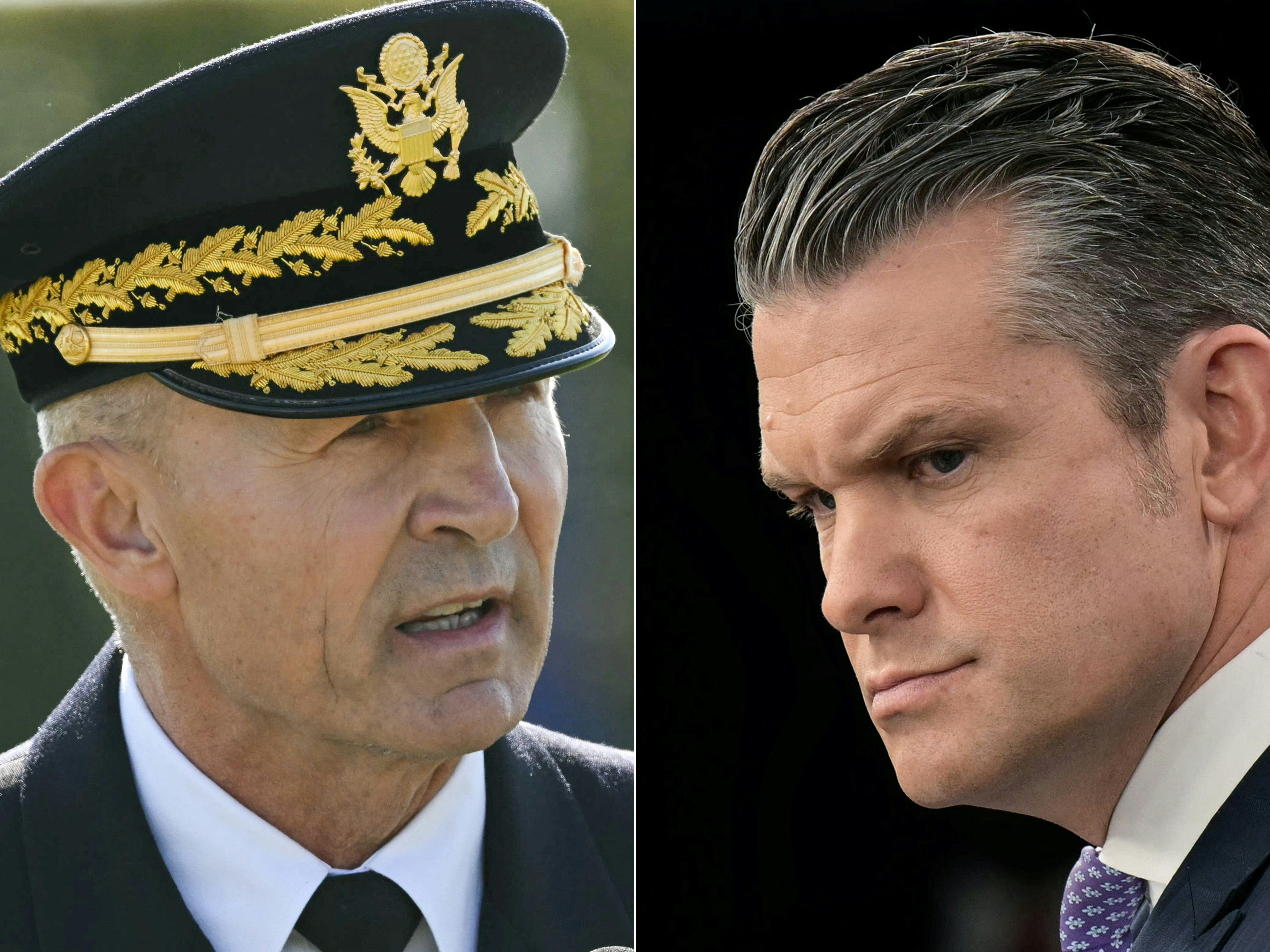
On Thursday afternoon, Gen. Randy George, the forty-first Chief of Staff of the United States Army, learned that he had been fired. He was in a meeting at the time. Pete Hegseth called him. There was no summons to the Pentagon, no private audience, no notification through the chain of command he had spent four decades ascending. His staff gathered afterward to receive the news in person; those present were described by a senior Pentagon official as “very stoic.” This is, perhaps, the appropriate register for the moment when you understand that your career has been terminated by telephone during an active war, with paratroopers from the division you were responsible for training already in the air toward the Middle East.
The announcement was confirmed in a statement from Pentagon spokesman Sean Parnell, who held a Fox News hosting position before this administration found other uses for him. “General Randy A. George,” it read, “will be retiring from his position as the 41st Chief of Staff of the Army effective immediately. The Department of War is grateful for General George’s decades of service to our nation.” The Department of War, which is what the institution now calls itself, having changed the name in the first weeks of the administration, and which the administration’s defenders insist is a point of pride rather than a signal of intent.
George is not the story. George is the conclusion. To understand what Thursday’s firing represents, you have to begin not with the Army chief of staff but with the Army’s top military lawyer.
In late February 2025, weeks after Hegseth took office, he announced that he was seeking nominations for the Judge Advocates General of the Army and the Air Force, effectively firing Lt. Gen. Joseph B. Berger III and Lt. Gen. Charles Plummer, the senior military legal officers of their respective branches, whose statutory function is to provide independent legal advice to military commanders. Hegseth offered an explanation for this, which is unusual because he rarely explains his removals. He said he wanted military lawyers who gave “sound constitutional advice” and did not “exist to be roadblocks to anything.” The Judge Advocates General are, by design and by law, precisely that: a check on what commanders can and cannot do, under the laws of armed conflict and the Uniform Code of Military Justice. They are the institutional memory of the boundaries. Hegseth’s stated objection to them was that they remembered.
The same week, he fired Gen. Charles Q. Brown Jr. as Chairman of the Joint Chiefs of Staff. No reason was given. Brown was a four-star officer with forty years of service who had commanded in combat and navigated the Pentagon through the final stages of the Afghanistan withdrawal. He was replaced by Lt. Gen. Dan Caine, a retired Air National Guard officer who had to be recalled to active duty and promoted past several ranks to fill the position. The speed of the swap mattered: the administration’s priority was not finding a qualified successor; it was removing the incumbent quickly enough that the institution had no time to absorb the disruption.
What followed over the next fourteen months was a systematic dismantling of the senior officer corps, conducted in waves, each framed as a personnel matter and each understood by the remaining officers in exactly the terms Hegseth had set out with the JAG firings: this is what happens when you become a roadblock. Adm. Lisa Franchetti, Chief of Naval Operations, was gone within months. Gen. James Slife, Air Force Vice Chief of Staff, the same. Adm. Linda Fagan, Commandant of the Coast Guard, departed without explanation. Gen. Timothy Haugh was removed in April 2025 from a dual role that no other officer has simultaneously held: director of the National Security Agency and head of United States Cyber Command, the positions responsible for electronic intelligence collection and offensive and defensive operations in the cyber domain. Adm. Shoshana Chatfield, the senior American military representative to NATO’s military committee, was fired the same week as Haugh. Gen. David Allvin, Chief of Staff of the Air Force, was shown the door in late August, four days before the firing that named the project most precisely.
Lt. Gen. Jeffrey Kruse directed the Defense Intelligence Agency. In June 2025, following American and Israeli strikes on Iranian nuclear facilities, his agency produced a classified preliminary assessment: the strikes had set Iran’s nuclear program back by a matter of months. The uranium stockpile had not been destroyed. The evidence suggested that material had been moved before the aircraft arrived. The program was damaged; it was not, by any rigorous definition, eliminated. Trump had declared it “completely and fully obliterated.” Hegseth told reporters that they could choose their own vocabulary: destroyed, defeated, obliterated, whatever word they preferred. “This was a historically successful attack.” Kruse was fired in August 2025, on grounds of “loss of confidence,” with no misconduct alleged. His agency had looked at the evidence and reported what it showed, and what it showed contradicted the announcement. He was removed for the gap between those two things and for no other reason, and the administration declined to say so publicly because it did not need to.
The removal of Kruse completed the intelligence layer of the purge: after Haugh at NSA and Cyber Command, the DIA directorship was also gone. The offices responsible for assessing what is actually happening in a war had been cleared of the officers most likely to say so.
Around the same time, Lt. Gen. Joe McGee left his position as Director for Strategy, Plans, and Policy on the Joint Staff, the officer responsible for advising the Chairman on long-term military strategy and planning for crisis contingencies. CNN reported that McGee had been pushed out after months of tension with Hegseth, having “frequently pushed back” on issues including Russia and Ukraine policy and military operations in the Caribbean. McGee had been nominated by the Biden administration for promotion; the current administration never renominated him. The Pentagon denied the CNN account. McGee did not comment. Whatever the precise circumstances of his departure, the effect was the same as every other departure: the position responsible for asking whether the strategy will work was vacated by the officer most likely to say when it would not.
Adm. Alvin Holsey was removed from Southern Command while overseeing active operations. Gen. James Mingus, Army Vice Chief of Staff, was gone before his term was complete. Lt. Gen. Jennifer Short was removed from her role as Hegseth’s own senior military assistant, which is notable primarily for the implication: even the officers working directly beside him were not exempt from the logic of the purge.
By Thursday, of the Joint Chiefs that Hegseth inherited in January 2025, two members remained: the commandant of the Marine Corps and the head of the Space Force. Every other position had been turned over, many more than once. The body that is constitutionally charged with advising the president and the secretary of defense on military matters is now, in its composition, Hegseth’s creation.
The replacement for George is Gen. Christopher LaNeve, acting Army chief pending Senate confirmation. Two years ago, LaNeve was a two-star general. His pre-Hegseth career was competent rather than distinguished: he commanded the 82nd Airborne Division for less than two years, then commanded the Eighth Army in South Korea for less than a year before being pulled out of that position as well. On the night of January 20, 2025, he called into the Commander in Chief’s Ball from Seoul on a video line and congratulated President Trump “on your victory as the 47th President of the United States.” Hegseth brought him to Washington as his top military aide. Trump nominated him as Army vice chief of staff last October, a meteoric advance for an officer of his seniority. He is now the prospective leader of the service branch that is preparing, with no officially confirmed mission but with clear operational direction, to deploy ground forces to the Middle East.
Three weeks before Hegseth fired George, George requested a meeting. He wanted to discuss the blocking of promotion recommendations for four senior officers, and what he described, through intermediaries, as Hegseth “interfering unnecessarily” with Army personnel decisions. NBC News reported Thursday that Hegseth had blocked or delayed promotions for more than a dozen Black and female senior officers across all four service branches. George and Army Secretary Dan Driscoll had objected, citing the officers’ records. Hegseth refused the meeting. Two weeks later, he called George by telephone.
In late September 2025, Hegseth delivered a speech to the nation’s generals and admirals. Toward its end, having made the case that institutional culture required fundamental transformation, he offered what amounted to a direct advisory: “If the words I’m speaking today are making your heart sink, then you should do the honorable thing and resign.” The speech was delivered months before the Iran war began. It described, without particular concealment, what kind of senior military it was his intention to lead.
Wednesday night, on the eve of George’s firing, Trump addressed the nation about Operation Epic Fury, now in its thirty-fourth day. Thirteen Americans have been killed. A hundred and forty have been wounded. The 82nd Airborne is in transit to a theater for which no ground mission has been publicly defined. Trump said the United States would “hit them extremely hard over the next two to three weeks.” He said Iran would be brought “back to the Stone Ages where they belong.” He named no objective whose achievement would indicate completion, no condition that would constitute success. Hegseth posted on social media afterward: “Back to the Sto,” the sentence ending before it arrived anywhere.
The constitutional defense of what Hegseth has done is straightforward and, in the narrow technical sense, accurate: the president appoints and may remove senior military officers, civilian control of the armed forces is both mandated and essential, and no general holds his commission as a personal entitlement. This is all true. It is also a description of the mechanism, not its purpose. Civilian control exists to ensure that democratic governance extends over military power, which means the military answers to the public’s elected representatives. It was not designed to permit a secretary of defense to construct a senior officer corps incapable of independent assessment, legal objection, or strategic disagreement. The distinction is between accountability and agreement. One of those is what democratic civilian control of the military requires. The other is what Hegseth has built.
The institution that results cannot tell him that an intelligence assessment is accurate when it contradicts him. It cannot advise that a legal constraint applies when he has decided it does not. It cannot plan for contingencies that require acknowledging the limits of the current strategy, because the officer whose job that was pushed back and left. It cannot request a meeting to discuss any of these matters, because requesting the meeting is how George found out he would not be taking any more meetings at all.
What it can do is deploy. The paratroopers are heading somewhere in the Middle East under a command structure that was reorganized yesterday morning, without explanation, by telephone, in the middle of a war. The JAG who might have raised a legal question about their rules of engagement was fired for being a potential roadblock. The intelligence director who would have assessed whether their objectives were achievable was fired for producing an assessment that was. The strategic planner who would have asked whether the strategy made sense was pushed out for pushing back.
The only remaining question is whether the answer, when it comes, will be the one the country was told to expect.


